
Caregiver decision guide
Room-by-Room Cruise Safety Tips for Elderly Passengers
Falls are the leading cause of serious injury for elderly cruise passengers. This guide adapts CareWise Guide's room-by-room hazard assessment framework to help you prevent falls in cabins, corridors, dining areas, pool decks, and gangways before they happen.
The first useful cruise safety tip for elderly passengers happens before the deposit: call the cruise line’s Special Needs or Accessibility desk and ask whether the actual cabin, route, and ports match the mobility aid the passenger will bring. A walker that works at home may still be a tight fit at a 22- or 23-inch standard cabin doorway. Many scooters and power wheelchairs will not. Fully accessible cabins may offer 32- to 36-inch doorways, roll-in showers, and 60-inch turning space, but they make up only a small share of inventory, estimated at about 3% to 5% of staterooms fleet-wide in one cruise-access guide.[1]
That is why “we’ll ask for help when we get there” is too late for the most important fall-prevention decision. Accessible cabins, pier assistance, scooter storage rules, and boarding help are usually handled before sailing. One accessible-cruise specialist advises mobility-aid users to notify the cruise line at least 30 to 60 days before departure, and to book 9 to 12 months ahead for peak seasons because accessible cabins are limited.[2]
A ship repeats many home fall hazards—bathroom water, thresholds, cluttered walking paths, dim nighttime routes—but adds motion, crowds, wet outdoor decks, narrow corridors, and port transfers. The same room-by-room logic used in home safety checks applies here, with less room for improvising once the ship has sailed. If you use CareWise Guide’s home hazard checklist approach, think of the ship as a temporary home that moves under your feet.
Before Booking, Measure the Person Against the Ship
Start with measurements, not general promises. Ask the accessibility desk for the clear width of the cabin doorway, bathroom doorway, balcony threshold if there is one, shower entry, bed clearance, and turning space. Then compare those numbers with the widest point of the walker, rollator, scooter, or wheelchair the passenger will actually use on the trip.
The difference between a standard cabin and an accessible cabin is not cosmetic. Standard cruise cabin doors are commonly described as 22 to 23 inches wide, while fully accessible cabins may have 32- to 36-inch doorways and 60-inch turning radii.[1] Those extra inches decide whether someone can enter straight, turn safely, close the door, reach the bathroom, and get out at night without backing up into furniture.
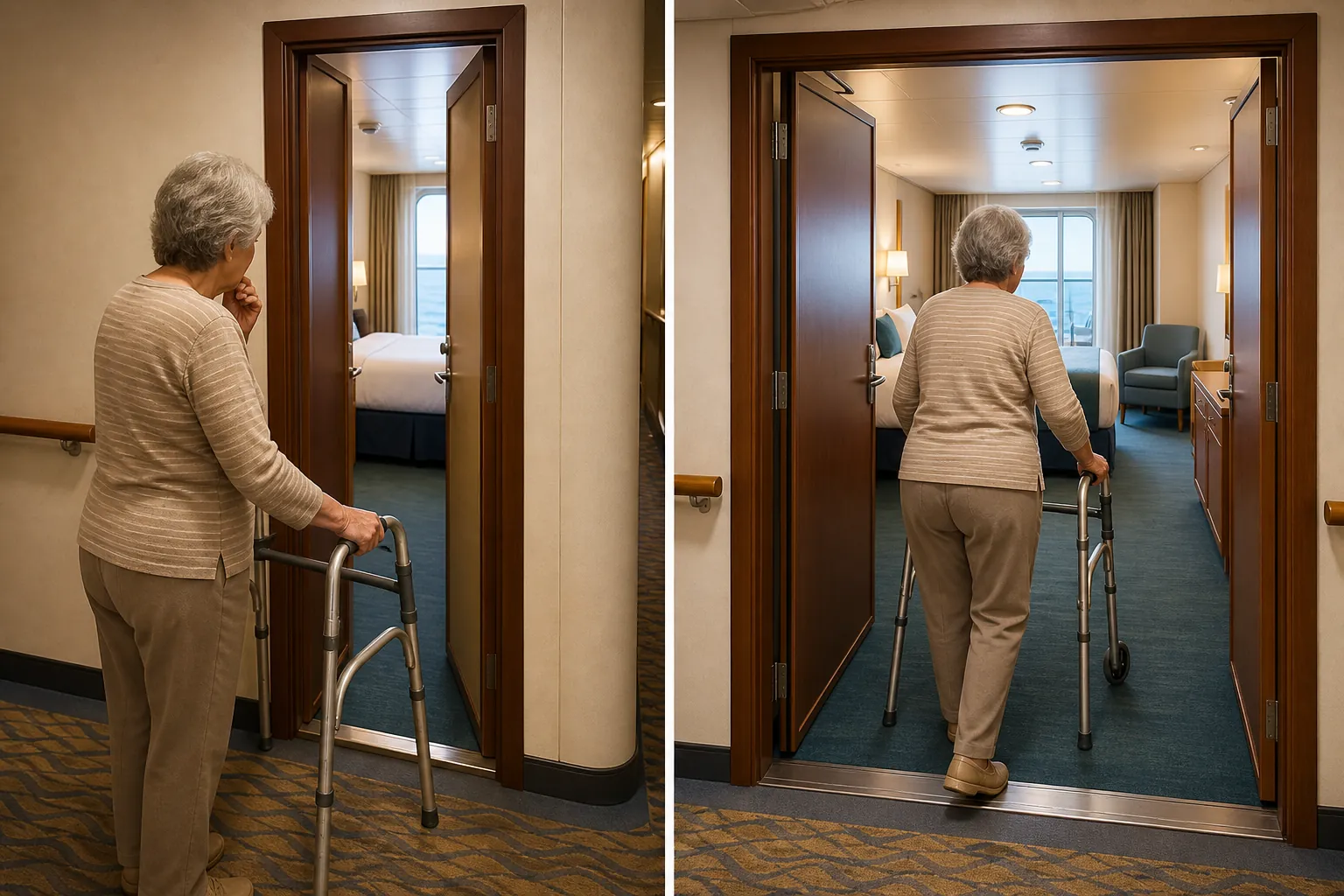
Get the answer in writing. A phone agent saying “it should fit” is not the same as a written note from the accessibility desk confirming dimensions, equipment needs, pier assistance, and any restrictions on where a scooter can be stored or charged. If the passenger has recently changed from a cane to a rollator, or from a manual wheelchair to a scooter, update the cruise line. The ship is planning for the device, not the memory of last year’s mobility.
| Before you book | What to verify |
|---|---|
| Cabin access | Doorway width, bathroom doorway width, turning space, bed clearance |
| Bathroom safety | Roll-in shower, shower threshold, grab bars, shower seat, toilet height |
| Mobility aid | Overall width, length, weight, charging and storage rules |
| Embarkation help | Pier assistance request, wheelchair assistance, boarding timing |
| Ports | Docked versus tender ports, scooter and power wheelchair limits |
Cabin and Bathroom: The Tightest Space Matters Most
In a home safety visit, the bathroom usually gets careful attention because water, turning, and transfers meet in one small room. A cruise bathroom deserves even more respect. The floor may be wet, the ship may shift, and the passenger may be trying to step over a lip while holding a towel instead of a rail.
Ask whether the shower is truly roll-in or merely has a low threshold. Ask whether a built-in or portable shower seat is available, where grab bars are placed, and whether the toilet area has enough side space for the passenger’s usual transfer method. If the cruise line cannot confirm the layout, ask for the ship-specific accessible cabin diagram or dimensions before paying the final balance.
Once onboard, do the bathroom inspection before unpacking. Walk the route from bed to bathroom with the shoes or slippers the passenger will wear at night. Check whether the door swings into the turning path, whether towels hang where they can be reached without bending, whether toiletries can stay at waist height, and whether the floor mat creates an edge that catches a toe or walker leg.
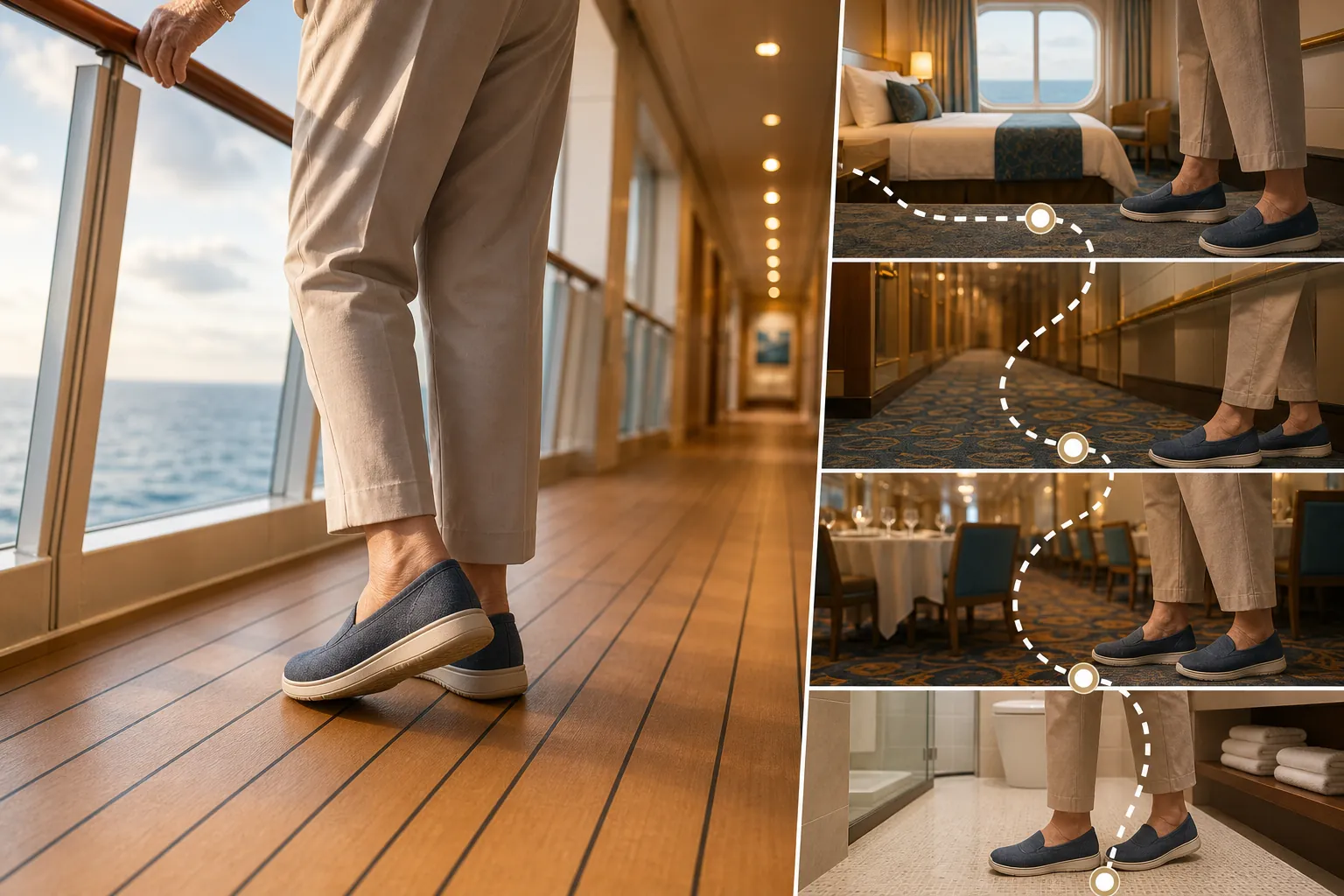
Non-slip footwear belongs in the cabin from the first hour, not buried in a suitcase. Bare feet, socks, and smooth-soled slippers are poor choices on a bathroom floor that may still be damp after a shower. Cruise safety advice for older travelers repeatedly emphasizes non-slip shoes and steady handrail use as practical daily fall-prevention habits onboard.[3] They will not fix a cabin that is too narrow, but they reduce the small slips that turn ordinary movements into injuries.
- Keep the path from bed to bathroom clear of luggage, charging cords, shoes, and room-service trays.
- Use a small night light or leave the bathroom light cracked if glare is not a problem.
- Place glasses, hearing aids, phone, and medications where they can be reached without standing in the dark.
- Ask the cabin steward early for extra towels only if they can be stored without crowding the floor.
- Report loose bathroom mats, poor drainage, or missing requested equipment before the first night.
Corridors and Elevators: Plan for Crowds, Not Empty Hallways
Cabin corridors can look manageable during boarding tours and become difficult when luggage, housekeeping carts, scooters, children, and dinner traffic all occupy the same narrow lane. A cane user who is steady at home may become the person everyone tries to squeeze around.
Before the trip, study the deck plan with a mobility lens. A cabin near the elevator is not always better if that elevator bank becomes a traffic jam after shows and meals. A cabin far forward or aft may mean long walks several times a day. If the passenger tires easily, ask whether a midship accessible cabin is available and whether the route to dining, theater, and medical center avoids frequent thresholds or heavy doors.
Onboard, choose timing as a safety tool. Leave for dinner before the main rush. Wait a few minutes after a show instead of joining the first wave toward the elevators. Use handrails in corridors even when the sea feels calm; the sudden sideways correction is often the movement that catches an older adult off guard.
Dining Rooms and Buffets: The Hazard Is Often Other People
At home, a fall-prevention plan might move dishes to a lower shelf or clear the path between stove and table. On a ship, the food is often farther away, the floor may change from carpet to tile, and the passenger may be carrying a plate while other guests cut across the walking path.
For a cane or walker user, buffet strategy matters more than variety. Visit at quieter times, ask a companion or crew member to carry the plate, and choose a table with a simple route to the exit rather than one tucked behind chairs. If the passenger uses a scooter, ask dining staff where it should be parked without blocking servers or creating a trip point for someone else.
Assigned dining can be safer than improvising each night because the staff learns the route, seating preference, and transfer needs. Ask for an end seat if it reduces shuffling between closely spaced chairs. If hearing or vision changes make crowded dining rooms disorienting, request a quieter section rather than waiting until fatigue has already set in.
Pool Decks and Outdoor Walkways: Wet, Bright, and Moving
Pool decks combine the easiest hazards to underestimate: wet surfaces, glare, wind, sandals, towels on the ground, and people who are looking at the ocean instead of their feet. The view is lovely. The walking surface still deserves suspicion.
Non-slip shoes matter here as much as in the bathroom. Flip-flops that work on a dry patio can fold, slide, or catch on a deck seam. A better cruise shoe for an older passenger has a closed or secure heel, a sole with grip, and enough structure that the foot does not shift sideways when the ship moves.
Before settling into a deck chair, inspect the route back to shade, restrooms, and elevators. Avoid crossing through puddled areas when a dry route exists. If the passenger uses a rollator, lock the brakes before sitting, but do not use the rollator as a deck chair substitute unless it is designed for that purpose and placed on a stable surface.
Gangways and Tender Ports Need Separate Permission
The gangway is where a cruise stops feeling like a hotel. Its slope changes with tide, dock height, weather, and ship position. It may be dry in the morning and slick by afternoon. It may have handrails, crew assistance, and a gentle grade at one port, then a steeper angle at the next.
Ask the accessibility desk which ports are docked and which require tender boats. This is not a minor excursion detail. Most cruise lines do not permit mobility scooters or power wheelchairs on tender boats, according to a cruise mobility-aid guide.[1] If the itinerary’s dream port is a tender port, the planning question becomes whether the passenger can safely transfer without that device, manage steps or a moving tender platform, and tolerate the return trip when tired.
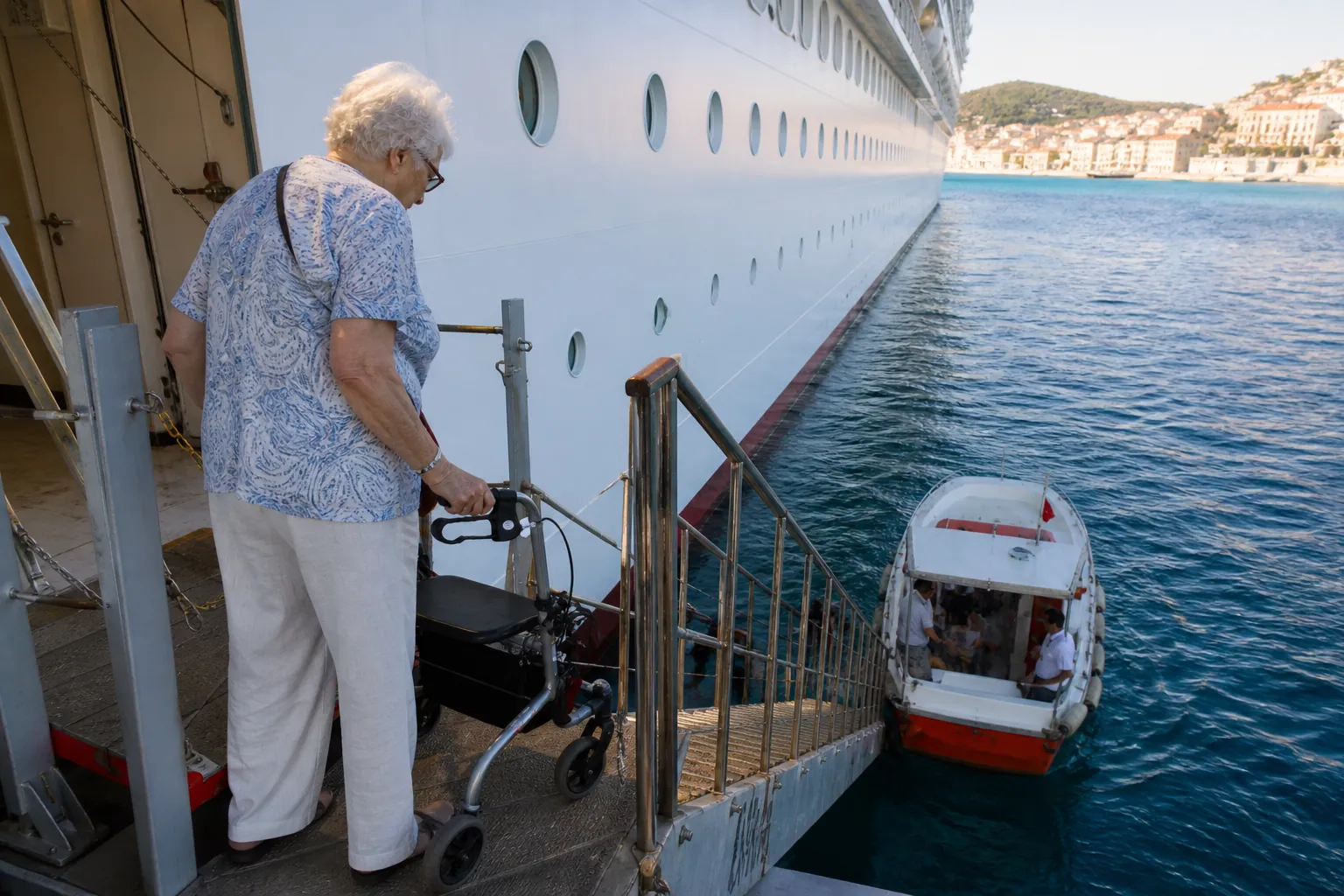
Tender limits are not a moral judgment on the trip. They are a physical boundary. Some passengers can enjoy the ship that day, choose a different excursion, or book a similar route with more docked ports. Others may decide that one tender-only destination is worth the risk because it matters deeply to them. The mistake is discovering the rule at the tender platform, with the scooter waiting behind and the shore excursion already paid for.
River cruises have their own version of this problem, especially with rafted ships, cobblestones, and steep local gangways. If you are comparing ocean and river itineraries, read the companion guide to fall risks on river cruises before assuming the smaller ship is automatically easier.
- Before booking: identify every tender port and ask whether the passenger’s mobility aid is allowed.
- Before each port: ask guest services about gangway slope, distance to transportation, and expected walking surface.
- At the gangway: use the handrail, accept crew assistance, and wait for a pause in traffic.
- After the excursion: allow extra time for a slower, more tired return to the ship.
Medical Preparation Supports Fall Planning
Medical preparation should not replace environmental planning, but it matters when a fall, infection, medication problem, or flare-up occurs away from land. CDC describes cruise ship medical centers as facilities for evaluation and treatment, but passengers should not think of them as full hospitals. CDC also recommends a pre-travel health visit 4 to 6 weeks before departure.[4]
Use that visit to review balance-affecting medications, blood pressure changes, sleep aids, diabetes supplies, anticoagulants, and any recent fall. Bring enough medication for the whole trip plus a delay, keep it in carry-on luggage, and carry a current medication list. If the passenger uses glasses, hearing aids, orthotics, or a mobility device, those are safety equipment too.
Travel insurance deserves special attention for older adults because onboard care and medical evacuation can be expensive. One senior cruise-safety guide warns that evacuation costs can reach tens of thousands of dollars and that policies should specifically address pre-existing conditions and medical evacuation.[5] If a recent fall might affect cancellation decisions, CareWise Guide’s discussion of river cruise cancellation after a fall is a useful starting point even for ocean-cruise families.
Sanitation Reports Are Useful, but They Do Not Measure Fall Risk
CDC Vessel Sanitation Program reports can help travelers check recent ship inspection information, especially when comparing ships. They should not be mistaken for a mobility-safety score. A clean galley report does not tell you whether a cabin doorway fits a scooter or whether a tender port will accept a power wheelchair.
There is also a timing caveat: a 2025 travel-insurance analysis noted that CDC Vessel Sanitation Program staffing cuts may affect future inspection frequency, so travelers should check the current CDC VSP site rather than relying on older summaries alone.[6] For fall prevention, the more direct evidence still comes from the ship’s accessibility desk, deck plans, written measurements, and port-specific tender rules.
The Short Version Before You Pay
A safe cruise for an elderly passenger is built before embarkation. Contact the accessibility desk early. Verify cabin, bathroom, doorway, and mobility-aid dimensions in writing. Check every tender port before falling in love with the itinerary. Pack non-slip footwear as daily safety equipment, not an afterthought. Review medications, medical coverage, pre-existing-condition rules, and evacuation coverage before the final payment date.
Then walk the ship the way you would walk through a new home for someone at risk of falling: bed to bathroom, cabin to elevator, elevator to dining room, dining room to deck, deck to gangway. The ocean view can wait a few minutes. The route underfoot decides whether the trip stays possible.
References
- Cruising with Mobility Aids: Cabin & Ship Access Guide for Seniors, Cruisebound.
- Accessible Cruise Expert Offers Top Tips for Cruising with a Disability, Wheelchair Travel.
- Seniors Cruise Tips: Too Many Cruisers Over 55 Fall For These 8 Cruising Traps, Tips For Travellers.
- Cruise Ship Travel, CDC.
- Senior Travel Safety Tips: Cruises, Medical Guardian.
- Cleanest Cruise Ships & Cruise Lines - CDC Data Report, Squaremouth.
Questions to bring to a clinician or OT
This is not medical, legal, or a family's final decision — only a framework. Bring these questions to a clinician, occupational therapist, or your local Area Agency on Aging.
Find Local HelpRelated reading
Noticed something outdated or inaccurate on this page? Flag a correction. We review every report against CDC, NIA, and AARP HomeFit guidance before updating a page.