
Caregiver decision guide
30-day recovery checklist for seniors after hospitalization
The first 30 days after a hospital discharge are a documented danger window for older adults: falls, medication errors, and early readmission are all more likely during this period. This caregiver-facing checklist covers what to do in the first 24–72 hours home, preventing falls and medication mix-ups, red flags that need a doctor's call, and Medicare home-health and follow-up basics.
Your parent is home. The next 30 days are not ordinary rest. They are the handoff month: hospital instructions move onto the kitchen table, old pill bottles sit next to new prescriptions, and the first nighttime walk to the bathroom may happen before anyone has moved the throw rug.
Use this senior recovery after hospitalization checklist to make the first month observable. It cannot prevent every fall, medication reaction, infection, or readmission. It can help the family notice what changed, write down what changed, and call the right person before a vague worry becomes a crisis.

30-day recovery checklist for the first month home
Print this, copy it into a shared note, or tape it inside a cabinet door. The first 24 to 72 hours deserve their own column because that is when families discover the missing walker tip, the stopped blood pressure pill still sitting in the organizer, the follow-up appointment no one scheduled, or the new confusion everyone hoped was just fatigue.
| Risk area | First 24–72 hours home | Rest of the month | Write down or escalate |
|---|---|---|---|
| Discharge paperwork | Find the discharge summary, medication list, diagnosis, activity limits, wound instructions, diet instructions, pending tests, and follow-up plan. | Keep all papers in one folder. Bring the folder to every appointment and home-health visit. | Missing instructions, unclear restrictions, test results that were pending, or no named clinician to call. |
| Medication safety | Compare the discharge medication list with every bottle, supplement, inhaler, insulin pen, eye drop, patch, and pill organizer already in the home. | Track side effects, dizziness, sleepiness, constipation, missed doses, and refills. Recheck after every appointment. | A medication appears on the old list but not the discharge list; a dose changed; two bottles seem to duplicate each other; your parent refuses or cannot swallow a medication. |
| Mobility and falls | Clear the route from bed to bathroom before the first night. Put the walker, cane, glasses, hearing aids, phone, and light within reach. | Watch transfers, toileting, showering, stairs, and outdoor steps. Follow physical therapy instructions if ordered. | New weakness, dizziness, a fall, near-falls, unsafe transfers, or your parent furniture-walking instead of using the prescribed device. |
| Eating, drinking, and basic function | Notice whether your parent can drink, eat, urinate, move bowels, toilet, dress, bathe, and get out of bed or a chair compared with before hospitalization. | Check weight only if the clinician instructed it. Otherwise track practical function: meals finished, fluids tolerated, bathroom trips, and stamina. | Not drinking, vomiting, no bowel movement when discharge instructions say to call, new incontinence, inability to transfer, or a sudden drop in appetite or alertness. |
| Mental status and delirium | Compare today with your parent’s normal: attention, sleep-wake pattern, speech, agitation, withdrawal, hallucinations, and ability to follow simple conversation. | Keep glasses, hearing aids, dentures, familiar objects, fluids, daylight, and calm orientation cues available. | Sudden confusion, unusual sleepiness, agitation, new hallucinations, or a sharp change in personality or attention. |
| Follow-up care | Confirm who scheduled the primary care, specialist, lab, imaging, therapy, or wound-care follow-up. Do not assume it happened. | Bring the medication list and your written questions. Ask which symptoms should trigger a same-day call. | No appointment date, no transportation plan, no home-health start date, or conflicting instructions from different clinicians. |
| Caregiver coverage | Decide who stays the first night, who handles medications, who answers calls, who drives, and who checks the home-health schedule. | Adjust coverage after the first few days based on toileting, mobility, sleep, and medication complexity. | The plan depends on an older adult safely doing tasks they cannot yet do, or on Medicare covering help it does not cover. |
Why the first month is different
Hospital recovery is not only recovery from the illness that caused the admission. Harlan Krumholz described “post-hospital syndrome” as a temporary period of generalized risk after discharge, shaped by stressors such as disrupted sleep, poor nutrition, deconditioning, and the strain of acute illness and hospitalization. In Medicare data cited in that article, the reason for readmission often did not match the reason for the original hospitalization: the same diagnosis accounted for only 37% of readmissions after heart failure, 29% after pneumonia, and 36% after COPD. That is why a checklist cannot focus only on the original diagnosis. The danger may show up as confusion, weakness, dehydration, a fall, or a medication problem instead. [1]
The often-quoted readmission number comes from Stephen Jencks and colleagues, who studied 2003–2004 Medicare fee-for-service claims. In that population, 19.6% of beneficiaries discharged from a hospital were rehospitalized within 30 days, 34.0% within 90 days, and 56.1% within one year. Those are not universal 2026 rates for every older adult, but they are a useful warning about the first month after discharge. [2]
Function has its own clock. In a study using 1993–1998 data on older adults discharged with a new or additional activity-of-daily-living disability, only about 30% returned to their pre-hospital baseline by one year. Among those who did recover, 62% recovered within the first month. Old data should not be treated as destiny for one person sitting at your kitchen table, but the timing matters: if recovery is going to happen, much of the visible functional change may happen early. [3]
Medication risk is also immediate. The Family Caregiver Alliance’s post-discharge checklist, citing underlying research, warns that medication errors at discharge can be as high as 40%. That figure should be read as a risk signal, not as a prediction for every discharge. It is high enough to justify a day-one review of every medication in the house. [4]
Falls after discharge are population-dependent. CDC STEADI materials note that older adults are more likely to fall during the first month after hospital discharge than older adults who were not hospitalized. A 2018 systematic review and meta-analysis described falls as a frequent problem after discharge among older adults, while a 2019 randomized trial in rehabilitation patients found that 42.9% fell within six months and 49.7% of recorded falls were injurious. Rehabilitation patients are not the same as all discharged older adults, so these numbers should not be flattened into one scare statistic. They do show why the bathroom path, the walker, dizziness, and transfers belong near the top of the family’s first-week list. [5][6][7]
First 24 to 72 hours: turn the discharge into a home plan
The hospital discharge packet is not useful until someone translates it into what happens tonight. Before everyone is tired, choose one person to be the document keeper. That person does not have to do all the care, but they need to know where the papers are, which medications changed, who has been called, and what questions are still unanswered.
Find the instructions that decide what happens at home
Discharge instructions should tell families what medicines to take, what activities are allowed, what symptoms to watch for, when to follow up, and whom to contact with problems. MedlinePlus tells patients and families to make sure they understand medicine instructions, follow-up appointments, diet, activity, wound care, equipment, and warning signs before leaving the hospital. If your parent is already home and any of those pieces are missing, call the discharging unit, primary care office, or listed specialist rather than guessing. [8]
- Put the discharge summary, medication list, therapy instructions, test orders, and appointment information in one folder.
- Circle any words you do not understand: “weight bearing,” “fluid restriction,” “hold,” “resume,” “as needed,” “homebound,” “skilled nursing,” “pending culture,” or “follow up in 7 days.”
- Write one phone number at the top of the folder for urgent discharge questions during business hours and one after-hours number if provided.
- List pending labs, imaging, biopsy results, cultures, or specialist reports. Pending tests are easy to forget once the patient is home.
- Ask whether the hospital notified the primary care clinician. Even if it did, schedule the follow-up yourself unless you have a confirmed date and time.
The Family Caregiver Alliance’s discharge-planning guide also notes that most states have CARE Act laws requiring hospitals to record a family caregiver’s name and provide instruction about needed aftercare tasks. That does not mean every family receives enough teaching in real life. If you are shown wound care, injections, oxygen equipment, transfers, or feeding instructions, ask to demonstrate the task back while someone watches. [9]
Set up the house before the first bathroom trip
The first night home is not the time to discover that the walker is folded in the trunk, the hallway light is burned out, or the portable commode is still in its box. Walk the route your parent will use when half-awake: bed to bathroom, chair to kitchen, chair to front door, and bed to phone. Remove cords, loose mats, laundry baskets, pet bowls, and low furniture from those paths. Put a light where the foot actually lands, not across the room.
- Place the walker, cane, or prescribed device within arm’s reach before your parent lies down.
- Put glasses, hearing aids, dentures, phone, water if allowed, tissues, and a call bell or simple noise-maker within reach.
- Check that shoes or non-slip socks are available for every transfer.
- Decide whether someone needs to walk with your parent to the bathroom overnight.
- If stairs are unavoidable, ask the clinician or therapist whether they are allowed and whether supervision is required.
Write down the new baseline
Do not rely on “seems better” or “seems tired.” Write what your parent can actually do on the first full day home. Can they get out of bed without help? Stand from the toilet? Walk to the kitchen? Manage stairs? Open pill bottles? Remember what they were told? Drink without coughing? Stay awake for meals? A simple baseline gives the clinician something concrete if you call two days later and say, “Yesterday she could walk to the bathroom with the walker; today she cannot stand from the chair.”
Medication reconciliation: the day-one pill review

Medication reconciliation sounds like pharmacy language. At home, it means this: no pill goes into the organizer until someone compares the discharge list with every medication already in the house. Include prescriptions, over-the-counter medicines, vitamins, supplements, creams, inhalers, patches, eye drops, injections, and “as needed” medications. The old pill organizer is not proof of the current plan.
| What to check | What to do | Why it matters |
|---|---|---|
| New medications | Match the drug name, dose, time of day, and reason for taking it against the discharge list. | New drugs may cause dizziness, sleepiness, stomach symptoms, constipation, bleeding risk, or confusion that families mistake for normal recovery. |
| Stopped medications | Remove stopped medications from the active pill area. Do not leave them in the organizer “just in case.” | A stopped medication can be restarted accidentally by habit, especially if it was used for years before the hospitalization. |
| Changed doses | Mark dose changes with a bright note until the next refill label matches the new instructions. | The bottle label may show the old dose even when the discharge list says something different. |
| Duplicate drugs | Look for two bottles with different names used for the same purpose, or a brand name and generic name that may be the same medicine. | Duplicates can happen when hospital, specialist, and home medication lists do not match. |
| As-needed medications | Write the exact reason and maximum frequency, if provided. Ask if unclear. | “As needed” is not enough when pain medicine, sleep medicine, laxatives, anti-nausea drugs, or anxiety medicines affect alertness and fall risk. |
| Supplements and over-the-counter products | Do not assume they are harmless. Put them on the list and ask whether to continue. | They can interact with prescriptions or worsen side effects. |
If anything does not match, do not solve it by family vote. Call the discharging clinician, primary care office, specialist, pharmacist, or home-health nurse, depending on who is available and who wrote the order. When you call, use exact language: “The discharge list says stop lisinopril, but the pill organizer still has it for every morning. Should we remove it?” That is easier to answer than “Are these pills okay?”
Watch the first week for medication effects that look like weakness or aging: dizziness when standing, unusual sleepiness, constipation, diarrhea, poor appetite, new confusion, tremor, low energy, or a fall. Do not stop prescribed medicines on your own unless the discharge instructions specifically tell you when to hold them. Do write down the symptom, time, dose, blood pressure or glucose reading if you were told to monitor it, and whom you called.
Mobility and fall prevention after hospitalization
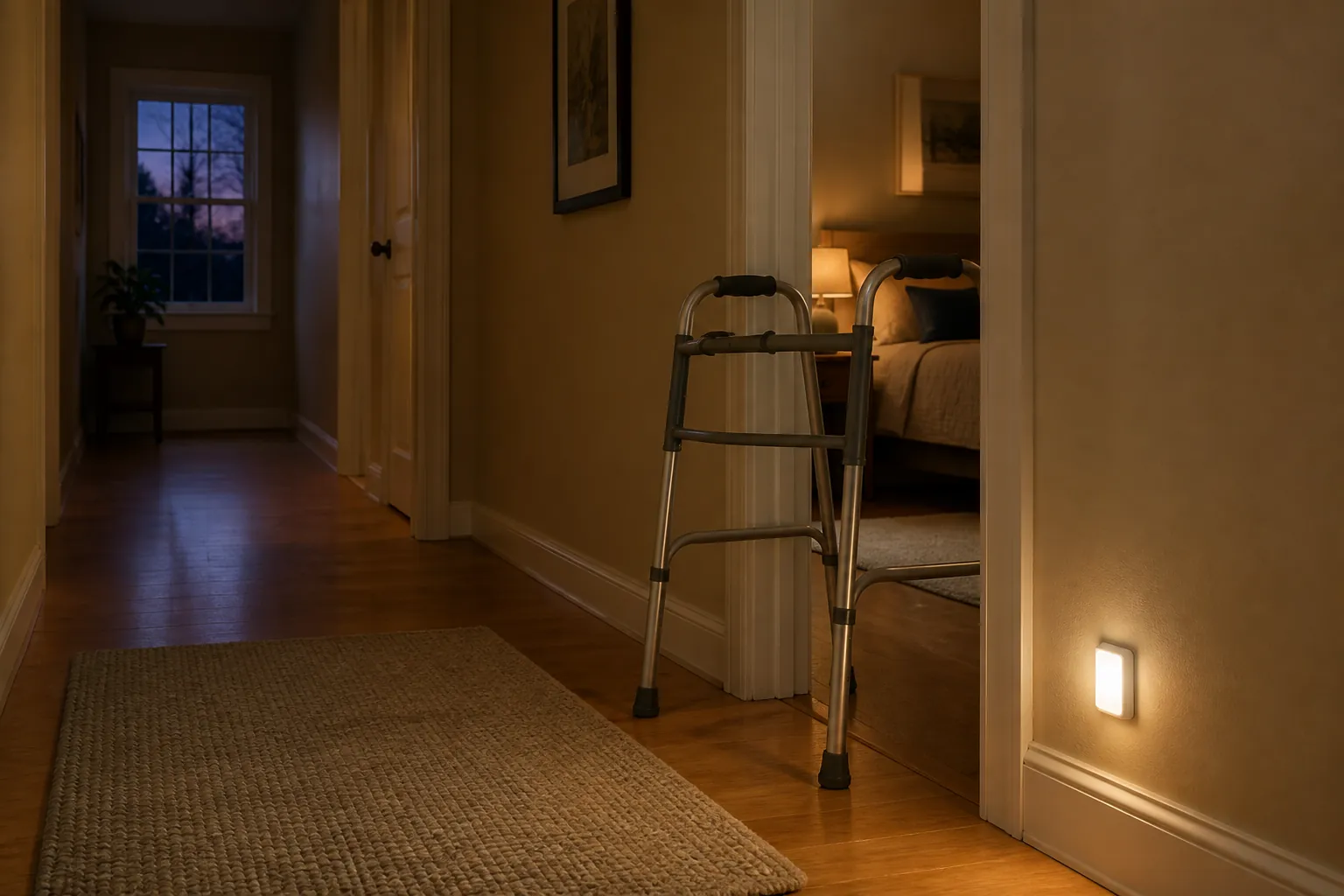
A parent who was steady before the hospital may not be steady now. They may be weaker from bed rest, lightheaded from medication changes, short of breath, afraid of falling, or determined to prove they do not need help. The family’s job is not to argue about independence in the hallway at midnight. It is to make the safest choice the easiest choice.
Check the four risky moments
- Standing up from bed or a chair: look for dizziness, swaying, grabbing furniture, or needing more than one attempt.
- Walking to the bathroom: check lighting, urgency, rugs, thresholds, oxygen tubing if used, pets, and whether the assistive device fits through the path.
- Toileting and bathing: notice whether your parent can turn, lower safely, clean themselves, and stand again without rushing.
- Leaving the house: steps, wet pavement, car transfers, portable oxygen, fatigue, and parking distance can turn a routine appointment into a fall-risk event.
If physical therapy gave exercises or device instructions, keep those papers where the caregiver can see them. If no therapy was ordered but your parent cannot transfer, walk safely, or manage stairs as needed at home, call the clinician and ask whether a therapy evaluation is appropriate. A walker that sits across the room is not fall prevention. A walker that your parent can reach, use correctly, and fit through the bathroom doorway is closer to useful.
Make near-falls count
A near-fall is not “nothing happened.” It is information. Write down what your parent was doing, the time of day, the lighting, the footwear, the device used, and whether dizziness, urgency, pain, or confusion was present. If the same pattern appears twice, change the setup and call for help instead of waiting for the actual fall.
Fall prevention after discharge is not only about removing clutter. It includes medication review, vision and hearing support, hydration if allowed, toileting plans, strength and balance work when prescribed, and honest supervision during transfers. If your parent’s pride makes them refuse the walker, try moving the argument away from identity and toward the immediate task: “Use it for the bathroom tonight. We’ll ask the therapist about the longer plan.”
Follow-up appointments and home health: confirm every handoff
Families often hear “follow up with your doctor” as if it were an appointment. It is not. A follow-up plan becomes real only when there is a date, time, clinician name, transportation plan, and reason for the visit. The same is true for home health. “They’ll call you” is not a start date.
- Call the primary care office within the timeframe listed on the discharge papers, or sooner if no timeframe is listed and the hospitalization was complex.
- Ask which clinician is responsible for medication questions before the follow-up visit.
- Confirm specialist appointments, lab draws, imaging, wound checks, therapy visits, and equipment deliveries.
- Ask whether the clinician has the hospital records. If not, bring the discharge packet or upload it through the portal.
- Bring your written baseline: walking, toileting, eating, drinking, sleep, confusion, pain, and medication concerns.
If home health was ordered, ask the agency when the first nurse or therapist will arrive and what service is actually scheduled. Skilled nursing, physical therapy, occupational therapy, speech-language pathology, and aide visits are different services. A nurse visit does not mean someone will stay all day. A bath aide visit does not mean household help is covered.
As of Q3 2026, Medicare describes home health coverage as part-time or intermittent skilled care for eligible beneficiaries who are under a doctor’s care, have a doctor-certified need for home health services, are homebound, and use a Medicare-certified home health agency. Medicare lists $0 for covered home health care services, while also stating that it does not cover 24-hour-a-day care at home, meals delivered to the home, homemaker services when that is the only care needed, or custodial/personal care when that is the only care needed. This is informational, not legal, financial, or medical advice; coverage can depend on the plan, orders, eligibility, and services documented. [12]
For a fuller benefits explanation, use the site’s guide to what home health care for the elderly is and isn’t. If the question is how many aide hours Medicare may cover in a skilled home-health episode, see Medicare home health aide hours. If what your parent needs is help with bathing, dressing, toileting, meals, supervision, or housekeeping without a skilled need, the more relevant page is Medicare custodial home care alternatives.
Red flags that override the checklist
A checklist is useful until it becomes an excuse to wait. Follow the discharge papers for diagnosis-specific warning signs. If a symptom appears life-threatening or you cannot safely move or wake your parent, use emergency services. For changes that are not clearly an emergency but are new, sudden, or worsening, call the listed clinician, primary care office, specialist, home-health nurse, or after-hours line the same day.
| What you see | Why it matters after hospitalization | Action |
|---|---|---|
| Sudden confusion, new agitation, hallucinations, unusual sleepiness, or a sharp change in attention | Delirium can appear as a sudden change in mental status, and families are often the first to notice that the person is not acting like themselves. | Call the clinician promptly; use emergency care if the person is unsafe, hard to wake, or the discharge instructions say to do so. |
| New inability to stand, transfer, toilet, walk, or use stairs compared with yesterday | A sudden functional drop can signal weakness, medication effects, dehydration, infection, pain, or another complication. | Call the clinician or home-health nurse the same day; do not keep attempting unsafe transfers. |
| Fall, near-fall, head hit, new pain after a fall, or fear of walking | Post-discharge falls can cause injury and can also reveal that the home setup or medication plan is not working. | Follow emergency instructions for injury or head impact; report falls and near-falls to the clinician or therapist. |
| Dizziness, faintness, unusual sleepiness, or unsteadiness after medications | Medication changes after discharge can affect alertness, balance, blood pressure, bowel function, and hydration. | Write down the timing and medication dose; call the prescriber or pharmacist before changing prescribed medicines. |
| Not drinking, vomiting, worsening weakness, very poor intake, or signs the person cannot manage fluids as instructed | Dehydration and undernutrition can worsen confusion, dizziness, constipation, and recovery. | Call the clinician the same day, especially if fluid intake was restricted or monitored in the discharge plan. |
| Missing glasses, hearing aids, dentures, or orientation cues in a confused patient | Sensory deprivation can worsen disorientation and make communication, eating, and safe movement harder. | Replace or locate the aids, keep familiar cues nearby, and tell the clinician if confusion is new or worsening. |
The American Geriatrics Society’s Health in Aging guidance emphasizes that delirium is a sudden change in mental function and that families can help by keeping glasses, hearing aids, and dentures available, helping with orientation, encouraging fluids when allowed, and supporting activity as appropriate. Mayo Clinic Press likewise emphasizes safe recovery basics for older adults after hospitalization, including attention to delirium risk, mobility, nutrition, hydration, sleep, and hearing or vision supports. [10][11]
Weeks 2 through 4: track function, not just appointments
By the second week, the crisis feeling may fade. That is when quiet decline can be missed. Keep checking the practical tasks that determine whether your parent is actually recovering: getting out of bed, toileting, bathing, dressing, eating, drinking, walking, stairs, medication management, sleep, and ability to follow conversation.
| Weekly check | What to compare | What to do with the answer |
|---|---|---|
| Mobility | Can your parent walk farther, transfer more safely, or use the prescribed device more reliably than last week? | If worse or unchanged despite therapy instructions, ask the clinician or therapist whether the plan needs adjustment. |
| Toileting and bathing | Is help still needed? Is urgency causing unsafe rushing? Is showering being avoided because it feels unsafe? | Consider equipment, supervision, occupational therapy input, or temporary hands-on help. |
| Medication management | Can your parent explain what changed, take doses on schedule, and avoid old discontinued medicines? | If not, keep caregiver control of setup and ask the pharmacist or clinician to simplify when possible. |
| Eating and drinking | Are meals and fluids improving, stable, or declining? | Report poor intake, swallowing concerns, vomiting, or dehydration concerns, especially if the discharge plan includes diet or fluid limits. |
| Thinking and sleep | Is your parent more alert and oriented, or more confused, withdrawn, restless, or reversed day-to-night? | Treat sudden or worsening confusion as a clinical issue, not normal aging. |
| Caregiver load | Can the current family schedule safely cover nights, bathing, transport, meals, medications, and supervision? | If not, reassess the type of in-home care needed instead of waiting for caregiver exhaustion. |
The National Council on Aging describes “one week of recovery for each day in the hospital” as a general rule of thumb after acute illness. Treat that as a rough expectation-setting tool, not a clinical guarantee. Some people recover faster, some slower, and some need prompt reassessment because the problem is not simply time. [13]
If the family is unsure what kind of help is now needed, use an ADL and IADL lens: bathing, dressing, toileting, transferring, continence, eating, cooking, shopping, housekeeping, transportation, medications, and finances. The site’s guide to what kind of in-home care an aging parent needs can help turn that into a practical care plan. If you are starting from scratch, how to get home care for an elderly parent walks through the first calls and decisions.
Caregiver coverage basics for the discharge month
The first month home often fails at the seams, not because no one cares, but because everyone assumes someone else handled the seam. One sibling thinks the hospital arranged home health. Another thinks the pharmacy called the doctor. The spouse thinks the adult child is staying overnight. The adult child thinks Medicare sends an aide for the day. Write the coverage plan as if tired people will have to follow it, because they will.
- Name the medication person: fills the organizer, tracks refills, confirms changes, and keeps old stopped medicines out of circulation.
- Name the appointment person: schedules follow-ups, arranges transportation, brings the discharge packet, and writes down the plan after each visit.
- Name the night-safety person for at least the first few nights if toileting, confusion, or transfers are uncertain.
- Name the home-health contact: confirms visit times, asks what each discipline will do, and reports missed visits or worsening symptoms.
- Name the escalation person: decides who calls the clinician, who drives to urgent care if instructed, and who stays with the older adult while that call happens.
Also decide what the family will not do without training. Wound care, injections, oxygen equipment, complex transfers, tube feeding, and medication changes should not be learned by improvising after dinner. Ask the nurse, therapist, pharmacist, or clinician to teach and watch you demonstrate the task back. If the task cannot be done safely by the available caregiver, that is not a character flaw. It is a care-plan problem.
The family’s job is not to become a hospital at home. It is to turn a risky, vague month into observable tasks, documented questions, and timely calls for help.
References
- Post-Hospital Syndrome — An Acquired, Transient Condition of Generalized Risk, New England Journal of Medicine, 2013
- Rehospitalizations among Patients in the Medicare Fee-for-Service Program, New England Journal of Medicine, 2009
- Recovery of Activities of Daily Living in Older Adults After Hospitalization for Acute Medical Illness, Journal of the American Geriatrics Society, 2008
- The Post-Discharge Checklist: 5 Important Steps, Family Caregiver Alliance
- Inpatient Care, CDC STEADI
- Falls prevention interventions for older adults after discharge from hospital: a systematic review and meta-analysis, 2018
- A randomized trial comparing digital video disc with written delivery of falls prevention education for older patients in hospital, 2019
- Going home after a hospital stay, MedlinePlus
- Hospital Discharge Planning: A Guide for Families and Caregivers, Family Caregiver Alliance
- Tip Sheet: Managing Delirium in Older Adults, Health in Aging
- The risks of hospital stays: A guide to safe recovery and returning home for older adults, Mayo Clinic Press
- Home health services, Medicare.gov
- Tips for Recovering After Being Hospitalized with Acute Illness, National Council on Aging
Questions to bring to a clinician or OT
This is not medical, legal, or a family's final decision — only a framework. Bring these questions to a clinician, occupational therapist, or your local Area Agency on Aging.
Find Local HelpRelated reading
Noticed something outdated or inaccurate on this page? Flag a correction. We review every report against CDC, NIA, and AARP HomeFit guidance before updating a page.