
Caregiver decision guide
Air Travel Document Checklist for Seniors
Air travel for seniors fails most often at the document layer, and the ID rules changed recently enough that most generic advice is now outdated. This three-layer checklist — checkpoint ID, carry-on health and medication paperwork, and copies left at home — tells older travelers and their caregivers exactly what to pack, plus what the REAL ID and TSA ConfirmID changes mean for 2026 travel.
The document failure that matters in 2026 is no longer just “forgot the ID.” For a U.S. domestic flight, every traveler 18 or older must show an acceptable ID at the TSA checkpoint, and since May 7, 2025, a state driver’s license or state ID must be REAL ID-compliant unless the traveler is using another TSA-accepted document, such as a passport or passport card. A plain, non-REAL-ID state license is not enough for domestic air travel anymore. [1] If the traveler arrives without an acceptable ID, TSA ConfirmID is a paid identity-verification process, costs $45, covers a 10-day travel period, and does not guarantee that the traveler will be allowed through screening. [2]
The safest way to prepare an older adult for a flight is to stop thinking of documents as one pile. Use three folders: one for the checkpoint, one that stays in the carry-on for health and insurance needs, and one set of copies left with a trusted person at home. International travel adds a fourth check, but it should not crowd the domestic basics.
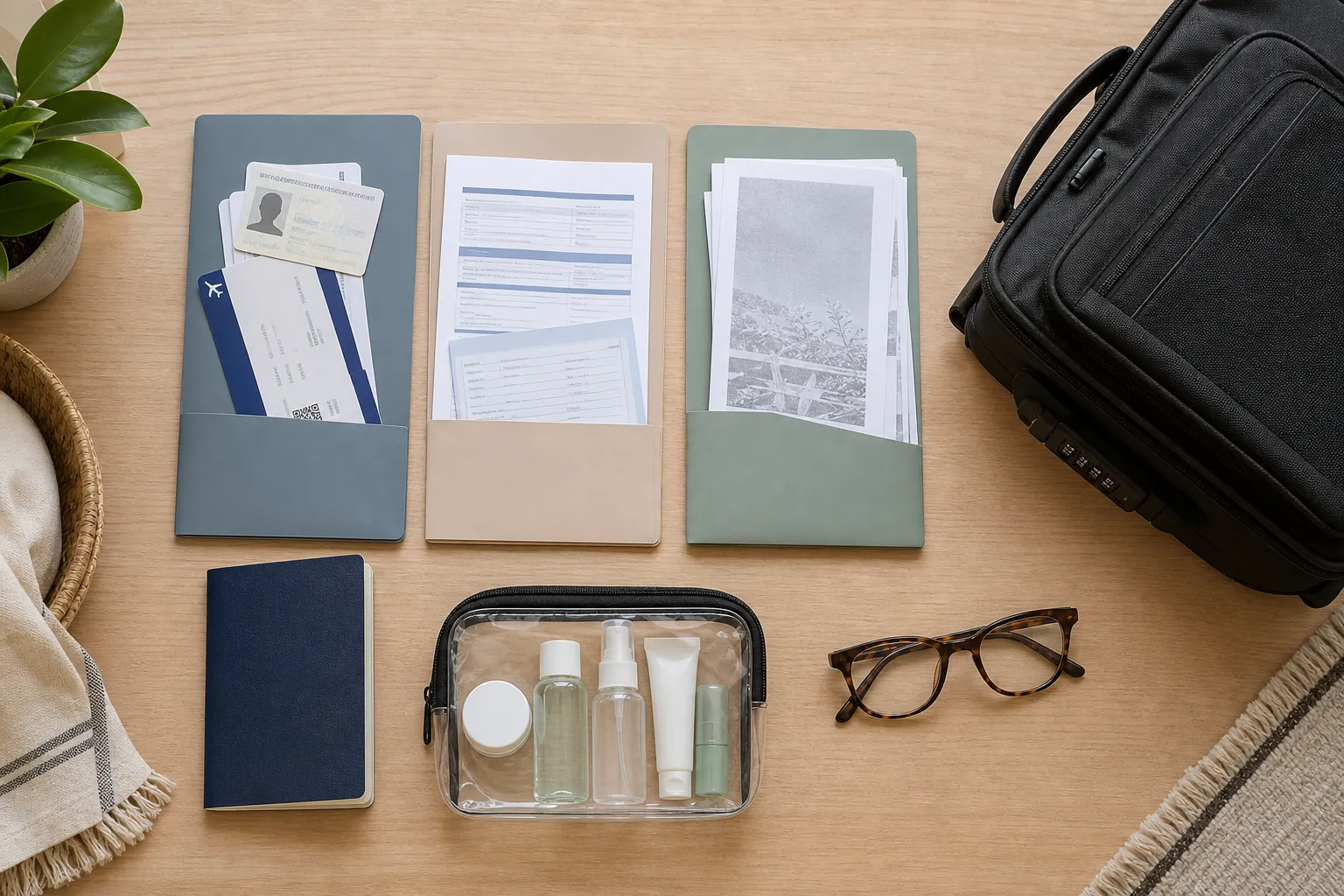
The three-folder checklist
| Folder | What goes in it | Verify before departure | Keep it where? |
|---|---|---|---|
| Checkpoint ID folder | One TSA-acceptable ID; boarding pass if printed; companion or caregiver contact card; any airline assistance confirmation if requested | For a state license or state ID, confirm REAL ID compliance. Check expiration. If relying on a passport, passport card, or another TSA-listed ID, confirm it is still acceptable and not outside TSA’s expired-ID allowance. [1] | On the traveler’s body or in the small personal item — never in checked luggage |
| Carry-on health, medication, and insurance folder | Current medication list; Medicare card and/or insurance cards; pharmacy information; physician or clinic contacts; allergy list; emergency contacts; copies of written prescriptions when helpful; documentation for medically necessary liquids or supplies | Confirm the medication list is current, names are readable, and the traveler can explain medically necessary liquids or supplies at screening. TSA allows medically necessary liquids over 3.4 oz in reasonable quantities when declared. [3] | In the carry-on or personal item that stays with the traveler |
| Home-copy folder | Copies of passport if relevant, driver’s license or state ID, Medicare card or insurance card, itinerary, hotel or host address, airline information, and emergency contacts | Confirm the trusted person knows where the folder is and is willing to answer a call during travel hours. NCOA recommends leaving copies of key ID, Medicare card, passport, and itinerary with someone trusted. [4] | With a trusted person at home, not only in the traveler’s email |
| International add-on | Passport; visa or entry documentation if required; destination medication rules; written prescriptions with generic drug names; travel insurance documents; Medicare/Medigap coverage details if applicable | Check passport validity, destination entry rules, medication legality, and health coverage before paying for the trip and again before departure. Some countries apply six-month passport-validity rules. [5][6] | Passport and entry documents in checkpoint folder; health and medication papers in carry-on; copies at home |
For a short domestic flight, this may look almost too simple: REAL ID license, insurance card, medication list, and copies left at home. For a traveler with insulin, heart medication, oxygen-related paperwork, a new diagnosis, or an overseas itinerary, the carry-on folder becomes just as important as the ID.
Layer 1: the checkpoint ID has to be settled before travel day
The checkpoint folder should hold the one document the traveler will actually show to TSA. Do not bury the passport in the carry-on “just in case” if the older adult plans to show it at screening. Do not assume the wallet license is acceptable because it worked years ago. Do not rely on the phrase “government-issued ID” unless the source also explains REAL ID.
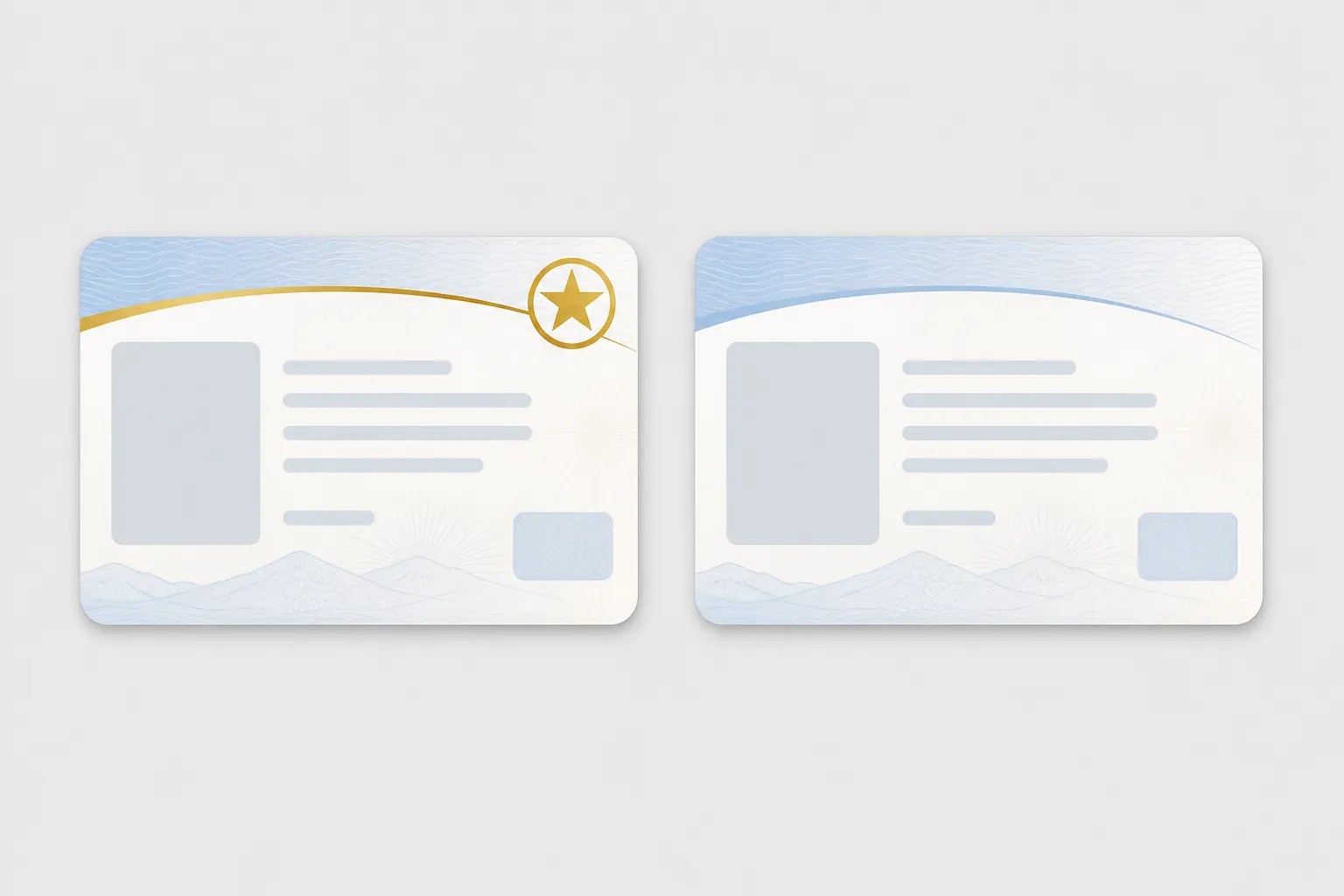
For a domestic U.S. flight
A traveler 18 or older must bring an acceptable ID. A REAL ID-compliant driver’s license or state ID is one option; other acceptable options listed by TSA include documents such as a U.S. passport or passport card. TSA’s acceptable-ID list is the controlling source, so check it directly if the traveler is using anything other than an obvious REAL ID license or passport. [1]
- Look for the REAL ID star on the state license or state ID. The star location and style can vary by state, so if there is any doubt, check the state motor vehicle agency or use another TSA-acceptable ID.
- Compare the name on the ID with the ticket. If the traveler has a suffix, middle name, hyphenated surname, or recent name change, handle the mismatch before online check-in if possible.
- Check expiration now, not the night before the flight. TSA states that it accepts expired IDs up to two years after expiration for the acceptable forms listed on its identification page, but an expired document is still a poor travel plan if renewal is possible. [1]
- If the older adult no longer drives, do not wait until the license is surrendered or expired to arrange a state ID, passport card, or passport.
ConfirmID is not a comfortable backup plan
TSA ConfirmID matters because it changes the consequence of showing up without acceptable identification. Since February 1, 2026, travelers who do not have an acceptable ID may use TSA ConfirmID by paying a $45 fee for identity verification over a 10-day travel period. TSA also says identity verification is not guaranteed. [2]
That is the part to underline for an older traveler who has a tight connection, limited stamina, a wheelchair-assistance request, or a caregiver waiting at the arrival airport. ConfirmID may be available, but it can add time, cost, uncertainty, and another line of explanation at exactly the moment when the traveler has the least patience for process.
If the traveler discovers the ID problem before leaving home, solve it before travel day. Use a passport if available and acceptable. Change the trip if there is no acceptable ID. Treat ConfirmID as an emergency possibility to understand, not as a planned substitute for a valid document.
Layer 2: health, medication, and insurance papers belong in the carry-on
The checkpoint ID gets the traveler into screening. The carry-on health folder helps when something goes wrong after that: a medication question, a delayed bag, a fall, a missed dose, an urgent-care visit, or a confused call from a hotel room.
This is not an edge case for older adults. NCOA reports that nearly 9 in 10 older adults take at least one medication, citing CDC National Center for Health Statistics data. [4] That does not mean TSA requires every pill to be in an original prescription bottle. It does mean the traveler should not be the only person who knows what the small white tablet is for.
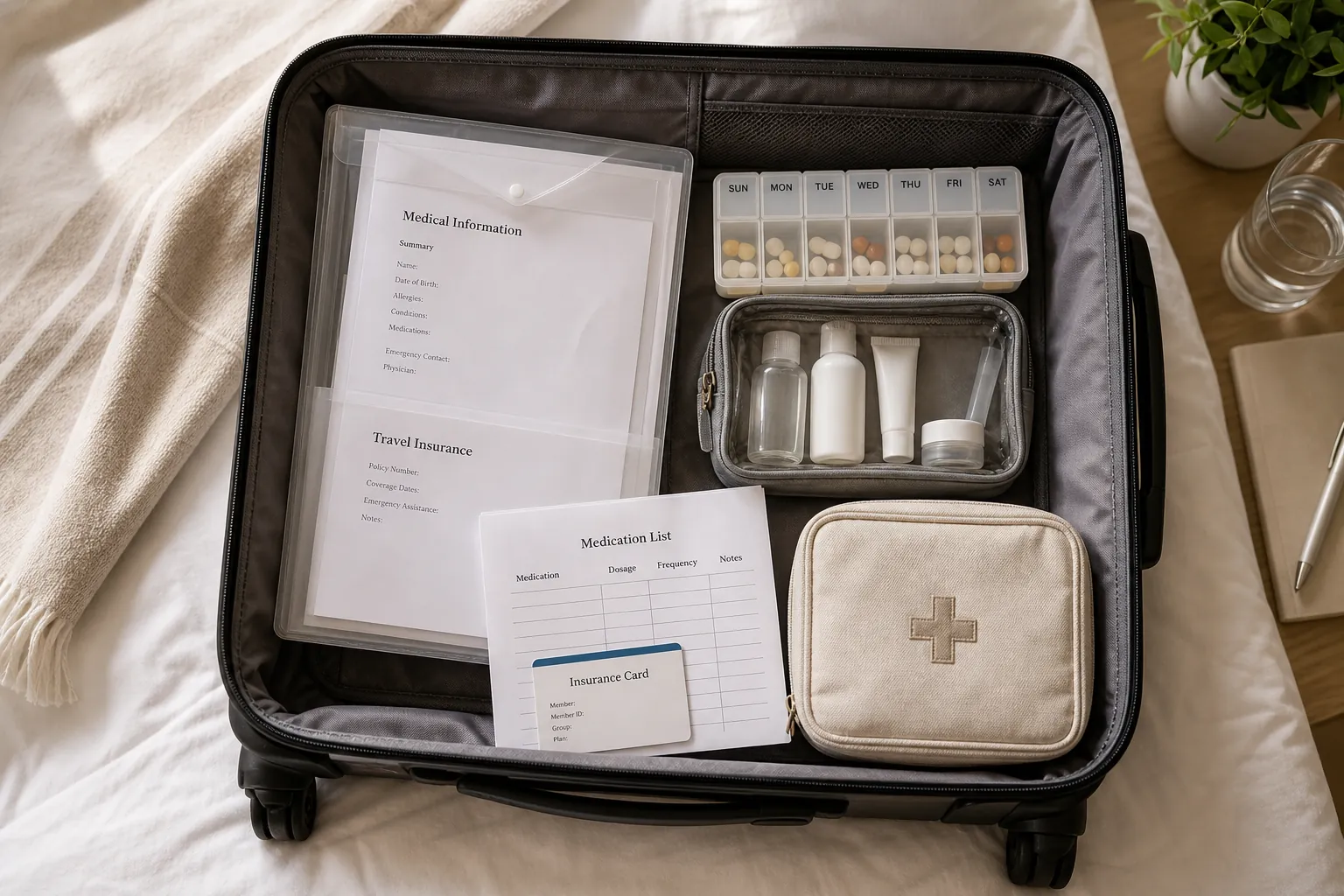
Medication paperwork to carry
- A current medication list, printed large enough to read without hunting for glasses.
- Drug names, dose, schedule, and reason for use when the traveler is comfortable including it.
- Prescribing clinician and pharmacy phone numbers.
- Allergy list, including medication allergies and serious food or latex allergies.
- Copies of written prescriptions when the medication is essential, unusual, injectable, a controlled substance, refrigerated, or needed internationally.
- A short note for medically necessary liquids, gels, aerosols, injectable supplies, nutrition, or medical devices if explanation at screening may be difficult.
For domestic TSA screening, medically necessary liquids over 3.4 oz are allowed in carry-on bags in reasonable quantities for the flight, but they must be declared to officers at the checkpoint. TSA also states that it does not require medications to be in prescription bottles, while noting that states may have their own laws about prescription medication labeling. [3]
That distinction prevents two bad plans. One is pouring every pill into an unlabeled container and expecting a tired traveler to explain it under pressure. The other is telling a senior they cannot use a weekly pill organizer because TSA demands original bottles. For many domestic trips, a pill organizer plus a printed medication list and pharmacy information is more usable than a bag full of bottles. For some medications, state rules, controlled-substance concerns, or international restrictions may still make labeled containers and written prescriptions the wiser choice.
Insurance and care information to carry
The older adult should have health coverage information in the same carry-on folder as the medication list, not in a suitcase that may be on another carousel. Include the Medicare card if the traveler uses Medicare, any Medicare Advantage or supplemental insurance card, prescription drug plan card if separate, dental or vision card if relevant, and travel insurance card or confirmation if purchased.
- Emergency contact name, relationship, phone number, and alternate phone number.
- Primary care clinician, key specialist, and pharmacy contacts.
- A short medical summary if the traveler has a condition emergency clinicians should know about quickly, such as diabetes, heart failure, seizure history, anticoagulant use, implanted devices, oxygen use, dementia, or severe allergies.
- A copy of any advance directive, health care proxy, or medical power of attorney if the traveler and family expect it may be needed during the trip.
- Airline wheelchair assistance, oxygen-related approvals, or medical-device confirmations if already arranged with the airline.
For trips where illness documentation, testing, or timing still matters, use a separate health-prep list rather than stuffing everything into the airport folder. The site’s COVID-19 travel testing checklist for older adults is a useful companion when a destination, facility, cruise, or family event has its own health-entry rules.
Layer 3: copies left at home are for the person who has to help
Copies left at home do not help if they sit in a drawer no one can access. Pick one trusted person who is likely to answer the phone during the travel window. Give that person the folder, or send a secure digital copy if that is how the family actually functions.
NCOA advises older travelers to make copies of key documents such as a passport, driver’s license, Medicare card, and itinerary and leave them with a trusted person before leaving home. [4]
- Front and back copy of the driver’s license, state ID, passport card, or other ID the traveler plans to use.
- Passport photo page if traveling internationally.
- Medicare card and other health insurance cards.
- Medication list and allergy list.
- Flight itinerary, confirmation numbers, hotel or host address, and ground-transportation plan.
- Emergency contacts on both sides of the trip: the person at home and the person meeting or hosting the traveler.
- Travel insurance policy number and assistance phone number if purchased.
- Copies of powers of attorney or health care documents if the family expects they might be needed.
This is the same kind of quiet planning that matters in emergencies at home. If you already keep a waterproof document folder for storms or evacuations, the travel-copy folder can borrow that habit. The hurricane season plan for elderly parents uses the same principle: documents only help when the right person can reach them at the right time.
International additions for older travelers
International travel should be added onto the three folders, not handled as a separate mystery pile. The passport and entry documents belong with the checkpoint documents. Medication legality and prescriptions belong in the carry-on health folder. Copies and emergency contacts stay with the trusted person at home.
Passport, visa, and enrollment checks
For U.S. passport holders, check the destination’s current passport-validity and visa rules directly through official State Department travel pages before booking and again before departure. The State Department’s older-traveler guidance points travelers toward planning for destination requirements, and CBP’s six-month validity bulletin is a reminder that some countries require passports to be valid for six months beyond travel dates. [5][6]
Do not rely on an old memory that “we only needed a passport last time.” Entry rules can change, and the consequence is usually not a small inconvenience. It can be denied boarding at the departure airport.
- Passport book, not just a passport card, for international air travel.
- Visa, electronic travel authorization, or entry form if the destination requires it.
- State Department destination page checked close to departure.
- STEP enrollment considered for the trip, especially for older adults traveling alone, with a tour group, or to a place where family would want consular contact options.
- Copies of passport, visa, itinerary, and lodging details left with the trusted person at home.
Medication legality abroad
Medication that is routine in the United States may be restricted, require documentation, or be illegal in another country. CDC advises travelers to check with the destination’s embassy or consulate before travel, carry copies of written prescriptions, and use generic drug names; it also notes that many destinations allow only a limited supply, often around 30 days. [7]
For an older adult taking several medications, this check should happen before final payment for a major trip, not while packing. Pay special attention to controlled substances, sleep medications, anxiety medications, pain medications, injectable drugs, refrigerated medications, and medical cannabis products. The document folder cannot make a prohibited medication legal, but it can keep an allowed medication from becoming an avoidable border or pharmacy problem.
Medicare, Medigap, and travel insurance
Medicare coverage outside the United States is narrow. Medicare.gov explains that Original Medicare generally does not cover health care when traveling outside the U.S., except in limited situations. It also states that some Medigap plans cover foreign-travel emergency care during the first 60 days of a trip, paying 80% of billed charges for certain medically necessary emergency care after a $250 annual deductible, with a $50,000 lifetime limit; Medigap Plans A, B, K, and L do not include that foreign-travel emergency benefit. [8]
That is not a reason to panic-buy a policy at the airport. It is a reason to read the actual plan documents before the trip. If the traveler has Medicare Advantage, a retiree plan, travel medical insurance, or a credit-card travel benefit, confirm emergency medical coverage, evacuation coverage, preauthorization rules, claim phone numbers, and whether the traveler must pay upfront and seek reimbursement.
Pre-existing-condition coverage is especially policy-specific. As one carrier example, Allianz describes a pre-existing medical condition exclusion waiver tied to requirements such as buying the policy within 14 days of the first trip payment and a 120-day look-back period. Those figures are Allianz’s terms, not a universal travel-insurance rule. [9]
The final verification pass
A week before departure, lay the folders on a table and verify them in order. First, the checkpoint folder: the ID is acceptable for the exact flight, the REAL ID issue is settled, the passport is valid if used, and no one is counting on ConfirmID as the plan. Second, the carry-on folder: medication list, insurance cards, emergency contacts, liquid or medical-supply documentation, and any prescriptions that would be hard to replace. Third, the home-copy folder: a trusted person has copies and knows when the traveler is in the air.
For international trips, add one last official-source check close to departure: State Department destination information, passport validity, visa or entry authorization, medication legality, Medicare or supplemental coverage, and travel-insurance terms. In 2026, the rules most likely to strand an otherwise capable older traveler are not hidden in a suitcase. They are printed on an ID, missing from a carry-on folder, or sitting at home with no one assigned to answer the phone.
References
- Acceptable Identification at the TSA Checkpoint — Transportation Security Administration
- TSA ConfirmID — Transportation Security Administration
- Travel Tips — Transportation Security Administration
- How to Travel Safely as an Older Adult — National Council on Aging
- Age 65+ Travelers — U.S. Department of State
- Six-Month Validity Update — U.S. Customs and Border Protection
- Traveling Abroad with Medicine — CDC Travelers’ Health
- Travel outside the U.S. — Medicare.gov
- Best Travel Insurance for Pre-Existing Medical Conditions — Allianz Travel Insurance
Questions to bring to a clinician or OT
This is not medical, legal, or a family's final decision — only a framework. Bring these questions to a clinician, occupational therapist, or your local Area Agency on Aging.
Find Local HelpRelated reading
Noticed something outdated or inaccurate on this page? Flag a correction. We review every report against CDC, NIA, and AARP HomeFit guidance before updating a page.