
Caregiver decision guide
Do long walks help seniors' hearts more than short walks?
New 2025 evidence ties sustained walks of 10-15+ minutes to lower heart risk than the same steps taken in short bursts — but total weekly volume and safety still matter most. The practical takeaway: build toward 150 minutes a week in walks as long as the person can safely manage.
For a senior’s heart health, the most honest short answer is this: sustained walks of about 10 to 15 minutes or longer are worth building toward when they are safe, but they should not replace the bigger goal of accumulating enough weekly movement. A parent who can manage one 15-minute walk after breakfast may be getting a heart-health advantage over the same number of steps scattered only in tiny trips. A parent who can only manage several short walks is not failing; those walks are the starting material.
The practical target is still the familiar one: gradually work toward 150 minutes a week of moderate-intensity aerobic activity, such as brisk walking, while adding strength and balance work as appropriate for older adults.[5][6] Inside that weekly target, prefer walks that last at least 10 to 15 minutes when the person can do them without more pain, breathlessness, dizziness, or fall risk.

What the 2025 bout-length study found
The reason this question deserves a direct answer is a 2025 Annals of Internal Medicine study that looked not just at how many steps people took, but how those steps were accumulated. The study included 33,560 UK adults from the UK Biobank who were taking fewer than 8,000 steps a day. Their average age was 62, and they were followed for about 9.5 years.[1]
That age detail matters. This was not a study only of frail adults in their 80s, and it should not be stretched into a command for every older person. It is still highly relevant to many families because it focused on suboptimally active adults — the people most likely to be asking whether a few short trips around the house, to the mailbox, or down the block are enough.
The comparison was striking. Among people whose steps came mostly in bouts shorter than 5 minutes, cardiovascular disease risk was 13.03%. Among those whose steps came in bouts of 15 minutes or longer, cardiovascular disease risk was 4.39%. Mortality risk was 4.36% in the mostly-under-5-minute group, compared with 0.80% in the 15-minute-or-longer group.[1]
| Step pattern in the 2025 study | Cardiovascular disease risk | Mortality risk |
|---|---|---|
| Steps mostly in bouts under 5 minutes | 13.03% | 4.36% |
| Steps in bouts of 15 minutes or longer | 4.39% | 0.80% |
The gap was even larger among the least active adults, those taking fewer than 5,000 steps a day. In that group, death risk was 5.13% for those whose steps came mostly in under-5-minute bouts, compared with 0.86% for those with 15-minute-or-longer bouts. Cardiovascular disease risk was 15.39% versus 6.89%.[1]
In household terms, this suggests that the “proper walk” may matter. If Dad is taking the same rough number of daily steps either way, the version that includes a continuous 10- to 15-minute walk appears to be associated with better heart outcomes than a day made only of scattered, very short bouts.
But the study was observational. It can show association, not prove that short walking bouts caused the higher risk or that lengthening the bouts by itself would produce the lower risk. The study population was also about 97% white, with a median of about 5,165 steps per day, so the findings should be read as important evidence rather than a universal rule.[1]
There is another caution that should not be brushed aside: short-bout walking can be a marker of hidden health problems. Someone may stop after 3 minutes because of chest symptoms, joint pain, fear of falling, poor balance, lung disease, deconditioning after illness, or a recent decline that has not yet been evaluated. In that situation, the short walks are not the villain. They are a clue.
Total weekly movement is still the stronger lever
Bout length is a useful dial, but it is not the only one. The better-established heart-health pattern is that older adults who accumulate more movement tend to have lower cardiovascular risk, especially when they are starting from low activity.
A 2023 Circulation meta-analysis found that, among adults 60 and older, taking about 6,000 to 9,000 steps per day was associated with a 40% to 50% lower risk of cardiovascular disease compared with taking about 2,000 steps per day.[2] A 2025 Lancet Public Health systematic review and dose-response meta-analysis similarly found that 7,000 steps per day, compared with 2,000, was associated with a 25% lower cardiovascular disease incidence risk and a 47% lower all-cause mortality risk.[3]
For adults 70 and older in ARIC-related research presented by the American Heart Association, each additional 500 steps per day was associated with a 14% lower risk of heart disease, stroke, or heart failure.[4] That is a useful caregiver number because 500 steps can be more realistic than a dramatic new routine. It may be one extra loop through the hallway, a slightly longer sidewalk route, or parking a little farther away when that is safe.
So if the choice is between one safe 15-minute walk and the same steps scattered into only very short walks, the sustained walk looks preferable for heart outcomes based on the 2025 bout-length evidence. If the choice is between several short walks and giving up because 15 minutes feels impossible, take the short walks and build from there.
Why “exercise snacks” do not cancel this out
Some readers have heard that very short “exercise snacks” can improve fitness markers. That is a different idea from the incidental under-5-minute walking bouts in the Annals study. Exercise-snack research generally refers to brief, structured bouts performed at moderate-to-vigorous intensity, not a slow shuffle from the recliner to the kitchen and back.[9][10]
Intensity is the bridge between the two messages. A short burst that raises effort on purpose is not the same exposure as a few low-intensity steps broken up by long sitting periods. For many older adults, though, especially those using a cane or recovering from a decline, the first job is not to chase intensity. It is to find a safe baseline and make it repeatable.
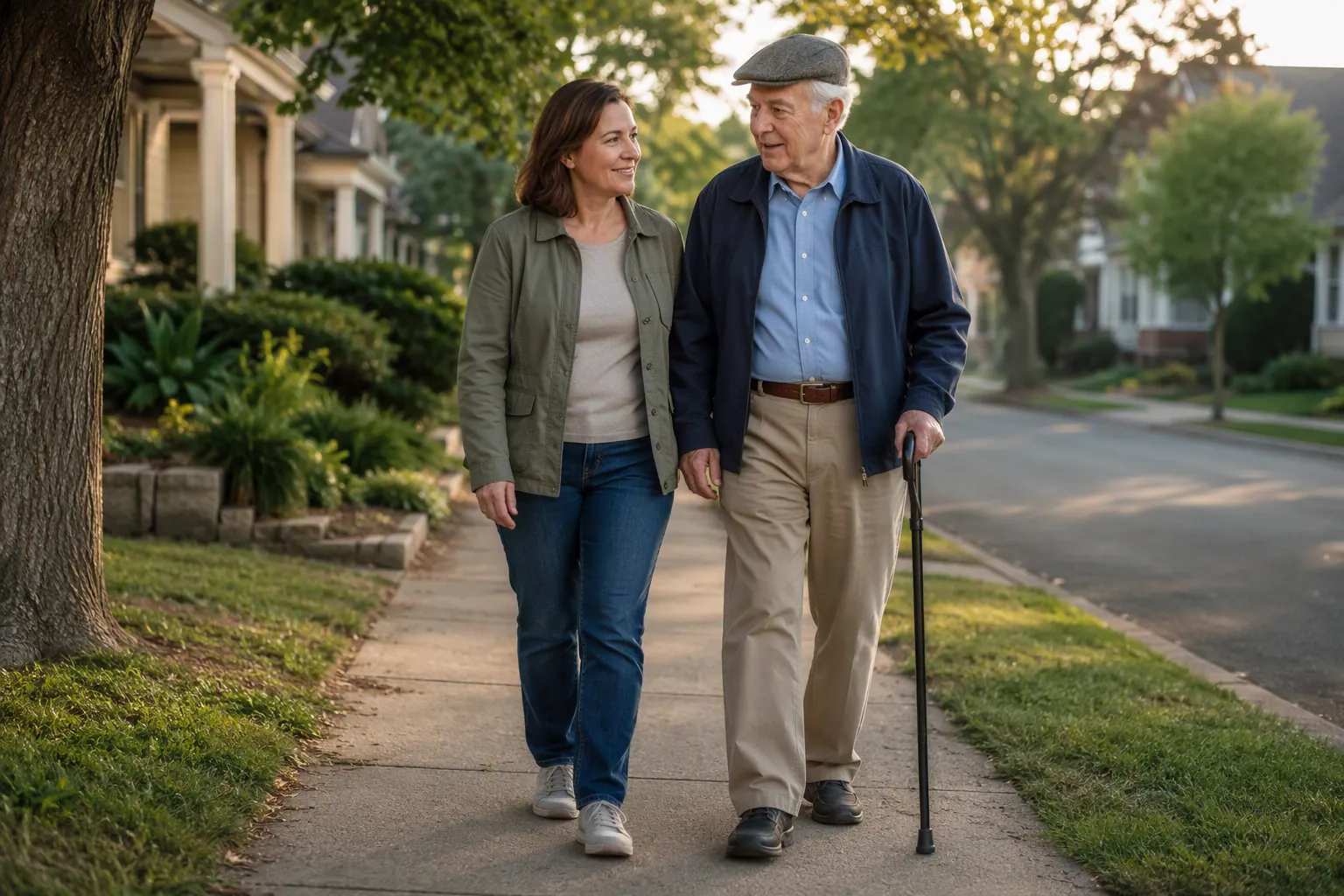
A realistic walking plan for a 60- to 85-year-old
Start with the walk the person can already do safely, not the walk the family wishes they could do. If the current safe walk is 4 minutes to the corner and back, that is the baseline. If it is 8 minutes with a cane after breakfast, that is the baseline. If symptoms or balance problems make outdoor walking unsafe right now, the baseline may be indoor laps with supervision.
Mayo Clinic’s general walking advice supports beginning with just a few minutes when needed and increasing gradually.[7] For the short-versus-long question, the cleanest progression is to lengthen one walk first, rather than trying to turn every trip into a longer session.
| Current safe baseline | This week’s adjustment | What not to do |
|---|---|---|
| Only 2-5 minutes at a time | Keep several short walks; try adding 30-60 seconds to one familiar route if symptoms and balance allow. | Do not force a 15-minute walk just to match a study category. |
| About 6-9 minutes at a time | Choose one daily walk to gently build toward 10 minutes. | Do not lengthen every walk at once. |
| About 10-14 minutes comfortably | Build one walk toward 15 minutes, or add a second shorter walk later in the day. | Do not turn the walk into a pace test. |
| 15 minutes or more safely | Use that sustained walk as an anchor and add weekly minutes gradually. | Do not ignore pain, dizziness, chest symptoms, or new unsteadiness. |
Moderate intensity does not require a speed lecture. The CDC and AHA describe the weekly aerobic target as moderate-intensity activity, and the NHS walking guidance uses the practical “able to talk but not sing” test for brisk walking.[5][6][8] For a caregiver, that test is more useful than arguing about miles per hour. If conversation is easy and the person could sing, the walk may be light. If they cannot speak in short sentences, it may be too hard.
A simple week might look like this: one slightly longer walk on most days, plus shorter walks as tolerated. Someone currently walking 5 minutes at a time might do two or three 5-minute walks a day and try to make one of them 6 minutes. Someone already walking 12 minutes might make the breakfast walk 15 minutes and leave the afternoon mailbox walk alone. The point is to create a longer sustained bout without stealing the confidence that comes from the shorter ones.
For the broader weekly structure — aerobic activity, balance, and strengthening — use a full CDC-based weekly fitness plan for aging adults. The question here is narrower: whether walking minutes are better gathered in short or longer bouts.
When walking is not the only way to collect heart-health minutes
Walking is convenient, measurable, and familiar, but it is not the only way an older adult can accumulate moderate-intensity cardiovascular minutes. If knees, weather, sidewalks, or fear of falling make walking unreliable, other activities may help fill the week.
Some older adults get moderate movement from doubles pickleball, water walking, stationary cycling, or active gardening. The same safety filter applies: the activity should raise effort without creating a fall hazard or symptom flare. For examples of lower-impact alternatives, see pickleball benefits for seniors and adaptive gardening tips for seniors.
Safety decides whether a longer walk is a good idea
A longer walk is only better if it is also safe enough to repeat. That means the route, footwear, assistive device, weather, lighting, rest options, and medication timing all matter. If a person is using a cane, recently fell, feels unsteady turning, or avoids walking because of fear of falling, the walking plan and the fall-prevention plan belong together.
Before adding distance, look at the route the person actually uses: the front steps, driveway slope, cracked sidewalk, hallway rugs, bathroom path, and where they would sit if they got tired. The CDC STEADI home fall-prevention checklist, a room-by-room fall-prevention checklist, and the fall prevention FAQ are more relevant here than a new step goal.
One more reason not to chase unlimited steps: fall evidence is not as clean as heart evidence. The 2025 Lancet Public Health review reported mixed findings for falls, including one large study suggesting higher fall risk above roughly 6,000 steps in some older subgroups.[3] That does not mean older adults should avoid walking. It means step goals need to be paired with balance, strength, environment, and judgment.
This article is general education, not personal medical advice. Stop the walk and seek medical guidance promptly for chest pain or pressure, unusual shortness of breath, fainting, new dizziness, new confusion, irregular or racing heartbeat, pain that does not settle with rest, or a sudden change in walking ability. If those signs are present, the next step is not a longer route; it is a clinician’s evaluation.
For heart health, sustained 10- to 15-minute walks are worth building toward, especially for less active adults. The first win, though, is more safe weekly movement. Keep the short walks, lengthen one of them when the body allows, and do not make the longer walk the goal if it makes the person less safe.
References
- Step accumulation patterns and risk for cardiovascular events and mortality among suboptimally active adults, Annals of Internal Medicine, 2025.
- Prospective Association of Daily Steps With Cardiovascular Disease: A Harmonized Meta-Analysis, Circulation, 2023.
- Daily steps and health outcomes in adults: a systematic review and dose-response meta-analysis, Lancet Public Health, 2025.
- For older adults, every 500 additional steps taken daily associated with lower heart risk, American Heart Association Newsroom, 2023.
- Older Adult Activity, Centers for Disease Control and Prevention.
- American Heart Association Recommendations for Physical Activity in Adults and Kids, American Heart Association, reviewed January 2024.
- Walking: Trim your waistline, improve your health, Mayo Clinic.
- Walking for health, NHS, December 2022.
- Exercise snacks, British Journal of Sports Medicine.
- Exercise snacks, PubMed Central, 2025.
Questions to bring to a clinician or OT
This is not medical, legal, or a family's final decision — only a framework. Bring these questions to a clinician, occupational therapist, or your local Area Agency on Aging.
Find Local HelpRelated reading
Noticed something outdated or inaccurate on this page? Flag a correction. We review every report against CDC, NIA, and AARP HomeFit guidance before updating a page.