
Caregiver decision guide
What to Do About Social Security When a Parent Dies
A step-by-step guide for adult children who have lost a parent receiving Social Security benefits, covering how to report the death, return any overpaid benefits, apply for the $255 lump-sum death payment, and file for ongoing survivor benefits — in the correct order to avoid costly mistakes.
Your parent died, they were receiving Social Security, and now there is a practical problem sitting on top of everything else: money may still arrive, agencies may already be moving, and one wrong assumption can create a repayment headache later. The first job is not to settle the whole estate. It is to confirm the death report and handle the Social Security benefit record in the right order.
Work the Social Security piece in this sequence:
- Confirm the death was reported to Social Security.
- Stop or return any benefit payment that is not payable.
- Ask whether anyone qualifies for the $255 lump-sum death payment.
- Apply for ongoing survivor benefits if a spouse, former spouse, dependent child, or other eligible survivor may qualify.
- Keep notes from every call, including dates, names, confirmation numbers if given, and instructions about returned payments.
That order matters because reporting a death and applying for survivor benefits are not the same task. Returning an overpayment is also its own task. The funeral home may start the process, but it does not clean up every benefit issue for the family.
First, Confirm That Social Security Was Actually Notified
In most cases, the funeral director reports the death to Social Security. SSA says funeral directors use Form SSA-721, Statement of Death by Funeral Director, to make that report, and the family should give the funeral director the deceased person’s Social Security number so the report can be made correctly.[1]
That is the usual pathway, not a reason to stop paying attention. Ask the funeral home directly: “Will you report the death to Social Security, and when?” Then write down the answer. If no funeral home is involved, or if you are not sure the report was made, USA.gov says you can report the death by calling Social Security at 800-772-1213 or by contacting your local Social Security office.[2]
Families cannot report a death to Social Security online. AARP’s plain-language guidance says the report must be made by phone or at a Social Security office, and it points families to the same national number, 800-772-1213, or a local office contact.[3]
If you are the adult child handling the bills, do not feel awkward about verifying. This is not second-guessing the funeral director. It is making sure the benefit record and the death record have met each other before another payment cycle creates a problem.
What to have in front of you when you call
Before calling, gather what you can. You may not need every item for the first call, but having the basics nearby keeps you from digging through folders while on hold.
- Your parent’s full legal name and Social Security number.
- Date of death and place of death.
- Name and phone number of the funeral home, if one is involved.
- Your own name, phone number, mailing address, and relationship to the deceased.
- Bank information for the account where Social Security benefits were deposited, if you are helping manage that account.
If you do not have the Social Security card, say so. Do not delay the call for days because one document is missing. The call can still clarify whether a report is already in the system and what Social Security wants next.
Then Deal With the Payment Rule Before Anyone Spends the Money
This is the part that catches families. Social Security benefits are paid one month behind. A payment received in July is for June. A payment received in August is for July.[4]
Social Security does not prorate retirement or disability benefits for the month of death. A person must live through the entire month to be entitled to that month’s benefit. If your parent dies in July, the July benefit is not payable, even if the death happened late in the month.[4]
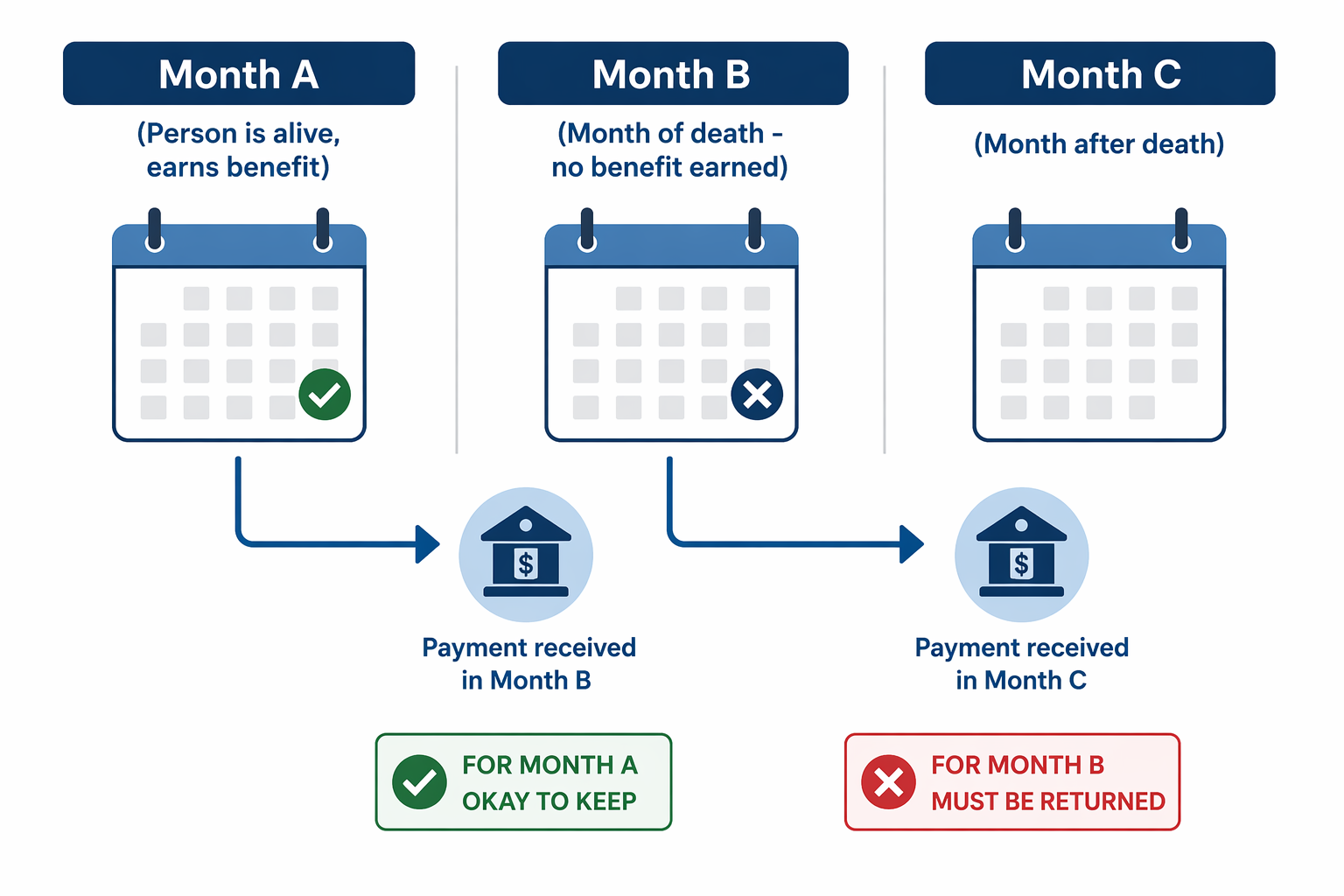
Here is the practical version: if a benefit arrives after the death, do not assume it is safe because it landed in the account. The payment date alone does not tell you whether the money is payable. You need to know which month the payment is for.
| If your parent died in July | What the payment usually represents | What to do |
|---|---|---|
| A Social Security payment arrived in July | June benefit, because benefits are paid one month behind | Usually payable if your parent lived through June; confirm with SSA before moving money if there is any doubt |
| A Social Security payment arrived in August | July benefit | Must be returned because there is no prorated benefit for the month of death |
| A paper check arrives after death | May be for a month that is not payable | Do not cash it; return it according to SSA instructions |
AARP uses the same month-behind logic to explain why both a payment for the month of death and any payment after that must be returned if they are not payable.[4] This is where a normal family mistake happens: someone sees a deposit, assumes the government would not have sent it if it were not allowed, and uses it for funeral or household bills. The deposit may still be an overpayment.
Direct deposit and paper checks are handled differently
For direct deposit, SSA instructs families to contact the bank or other financial institution and ask it to return any benefit received for the month of death or later.[1] Do that before closing the account if possible. Closing the account first can make the trail harder to follow.
If the bank cannot or will not return the deposit, ask Social Security what repayment method it wants and where to send it. Keep a copy of the bank’s response, the SSA instruction, and proof of payment. This is not a place to rely on memory.
For a paper check, SSA says not to cash checks received for the month of death or later and to return them as soon as possible.[1] If the check envelope or check stub gives a return address, use the address Social Security provides there. If you are unsure, call SSA before mailing anything.
Caregiver discussions around this issue often show the same confusion: families know they should stop payments, but the month-of-death rule feels backwards until someone explains that the payment arriving now may be paying for last month.[5] Treat those stories as a warning sign, not as the rulebook. The rulebook is SSA; the stories show where people trip.
Ask About the $255 Lump-Sum Death Payment, but Do Not Count on It
The lump-sum death payment sounds broader than it is. It is $255, and many adult children will not be eligible to receive it. SSA says the payment may be made to a surviving spouse who was living in the same household as the deceased, or in some cases to a spouse or child who was eligible for benefits on the deceased person’s record.[6]
AARP notes that the lump-sum death payment must be claimed within two years of the insured worker’s death.[7] That deadline is worth writing down, but the amount is not enough to build plans around. Ask about it during the SSA call so it is not missed, then let Social Security determine whether anyone qualifies.
For an adult child settling a parent’s affairs, the key question is usually not “How do I get the death benefit?” It is “Is there a surviving spouse, dependent child, or already-entitled family member who should be asking SSA about this?” If the answer is no, there may be no lump-sum payment for the family.
Survivor Benefits Are a Separate Application
Reporting the death stops or adjusts the deceased person’s benefit record. It does not automatically file a new survivor-benefit claim for everyone who might qualify. SSA describes survivor benefits for widows, widowers, surviving divorced spouses, children, and dependent parents, with eligibility depending on the relationship, age, disability status, caregiving role, and the deceased worker’s record.[6]
Do not spend days trying to calculate the exact benefit before making contact. A surviving spouse, surviving divorced spouse, minor child, disabled adult child, or dependent parent may need an appointment. SSA’s survivor-benefit application materials, including Form SSA-10 for widow’s, widower’s, or surviving divorced spouse’s benefits, show the kind of information Social Security may request, such as identifying information, marriage information, prior benefit information, and direct-deposit details.[8]
Survivor benefits cannot be applied for online. SSA directs people to call 800-772-1213 to report a death or apply for survivors benefits; families may also contact a local Social Security office.[1] AARP also states that survivor-benefit applications must be handled by phone or in person, not through an online application.[3]
A surviving spouse’s age can affect the monthly amount. AARP explains that survivor benefits can start as early as age 60 for a widow or widower, with reduced benefits at that age, and can reach up to 100% of the deceased spouse’s benefit if claimed at the survivor’s full retirement age or later.[7] Those percentages are planning information, not a substitute for SSA’s calculation on the actual record.
If the family includes a public employee or former public employee, ask SSA directly how current rules affect the survivor calculation. The elimination of GPO and WEP may matter for some families, but this is not a reason to delay the survivor-benefit call while trying to interpret policy updates on your own.
Do not rely on unofficial processing timelines
SSA’s own public pages do not give one dependable processing-time promise for survivor-benefit claims. If someone tells you it always takes a certain number of weeks, treat that as anecdotal unless SSA confirms it for the claim in front of you. The useful question for the appointment is: “If benefits are approved, what month could they begin, and is there anything time-sensitive we need to file now?”
A Clean Call Script for the Person Handling It
When you call Social Security, you do not need to tell the whole family history. You need to get the record straight and identify the next required action. A simple script keeps the call from wandering.
- “I am calling about my parent, who died on [date]. They were receiving Social Security benefits. Has the death been reported on the record?”
- “The funeral home is [name]. They told us they would report the death. Do you need anything else from the family?”
- “A payment was received on [date]. Can you confirm which month that payment was for and whether it must be returned?”
- “If it must be returned, should the bank return the direct deposit, or should we send payment to SSA?”
- “Is anyone potentially eligible for the $255 lump-sum death payment or monthly survivor benefits?”
- “If a survivor-benefit application is needed, can we schedule the phone or in-person appointment now?”
After the call, write down what happened while it is still fresh: date, time, number called, representative name if given, whether the death was already verified, what payment must be returned, and whether a survivor-benefit appointment was scheduled.
What Not to Do in the First Few Weeks
A few actions create more cleanup than they save. Hold off on these until the Social Security payment issue is clear:
- Do not cash a Social Security paper check made out to your deceased parent.
- Do not spend a direct deposit until SSA or the bank confirms it is payable.
- Do not assume the funeral home’s report also applied for survivor benefits.
- Do not close the receiving bank account before checking whether a deposit must be returned.
- Do not wait for a letter if there is a surviving spouse or dependent family member who may need a survivor-benefit appointment.
There is no prize for doing this perfectly while grieving. The goal is smaller and more useful: verify the death report, keep unpayable money from being spent, ask about the limited lump-sum payment, and get any eligible survivor into the application process by phone or appointment.
References
- What to do when someone dies, Social Security Administration.
- Report the death of a Social Security or Medicare beneficiary, USA.gov.
- How To Report A Death To Social Security, AARP.
- Do You Have to Pay Back Social Security When Someone Dies?, AARP.
- Stopping Social Security Payments After Death, AgingCare.
- Survivor benefits, Social Security Administration.
- Social Security Survivor Benefits: 10 Things Spouses Need to Know, AARP.
- Form SSA-10 | Information You Need to Apply for Widow's, Widower's or Surviving Divorced Spouse's Benefits, Social Security Administration.
Questions to bring to a clinician or OT
This is not medical, legal, or a family's final decision — only a framework. Bring these questions to a clinician, occupational therapist, or your local Area Agency on Aging.
Find Local HelpRelated reading
Noticed something outdated or inaccurate on this page? Flag a correction. We review every report against CDC, NIA, and AARP HomeFit guidance before updating a page.