
Caregiver decision guide
First Steps When a Parent Is Diagnosed With ALS
In the first weeks after a parent's ALS diagnosis, knowing which steps carry hard deadlines — disability and Medicare applications, advance directives, voice banking — and which can wait is what prevents the delays families most regret. This action plan gives adult children an ordered starting sequence that keeps the parent's autonomy central and eases the overwhelm.

When a parent is diagnosed with ALS, the first mistake many families make is trying to solve the whole disease in one sitting. That is too much for any kitchen table. The better question in the first days is narrower: what will your parent lose the chance to decide, apply for, record, or authorize if everyone waits until they feel ready?
This is not medical, legal, or financial advice. It is a first-weeks care-coordination sequence for adult children who need to help without taking over. Your parent remains the decision-maker unless they lack capacity or have legally assigned that role to someone else.
Do these first, not everything
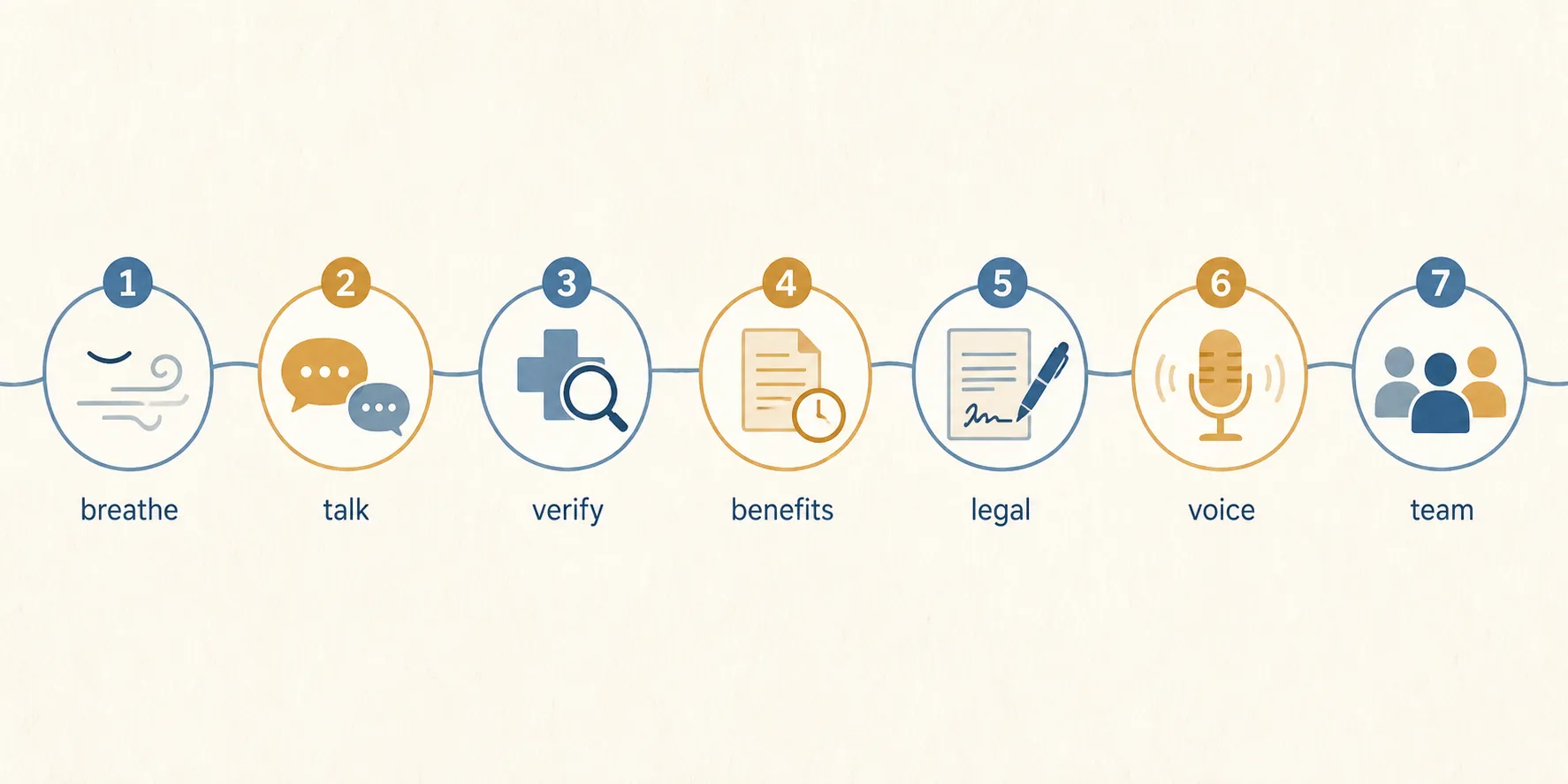
I AM ALS gives families a useful starting frame: breathe, talk openly with the parent about values and your role, learn from trusted sources, start disability and benefits applications because they can take months, build a support team, and make time for yourself as a caregiver.[1][2] For the first weeks after diagnosis, the order matters because some tasks carry compounding delays.
- Breathe and stabilize the next few days. Do not let panic assign permanent roles.
- Ask your parent how they want decisions made, who may receive information, and what help they do or do not want right now.
- Verify the diagnosis path and connect with a multidisciplinary ALS clinic or ALS-experienced neurology team.
- Start disability, Medicare, insurance, and VA benefit pathways where relevant. Do this before the family feels administratively ready.
- Complete or update advance directives, health care decision authority, financial authority, and release-of-information permissions.
- Begin voice banking or message banking while speech is still available enough for your parent to choose how they want to sound.
- Build one shared care binder and a small team of people with named jobs.
- Then move into home safety, equipment planning, transportation, and caregiver self-care routines.
The first conversation should decide roles before anyone “helps”
The first family meeting does not need to settle feeding tubes, wheelchairs, finances, and every possible medical choice. It does need to settle one operating rule: your parent is not the project. They are the person whose life is being planned.
Target ALS gives a simple standard that families should not skip: people with ALS remain the best judges of what they can do, and help should be specific, present, and non-condescending.[3] That matters in the first week because adult children often start calling doctors, researching equipment, and emailing relatives before asking the parent what access they actually want to grant.
Use plain questions. Write the answers down. If your parent is tired, do ten minutes and stop.
- “Do you want me to come to appointments, or only help you prepare questions?”
- “Who should be allowed to hear medical updates directly?”
- “If siblings disagree, how do you want the final decision made?”
- “Are there decisions you want made now while you can explain them clearly?”
- “What kind of help feels useful, and what kind feels like being managed?”
A practical result should come out of this conversation: permission boundaries. Who may log in to the patient portal? Who may schedule appointments? Who may talk to insurance? Who gets the medication list? If the answer is “not yet,” honor that. If the answer is “yes, please,” get the release forms and passwords handled while everyone is sitting at the table.
Verify the diagnosis path and get coordinated ALS care
ALS is not diagnosed with one definitive test. Clinicians track symptoms, rule out other conditions, and use tests to support or exclude possible explanations; ALS symptoms can overlap with other neurological disorders.[4][5] That is why a second opinion or referral to an ALS-experienced team is not an insult to the first doctor. It is a safety step.
Ask the diagnosing neurologist for a referral to a multidisciplinary ALS clinic or an ALS care team that can coordinate neurology, respiratory care, physical therapy, occupational therapy, speech-language pathology, nutrition, social work, and equipment planning. A family should not have to discover, one missed appointment at a time, that swallowing, breathing, mobility, communication, and benefits paperwork are all moving on different clocks.
The baseline numbers are serious enough without exaggeration. The Family Caregiver Alliance reports that about 6,000 Americans are newly diagnosed with ALS each year, average survival after confirmed diagnosis is three to five years, and about 10% of people live 10 years or longer.[6] Those numbers should not be used to rush your parent into choices they do not want. They should be used to justify getting the right team assembled now.
Be careful with medication information found online. ALS drug lists age quickly. Mayo Clinic’s May 2026 treatment page lists riluzole, edaravone, and tofersen; ask the ALS clinician to verify what is currently approved, appropriate for your parent’s specific situation, and available through your parent’s insurance or trial pathway.[5] Do not build the first month around an outdated article or a medication name someone remembers from a news story.
Start benefits and coverage work before the family feels ready
This is the part families regret postponing. Disability, Medicare, VA, employer leave, supplemental insurance, and financial paperwork are dull until the first denial, missing form, or uncovered device turns them urgent. Starting an application is not the same thing as being approved, and this section is not benefits advice. It is a warning about time.
Last verified: August 25, 2026. I AM ALS notes that disability and benefits applications can take months.[1][2] ALS News Today reports that people with ALS who receive Social Security Disability Insurance are automatically eligible for Medicare without the usual waiting period, and it cites estimated annual U.S. ALS treatment costs ranging from $16,000 to $200,000.[4] Those are exactly the kinds of delays and costs that should move benefits work into the first-weeks category.
| Pathway | Start this week | Do not assume |
|---|---|---|
| SSDI and Medicare | Ask the ALS clinic or social worker what documentation is needed for SSDI. If your parent is eligible and applies, track every submission and confirmation number. Last verified: August 25, 2026. [1][2][4] | Do not assume Medicare happens just because the diagnosis exists. The reported Medicare rule applies to people with ALS receiving SSDI. [4] |
| Private insurance and supplemental coverage | Call the insurer with your parent’s permission. Ask about ALS clinic coverage, respiratory equipment, mobility equipment, home health, speech devices, medications, and prior authorization rules. | Do not assume the first customer-service answer is complete. Ask where the rule is written and save the reference number. |
| VA benefits | If your parent is a veteran, ask about ALS-related VA disability and health care pathways. The VA Caregiver Support Program states that veterans with 90 or more days of active service have been eligible for ALS disability benefits and VA health care since 2008, and that ALS occurs in veterans at about 1.5 times the rate of the general population. Last verified: August 25, 2026. [7] | Do not assume your parent is ineligible because they did not serve in combat or because the diagnosis came decades after service. Ask the VA or a qualified veterans service officer. |
| Your own job leave | If you are the adult child likely to attend appointments or provide care, check your employer leave, sick time, remote-work, and FMLA-related options. | Do not confuse your job protection with your parent’s disability or health coverage. They are separate systems. |
For the first benefits folder, collect only what is needed to begin: your parent’s legal name and Social Security number, diagnosis documentation, neurologist contact information, medication list, employment history if SSDI may apply, military service records if VA benefits may apply, insurance cards, and a running log of calls. A simple log beats a perfect binder that never gets started.
Put decisions in writing before choices become guesses

Advance directives are not a sign that the family is giving up. They are how your parent keeps authority when speech, fatigue, emergency care, or disagreement makes authority harder to exercise. Mayo Clinic encourages people with ALS to make care decisions early, and the Family Caregiver Alliance recommends reviewing advance directives periodically, suggesting every six months.[5][6]
Do not wait for a crisis to discover that the sibling who “handles medical stuff” cannot legally receive information, or that the adult child paying bills has no financial authority, or that the person everyone assumes is the decision-maker is not the person your parent would choose.
Documents to ask about early
- Advance directive or living will: what care your parent would or would not want in serious medical situations.
- Health care proxy or medical power of attorney: who can make medical decisions if your parent cannot.
- HIPAA or medical release forms: who may receive information from clinicians and hospitals.
- Financial power of attorney: who can handle bills, benefits, accounts, and insurance issues if needed.
- Will, trust, beneficiary designations, and account access: review with a qualified attorney or financial professional.
Legal forms vary by state, and complicated family or financial situations deserve an elder-law attorney. For a practical walkthrough, use the site’s power of attorney checklist, then pair it with the end-of-life care planning roadmap and the complete end-of-life planning checklist for seniors. The goal is not to force every decision in one night. It is to make sure your parent’s choices are recorded while your parent can still explain them.
Bank the voice before the voice is a problem

Voice banking is one of those tasks that can feel too intimate to start right away. Start anyway, gently. The point is not to make your parent rehearse loss. The point is to let them choose, while they still can, whether a future speech device should sound more like them.
Ask the ALS clinic for a speech-language pathology referral and ask specifically about voice banking, message banking, augmentative and alternative communication, device coverage, and timing. If your parent wants to record, schedule the first session when they are rested. Do not let the most tech-comfortable child take over the process unless your parent wants that help.
- Choose a quiet room and a simple recording setup recommended by the clinic or vendor.
- Let your parent decide whether they want synthetic voice banking, personal message recordings, or both.
- Record practical phrases as well as personal ones: greetings, names, favorite sayings, comfort phrases, and decision phrases such as “yes,” “no,” “I need a break,” and “please ask me first.”
- Back up files and account information in the care binder with your parent’s permission.
Build one reachable system: clinic, binder, helpers
Most first-month failures are not dramatic. They are the unopened portal message, the missed call from the clinic, the medication change written on a sticky note, the sibling who says “I didn’t know that appointment was today.” A parent with ALS should not have to become the family’s information router.
Make one shared system, with your parent’s consent, that contains the essentials:
- ALS clinic number, neurologist number, pharmacy, primary care doctor, and after-hours instructions.
- Current medication list, allergies, diagnoses, surgeries, and insurance information.
- Patient portal login plan: who has access, where credentials are stored, and what your parent does not want shared.
- Benefits application log: date submitted, confirmation numbers, documents still missing, next follow-up date.
- Legal document locations and names of decision-makers.
- A helper list with assigned jobs: rides, meals, paperwork, home projects, appointment notes, respite, sibling updates.
If you need a template for the paperwork side, adapt the site’s emergency contact binder for aging parents. Keep it plain enough that someone can use it at 2 a.m. without understanding the whole family history.
Build the support team around specific offers. I AM ALS encourages caregivers to assemble help rather than carry everything alone, and Target ALS emphasizes being present, offering specific help, and avoiding condescension.[1][2][3] “Let me know if you need anything” is kind but weak. “I can drive to the ALS clinic on the second Tuesday of each month” is usable.
What can wait until the deadline steps are moving
Home safety, equipment, transportation, and caregiver endurance are not optional. They are just not always the first fire unless your parent is already falling, choking, short of breath, unable to transfer safely, or unsafe alone. If any of those are happening now, call the ALS clinic promptly and ask what needs same-week attention.
Once benefits, legal authority, diagnosis verification, voice banking, and the care binder are moving, use the next layer of planning:
- For a home walkthrough, use the three-layer fall-prevention system rather than buying equipment at random.
- For mobility equipment and transfers, keep the wheelchair safety checklist for seniors at home nearby when the clinic starts discussing devices.
- For your own role, use the caregiver self-care checklist before exhaustion becomes the family’s silent plan.
- If burnout signs are already showing, match them to a concrete respite option with this caregiver burnout and respite guide.
- If the whole family needs a broader organizing plan, start with Help for Elderly Parents: A Practical Action Plan and adapt it to the ALS clinic’s guidance.
By the end of the first weeks, the family does not need to be “ready for ALS.” That is not a fair standard. A better threshold is this: your parent’s wishes are written down, slow applications have started, the clinical team is forming, the voice and paperwork are protected, and the next tasks are in a reachable system instead of scattered across fear, memory, and missed calls.
References
- Caring for a Parent with ALS — I AM ALS
- Caregivers: Start Here — I AM ALS
- How to Help Someone With ALS: Tips for Friends, Family Members and Caregivers — Target ALS
- Next Steps After an ALS Diagnosis — ALS News Today, 2024
- Amyotrophic lateral sclerosis (ALS) - Diagnosis and treatment — Mayo Clinic, May 2026
- Amyotrophic Lateral Sclerosis (ALS) — Family Caregiver Alliance
- Caregiver Tips by Diagnosis: ALS — VA Caregiver Support Program
Questions to bring to a clinician or OT
This is not medical, legal, or a family's final decision — only a framework. Bring these questions to a clinician, occupational therapist, or your local Area Agency on Aging.
Find Local HelpRelated reading
Noticed something outdated or inaccurate on this page? Flag a correction. We review every report against CDC, NIA, and AARP HomeFit guidance before updating a page.