
Caregiver decision guide
5-Minute Daily Thumb Exercises for Senior Arthritis Pain
A simple 5-minute daily thumb exercise routine can help seniors with thumb arthritis reduce pain and maintain hand function for everyday tasks. This guide provides five safe, equipment-free exercises sequenced from easiest to hardest, with guidance on when to stop and consult a specialist.
A painful thumb rarely announces itself as a big medical problem. It shows up when a jar lid will not turn, when a shirt button takes too long, when a key pinches at the base of the thumb, or when the hand does not feel as trustworthy on a stair railing. That is why thumb pain relief exercises for seniors should be judged by ordinary life, not by whether they look impressive.
The thumb is small, but it does a large share of the hand’s work. Harvard Health cites certified hand therapist Christine Caiati, OTR/L, CHT, in noting that about 40% of overall hand function relies on the thumb.[1] When the base of the thumb becomes sore, weak, or stiff, the trouble is not just “a little arthritis.” It can change how safely and confidently someone manages the day.
It is also common. A meta-analysis in Osteoarthritis and Cartilage found that radiographic thumb base osteoarthritis affects 33% of males and 39% of females by age 80, based on 29,802 participants across 16 studies.[2] In the Framingham Osteoarthritis Study, hand osteoarthritis joints had a 3.5 times higher prevalence of pain than joints without hand osteoarthritis, and the thumb base had the highest pain prevalence ratio at 5.2.[3] Those numbers do not tell one person exactly what is happening in one thumb, but they do explain why this problem deserves a practical routine instead of a shrug.
For mild-to-moderate thumb base arthritis, a short daily exercise program is a reasonable home strategy. A 2024 systematic review of randomized controlled trials found that exercise-based interventions for thumb carpometacarpal osteoarthritis produced clinically superior outcomes compared with no treatment, especially in the short term.[4] That is support, not a guarantee. A sore senior hand still needs a gentle start, low repetitions, and clear stop rules.
Before You Start: Keep the Thumb Quiet, Not Tough
This routine is meant for a thumb that feels achy, stiff, or mildly sore with daily use, especially near the base of the thumb. It is not meant for sharp pain, new swelling after an injury, numbness, catching or locking, sudden weakness, or pain that is getting worse instead of settling. Those signs need a clinician’s eye because trigger thumb, De Quervain’s tenosynovitis, carpal tunnel syndrome, injury, and more advanced arthritis can require different care.
Use a table, sit with both feet on the floor, and keep the shoulder relaxed. The goal is an easy, warm movement feeling. Mild stretching or light effort is acceptable. Sharp pain, burning, tingling, joint catching, or pain that lingers after the exercise is a stop signal.
| Exercise | How much | Main purpose |
|---|---|---|
| Table-supported thumb IP flexion | 8-10 slow reps | Start with the smallest thumb joint |
| Thumb opposition and finger taps | 8-10 gentle taps to start | Practice daily pinch control |
| L-form stretch | 8-10 slow reps | Open the thumb web space gently |
| Gentle tennis ball squeeze | 8-10 reps with a 3-second hold | Light grip activation, not hard strengthening |
| Thumb circles | 8-10 circles each direction if comfortable | Finish with controlled motion |

The 5-Minute Daily Thumb Routine
Move through these in order. The first two are the easiest for most hands because the table does some of the work and the movement is familiar. The tennis ball comes late on purpose. A ball can tempt people to squeeze too hard, and a painful thumb does not need a contest.
1. Table-Supported Thumb IP Flexion
Rest the hand on a table with the palm facing sideways or slightly upward, whichever feels more natural. Keep the thumb supported. Bend only the tip joint of the thumb, as if making a small nod with the thumb tip, then slowly straighten it again.
- Do 8-10 slow repetitions.
- Keep the base of the thumb quiet; the motion should come mostly from the thumb tip.
- It should feel easy, small, and controlled.
- Stop if the thumb base pinches, catches, or starts to ache more with each repetition.
This is a good first movement on stiff mornings because it asks very little of the sore base joint. If even this small motion hurts sharply, skip the rest of the routine for now and get the thumb evaluated.
2. Thumb Opposition and Finger Taps
Hold the hand in front of you or rest the little-finger side of the hand on the table. Touch the thumb gently to the index fingertip, then open the hand. Touch the middle fingertip, then open. Continue to the ring finger and little finger only as far as the thumb can travel without strain.
- Aim for 8-10 gentle taps total at first, or 8-10 rounds if the thumb is comfortable.
- Use a soft touch, not a hard pinch.
- Let the hand open between taps so the thumb is not held in one tight position.
- Stop if reaching the ring finger or little finger causes a sharp pull at the thumb base.
This movement matters because it resembles the little pinches that fill a day: picking up pills, holding a zipper tab, pulling a card from a wallet, or fastening a button. If the little finger is too far away, do not chase it. Tap only the fingers that the thumb can reach calmly.
3. L-Form Stretch
Place the hand on the table with the palm down or slightly turned. Move the thumb away from the palm to make a loose “L” shape between the thumb and index finger. Hold for a breath, then bring the thumb back toward the hand.
- Do 8-10 repetitions at a slow pace.
- Keep the motion smooth; do not pull the thumb back with the other hand.
- You may feel a mild stretch in the web space between the thumb and index finger.
- Stop if the stretch turns into joint pain at the thumb base.
The L-form stretch should never be forced. Older thumbs often have less range than they used to, and the purpose is to keep comfortable motion available, not to push the joint into a shape it no longer wants.
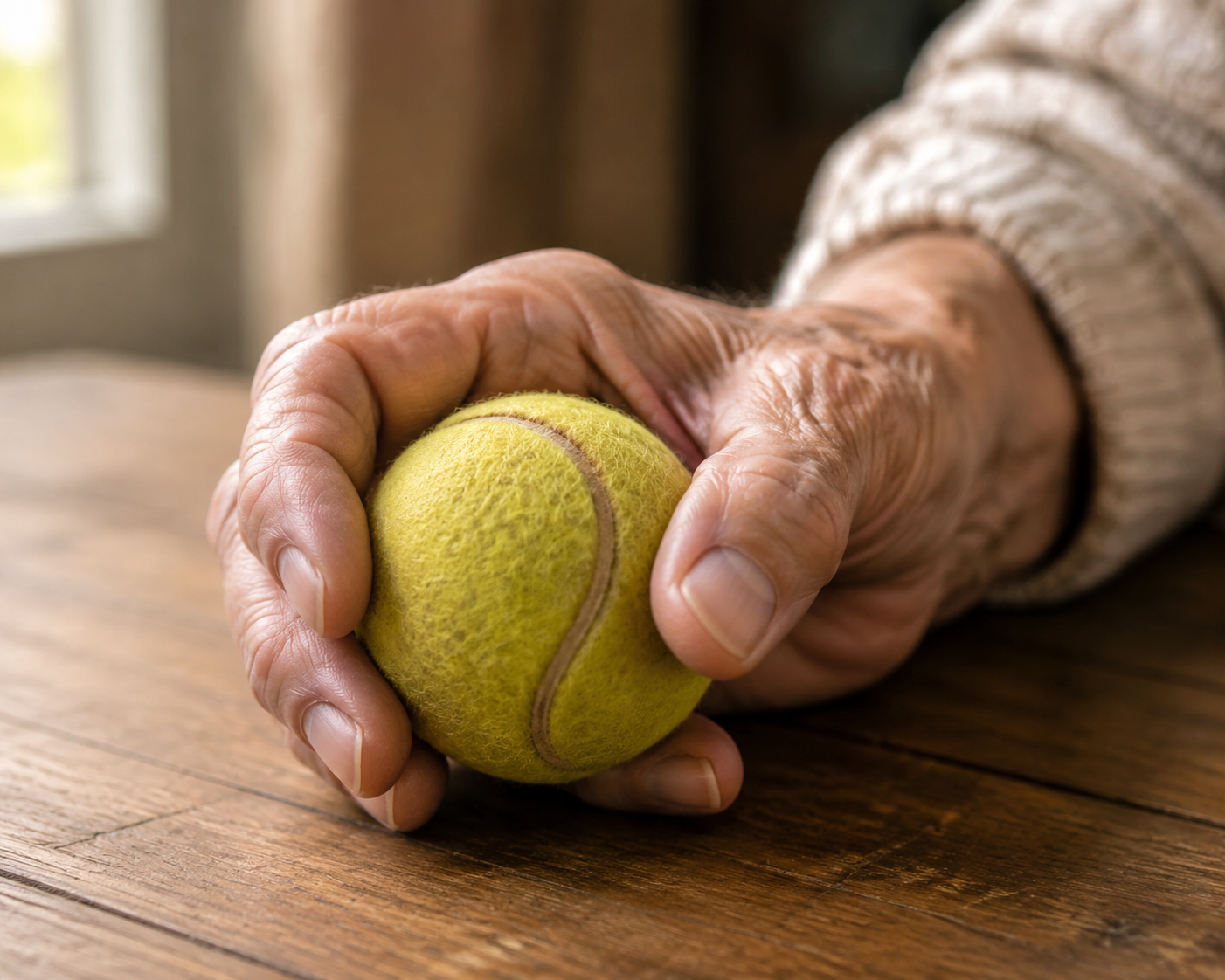
4. Gentle Tennis Ball Squeeze With a 3-Second Hold
Place a tennis ball on the table and cup the hand around it. The thumb rests lightly on one side or over the top, depending on what feels comfortable. Squeeze just enough to slightly dent or steady the ball, hold for 3 seconds, then relax fully.
- Do 8-10 gentle squeezes.
- Keep the effort low, about a light handshake rather than a firm grip.
- Let the fingers and thumb relax between repetitions.
- Stop if the thumb base feels compressed, stabbed, or more painful after the hold.
This is activation, not grip training. Seniors with thumb arthritis do not need to prove they can crush a ball. The useful question is whether the hand can practice a safe, mild squeeze that may carry over to a mug handle, a garden hose nozzle, or a railing.
5. Thumb Circles
Finish with the hand supported on the table or held in a relaxed position. Move the thumb in a small circle, as if drawing a coin-sized loop in the air. Make the circle smaller if the thumb feels unsteady.
- Try 8-10 circles in one direction, then 8-10 in the other direction if comfortable.
- Keep the wrist still and the movement slow.
- The feeling should be loose and controlled, not grindy or strained.
- Stop if circling causes clicking with pain, catching, sharpness, or a deep ache at the base.
Some thumbs like circles; some do not. If this last exercise is the only one that irritates the joint, leave it out for a week and keep the earlier movements. A home routine is allowed to be sensible.
How to Calibrate the Routine Day by Day
Five minutes is enough for this plan. More is not automatically better, especially for a thumb that is already sore from opening containers, carrying groceries, or leaning on a cane. Start with one round per day. If the hand feels calmer and daily tasks feel easier after several days, stay there. There is no prize for turning a helpful routine into an overuse problem.
- Use the table whenever the thumb feels uncertain; support often makes the difference between useful motion and guarding.
- Keep every movement below sharp pain; mild effort is acceptable, joint pain is not the target.
- Shorten the range before you drop the exercise; a smaller comfortable motion is better than a larger painful one.
- Treat the tennis ball as optional on flare-up days; it is the easiest exercise to overdo.
- Judge progress by function: jars, buttons, keys, mugs, railings, and kitchen tools.
A simple tracking method works well: once a day, notice one task that usually bothers the thumb. Do not give it a complicated score unless that helps. Just write a few words, such as “coffee mug easier,” “button still hard,” or “jar lid worse today.” Over a week or two, that record is more useful than guessing from memory.
If the thumb is more sore after the routine, cut the repetitions in half the next day. If it is still more sore, remove the tennis ball squeeze. If symptoms continue to climb, stop the routine and arrange an evaluation. Pain that keeps arguing back is information.
When Home Exercises Are Not Enough
Home exercises fit best when symptoms behave like mild-to-moderate arthritis: stiffness, aching near the thumb base, discomfort with pinch or grip, and some relief with rest or gentler use. They are not a substitute for diagnosis when the pattern is different.
- Stop and seek professional advice if pain is sharp, sudden, or worsening.
- Get evaluated if the thumb locks, catches, gives way, or cannot move normally.
- Ask for care if numbness, tingling, or night symptoms appear.
- Do not keep exercising through swelling, redness, heat, or pain after a fall or twist.
- If daily tasks are becoming unsafe or impossible, the thumb needs more than a printed routine.
A clinician may discuss splints, joint protection, adaptive tools, medication options, injections, therapy, or surgery depending on the diagnosis and severity. Those choices belong in an individual care plan. The purpose here is narrower: a safe daily starting point for the common sore thumb that still has comfortable motion to work with.
For many seniors, the right thumb routine is modest: a supported bend, a few fingertip taps, a gentle opening stretch, a light ball squeeze, and small circles. Done calmly and stopped when symptoms object, those five minutes can help protect the hand skills that keep a person dressing, cooking, gardening, and holding on with confidence.
References
- Get a grip: How to manage thumb arthritis, Harvard Health.
- OARSI Meta-analysis (prevalence), Osteoarthritis and Cartilage.
- Framingham Osteoarthritis Study.
- 2024 systematic review on exercise for thumb CMC OA.
- Hand exercises for people with arthritis, Mayo Clinic.
- Thumb Arthritis: Exercises, Kaiser Permanente.
Questions to bring to a clinician or OT
This is not medical, legal, or a family's final decision — only a framework. Bring these questions to a clinician, occupational therapist, or your local Area Agency on Aging.
Find Local HelpRelated reading
Noticed something outdated or inaccurate on this page? Flag a correction. We review every report against CDC, NIA, and AARP HomeFit guidance before updating a page.