
Caregiver decision guide
How to Claim Veterans Disability Benefits for Seniors
Many senior veterans and their families overpay for care because they don't know about the VA Aid & Attendance pension benefit. This guide explains eligibility, the care-cost math that can unlock up to $29,000 a year, and how to apply without costly mistakes.
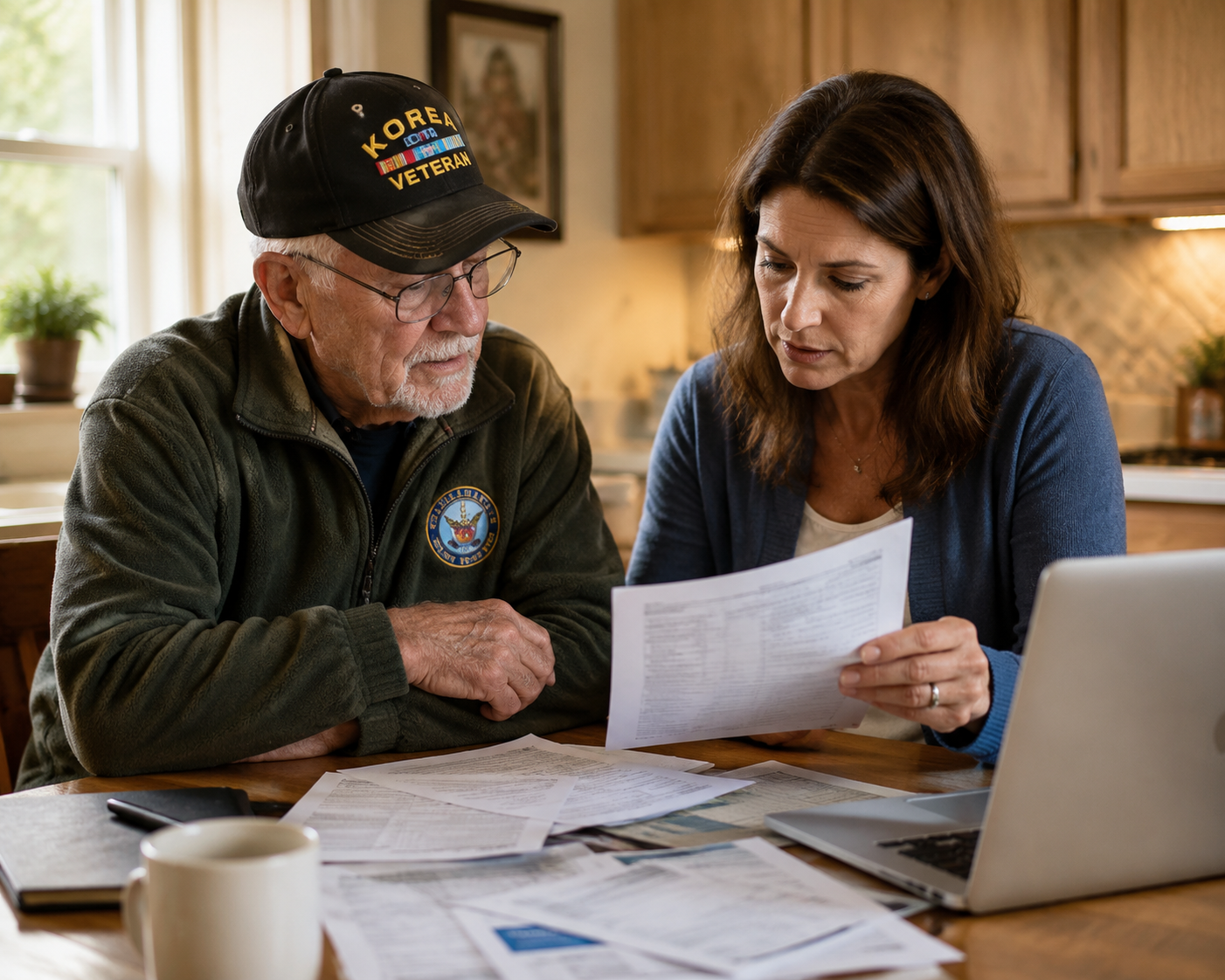
A lot of families rule out veterans disability benefits for seniors for the wrong reason: the Social Security deposit looks too high. Dad gets $3,200 a month, so the family assumes the VA will say no. Then the assisted living bill arrives for $4,500 a month, and nobody has explained that those care costs may change the eligibility math.
For 2026, the VA’s Maximum Annual Pension Rate with Aid & Attendance is $29,093 for a single veteran, $34,488 for a veteran with one dependent, $46,143 for two married veterans who both qualify, and $18,697 for a surviving spouse.[1] Those are not automatic payments. They are maximum annual pension amounts, and the VA looks at countable income, net worth, service history, and care need before deciding whether a person qualifies.
The part families miss is countable income. Unreimbursed medical and long-term care expenses can be subtracted before the VA calculates pension eligibility. In the common caregiving situation where monthly care costs are higher than monthly income, the person who looked “over income” on paper may be much closer to qualifying than the checking account made it seem.[2]
First, separate Aid & Attendance from disability compensation
The phrase “veterans disability benefits for seniors” causes trouble because people use it to mean several different things. VA disability compensation is for disabilities connected to military service. VA Pension with Aid & Attendance is different: it is a needs-based pension benefit for eligible wartime veterans or surviving spouses who need help with daily activities or are housebound.[2]
That distinction matters because the wrong mental bucket leads to the wrong form, the wrong evidence, and weeks of frustration. A senior veteran does not need to prove that dementia, frailty, fall risk, or the need for bathing help was caused by military service in order to explore Aid & Attendance. The question is whether the person meets the pension rules, has qualifying wartime service, needs personal assistance, and falls within the financial limits after allowable expenses are counted.
| Benefit people often confuse | What it is really asking |
|---|---|
| VA disability compensation | Is the condition connected to military service? |
| VA Pension with Aid & Attendance | Is the wartime veteran or surviving spouse financially eligible and in need of daily care or housebound support? |
The three gates that matter before you start forms
Before downloading anything, test the situation against three gates: wartime service, care need, and financial eligibility. A weak answer on one gate does not always mean the case is hopeless, but it does tell you where an accredited helper needs to look first.
Wartime service does not mean combat
Many families stop here because nobody in the family thinks of the veteran as a “combat veteran.” For this pension benefit, wartime service is not the same thing as combat service. The key issue is whether the veteran had at least one day of active duty during a recognized wartime period, not whether the person was deployed into combat or served in a particular role.[3]
That is why a discharge paper can be more useful than family memory. Someone may have served stateside, worked in supply, trained others, or served between assignments and still have qualifying wartime service if the dates fit the VA rules.
The care need must be real and documented
Aid & Attendance is meant for someone who needs another person’s help with daily activities, is bedridden, is in a nursing home because of physical or mental incapacity, or has severely limited eyesight under VA criteria.[2] For families, this usually shows up in ordinary language first: help bathing, dressing, transferring, managing medications, getting safely to the bathroom, preventing wandering, or staying safe when left alone.
The VA will not approve a claim just because care is expensive. The claim needs medical support, usually including VA Form 21-2680, the examination for housebound status or permanent need for regular Aid & Attendance.[4] If memory care or assisted living is involved, the family should be ready to show what services are actually being provided, not just the monthly rent.
Financial eligibility is where care bills can change the answer
The VA Pension is needs-based, so income and net worth matter. But gross income is only the beginning. The VA allows certain unreimbursed medical expenses, including many long-term care expenses, to reduce countable income for pension purposes.[1][2]
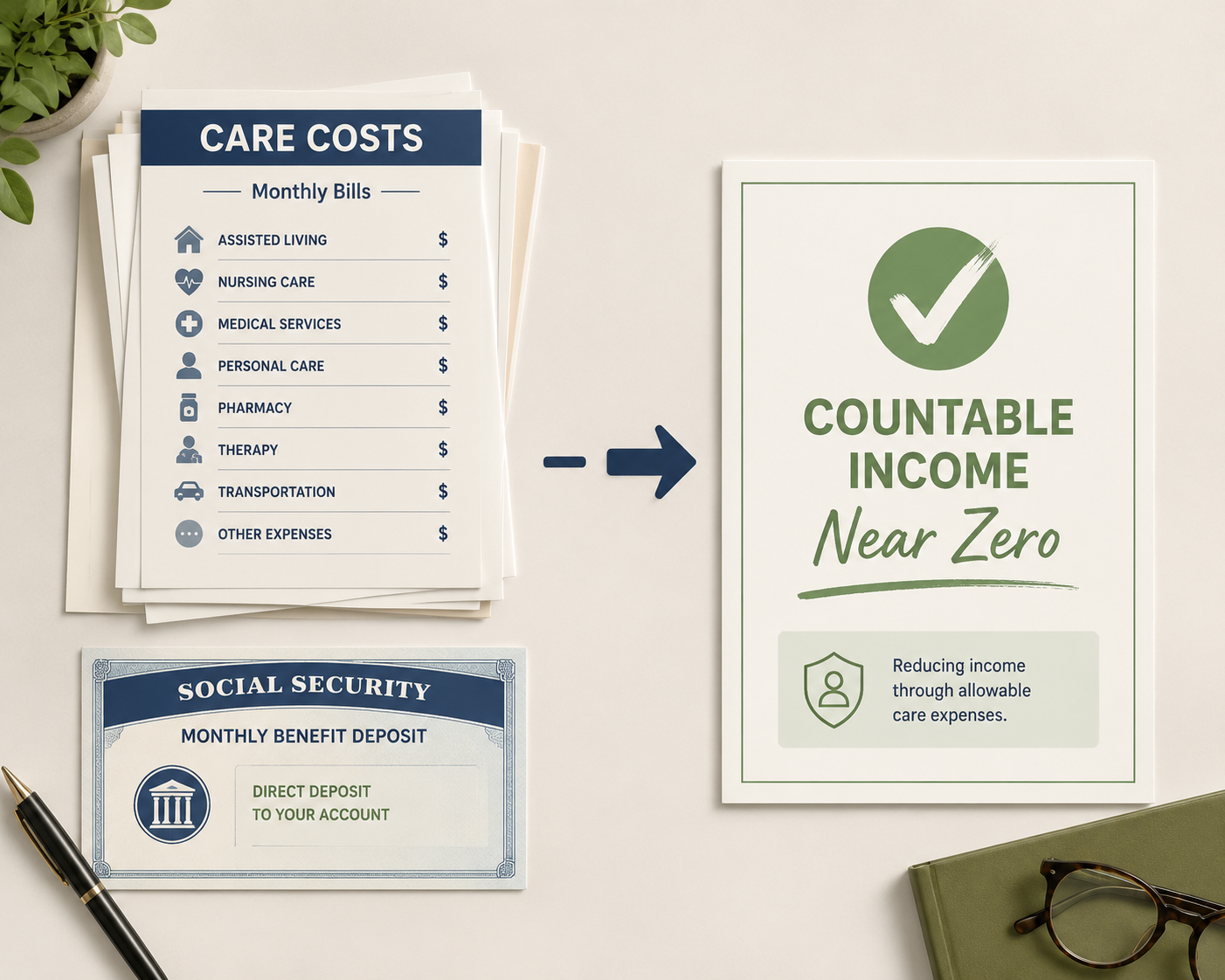
Here is the practical reframe. If a veteran receives $3,200 per month in Social Security and pays $4,500 per month for assisted living, the household may look income-rich to a tired caregiver reading a bank statement. But after allowable care costs are considered, the VA countable-income calculation may look very different, potentially near zero in that simplified example.[2][3]
That does not mean every assisted living bill is fully deductible in every case. It means the family should not decide eligibility by staring at the deposit column alone. The expense side of the ledger is part of the pension calculation.
Run the countable-income math before assuming no
A clean first pass does not require software. It requires the same records families already collect when they are trying to understand why the account is falling every month.
- Add recurring income: Social Security, pension income, retirement withdrawals, annuity payments, and other regular deposits.
- List unreimbursed medical and care expenses: assisted living, memory care, in-home aides, adult day care, insurance premiums, prescription costs, and other qualifying out-of-pocket medical costs.
- Subtract the allowable expenses from income to estimate countable income.
- Compare the result with the 2026 MAPR amount for the right household category.
- Check net worth separately, because income eligibility and asset eligibility are not the same test.
For 2026, the VA net worth limit for pension purposes is $163,699. The VA says this limit does not include the person’s primary residence or one vehicle.[1] That exclusion is important for older homeowners who have modest cash flow but a house they have lived in for decades.
The net worth rule is also where families can hurt themselves by trying to be clever. Asset transfers within the past three years can be scrutinized under the VA look-back rules.[3][5] Do not move money, retitle property, give away assets, or buy financial products to “qualify” before talking with a Veterans Service Officer or another VA-accredited representative.
| 2026 household category | Maximum annual pension rate with Aid & Attendance |
|---|---|
| Single veteran | $29,093 |
| Veteran with one dependent | $34,488 |
| Two married veterans who both qualify | $46,143 |
| Surviving spouse | $18,697 |
The maximum is not the promise. It is the ceiling. The actual amount depends on the VA’s calculation after income, expenses, household status, and eligibility are reviewed.
Why so many families miss it
The underclaiming problem is real enough to see in caregiver conversations, veterans outreach, and reporting, but it should not be dressed up with a fake national dollar amount. A March 2026 WDBJ7/Aging Untold report described widespread lack of awareness among veterans and surviving spouses, and Patriot Angels likewise says thousands miss the benefit.[3][6] That supports the pattern: people do not claim what they do not know exists.
The more damaging version is when a family does know a VA benefit exists but rules itself out for the wrong reason. “He wasn’t in combat.” “Mom has Social Security.” “They own their house.” “We already moved into assisted living, so it is too late.” Any one of those thoughts can end the search before the right calculation begins.

What to gather if the math looks possible
Once the service dates, care need, and financial picture look plausible, the task shifts from guessing to documenting. This is the point where forms matter.
- Military records: discharge papers, usually the DD214 or other separation documents showing active-duty dates and character of discharge.
- Income records: Social Security award letters, pension statements, annuity statements, retirement account distributions, and other recurring income documentation.
- Care expense proof: assisted living invoices, memory care agreements, home-care invoices, caregiver logs when relevant, pharmacy receipts, insurance premiums, and unreimbursed medical bills.
- Medical evidence: physician documentation describing the need for help with daily activities, supervision, housebound status, or nursing-home-level care.
- Asset information: bank balances, investment accounts, property information, and vehicle information needed for the pension net worth review.
The pension claim for a veteran is generally filed on VA Form 21P-527EZ, and the medical examination for Aid & Attendance or housebound status is VA Form 21-2680.[4] A surviving spouse uses a different pension pathway, so a widow or widower should not assume the veteran’s form is the right one without checking VA instructions or accredited help.
Use accredited help, especially before asset decisions
A good helper will not start by selling urgency. They will ask for dates of service, marital status, care setting, monthly income, monthly care costs, assets, and any transfers in the past three years. They will also know the difference between a pension claim and a service-connected disability claim.
Start with VA.gov and a Veterans Service Officer or VA-accredited representative. The VA maintains tools for finding accredited representatives, and many county or state veterans offices can help families file pension claims without charging a fee.[7] Paid advice is not automatically bad, but paying someone who is not accredited to steer a pension claim or asset strategy can create more trouble than it solves.
If someone tells you to transfer assets first and ask questions later, slow down. The three-year look-back is exactly the kind of rule that punishes rushed decisions.[3][5]
A short next-step checklist
- Confirm whether the veteran had active-duty service during a recognized wartime period.
- Write down the current care need in plain terms: bathing, dressing, transfers, medication management, supervision, memory care, or housebound limitations.
- Add monthly income, then subtract recurring unreimbursed care and medical expenses to estimate countable income.
- Compare the result with the 2026 VA pension rate category that fits the household.
- Check assets against the 2026 net worth limit before making any transfers.
- Contact a VSO or VA-accredited representative before filing if the numbers are close or the asset history is complicated.
If a senior wartime veteran or surviving spouse is already paying substantial care costs, do not let the Social Security deposit be the end of the analysis. Run the countable-income math, gather the care records, and get accredited help before deciding the benefit is out of reach.
References
- VA pension rates for Veterans, VA.gov.
- VA Aid And Attendance Benefits And Housebound Allowance, VA.gov.
- VA Benefits for Seniors Over 70, Patriot Angels.
- About VA Form 21-2680, VA.gov.
- 2026 Veterans Pension Rates, Military.com.
- Aging Untold: Many veterans, spouses unaware of Aid and Attendance benefits, WDBJ7, March 2026.
- Get help from an accredited representative or VSO, VA.gov.
Questions to bring to a clinician or OT
This is not medical, legal, or a family's final decision — only a framework. Bring these questions to a clinician, occupational therapist, or your local Area Agency on Aging.
Find Local HelpRelated reading
Noticed something outdated or inaccurate on this page? Flag a correction. We review every report against CDC, NIA, and AARP HomeFit guidance before updating a page.