
Caregiver decision guide
Is Your 70-Year-Old Mom's Viral Video Habit Actually Healthy?
Many adult children worry when their aging parent spends hours watching viral videos. This article explains why reacting, sharing, and commenting on online content may actually support cognitive health, social connection, and independence — and when to be concerned.
The first time you catch your mother laughing at a viral video, it may not look like health behavior. It may look like the phone has won. She is sitting there with the volume too high, replaying a clip you do not find funny, then sending it to three people who may or may not answer.
But a 70-year-old woman reacting to a viral video is often doing more than filling time. She is noticing a joke, deciding whether it is ridiculous or clever, comparing it with what she knows, choosing someone to send it to, and waiting to see whether the family chat wakes up. That is not the same as staring blankly at a screen. It is interpretation, social reach, and a small claim to still being part of the conversation.
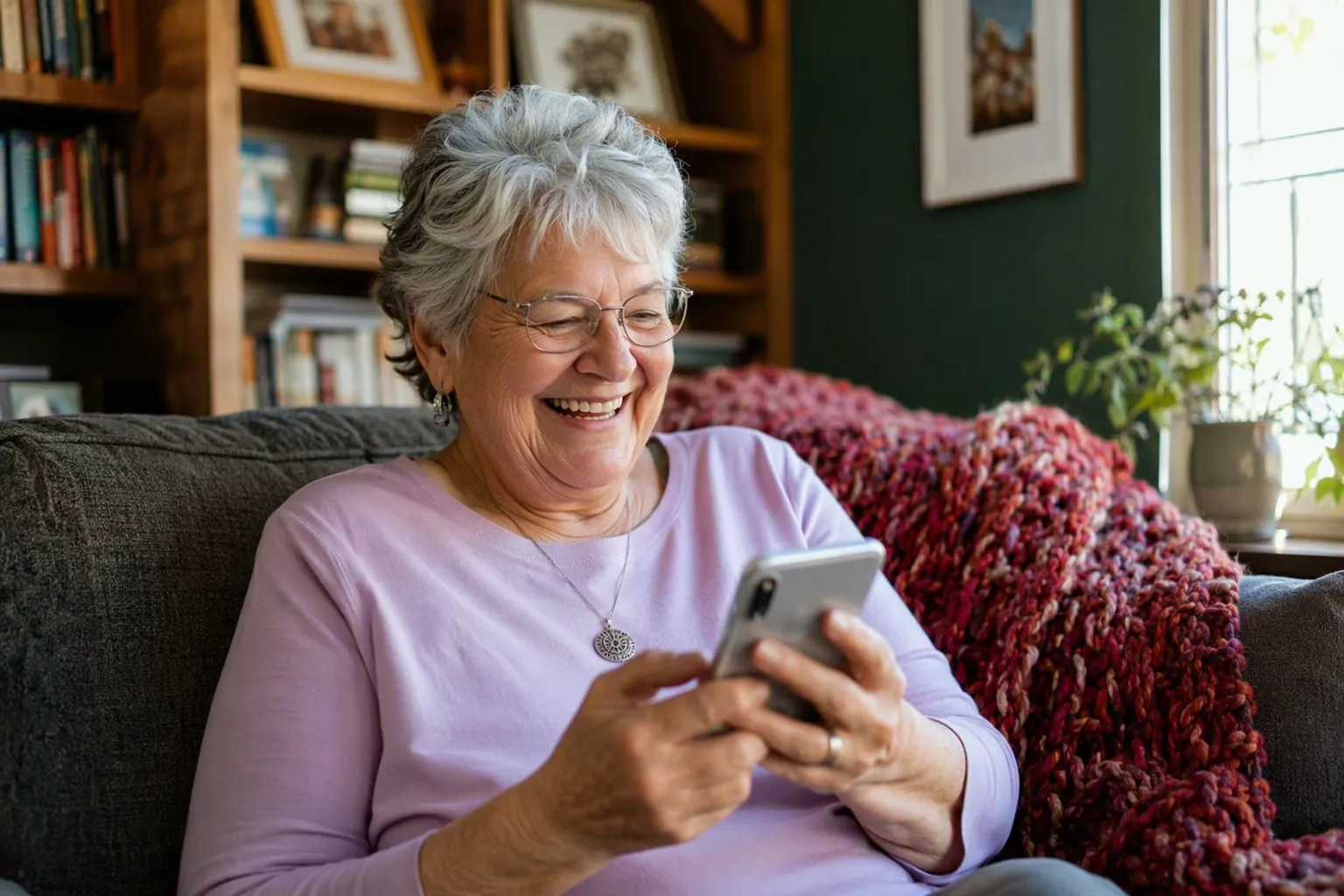
That distinction matters for caregivers because the private worry is rarely just “too much TikTok.” It is usually something larger: Is she lonely? Is she being drawn into scams? Is she losing her daily rhythm? Is this replacing real life? Those are fair questions. They are also different questions from whether older adults are allowed to enjoy unserious things online.
The clip is not the whole story
There is no single definitive “70 year old woman reacts to viral video” clip. The phrase points to a broader pattern: older women watching, judging, laughing at, explaining, parodying, or responding to the same online culture their children and grandchildren see. Sometimes the older adult is the viewer. Sometimes she becomes the subject. Sometimes she becomes the creator.
That last version is the most interesting one. SJ Mendelson, known online as Bubbie SJ, was 73 when a TikTok video of her listing candid “reasons I love being old” drew nearly 1 million views, according to Newsweek. She told the outlet that people messaged her saying, “I'm getting older, now I'm not so upset.”[1]

That is a better example than another lecture about limiting screen time because it shows the exchange clearly. An older woman did not merely absorb a platform built by younger people. She used it to reframe aging in public. Younger viewers did not only watch her as a novelty. Some wrote back as people who felt less afraid of becoming old themselves.
The same bridge has been visible in a more produced form in the Elders React videos from Fine Brothers Entertainment. In one analysis of seniors reacting to viral internet culture, including videos such as Nyan Cat, ChangingAging described the format as “genius for bridging the generational divide.”[2] The point is not that every clip is profound. It is that shared reaction gives families and strangers a way to meet without pretending everyone grew up in the same world.
What reaction videos ask the brain to do
A viral video often arrives with no helpful introduction. A dance trend, a prank, a pet clip, a strange cooking shortcut, a grandchild's meme, a political joke, a song from a different decade remixed into something unrecognizable: the older viewer has to orient herself quickly. What am I seeing? Is this sincere? Is it supposed to be funny? Why are people sharing it?
That small act of orientation is cognitive work. It uses attention, memory, emotional reading, comparison, and flexible interpretation. It is not the same as a prescribed brain exercise, and the available research does not prove that reacting to viral videos prevents cognitive decline. But it is also not nothing. It asks an older adult to keep processing novelty instead of only revisiting familiar material.
Research on older adults and TikTok supports the idea that some older users are acting with purpose. Ng and Indran's 2022 article in The Gerontologist describes older adults using TikTok to consciously reframe aging, which is very different from the assumption that they are merely being swept along by an app.[3]
There is also evidence that the tone of online portrayals matters. A PLOS ONE analysis of TikTok videos about older adults found that content portraying older adults as “warm” was 43% less likely to carry negative age stereotypes.[4] That does not make every warm clip harmless or every reaction video respectful. It does suggest that humanizing older adults online can change the frame in which aging is seen.
For a family caregiver, this is the first practical shift: do not judge the habit only by the platform. Watch the behavior. A mother who laughs, pauses, rewatches, asks what a phrase means, says “send this to your brother,” or argues that the young people in the video have no sense is not mentally absent. She is participating.
Why sharing a silly clip can count as connection
Families often try to manufacture connection with older parents through dutiful questions. How was your day? Did you eat? Did you take your medication? Those questions may be necessary, but they can make every conversation feel like a check-in from management.
A video changes the entry point. Now there is an object in the middle of the conversation. She can send something without announcing that she is lonely. You can answer without sounding like you are monitoring her. A grandchild can reply with a laughing emoji, a correction, or another clip. The exchange may be small, but small is not worthless when the alternative is silence.
This is where online behavior starts to matter for aging at home. Social connection is not a decorative extra. CDC's STEADI fall-prevention framework identifies social isolation as a modifiable fall-risk factor.[5] That does not mean TikTok prevents falls. It means a caregiver should not treat social participation as separate from physical safety.
The bridge is indirect but worth taking seriously: connection can support mood, confidence, daily structure, and willingness to stay engaged with other people. Those are the same conditions that make it easier to keep up with appointments, movement, home routines, and the many unglamorous tasks that protect independence. If you are already working through a fall prevention pathway, the social side belongs in the conversation along with rugs, lighting, footwear, medication review, and strength.
Generativity is not just giving advice at Thanksgiving
Older adults are often talked about online as recipients: recipients of care, advice, warnings, scams, services, reminders. Bubbie SJ's video is useful because it reverses that direction. She offered a way to think about old age, and people younger than her received it as reassurance.[1]
That kind of exchange is generativity: the feeling that one's experience can still be useful to someone else. It does not have to look solemn. It may come through a joke, a blunt comment, a reaction to a trend, or a story that starts because a clip reminded her of “how people used to do it.”
This is one reason I am wary of approving only the kinds of activities that look therapeutic from across the room. A crossword puzzle is respectable. A chair exercise video is respectable. A viral clip of a grandmother telling younger people why getting old is not the disaster they imagine may be doing a different kind of work. It lets an older woman be seen as a person with a viewpoint, not only as a person with needs.
The health link is real, but it is not magic
The strongest case for taking viral video habits seriously is not that one app or one trend is good for older adults. The case is that certain forms of digital engagement overlap with known supports for aging well: social contact, confidence, activity, mood, and cognitive stimulation.
A 2025 Frontiers in Psychology study linked social media use with physical activity in older adults through pathways involving social capital and self-efficacy.[6] That is not the same as saying watching videos makes someone exercise. It does suggest that digital interaction can sit inside a larger pattern of active aging when it builds confidence and social resources.
Research on internet use and older adults' mental health has also connected internet use with reduced depression and improved cognition in older adults.[7] Again, the careful reading matters: internet use is a broad category, and the benefit depends on what the person is doing, how it affects mood, and whether it supports or replaces life outside the screen.
| What she is doing | Why it may matter | What to watch |
|---|---|---|
| Laughing, commenting, asking what something means | Processing novelty, humor, tone, and social cues | Confusion that becomes distress rather than curiosity |
| Forwarding clips to family or friends | Creating low-pressure contact and shared references | Sending only alarming, manipulative, or scam-like content |
| Posting her own reaction or perspective | Practicing confidence, identity, and generativity | Oversharing personal details or attracting unsafe contact |
| Following creators who make her feel capable or included | Supporting mood and self-efficacy | Content that increases fear, shame, or helplessness |
The useful question is not “Is screen time good or bad?” It is whether this particular screen time leaves her more connected, more animated, more informed, and more willing to participate in daily life.
Where fall prevention enters the picture
It would be too neat to say that a 70-year-old woman who reacts to viral videos is lowering her fall risk. The research does not prove that. A video habit does not replace balance work, medication review, vision care, safer flooring, good lighting, or a properly fitted mobility aid.
But independence at home is held together by more than grab bars. A person who is isolated, discouraged, or disconnected from ordinary conversation may be harder to motivate, harder to monitor, and less likely to speak up early when something changes. A person who is regularly communicating, even through silly clips, gives the family more openings to notice mood, energy, speech, confusion, pain, and confidence.
That is why digital connection belongs near, not instead of, practical home safety. If your mother is using a tablet or phone for video calls, clips, and family chats, make the setup physically sensible: good lighting, a stable chair, a reachable charger, a surface that does not require twisting, and no cord stretched across a walkway. A home modification checklist should include the places where she actually spends time, not only the bathroom and stairs.
If she watches from a recliner, kitchen table, or bedside chair, notice whether she can stand safely after sitting awhile. If she needs a cane, walker, or better seating arrangement to move comfortably between her favorite spot and the rest of the house, that belongs in the same practical category as mobility-independence decisions, not in a separate box labeled “phone habit.”
When the habit deserves concern
Caregivers are not wrong to be alert. Older adults can be targeted by online fraud. Algorithms can feed fear and outrage. A person can appear socially active while becoming more isolated offline. A mother can say she is “just watching a few videos” while losing sleep, skipping meals, or sitting for long stretches that leave her stiff and unsteady.
The warning signs are usually behavioral, not aesthetic. The fact that you find a clip silly is not evidence of harm. The fact that she becomes frightened, secretive, financially pressured, sleep-deprived, or harder to engage is evidence that something needs attention.
- Treat it as healthy engagement when she laughs, explains, debates, shares with known people, asks questions, or uses clips to start conversations.
- Look closer when she is repeatedly upset by what she watches, believes alarming claims without checking, or becomes more fearful of leaving home.
- Intervene promptly if anyone online asks for money, gift cards, banking details, medical information, passwords, or secrecy.
- Notice whether screen time is replacing meals, medications, sleep, movement, appointments, hobbies, or in-person contact.
- Check whether her viewing spot creates physical risk: poor lighting, loose cords, an unstable chair, or a phone that makes her walk while distracted.
The conversation goes better if it starts with curiosity rather than confiscation. “Show me the one you were laughing at” will usually tell you more than “You've been on that thing all day.” You can learn what she is watching, whether she understands the platform, whether she is being contacted by strangers, and whether the habit is opening or closing her world.
How to respond without making it a fight
A caregiver does not need to become fluent in every meme. You do need enough familiarity to know whether your mother's digital life is nourishing, neutral, or risky. Sit with her for a few minutes. Ask who sent the clip. Ask why she liked it. Ask whether she wants help sending it to someone. If she posts, ask what kinds of comments she receives.
Then make the safer choice the easier choice. Help her adjust privacy settings. Turn on multifactor authentication where she can manage it. Agree that no one legitimate will ask her to buy gift cards or keep a financial request secret. Put important family contacts where she can reach them quickly. If she likes watching from one spot, make that spot safer rather than pretending she will stop sitting there.
It is also reasonable to build in movement without turning every pleasure into therapy. After a few videos, she can stand, refill water, walk to the window, or do the exercises her clinician already recommended. If she uses equipment, review whether the chair, table height, and walking path work with her cane, walker, or rollator; mobility equipment comparisons are only useful if they match the places where daily life actually happens.
If a 70-year-old woman's viral video habit leads her to laugh, comment, share, ask questions, reminisce, debate, or stay connected, treat it as one small support for aging in place. If it makes her fearful, isolated, exploited, sedentary in a harmful way, or harder to engage offline, treat it as a care issue. The phone is not the diagnosis. The pattern is.
References
- Elderly Woman Lists Candid Reasons Why She Loves Being Old, Newsweek
- Elders React To Viral Videos Bridges Generational Gap, ChangingAging
- Not Too Old for TikTok: How Older Adults Are Reframing Aging, The Gerontologist, 2022
- Videos about older adults on TikTok, PLOS ONE
- About STEADI, Centers for Disease Control and Prevention
- Digital interaction and active aging: the impact of social media use on physical activity in older adults, Frontiers in Psychology, 2025
- The impact of Internet use on older adults' mental health, International Journal of Environmental Research and Public Health
Questions to bring to a clinician or OT
This is not medical, legal, or a family's final decision — only a framework. Bring these questions to a clinician, occupational therapist, or your local Area Agency on Aging.
Find Local HelpRelated reading
Noticed something outdated or inaccurate on this page? Flag a correction. We review every report against CDC, NIA, and AARP HomeFit guidance before updating a page.