
Caregiver decision guide
Signs Your Elderly Parent May Need to Step Back from Responsibilities
Unsure if your aging parent is struggling with daily tasks? This guide lists concrete warning signs across eight life domains—mobility, medication, hygiene, home management, nutrition, finances, driving, and social engagement—and explains when a pattern of changes means it's time to consider handing over responsibilities.
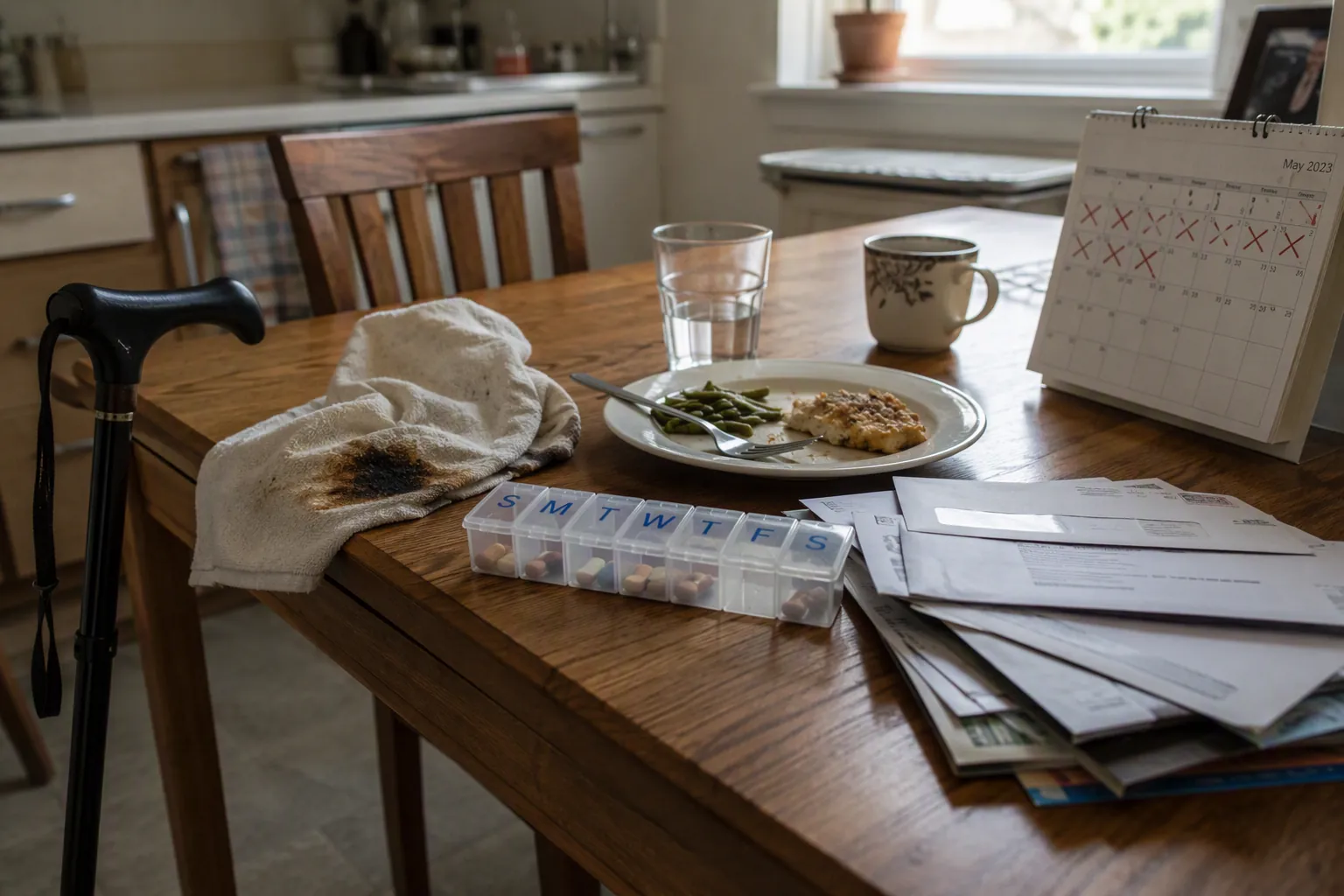
The visit does not have to begin with an emergency. More often, it begins with a table that looks wrong: mail stacked where it used to be sorted, a pill organizer with yesterday’s dose still inside, less real food in the refrigerator, and a parent who reaches for the counter before crossing the kitchen. Any one of those things can have a harmless explanation. Together, repeated across visits, they are the signs an elderly parent may need to step back from responsibilities.
The useful question is not whether your parent can still perform a task once, on a good day, with effort. It is whether they can do it reliably, safely, and without quiet workarounds that hide the strain. A missed bill, a burned pan, or a skipped shower may be a one-off. A pattern across mobility, medication, hygiene, home management, nutrition, finances, driving, and social connection deserves a plan.
The Pattern Matters More Than One Bad Day
Families often wait for one undeniable event: a fall, a car crash, a hospitalization, a shutoff notice. That is understandable, but it is also how preventable problems become decisions made under pressure. Earlier intervention usually starts with smaller evidence: the same prescription confusion twice, the same spoiled food on two visits, the same hesitation at the stairs, the same stack of unopened envelopes.
A practical threshold is this: if warning signs appear in more than one life domain, or if one domain carries immediate safety risk, observation should turn into action. Action does not automatically mean moving a parent, taking over everything, or treating them as incapable. It means documenting what changed, asking directly but respectfully, and shifting the riskiest responsibilities before a crisis does it for you.
| Domain | Concrete signs to notice | When it becomes an intervention issue |
|---|---|---|
| Mobility | Shuffling, furniture-walking, fear before stairs, fewer outings, new bruises | When balance changes repeat, the parent avoids normal routes, or walking looks unsafe |
| Medication | Missed doses, double doses, old bottles mixed with new ones, vague explanations | Immediately if high-risk drugs are involved or the pill routine cannot be reconstructed |
| Hygiene | Body odor, unchanged clothes, neglected hair, avoiding showers | When bathing, toileting, or dressing is being skipped because of fear, pain, memory, or depression |
| Home management | Burned cookware, gas left on, electrical hazards, cluttered walkways, spoiled trash | Immediately for fire, gas, electrical, or fall hazards |
| Nutrition | Spoiled food, little fresh food, weight loss, uneaten prepared meals | When the fridge no longer matches what the parent says they are eating |
| Finances | Unpaid bills, unopened mail, duplicate payments, unusual confusion about accounts | When mail avoidance or errors repeat, especially alongside memory or medication issues |
| Driving | New dents, getting lost, close calls, traffic tickets, fear from passengers | When unsafe behaviors are observed by others or the parent cannot self-correct |
| Social engagement | Withdrawal, canceled routines, loss of interest, fewer calls, staying home | When isolation is new, persistent, or paired with mood, memory, mobility, or grief changes |
Mobility: Do Not Shrug Off the New Hand on the Wall
Mobility changes are easy to excuse because they often look ordinary at first. A parent holds the counter while walking. They stop using the basement stairs. They say the grocery store is “too much trouble.” They move slower in the hallway and laugh it off. But these are not just style changes in how someone gets around.
The CDC’s STEADI fall-prevention materials report that more than 1 in 4 older adults falls each year, and that more than 41,000 older adults die from falls annually, or 112 deaths per day.[1] Those numbers do not mean every cautious step predicts a fall. They do mean that shuffling, furniture-walking, fear-of-falling hesitation, new bruises, or avoiding normal movement deserve attention before the first serious injury.

There is an important caution here: significant mobility loss should not be treated as an inevitable part of aging. HealthInAging.org’s caregiver guide says significant loss of mobility is not a normal part of aging and is often reversible with appropriate care.[2] That changes the tone of the conversation. The point is not “You are declining, so give up.” The point is “Something changed, and it needs assessment.”
The threshold for stepping back from responsibilities comes when mobility problems make the responsibility unsafe. A parent who can still cook but has to carry hot pans while gripping furniture may need help with meals. A parent who manages laundry only by bracing on basement stairs may need the laundry moved or handled by someone else. If stairs are the pressure point, compare realistic options such as rails, ramps, room changes, or a stair lift rather than assuming one solution fits every house; a practical next read is this stair lift vs. alternatives guide.
Medication: The Fastest Place to Stop Guessing
Medication mistakes are not the place to wait and see, especially when blood pressure drugs, blood thinners, insulin, sedatives, or several prescriptions are involved. A Place for Mom notes that medication mismanagement involving blood pressure or blood-thinning drugs can have life-threatening consequences within hours.[3] That is why a half-full Tuesday compartment on Wednesday morning is not just a household detail.
Look for missed doses, double doses, pills placed back in the wrong bottle, expired prescriptions still in use, new confusion after a medication change, or a parent who cannot explain what a medication is for. Also notice the story around the mistake. “I skipped it because I felt fine,” “I think the doctor stopped that one,” and “The pharmacy messed it up” may each be true once. Repeated vagueness means the system is no longer reliable.
Intervention can be narrow at first. Reconcile the medication list with the prescriber or pharmacist. Remove discontinued bottles. Set up a weekly pill organizer only if someone can verify it is filled correctly. Ask whether side effects, cost, vision problems, or hand pain are part of the issue. If nobody can reconstruct what was taken in the last day or two, especially with high-risk drugs, call the clinician or pharmacist rather than trying to solve it from memory.
Home Management: Burn Marks, Gas, Wires, and Walkways
A messy house after illness, grief, or a busy week is not the same thing as an unsafe house. The signs that change the urgency are hazards with consequences: burned pots, scorch marks on towels, a gas burner left on, overloaded outlets, frayed cords, space heaters used carelessly, cluttered walking paths, loose rugs, or spoiled trash that has not been taken out.
TheKey’s home-care checklist identifies safety hazards such as burned pots, gas appliances left on, and electrical issues as immediate intervention thresholds.[4] Age Safe America’s home-safety materials similarly focus attention on hazards that affect whether an older adult is safe living alone.[5] This is where “respecting independence” has to include the neighbor, the apartment building, and the parent who may be asleep when the smoke alarm goes off.
The first response should match the danger. Gas left on is not a note on the fridge; it is a change in how cooking happens. Burned cookware may mean meals need supervision, appliance shutoff devices, simpler food routines, or someone else preparing hot meals. Electrical hazards and blocked walkways call for immediate removal or repair, not a promise to “be more careful.” For bathrooms, where hygiene and fall risk often collide, properly placed supports matter more than decorative safety products; this grab bars installation guide can help you think through placement and use.
Driving: Independence Is Not the Only Person in the Car
Driving is one of the hardest responsibilities to discuss because it carries identity, routine, pride, and access to the outside world. It also carries public risk. The question is not whether your parent has driven safely for decades. It is whether current driving behavior is still safe enough for the parent, passengers, pedestrians, and other drivers.
HealthInAging.org’s driving tip sheet lists observable warning behaviors families can use when discussing whether it is time to stop driving, including getting lost, having close calls, receiving traffic tickets, driving too slowly or too fast, becoming confused at exits, reacting slowly, drifting between lanes, hitting curbs, and having new dents or scrapes on the car.[6] A single scrape has many possible explanations. New dents plus getting lost plus a passenger feeling frightened is a different matter.
Do not make the driving conversation depend only on diagnosis. Some people with medical problems drive safely for a time; some people without a clear diagnosis no longer do. Collect specifics: where they got lost, what the passenger saw, whether there were tickets, whether the car has damage, whether night driving or left turns are the problem. Then shift the specific responsibility. That may mean no night driving, no highway driving, a formal driving evaluation, arranged rides, delivery services, or handing over the keys if unsafe behaviors continue.
Nutrition: The Refrigerator Often Tells a More Honest Story
Nutrition problems can hide behind polite answers. “I’m eating fine” may sit next to sour milk, expired leftovers, unopened meal deliveries, or a freezer full of food that never becomes dinner. TheKey flags spoiled food in the refrigerator and significant weight loss as under-recognized red flags because they can cut across several domains at once.[4]
Spoiled food may mean poor vision, low energy, depression, memory change, loss of smell, pain while standing, or fear of going to the store. Weight loss may reflect medical illness, dental problems, medication side effects, grief, or the simple fact that cooking for one has become too much work. The intervention threshold is reached when the visible food supply no longer matches the stated routine, when weight loss is noticeable, or when prepared food repeatedly goes uneaten.
Start by reducing the number of steps between hunger and a safe meal. That may mean grocery delivery, prepared meals, easier packaging, shared meals, a stool for food prep, or someone checking the fridge weekly. If weight loss, swallowing problems, vomiting, diarrhea, or appetite loss are present, raise it with a clinician rather than treating it only as a shopping problem.
Finances and Mail: Paper Piles Can Be Cognitive Clues
Unopened mail has a way of looking like clutter until a late notice appears. Then the pile becomes evidence. AgingCare notes that unpaid bills and unopened mail often indicate cognitive changes that can also affect medication and driving safety.[7] The point is not that every missed payment means dementia. The point is that money management is a complex task, and repeated failures can reveal changes before a parent admits anything is wrong.
Look for duplicate payments, utilities close to shutoff, charitable solicitations with checks written to many organizations, confusion about bank calls, bounced payments, tax notices, or a parent who becomes unusually defensive when mail is mentioned. Shame often arrives before disclosure. A parent may hide the pile because they are embarrassed, not because they are careless.
The narrowest useful step may be enough at first: permission to sort mail together, automatic payments for essentials, alerts from the bank, a trusted contact on accounts, or a durable power of attorney prepared before it is urgently needed. If financial confusion appears alongside medication mistakes or unsafe driving, treat it as a broader functioning signal, not an isolated bookkeeping issue.
Hygiene: Ask What Makes the Task Hard
Hygiene changes are easy to personalize. Families may read body odor, dirty clothes, unwashed hair, or skipped showers as stubbornness or loss of pride. Sometimes the reason is more practical: the tub is frightening, the shower floor feels slippery, arthritis makes buttons painful, depression has flattened motivation, dementia has changed sequencing, or pain makes standing long enough impossible.
The intervention threshold is not perfection. It is when bathing, toileting, dressing, oral care, or laundry is being skipped often enough to affect health, dignity, skin condition, odor, infection risk, or social life. If bathing is the flashpoint, especially when memory changes are present, the problem may be fear, sensory discomfort, modesty, or not understanding the sequence anymore. This guide to why a parent with dementia may resist bathing can help separate refusal from the barriers underneath it.
A respectful first step is to change the task before taking over the person. Add a shower chair, install grab bars, switch to easier clothing, arrange laundry help, warm the bathroom before bathing, or ask whether pain is making the routine impossible. If the change is sudden, medical review matters; infection, medication effects, pain, or mood changes can show up first as self-neglect.
Social Withdrawal: It May Not Be “Just Getting Older”
A parent who stops going out may be making a choice. They may also be covering for fear of falling, pain, hearing loss, grief, depression, early dementia, incontinence worries, or the embarrassment of not keeping up. Withdrawal becomes more concerning when it is new, persistent, and paired with other changes: less food, poorer hygiene, missed appointments, sleep changes, memory lapses, or a newly cautious walk.
Depression in older adults is commonly missed because it may show up as physical complaints, low energy, slowed movement, irritability, memory trouble, or withdrawal rather than clearly stated sadness. HelpGuide cites a 2023 global meta-analysis finding that over one-third of older adults have some degree of depressive symptoms, while another pooled meta-analysis found 31.74%, a similar range.[8] Those figures describe symptoms, not proof that any one withdrawn parent is depressed, but they are enough reason not to dismiss withdrawal as personality or age.
The distinction matters because depression and early dementia can overlap. Rapid onset after loss, illness, medication change, or isolation may point toward depression, which is treatable. Slow, progressive change with worsening memory, judgment, language, or daily-task sequencing may raise concern for dementia. Either way, the next step is assessment, not a family verdict from the kitchen table.
How to Turn What You Notice Into a Plan
The strongest conversations begin with specifics. “I’m worried about you” is true, but easy to wave away. “I found two missed blood pressure doses, the gas burner was left on, and you held the wall from the bedroom to the kitchen on both visits this month” is harder to dismiss and less insulting than a vague accusation of decline.
- Document the pattern: dates, what you saw, what your parent said, and whether it repeated.
- Separate immediate hazards from slower concerns: gas, medication errors, unsafe driving, and fall hazards move first.
- Ask about barriers before announcing solutions: pain, fear, cost, vision, grief, side effects, and embarrassment all change the right response.
- Bring concrete examples to a clinician: medication confusion, mobility change, weight loss, mood change, memory trouble, or sudden hygiene decline.
- Shift specific responsibilities before making broad conclusions: cooking, driving, bill paying, medication setup, bathing support, or transportation.
U.S. News’ senior-care guidance emphasizes practical steps when a parent may need more help, including assessing needs, involving the older adult, talking with professionals, and considering care options that fit the situation.[9] That order matters. A parent is more likely to cooperate when the conversation is about a defined risk and a defined support, not a sudden family takeover.
Sometimes the right support is modest: a pill check, a bath aide twice a week, transportation, meal delivery, a home-safety repair, or physical therapy. Sometimes the pattern is wider. If mobility, medication, food, mail, and isolation are all slipping, it may be time to compare broader support models, including companion care, scheduled home care, or alternatives to traditional home care. These guides on a live-in companion for an elderly parent and options instead of home care can help once the immediate safety questions are named.
The line between normal aging and concerning decline is not always sharp. A bad week, a cold, grief, medication changes, or pain can temporarily make someone look less capable than they are. That is why the pattern matters. If warning signs are accumulating across domains, the question is no longer whether your parent is “getting older.” It is which responsibilities need support, transfer, or professional assessment now.
References
- STEADI - Older Adult Fall Prevention, CDC, https://www.cdc.gov/steadi/index.html
- Caregiver Guide: Mobility Problems, HealthInAging.org / American Geriatrics Society, https://www.healthinaging.org/tools-and-tips/caregiver-guide-mobility-problems
- 10 Signs Your Elderly Parent Needs Help, A Place for Mom, https://www.aplaceformom.com/caregiver-resources/articles/parents-need-help
- Warning Signs Aging Parent, TheKey, https://thekey.com/resources/learning-center/warning-signs-aging-parent
- 10 Warning Signs Your Aging Parent May No Longer Be Safe Living Alone, Age Safe America, https://agesafeamerica.com/home-safety-hub/blog/10-warning-signs-your-aging-parent-may-no-longer-be-safe-living-alone/
- Tip Sheet: Discussing When It's Time to Stop Driving, HealthInAging.org / American Geriatrics Society, https://www.healthinaging.org/tools-and-tips/tip-sheet-discussing-when-its-time-stop-driving
- Warning Signs That Elderly Parent Needs Help, AgingCare.com, https://www.agingcare.com/articles/warning-signs-that-elderly-parent-needs-help-138989.htm
- Depression in Older Adults, HelpGuide.org, https://www.helpguide.org/mental-health/depression/depression-in-older-adults
- Identifying the Right Time for Senior Care, U.S. News, https://health.usnews.com/senior-care/caregiving/articles/identifying-the-right-time-for-senior-care
Questions to bring to a clinician or OT
This is not medical, legal, or a family's final decision — only a framework. Bring these questions to a clinician, occupational therapist, or your local Area Agency on Aging.
Find Local HelpRelated reading
Noticed something outdated or inaccurate on this page? Flag a correction. We review every report against CDC, NIA, and AARP HomeFit guidance before updating a page.