
Caregiver decision guide
What Seniors Gain from a Walkable Downtown
This article helps family caregivers and older adults evaluate whether a downtown's walkability truly benefits seniors — improving health, independence, and social connection — or hides outdoor fall hazards. It explains how to audit sidewalks, crosswalks, lighting, and rest stops using proven walk-safety criteria.
After the throw rugs, grab bars, thresholds, and hallway lights have been checked, the next “room” in a fall-prevention plan may be the downtown block where an older parent picks up prescriptions, meets a friend for coffee, visits the library, or walks to an appointment. That block can be part of a good aging-in-place plan. It can also be where the safety checklist quietly stops working.
The benefits of a walkable downtown for seniors are real: routine walking supports physical activity, errands without a ride, familiar social contact, and a sense of choice after driving becomes harder. CDC guidance for older adults points to 150 minutes a week of moderate-intensity aerobic activity as a baseline target, with additional muscle-strengthening and balance activity when possible.[1] A downtown that lets someone fold part of that movement into ordinary life is valuable.
But “walkable” has to mean more than attractive storefronts and a coffee shop within a few blocks. For an older body, the question is whether the path works step by step: pavement, curb ramp, signal time, lighting, resting place, weather maintenance, and the trip home when legs are more tired than they were on the way out.
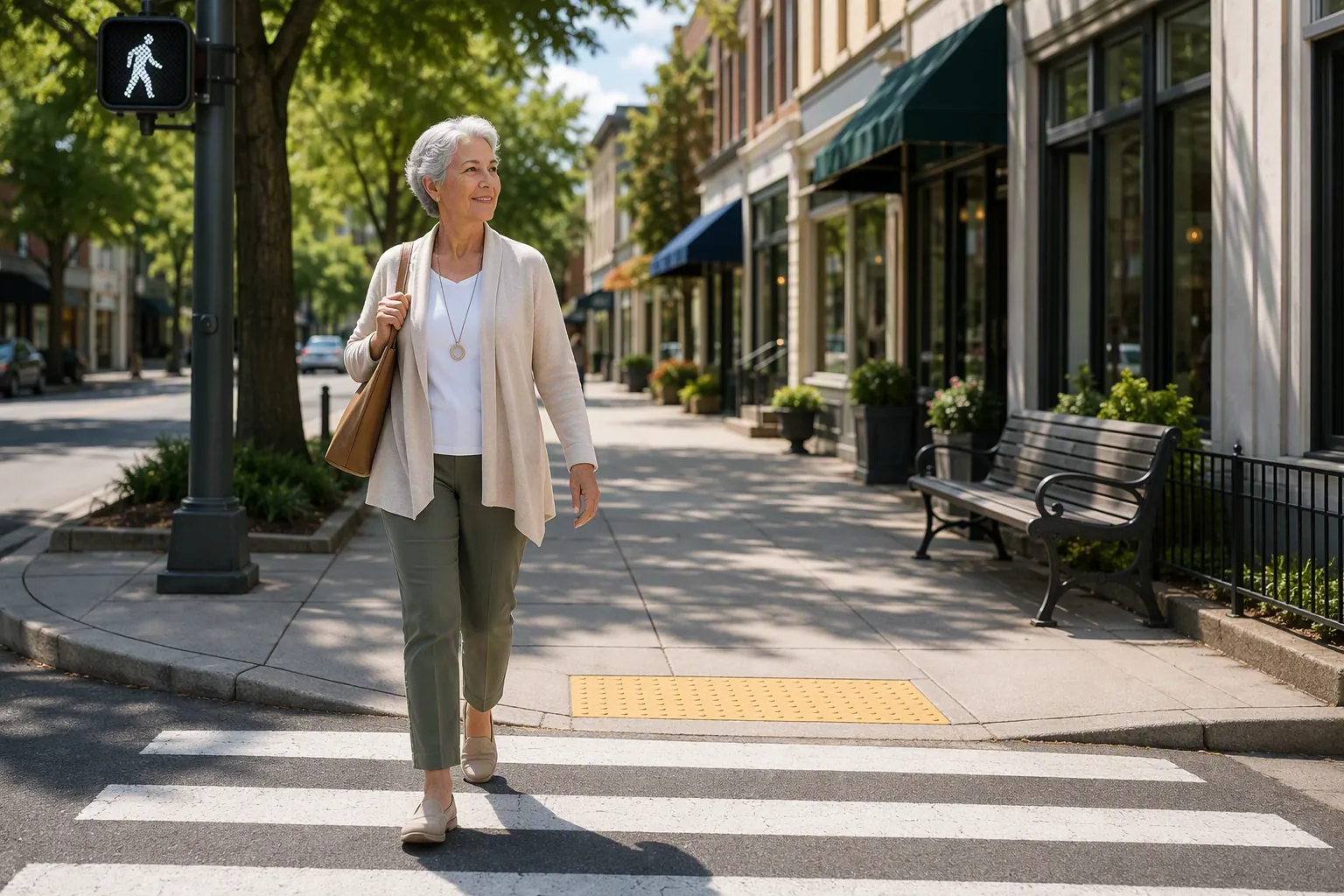
That narrower definition matters because outdoor public space is a major fall setting. A 2026 BMC Public Health Delphi study frames the issue this way: roughly 30% of community-dwelling adults age 65 and older fall each year, nearly half of falls occur outdoors, and about three-quarters of outdoor falls are triggered by environmental factors.[2] Those figures do not make downtown walking a bad idea. They make downtown design and route choice part of the same safety conversation as the bathroom floor.
What a usable downtown gives an older adult
A good walking route can preserve a kind of independence that does not show up on a medical chart. It lets an older adult decide, “I can get there myself.” That may mean a pharmacy trip, a haircut, a library visit, a park bench, worship services, a familiar café, or a short loop that keeps the day from shrinking to the living room.
For family caregivers, this is where the conversation can go wrong. If every concern about sidewalks becomes “Maybe you shouldn’t walk there,” the older adult hears loss of control. If every objection is dismissed as worrying too much, the caregiver sees preventable risk being ignored. A better middle ground is to ask whether the route is senior-usable, not merely nearby.
Senior-usable walking has a practical standard: the person can complete the trip without rushing a crossing, stepping around broken pavement, standing too long without a rest option, navigating dark edges, or being forced into traffic because a sidewalk is blocked. The benefit is not just that the destination is close. The benefit is that the whole trip remains manageable.
Outdoor fall evidence changes what “walkable” should mean
A charming downtown can hide the exact hazards that matter most: uneven slabs, curb lips, faded crosswalks, blocked sightlines, puddled curb ramps, loose gravel, poor contrast, and a signal that assumes everyone crosses at the same pace.
One frequently cited study by Li and colleagues looked at adults age 45 and older in northern California, so its figures should be read as study findings rather than national estimates. Still, the pattern is useful for a downtown audit: outdoor falls were the most recent fall for 58% of fallers; sidewalks, curbs, and streets accounted for 34% of outdoor fall locations; environmental causes precipitated about 73% of outdoor falls; 47.3% occurred while walking; and more than 70% of outdoor fallers landed on a hard surface.[3]
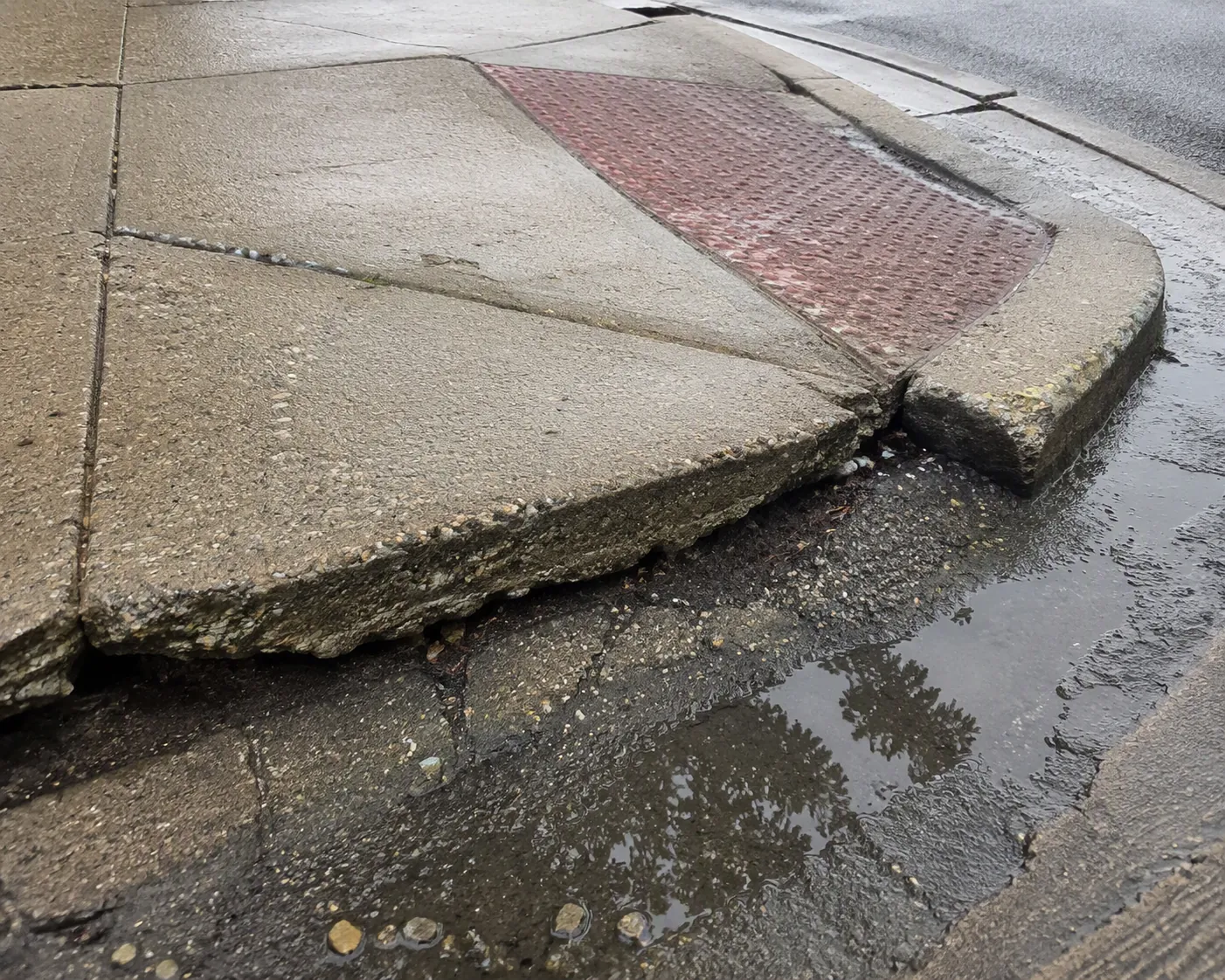
That is the part many walkability conversations skip. A sidewalk fall is not the same as a stumble on carpet. Downtown pavement is unforgiving, and a person may be carrying a bag, watching traffic, adjusting to glare, or using a cane while also trying to keep up with a crossing signal. CDC fall data adds the broader stakes: about 1 in 4 older adults falls each year, about 3 million emergency department visits occur annually for older adult falls, and about 37% of older adult fallers report an injury that required medical treatment or restricted activity for at least one day.[4]
There is another detail worth taking seriously: necessary walking can be riskier than recreational walking. UMass Medical School summarized Li et al. research finding that older adults had twice the fall risk when walking out of necessity compared with recreation, and four times the injury risk from a sidewalk fall compared with a fall in a recreational area.[5] That matters for seniors who are not walking downtown for a pleasant loop on a perfect morning. They may be going because the prescription is ready, the appointment is today, or there is no available ride.
Audit the downtown like an outdoor room
A useful downtown audit does not require a clipboard and a hard hat. It does require walking the actual route at the time it is usually used, at the pace of the older adult who will use it, with the same cane, walker, shoes, shopping bag, glasses, or hearing limitations that are part of real life. If a caregiver walks ahead at their own speed, the audit will miss the problem.
AARP offers a Walk Audit Tool Kit for structured observation, and NHTSA’s older pedestrian safety guidance gives practical reminders for walking safely around traffic.[7][8] For a family decision, the point is not to grade the whole downtown. The point is to decide whether one parent’s route to one or two important destinations is dependable enough to support independence.
| What to check | What makes the route senior-usable |
|---|---|
| Sidewalk surface | Continuous, even, wide enough for the person’s mobility aid, and free of lifted slabs, holes, loose gravel, puddles, and abrupt slope changes |
| Curbs and curb ramps | Curb ramps line up with the crosswalk, have a smooth transition, are not blocked by cars or snow, and do not require a sideways step into traffic |
| Crosswalk timing and visibility | The person can enter, cross, and finish without rushing; drivers can see the pedestrian; markings and signals are clear |
| Lighting and contrast | Sidewalk edges, steps, curb cuts, storefront recesses, and pavement changes are visible in the conditions the person actually uses |
| Traffic exposure | Turning vehicles, parking lot exits, delivery zones, and wide intersections do not force quick decisions or unpredictable movements |
| Rest points | Benches, low walls, indoor stops, or other safe pauses appear before fatigue changes gait or attention |
| Weather maintenance | Leaves, ice, snow, puddles, heat, glare, and drainage problems are handled well enough for ordinary trips, not just sunny-day walks |
| Necessity trips | The route still works when the destination is an errand or appointment, not only when the walk is optional |
Sidewalks: look for the trip hazard before the destination
Start with the surface underfoot. A raised slab that looks minor to a younger adult can be enough to catch a toe, cane tip, or walker wheel. A puddle at a curb ramp may force someone to step around it. A sandwich board, café chair, planter, scooter, or trash bin can narrow the path exactly where balance is already being tested.
Walk the route slowly and watch where the older adult looks. If they have to keep their eyes down the whole time to avoid cracks, they are not also watching turning vehicles, other pedestrians, dogs, bicycles, or changing signals. That divided attention is part of the hazard.
- Mark the exact spots where a foot, cane, or walker wheel catches.
- Notice whether the sidewalk tilts toward the street, driveway, or storefront.
- Check whether the route remains usable when other people are passing.
- Look for places where a mobility aid would require a detour into the curb lane or parking lot.
Curbs and curb ramps: the small transition that decides the trip
A curb ramp is not automatically safe because it exists. It has to be placed where the person needs to cross, meet the street without a jolt, drain well, remain visible, and stay clear of parked cars. The awkward moment is often at the bottom: a lip, puddle, crumbling edge, or patch of sand can turn the crossing into a balance problem before traffic even enters the picture.
For a cane user, the question is whether the cane can find predictable contact. For a walker user, the question is whether the front wheels roll smoothly or stop suddenly. For someone with low vision, the question is whether the ramp, curb edge, and crosswalk direction are readable enough to use without guessing.
Crossings: do not make the senior race the signal
Intersections are where a pleasant walk can become a timed test. The older adult has to judge traffic, step down or roll down a ramp, stay within the crosswalk, manage glare or noise, and reach the opposite curb before drivers get impatient.
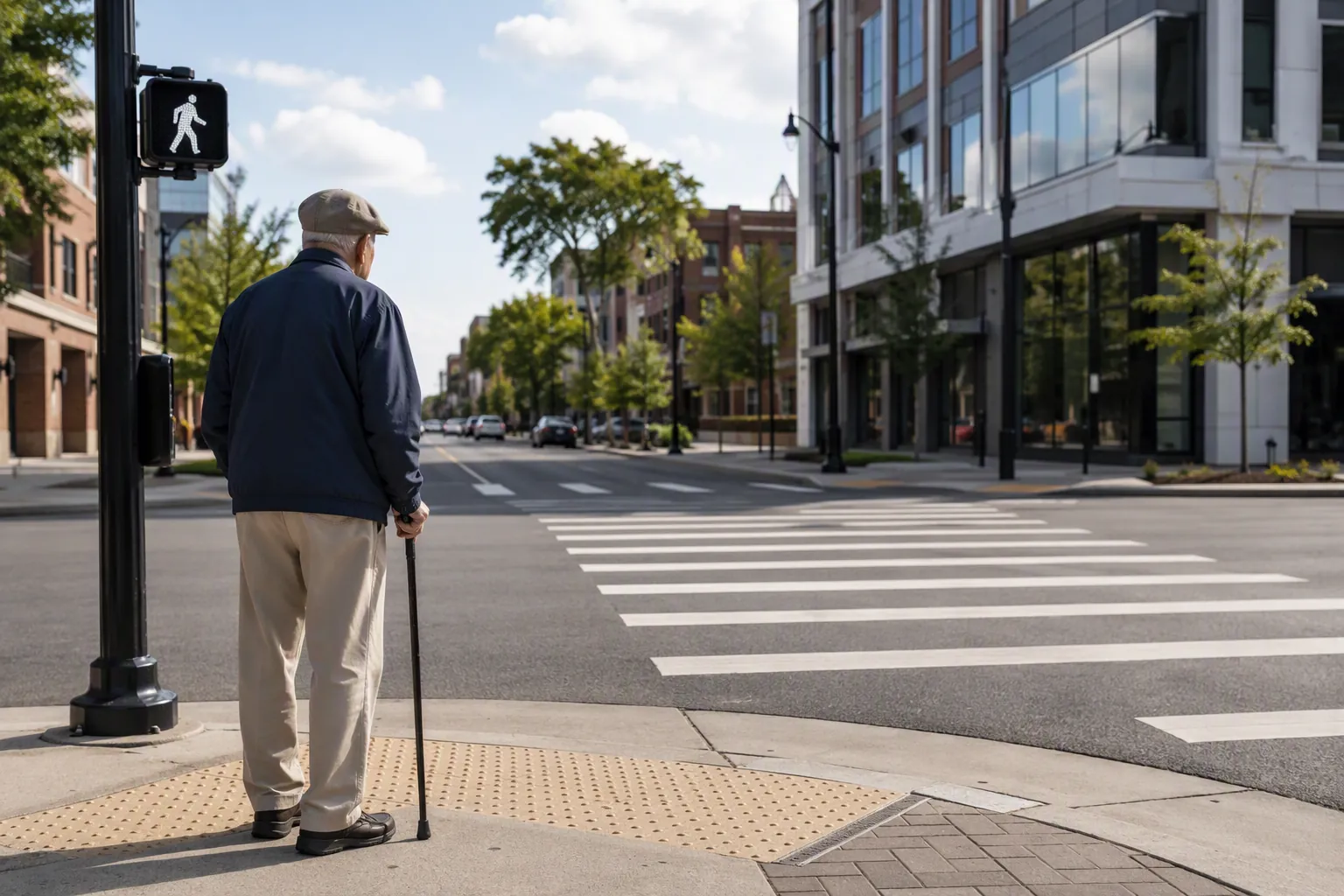
Older pedestrian speed is not a new concern. A 2007 AAA Foundation report found that older pedestrians walked about 0.5 to 0.8 feet per second slower, and that a 3.5 ft/s walking speed accommodated the 15th-percentile older pedestrian while signal timing based on 4 ft/s did not.[6] Because that report is older, families should not treat 3.5 ft/s as the final current standard for every location. Local signal timing and current transportation guidance should be verified. The practical test, however, remains simple: can this person cross this intersection without hurrying?
During the audit, time the crossing only as an observation, not as a contest. Start from where the older adult naturally waits, not from the curb edge if they usually stand farther back. Watch whether they begin only after the walk signal appears, whether they hesitate at the curb ramp, and whether the countdown creates pressure to speed up. If the safe crossing requires a near-jog, it is not a senior-usable crossing for that person.
Lighting, contrast, and storefront edges
Daytime and evening can be two different routes. A sidewalk that looks clear at noon may become confusing when the sun is low, storefront lights create reflections, or a recessed doorway leaves a dark patch at the edge of the path. Contrast matters: curb edges, single steps, brick-to-concrete changes, tree wells, and sloped entries should be visible before the foot is already committed.
If the older adult has cataracts, macular degeneration, glaucoma, bifocals, or trouble adjusting between bright and dim spaces, do not assume a well-lit street is easy to read. Walk the route in the conditions that matter: late afternoon after an appointment, early evening after dinner, or a rainy morning when glare and puddles are both present.
Traffic exposure: the hazards beside the sidewalk
Not every danger is on the walking surface. Downtown routes often pass parking lot exits, alleys, delivery zones, angled parking, curbside pickup areas, and intersections where drivers turn while scanning for other cars. An older pedestrian may be doing everything carefully and still be hard for a driver to notice.
For this part of the audit, stand where the older adult stands. Are drivers looking at the pedestrian path or only at traffic? Does a parked SUV block the sightline? Is the crosswalk set back in a way that makes the pedestrian appear late to turning drivers? Does the older adult need to twist quickly to check over a shoulder? The route may be short and still demand too much rapid scanning.
Benches and restrooms are safety features, not luxuries
Fatigue changes walking. A person who starts with a steady gait may shorten steps, look down more, drag a foot, lean harder on a cane, or make poorer crossing decisions after several blocks. That is why benches, indoor sitting spots, public restrooms, and predictable places to pause belong in the safety audit.
A bench is more useful when it has armrests, shade or weather protection, enough surrounding space for a walker, and a location that does not require stepping onto grass or uneven brick. A restroom is more useful when reaching it does not require stairs, a purchase, a code the older adult does not have, or a long detour. These are ordinary details, but they decide whether the trip stays voluntary or becomes a strain.
Weather maintenance: audit the bad-day version too
The downtown that works in May may not work in February, after leaf fall, during summer heat, or after a hard rain. Drainage at curb ramps, ice at shaded corners, wet leaves near tree wells, snow piled at the end of a crosswalk, and glare from wet pavement can all turn a familiar path into a different route.
This does not mean every trip has to be canceled in imperfect weather. It means the plan should name the conditions that change the decision: “This route is fine when dry,” “Use the north side of the street after rain,” “Call for a ride if the curb ramp is icy,” or “Take the longer route because it has the cleared sidewalk.” Independence improves when the rules are clear before anyone is standing at the door arguing.
Test the trips that actually matter
A recreational stroll is not the same as a necessary errand. The easier audit is a pleasant loop: good weather, no bag, no appointment time, no pressure. The more important audit is the pharmacy route, the clinic entrance, the grocery bag walk, the library block after dusk, or the café trip that includes crossing the busiest street.
Choose one or two destinations that matter most to the older adult and walk those routes in both directions. The return trip matters because fatigue, medication timing, weather, and carried items may be different. A route that works going out may fail coming back if the only bench is on the wrong side of the street or the safer crossing is farther than expected.
- Pharmacy route: Is there a safe place to wait if the prescription is not ready?
- Clinic route: Does the entrance require crossing a driveway, parking lot lane, or uneven threshold?
- Grocery route: Can the older adult manage the sidewalk and crossing while carrying a light bag?
- Social route: Is the path still readable and well lit at the time the person usually returns home?
- Transit or rideshare connection: Is the waiting area safe, seated, visible, and close enough to the destination?
If a route fails, the answer is not always “stop walking.” Sometimes it is a different side of the street, a different crossing, a rest stop built into the trip, a daylight-only rule, a rolling cart instead of hand-carried bags, or a scheduled ride for the one destination that requires too much traffic exposure.
When to bring in clinical judgment
A downtown audit can identify environmental hazards. It cannot diagnose why a person is unsteady, why vision has changed, whether a medication increases dizziness, or whether a cane or walker is fitted correctly. If the route seems reasonable but the older adult is still stumbling, rushing, veering, freezing at curbs, or avoiding walks they used to enjoy, that is a reason to discuss fall risk with appropriate clinicians.
Useful clinical conversations may include balance, strength, vision, footwear, blood pressure changes, medication side effects, foot pain, neuropathy, and mobility aid selection. This article is educational and is not medical advice. Individual fall risk and treatment decisions should be reviewed with qualified health professionals who know the person’s health history.
Connect the downtown route to the aging-in-place plan
Community access belongs beside home safety, social support, transportation, and care planning. If you are already reviewing the home, use the Aging in Place Readiness Audit to place the downtown route inside the larger independence picture. For families still sorting out what aging in place should include, the aging-in-place glossary can help frame the goal as usable independence rather than staying in one building at all costs.
If a fall has already happened, shift from route planning to response. The first questions are medical assessment, injury monitoring, documentation, and follow-up care. The site’s first 72 hours after a parent falls guide and the guide to activating senior health services after a fall are the better path for that situation.
A downtown benefits seniors when it lets them walk for health, errands, and connection without forcing them to gamble on broken surfaces, rushed crossings, darkness, traffic exposure, or fatigue. The goal is not to keep older adults indoors. The goal is to make the outside route worthy of the independence it promises.
References
- Older Adults: Physical Activity Guidelines, Centers for Disease Control and Prevention.
- Falls prevention in outdoor public spaces: results from an interdisciplinary Delphi study, BMC Public Health, 2026.
- Outdoor Falls Among Middle-Aged and Older Adults: A Neglected Public Health Problem, American Journal of Public Health, 2006.
- Facts About Falls, Centers for Disease Control and Prevention.
- Older adults who walk out of necessity at highest risk for outdoor falls, UMass Medical School, 2014.
- Pedestrian Signal Safety for Older Persons, AAA Foundation for Traffic Safety, 2007.
- AARP Walk Audit Tool Kit, AARP.
- Stepping Out as an Older Adult — Be Healthy, Walk Safely, National Highway Traffic Safety Administration.
Questions to bring to a clinician or OT
This is not medical, legal, or a family's final decision — only a framework. Bring these questions to a clinician, occupational therapist, or your local Area Agency on Aging.
Find Local HelpRelated reading
Noticed something outdated or inaccurate on this page? Flag a correction. We review every report against CDC, NIA, and AARP HomeFit guidance before updating a page.