
Caregiver decision guide
The Aging in Place Readiness Audit: A 5-Point Assessment for Family Caregivers
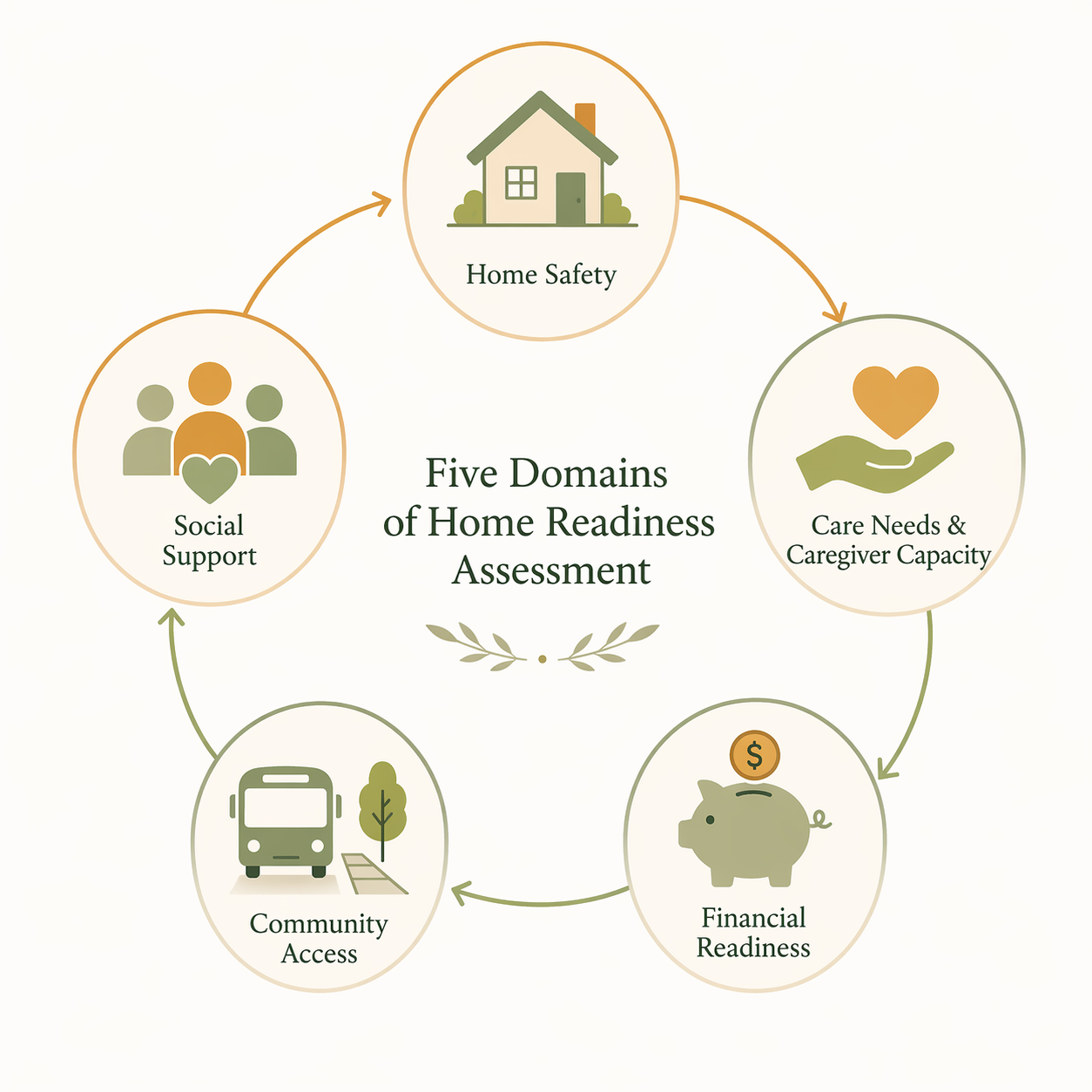
This article provides a structured five-domain audit—home safety, care needs and caregiver capacity, financial readiness, community access, and social support—to help adult children objectively assess whether an older parent can safely age in place and identify what gaps must be closed first.
Sixty percent of older adults without a caregiver say they’d want to stay in their home with help if they could no longer manage alone. Only 37% think it will happen. That 23‑point gap is not a neutral statistic. I read it as a measure of how many families are betting on hope instead of a plan.
I have watched too many families assume Mom can stay home until she falls, or until the person who said “I’ll take care of her” collapses. The real question is not “does she want to stay?”—of course she does. It is: can the home, the caregiver, the money, the neighborhood, and the social network all hold at the same time? That is what a structured readiness audit tries to answer. Below are the five domains that matter.
Home Safety: What You're Missing
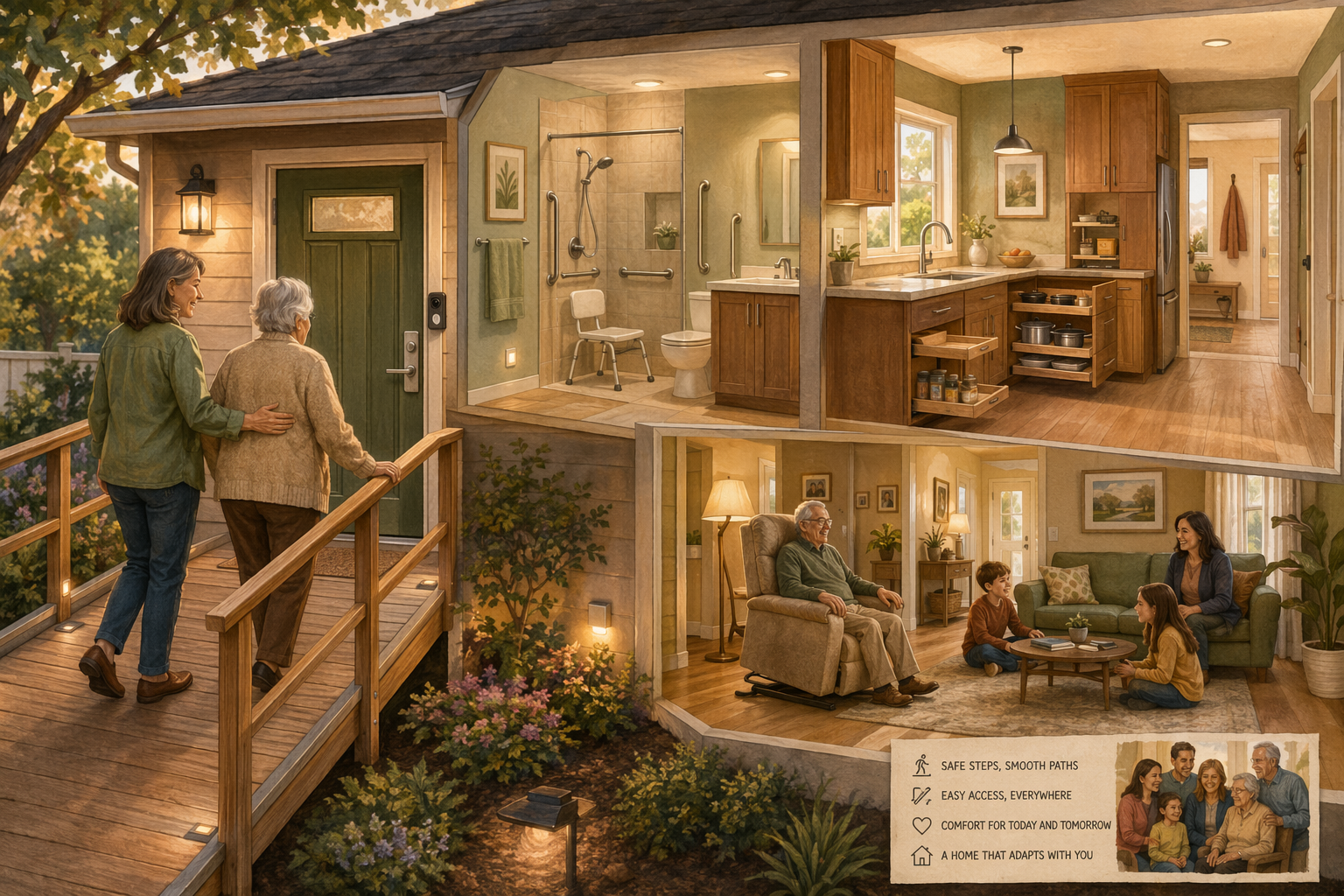
Only one in ten American homes meets basic aging‑readiness criteria: a step‑free entrance, a bedroom and bathroom on the first floor, and at least one bathroom accessibility feature (PMC). The rest were built for people in their 30s and 40s, not for bodies that have been around for seven or eight decades.
Every year one in four older adults falls, and up to two‑thirds of those falls happen inside or just outside the home. Falls cost the healthcare system $80 billion annually—two‑thirds paid by Medicare. A single grab bar in the shower improves the chance of recovering balance by 75 to 76 percent. But most bathrooms do not even have one.
The Caregiver Is the Weakest Link — and It Is Often You
Here is the statistic I cannot stop thinking about. I want it to sit on your chest for a moment: spousal caregivers who report strain are nearly two‑thirds more likely to die within four years than non‑caregivers. That is not a metaphor. That is an epidemiological finding from PMC. The person providing the care may be shortening their own life.
Nationally, 53 million informal caregivers provide an estimated $470 billion in unpaid care every year. Seventy‑eight percent of adults over 55 have at least one chronic condition; a third of people aged 60 to 79 take five or more prescription drugs. That means the average caregiver is not just running errands — they are managing complex medications, monitoring symptoms, and often putting their own health second.
If you are reading this as an adult child, the question is not “can I help a few hours a week?” It is: “can I sustain this for years while working, raising kids, and staying healthy?” If the answer wavers even a little, that is a red flag. Do not dismiss it. The First 30 Days as a Caregiver guide can help you set realistic expectations, but the audit is asking you to face the possibility that you cannot do it alone.
The Financial Numbers You’ve Been Avoiding
Only 21% of adults 65 and older have long‑term care insurance. That means 79% of families will absorb the cost out‑of‑pocket or through Medicare — and Medicare does not pay for custodial care at home.
The national average for adapting a home for aging in place runs $3,000 to $15,000. That buys grab bars, a raised toilet seat, perhaps a ramp. But if your parent needs a stair lift, that’s $2,000 to $5,000 for a straight model; a walk‑in tub runs about $10,000. Those are installation costs only. The real expense is ongoing care: a few hours of home health aide per week can quickly exceed the cost of modifications within a year.
Meanwhile, fall-related healthcare costs $80 billion annually. A single fall that results in a hip fracture can erase the savings from skipping a stair lift. If you are serious about aging in place, you need to look at the full financial picture. Our guide to paying for home modifications covers grants, loans, and tax credits. And the CAPS cost breakdown shows what professional help actually costs.
The Neighborhood and the People in It
A Harvard Health survey of 18,000 people over 50 found something striking: those who perceived their neighborhoods as unsafe were more likely to experience functional decline over ten years and less likely to recover from mobility problems. Perceived safety is not just about fear — it affects whether people go outside, walk to the store, see a doctor.
If the nearest grocery is a fifteen‑minute drive and your parent no longer drives, that house is not “aging in place” — it’s a trap. Walkability, transit access, and proximity to medical care are not bonuses; they are core infrastructure. Rate the neighborhood alongside the grab bars.
More than a third of adults over 45 feel lonely. Among community‑dwelling older adults, 24% are socially isolated. The research ties isolation to higher risks of dementia, stroke, and premature death — comparable in magnitude to smoking fifteen cigarettes a day. A perfectly modified, fully funded, safely located home is still a failure if the person inside has no one to talk to. This domain is the easiest to overlook and one of the hardest to fix. Our guide for older adults living alone offers practical ways to build connection, but the audit question is blunt: is there a social network that will actually show up?
Scoring Your Readiness — Honestly
Rate each domain on a scale of 1 to 5, where 1 is a critical gap and 5 is fully ready. Write down the number. Do not let a high score in one domain cancel out a low score in another.
| Domain | 1 (Critical) | 2 | 3 (Moderate) | 4 | 5 (Ready) |
|---|---|---|---|---|---|
| Home Safety | No step‑free entry; no bedroom or bath on first floor | Single feature present | Step‑free entry + one bathroom mod | Two or more features | Fully modified, no falls in 2 years |
| Caregiver Capacity | Primary caregiver already strained; no backup | Some help but no plan for escalation | Regular help, some respite | Strong network, backup scheduled | Paid care in place, caregiver healthy |
| Financial Readiness | No LTC insurance, no savings for care | Underfunded for basic mods | Mods affordable, but care costs not covered | Mods + some care budget | Full funding for mods and 3+ years of care |
| Community Access | No car, no transit, no nearby services | Limited options | Occasional rides available | Reliable transport + some walkability | Walkable neighborhood with medical and grocery |
| Social Support | Isolated, no regular contact | Phone/family calls only | Weekly visits | Daily contact, group activities | Strong social network, engaged locally |
If your total is under 15 — or if any single domain scores a 1 — you need to close those gaps before proceeding, or consider whether a different arrangement (assisted living, memory care, moving in with family) is safer and more honest.
When the Audit Says ‘Not Yet’ — or ‘Not Here’
A low score is not a personal failure. It is information. The worst outcome is to ignore the audit, proceed on hope, and deal with a crisis at 2 AM. That crisis will cost more — emotionally and financially — than any modification or move.
If the audit reveals a red flag, start by closing the cheapest, fastest gap. Call a CAPS‑certified contractor for a home assessment. Talk to a geriatric care manager. Contact your Area Agency on Aging. And if the honest answer is that aging in place cannot work safely, give yourself permission to switch paths. The goal is not to stay home at any cost. The goal is to keep your parent safe and yourself whole.

The audit is a tool, not a verdict. Denial is the real enemy.
Questions to bring to a clinician or OT
This is not medical, legal, or a family's final decision — only a framework. Bring these questions to a clinician, occupational therapist, or your local Area Agency on Aging.
Find Local HelpRelated reading
Noticed something outdated or inaccurate on this page? Flag a correction. We review every report against CDC, NIA, and AARP HomeFit guidance before updating a page.