
Caregiver decision guide
Weekly Mobility Exercises to Keep Seniors Independent
A weekly plan built on the CDC's activity guidelines for adults 65 and older shows exactly which mobility exercises to do, how often, and at what reps and holds — plus what this routine can realistically preserve for walking ability and daily independence.
The first sign is often ordinary. Getting out of a low chair takes a hand push. The parking lot feels longer than it used to. A short walk with family becomes a quiet negotiation with pace, benches, and pride.
The useful answer is not “stay active.” For mobility exercises for seniors to stay independent, the weekly dose matters: aerobic work for walking endurance, strength work for rising, stairs, carrying, and transfers, and balance practice for steadier movement. The CDC’s activity guidance for adults 65 and older gives the backbone: at least 150 minutes a week of moderate-intensity aerobic activity, muscle-strengthening activity at least 2 days a week, and balance activities such as heel-to-toe walking or standing from a chair; when the full recommendation is not possible, some activity is better than none. [1][2]
That mix reduces risk and protects function. It does not make anyone fall-proof, pain-proof, or immune to medical problems. The point is more practical: keep enough walking capacity and leg strength that everyday tasks do not quietly get handed off to someone else.
The weekly plan at a glance
| Day | Main work | What to do |
|---|---|---|
| Monday | Aerobic + balance | 30-minute moderate walk, or shorter walks that add up; 3–5 minutes of heel-to-toe practice near support |
| Tuesday | Strength | Sit-to-stand, wall or counter push-up, heel raise, step-up or supported stair practice, and carry practice; 8–12 reps per activity |
| Wednesday | Aerobic | 30-minute moderate walk, stationary bike, water walking, or another steady activity |
| Thursday | Balance + optional easy walk | Heel-to-toe walking, side steps, supported single-leg stand, and controlled chair stands |
| Friday | Aerobic | 30-minute moderate walk or equivalent |
| Saturday | Strength + aerobic | Repeat strength work; add a 30-minute walk if this is one of the 5 aerobic days |
| Sunday | Aerobic or rest | Use this day to reach the weekly aerobic total, or rest if the 150 minutes are already done |
The CDC’s standard target is 150 minutes of moderate-intensity aerobic activity a week, often translated as about 30 minutes a day on 5 days, or 75 minutes a week of vigorous-intensity activity. Muscle-strengthening should happen at least 2 days a week, with 8–12 repetitions per activity, at an effort where doing one more repetition would be hard. [1][2]

Walking days: build the capacity to cross the lot, not just log minutes
Walking is the simplest aerobic choice because it matches the task most people are trying to preserve. The goal is not a heroic pace. The goal is repeatable moderate effort across the week: a walk that feels like exercise, stays controlled, and leaves enough in reserve to get home safely.
For someone already walking comfortably, the cleanest schedule is 30 minutes on 5 days. For someone who is deconditioned, that same total can be approached gradually. A first version might be a short walk to the end of the block and back, repeated on several days, with the route extended only after the current distance feels reliable.
- Use a route with a predictable surface before adding hills, curbs, or busy crossings.
- Add minutes before adding speed. A longer steady walk is usually more useful for daily independence than a fast walk that requires a long recovery.
- If 30 minutes at once is too much, split the day into shorter walks and keep the weekly habit alive.
- Use the same route occasionally as a quiet test: if the mailbox, corner, or usual loop starts feeling easier, the plan is doing something that matters.
A cane, walking poles, or a companion does not make the walk count less. The practical question is whether the person can repeat the work safely and often enough to keep walking from shrinking out of the week.
Strength days: protect chair rises, stairs, carrying, and transfers
Strength work is where many independence plans become too vague. “Do some exercises” is not enough. The CDC gives a usable effort rule: choose strengthening activities for the major muscle groups and perform 8–12 repetitions per activity, reaching the point where another repetition would be hard. [2]
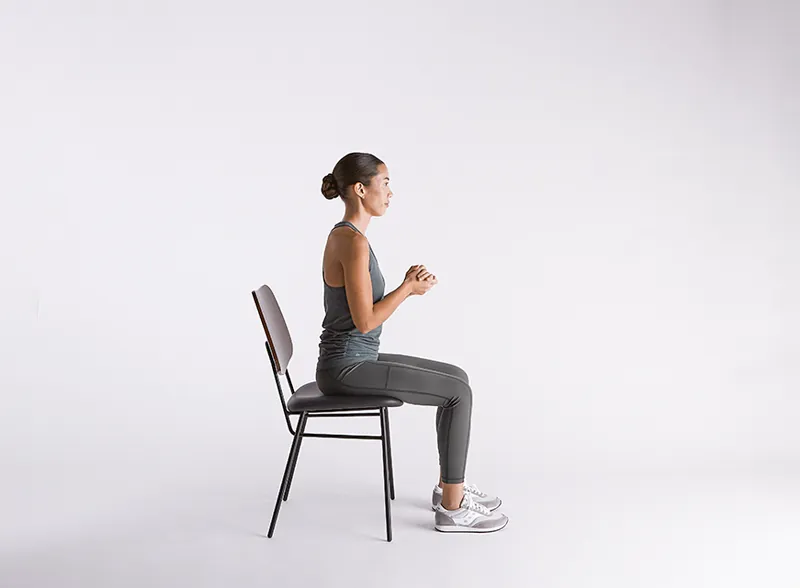
Two strength days a week can be built around a chair, wall, counter, step, and a light household load. Rest a day between harder strength sessions when possible.
| Exercise | Dose | Why it belongs |
|---|---|---|
| Sit-to-stand from a firm chair | 8–12 reps; use hands only as much as needed | Direct practice for getting up from chairs, toilets, car seats, and waiting-room seats |
| Wall or counter push-up | 8–12 reps | Helps with pushing up from surfaces and controlling the upper body during transfers |
| Supported heel raise | 8–12 reps while holding a counter or chair back | Builds lower-leg strength used in walking and stepping |
| Step-up or supported stair practice | 8–12 reps each side if safe; use a rail | Keeps stair and curb ability from becoming a once-a-month surprise |
| Carry practice | 8–12 short carries with a light bag or household object | Matches grocery bags, laundry, and moving objects from one room to another |
The 8–12 repetition range should not become a contest. If 8 clean sit-to-stands are not possible, start with fewer and use the chair arms. If 12 are easy and another repetition would not be hard, progress by using less hand support, slowing the lowering phase, adding a second set, or choosing a slightly lower but still safe chair.
A good strength day does not have to leave someone sore. It should leave clear evidence that the body had to work: the last few repetitions require attention, but posture and control do not fall apart.
Balance practice fits between the bigger pieces
Balance work is not a separate lifestyle. It can be attached to walking days, strength days, or the few minutes before lunch. The CDC names balance activities such as heel-to-toe walking and standing from a chair as examples for older adults. [1][2]
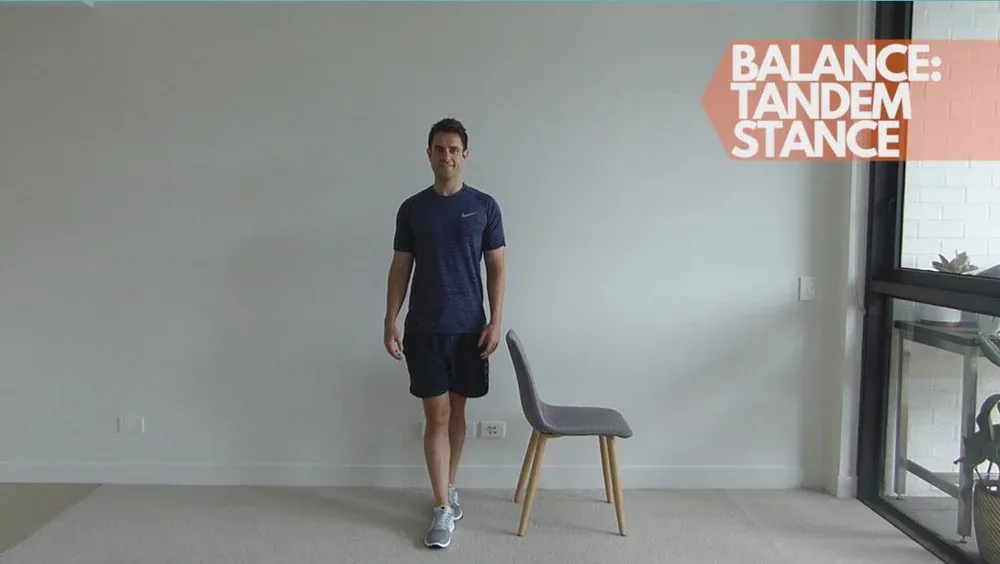
| Balance move | How to do it | Progress only when |
|---|---|---|
| Heel-to-toe walk | Walk near a counter or wall, placing one foot directly in front of the other | The movement stays controlled without grabbing for support |
| Tandem stance | Stand with one foot directly in front of the other, near support | The hold feels steady enough to reduce hand contact |
| Supported single-leg stand | Hold a counter and briefly lift one foot, then switch sides | There is no hip drop, twisting, or panic step |
| Controlled chair stand | Rise from a chair and sit back down slowly | The knees, trunk, and feet stay controlled through the whole motion |
| Side steps at the counter | Step sideways along a counter, then return | The feet clear the floor without shuffling or crossing unexpectedly |
Balance practice should feel attentive, not reckless. The surface should be stable. A counter, heavy table, or hallway wall should be close enough to touch immediately. Reducing hand support is a progression; it is not the starting rule.
If the full CDC target is too much right now
The full week is the target, not the entry fee. The CDC explicitly notes that some physical activity is better than none when older adults cannot meet the recommendations. [1]
A smaller first week should still include the same three ingredients. That matters because walking alone may not rebuild chair-rise strength, and strength alone may not maintain walking endurance.
| Current ability | Reasonable first version | How to progress |
|---|---|---|
| Mostly sedentary but walking safely indoors | Short walks on several days, 1 strength day, and brief balance practice near support | Add one walking day before increasing exercise difficulty |
| Walking outside but tiring quickly | Several moderate walks below 30 minutes, 2 short strength days, balance practice after walks | Add walking minutes gradually until the week approaches the CDC total |
| Can walk 30 minutes but struggles with chairs or stairs | Keep walking schedule; make the 2 strength days nonnegotiable | Progress sit-to-stands and step practice before adding harder balance drills |
| Recent pain, recent fall, or uncertainty about safety | Use clinician or physical therapist guidance before building the plan | Progress only with a safe starting level and clear stop rules |
The smaller version should be written down anyway. A vague intention to “move more” disappears quickly. A visible week with walking days, strength days, and balance minutes gives the adult child something to support without turning every phone call into a reminder.
What the LIFE study adds
The CDC guidance gives the prescription. The LIFE study gives a reality check. In that randomized clinical trial, a structured physical activity program helped protect walking ability and daily-task function in older adults, even though real-world adherence was not perfect. [3]
That is the right kind of evidence for this problem. Independence is not measured only by whether someone completed an elegant routine. It shows up in whether walking remains possible, whether ordinary tasks remain manageable, and whether help is delayed or reduced.
The study should not be stretched into a guarantee. Exercise can reduce mobility decline and support function; it cannot remove every fall risk, medical setback, medication effect, vision problem, or home hazard. The practical conclusion is narrower and still important: structured activity is worth doing because measurable functional protection is possible.
Safety rules that keep the plan usable
A mobility plan should start from current ability, not from what someone thinks they ought to be able to do. Use support early. Choose shoes that do not slide. Keep the first few sessions familiar enough that the person can learn the routine without worrying about the floor, weather, traffic, or equipment.
- Stop the session for chest pain, faintness, severe shortness of breath, sudden weakness, new confusion, or symptoms that feel unusual or alarming.
- Back off if joint pain changes the way the person walks, rises, or places weight through a leg.
- Ask a clinician or physical therapist for a starting level when there has been a recent fall, surgery, new diagnosis, worsening pain, dizziness, or uncertainty about safe movement.
- Do balance exercises where support is immediately reachable, not in the middle of an open room.
- Progress one variable at a time: more minutes, more repetitions, less hand support, or more challenging terrain — not all at once.
A refrigerator version
| Weekly target | What counts |
|---|---|
| Aerobic work | Aim for 150 minutes a week of moderate activity, such as about 30 minutes on 5 days; start below that if needed and build |
| Strength work | At least 2 days a week; 8–12 reps per activity, hard enough that another rep would be difficult |
| Balance work | Several short practices a week using heel-to-toe walking, tandem stance, supported single-leg stand, side steps, or controlled chair stands |
| Progression | Make the current version steady before adding time, reps, speed, load, or less support |
| Standard of success | The routine repeats next week and helps preserve walking, rising, carrying, stairs, and daily tasks |
A smaller plan done consistently is a better start than a perfect plan abandoned by Thursday. The useful measure is whether the week contains walking endurance, real strengthening, and balance practice often enough to keep ordinary independence from narrowing unnoticed.
References
Questions to bring to a clinician or OT
This is not medical, legal, or a family's final decision — only a framework. Bring these questions to a clinician, occupational therapist, or your local Area Agency on Aging.
Find Local HelpRelated reading
Noticed something outdated or inaccurate on this page? Flag a correction. We review every report against CDC, NIA, and AARP HomeFit guidance before updating a page.