
Caregiver decision guide
Alaska Cruise Safety Checklist for Seniors with Mobility
An Alaska cruise is safer for seniors with mobility issues when the key decisions happen before booking: dock vs. tender ports, cabin and equipment fit, health and insurance prep, and a written emergency plan. This phase-by-phase checklist keeps those choices planned rather than improvised.
An Alaska cruise can be a reasonable trip for a senior with mobility issues, but the safety checklist starts before the deposit feels final. The first pass is not “which glacier looks best?” It is: does this sailing dock or tender, does the cabin actually fit the device, are the battery and charging rules workable, has the cruise line received the mobility paperwork on time, and who pays if medical care or evacuation is needed?
That order matters. Once the ship is moving, a crew member can bring a chair, point out an elevator, or help with a gangway. They cannot make a standard cabin doorway wider. They cannot promise every tender will be safe in rough water. They cannot turn a shore excursion bus into a lift-equipped vehicle because a walker user arrived at the curb.
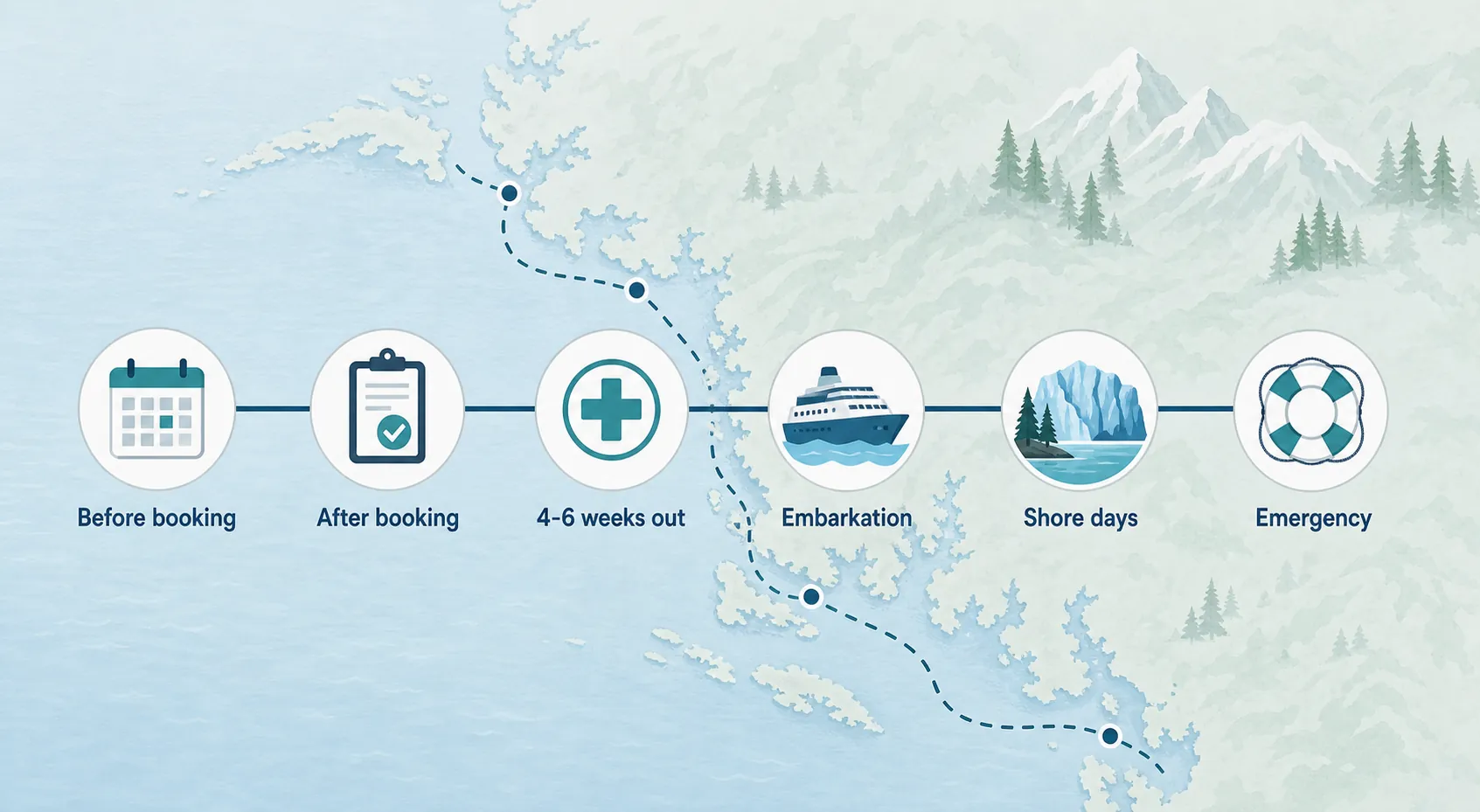
The short version: what to decide at each phase
| Phase | Decisions that belong here |
|---|---|
| Before booking | Confirm dock-versus-tender exposure on the exact itinerary; reserve a genuinely accessible stateroom if needed; check mobility-device width, turning space, storage, charging, and battery rules; review medical and evacuation coverage before the deposit becomes hard to unwind. |
| After booking | Submit the cruise line’s accessibility or mobility forms; reserve rental equipment if not bringing your own; request accessible transfers and shore excursions in writing; save confirmations where the caregiver can find them. |
| 4–6 weeks before travel | Schedule the pre-travel health visit; review medications, vaccines, fall history, seasickness plan, and stamina limits; create a written emergency sheet. |
| Embarkation and onboard | Set up the cabin and bathroom before the first night; avoid stairs when tired; plan elevator routes; watch wet decks, thresholds, low light, and rushed dining or theater exits. |
| Shore days | Reconfirm whether the ship docks or tenders; verify lift-equipped transport, roll-on access, walking distance, restroom access, and the return plan if the senior cannot finish the excursion. |
| Emergency planning | Know who calls the ship medical center, who contacts insurance, who stays with the senior, who manages the device, and what happens if a port or excursion becomes inaccessible. |
Why this checklist starts before booking
The safety background is not imaginary. Among U.S. adults age 65 and older, the CDC reports that more than 1 in 4 fall each year, totaling more than 14 million falls; the age-adjusted fall death rate rose 21% from 2018 to 2024.[1] The National Safety Council reports 43,020 older-adult fall deaths in 2024 and 3.85 million emergency department visits in 2023.[2]
Cruise-specific research is narrower and should be treated that way. In one 2010 single-ship injury study, 663 injuries were recorded, the median victim age was 72, and falls accounted for 44.8% of onboard injuries and 69.4% of injuries ashore; cabins and bathrooms were the most common onboard locations in that study, while streets and buses led ashore, and 3.6% of injuries occurred on tenders.[3] A 2007 case series of 8 significant cruise-ship injuries found that all were falls, with 5 occurring in stairwells.[4] Those are not industry-wide rates. They are useful reminders about the places where a mobility plan tends to fail: transfers, stairs, bathrooms, buses, tenders, and tired walking.
For a caregiver, that translates into a very plain booking rule: if the itinerary, cabin, equipment, medical coverage, and emergency plan cannot be verified before booking, the safer move is to change the sailing, ship, cabin, excursion plan, or timing.
Before booking: verify access where the trip can actually break
A cruise can make Alaska easier because the hotel room moves with you. That convenience is real. It is also why the wrong cabin, the wrong tender port, or the wrong scooter can affect the whole week instead of one afternoon.

Dock versus tender is not a scenic detail
A docked port usually means the passenger leaves by gangway onto a pier. A tender port means the ship anchors offshore and passengers transfer to a smaller boat. For a steady walker, that may be merely inconvenient. For someone using a wheelchair, scooter, rollator, or cane, it can decide whether going ashore is possible at all.
The exact answer is sailing-specific. Royal Caribbean’s accessibility material, for example, explains that tendering depends on the port, the tender, and safety conditions, and it lists Icy Strait Point among tender ports in its assistance material.[9] That does not mean every Alaska sailing behaves the same way. Weather, ship size, port congestion, and the season’s berth assignments can change the practical answer.
- Ask the cruise line or travel advisor for the tender status of each port on the exact sailing, not the generic port page.
- Ask whether the senior may remain seated in the wheelchair or scooter during boarding, or whether a transfer is required.
- Ask whether crew can assist the passenger, the device, or both, and what the line will not do.
- Ask what happens if the sea state makes tendering unsafe for mobility-device users on that day.
- Keep the answer in writing with the booking record.
This is one place where “we’ll help when you get there” is too vague. The person saying it may not be the person at the gangway, and the gangway crew still has to follow the line’s safety rules.
A wheelchair-accessible cabin is not the same as a nearby cabin
The cabin decision should come before the ship, fare, or balcony debate. A standard cabin may be fine for a cane user who can step into the bathroom, turn safely, and park a folded walker. It may be a bad choice for a scooter user who needs to drive through the doorway, turn inside, charge the device, and transfer without climbing over furniture.
Princess, for example, states that mobility devices in standard staterooms must not exceed 22 inches wide, while accessible staterooms accommodate devices up to 31 inches wide; it also says devices must be stored and charged in the stateroom, not in hallways.[5] Princess also lists gel, dry-cell, or lithium batteries as acceptable battery types and says wet-cell batteries are not allowed.[5]
Those numbers are not a universal cruise standard. They are an example of how specific the question has to be. “My mother uses a scooter” is not enough. The booking conversation needs the device width, length, turning radius, battery type, charger needs, and the senior’s transfer ability.
- Measure the device at its widest point, including baskets, armrests, brake handles, and add-ons.
- Confirm whether the cabin doorway width is clear opening width, not just a category description.
- Ask whether the bathroom has a roll-in shower, grab bars, shower seat, raised toilet, and enough transfer space for this person’s stronger side.
- Ask where the device will charge without creating a nighttime trip hazard.
- If the senior cannot safely step over a bathroom threshold at home, do not assume a cruise bathroom will be easier.
Mobility forms have deadlines, and missing them changes the trip
Cruise lines use accessibility forms to plan boarding assistance, stateroom placement, device storage, oxygen, dietary needs, and other accommodations. Princess says its mobility questionnaire is due no later than 60 days before sailing.[6] That deadline is not a courtesy reminder; it is part of the operating plan.
For Alaska cruisetours, the land portion can add another layer. Holland America says mobility equipment on Alaska cruisetours must be no more than 23 inches wide, 40 inches long, and 100 pounds without the battery; coach lifts have a 500-pound limit including the guest, and staff cannot individually lift more than 50 pounds.[7] Its tender and mobility-equipment FAQ also directs guests to review how they will get on and off the ship with mobility equipment.[8]
That kind of limit is not about politeness or customer service. It is about whether the bus lift, tender platform, gangway, and staff-assistance rules match the person and equipment you are bringing.
Bring the device, rent one, or change the trip?
If a senior uses a scooter only for long distances, renting can make sense. If the device is needed for transfers, toileting, or balance every day, switching to unfamiliar equipment at the pier can create its own risk.
AARP advises travelers with mobility challenges to book accessible cabins far ahead, sometimes a year or more in advance, and it notes that cruise-approved rental vendors can deliver mobility equipment to the stateroom.[10] Cruise Critic describes the same basic rental model and notes that ship wheelchairs are generally for emergency use rather than full-trip passenger use; it also gives sample 7-day rental anchors of about $85 for a wheelchair and $185 for a scooter in Miami/Fort Lauderdale markets.[11] Scootaround’s cruise rental page lists, as an example, an approximately $288 8-day transportable scooter rental at Seattle with a 21-inch base width, 42-inch length, 36-inch turning radius, and 325-pound capacity.[12]
Those prices and dimensions are planning anchors, not quotes for a specific Alaska sailing. The useful habit is to treat the rental confirmation as part of the access plan: exact model, dimensions, battery type, delivery location, pickup location, after-hours contact, and what happens if the device is not in the room when boarding begins.
Health, medications, insurance, and evacuation need their own written plan
The medical plan should not be a folder someone thinks is packed somewhere. It should be a one- or two-page document that the senior, caregiver, and travel companion can use under stress.
CDC travel guidance for older adults recommends seeing a healthcare provider 4–6 weeks before travel.[13] For a mobility-limited Alaska cruise, that visit should cover more than routine refills: recent falls, dizziness, blood pressure changes, neuropathy, stamina, pain control, seasickness medication interactions, sleep medications, bathroom urgency, and whether the person can safely manage transfers in an unfamiliar bathroom.
CDC cruise guidance also reminds travelers that cruise ships place people in close contact and that travelers should prepare for health risks before departure.[14] For seniors with mobility issues, illness and mobility are connected. A mild stomach illness can mean urgent bathroom trips on a moving ship. A sedating medication can turn a late dining reservation into a fall risk. A missed diuretic can become swelling that makes shoes or braces harder to use.
Medication planning should assume delays
- Carry medications in original labeled containers when possible.
- Pack extra doses in case of travel delays, missed flights, port changes, or quarantine.
- Keep essential medications, glasses, hearing-aid supplies, chargers, and mobility-device keys in carry-on luggage.
- Ask the clinician which medications increase dizziness, bleeding risk, dehydration, sedation, or bathroom urgency.
- Write down generic names, doses, timing, allergies, and the prescribing clinician’s contact information.
Do not assume Medicare or the ship medical center solves the money problem
Cruise medical care is not the same as being near your regular hospital. Cruise Critic’s senior travel guidance warns that Medicare is generally not accepted on foreign-flagged ships.[15] Cruise Critic’s medical-facilities guide also describes ship medical centers as able to handle many common illnesses and injuries, but not as substitutes for full hospitals.[16]
A 2026 CruiseBooking.com medical-center guide gives directional cost ranges of about $100–$200 for a basic visit, $300–$600 for an after-hours visit, $1,000–$3,000 per day for overnight medical-center care, and $50,000–$100,000 for helicopter evacuation.[17] Those are not guaranteed charges for a particular ship or insurer. They are large enough to justify checking coverage before booking rather than after a fall.
Benefits and claims rules vary by plan, state, country, cruise line, and year. Last verified: August 5, 2026. This section is educational travel-planning information, not financial, insurance, legal, or medical advice. Before paying final fare, call the insurer and ask about foreign-flagged cruise ships, out-of-network shipboard care, ports in Canada, emergency evacuation, preexisting conditions, mobility-device loss or damage, trip interruption, and whether preauthorization is required when communication is limited.
What the emergency sheet should contain
The written emergency plan should be boring enough to use when no one is thinking clearly. Keep one paper copy in the cabin, one with the caregiver, and one digital copy available offline.
- Full name, date of birth, passport information, ship name, sailing dates, cabin number, and booking number.
- Diagnoses, surgeries that affect transfers, fall history, blood thinner use, allergies, baseline cognition, and communication needs.
- Medication list with dose, schedule, purpose, and where the medication is packed.
- Mobility limits: cane, walker, rollator, manual wheelchair, scooter, transfer assistance, maximum walking distance, stair ability, and whether the person can step into a van or tender.
- Device details: model, dimensions, battery type, charger location, rental vendor, after-hours number, and pickup instructions.
- Emergency contacts at home, travel companions, primary clinician, pharmacy, insurer, travel insurance administrator, and credit card assistance line.
- Decision plan: what the caregiver will do if the senior falls, becomes ill, cannot tender, cannot complete an excursion, or needs to leave the ship for care.
If a fall has already happened, use the site’s post-fall guidance rather than this planning checklist: cruise fall safety checklist.
After booking: turn promises into confirmations
After booking is the phase for chasing paperwork, not assuming the reservation record speaks for itself. If an accessible cabin, boarding assistance, rental scooter, accessible transfer, or excursion accommodation matters, it needs a confirmation that names the service, date, port, and passenger.
- Submit the cruise line’s mobility or accessibility form and save the confirmation.
- Send device dimensions and battery type exactly as measured.
- Reserve rental equipment early enough to get the right model, not just whatever remains.
- Ask for accessible pier transfers, hotel shuttles, airport transfers, and land-tour buses in writing.
- Put all access confirmations in one shared folder and print the most important ones.
For a similar plan-ahead structure outside cruising, see the site’s senior travel safety checklist for nonstop flights and river cruise disruption checklist for seniors.
Onboard fall prevention: set up the room before anyone is tired
The first cabin walk-through should happen before dinner, not at 2 a.m. Move luggage out of the path from bed to bathroom. Decide where the walker or scooter parks and charges. Check whether the bathroom floor gets slick, whether the shower seat feels stable, whether the toilet transfer works, and whether a night light or bathroom light can stay on without blinding anyone.
- Use elevators instead of stairs when the senior is tired, rushed, carrying anything, or the ship is moving noticeably.
- Treat pool decks, buffet entrances, spa areas, gangways, and exterior decks as wet-floor zones.
- Use shoes with secure backs and non-slip soles; avoid loose slippers for hallway or bathroom trips.
- Plan routes to dining rooms, theaters, muster areas, and elevators before peak crowds.
- Build rest into scenic days. Alaska views are not improved by arriving exhausted and unsteady.
For a deeper location-by-location fall review, use the site’s cruise fall safety checklist and the companion article on senior cruise fall hazards. This Alaska checklist is deliberately keeping its weight on the decisions that must be made before the ship leaves.
Shore days in Alaska: accessible is still port-by-port
Alaska ports can be wonderfully workable for mobility-limited travelers when the ship docks, transportation is arranged, and the excursion matches the person’s stamina. They can also fall apart at the first shuttle step.
Emerging Horizons describes several accessible Alaska shore options: Sitka’s Halibut Point terminal had level access and a free lift-equipped shuttle in its 2022 report; Juneau options include roll-on access at the Goldbelt Tram and drive-up glacier viewing at Mendenhall; Skagway’s White Pass Railway has lift-equipped cars that should be booked in advance; and Ketchikan’s Lumberjack Show offers level access.[18] Alaska Cruise Hub’s Sitka accessibility page also notes shuttle pre-booking information for 2025/2026.[19]
Those examples are useful, but they are not permission to stop verifying. Ask about the current season, the exact dock, the distance from gangway to shuttle, whether the shuttle has a lift, whether the driver can secure a wheelchair, whether restrooms are accessible, and whether the senior can stay with the device throughout the excursion.
- For Sitka: confirm whether your ship docks or tenders, how the terminal shuttle works that season, and whether accessible shuttle space must be reserved.
- For Juneau: verify roll-on access, queue length, accessible transport to Mendenhall, and the walking or rolling distance at the viewpoint.
- For Skagway: reserve lift-equipped rail cars early and confirm boarding location, companion seating, and restroom expectations.
- For Ketchikan: check level access, seating location, nearby restrooms, rain cover, and walking distance from ship or shuttle.
Route choice can also affect comfort and stability. ALASKA.ORG notes that Vancouver roundtrip Inside Passage routes stay in more protected water, while Seattle departures include open-Pacific days, a distinction that can matter for seasickness and, indirectly, fall risk for someone who becomes dizzy or unsteady.[20]
The practical decision standard
Before treating an Alaska cruise booking as final, the caregiver or senior should be able to answer five questions without guessing:
- Which ports on this exact sailing dock, and which require tendering?
- Does the cabin fit the person, the mobility device, the bathroom transfer, and the charging plan?
- Do the cruise line’s device, battery, lifting, and paperwork rules match the equipment and assistance needed?
- How will shipboard care, care in port, trip interruption, and evacuation be paid for and arranged?
- What is the written plan if the senior falls, becomes ill, cannot tender, or cannot complete an excursion?
If those answers are solid, an Alaska cruise can concentrate lodging, meals, scenery, and transportation into a trip that is ambitious without being reckless. If the answers depend on hope at the gangway, change the itinerary, ship, cabin, excursion plan, or timing before the ship has the final say.
References
- Older Adult Falls Data, Centers for Disease Control and Prevention
- Older Adult Falls, National Safety Council Injury Facts
- Injuries aboard a passenger ship, PubMed, 2010
- Significant injuries in cruise ship passengers: a case series, PubMed, 2007
- Accessibility at Sea, Princess Cruises
- Mobility Device Form, Princess Cruises
- Can I use my personal mobility equipment on Alaska cruisetours?, Holland America Line
- How will I get on and off the ship with mobility equipment?, Holland America Line
- Additional Assistance, Royal Caribbean
- Cruising with Mobility Challenges, AARP
- How to Rent a Scooter or Wheelchair for Your Cruise, Cruise Critic
- Cruise Scooter Rentals, Scootaround
- Older Adults and Healthy Travel, Centers for Disease Control and Prevention
- Cruise Ship Travel, Centers for Disease Control and Prevention
- Cruise Tips for Senior Travelers, Cruise Critic
- Cruise Ship Doctors and Medical Facilities Onboard, Cruise Critic
- Cruise Ship Medical Centers: What Services & Facilities Are Available?, CruiseBooking.com, 2026
- Accessible Alaska Shore Excursions, Emerging Horizons
- Sitka Accessibility, Alaska Cruise Hub
- How to Avoid Motion Sickness on a Cruise, ALASKA.ORG
Questions to bring to a clinician or OT
This is not medical, legal, or a family's final decision — only a framework. Bring these questions to a clinician, occupational therapist, or your local Area Agency on Aging.
Find Local HelpRelated reading
Noticed something outdated or inaccurate on this page? Flag a correction. We review every report against CDC, NIA, and AARP HomeFit guidance before updating a page.