
Caregiver decision guide
Which Electric SUVs Work for Seniors with Mobility Issues?
Most EV SUV rankings skip the question that matters: can a senior with hip, knee, or balance limitations get in and out, reach the controls, load a walker, and stay protected in a crash? This guide turns that question into a measurable fit checklist applied to the 2026 electric SUV shortlist, so caregivers and older drivers know exactly what to verify on a test drive.
The best electric SUVs for seniors with mobility issues are not simply the ones with the longest range, the most cargo space, or the smoothest software. They are the ones an older adult can enter without a climb or a drop, exit without twisting on one leg, control without hunting through screens, load with the actual walker or rollator they use, and trust if another driver makes a mistake.
That last point is not theoretical. IIHS reports that there were about 36 million licensed drivers age 70 and older in 2024, representing 87% of that population, up from 73% in 1997. In the same year, 5,679 people age 70 and older were killed in crashes. IIHS also makes the uncomfortable distinction that older drivers are not necessarily over-involved in crashes; their higher per-mile fatality rates are tied largely to fragility. In crashes involving drivers 70 and older, 70% of the people killed are the older drivers themselves or their passengers [1].
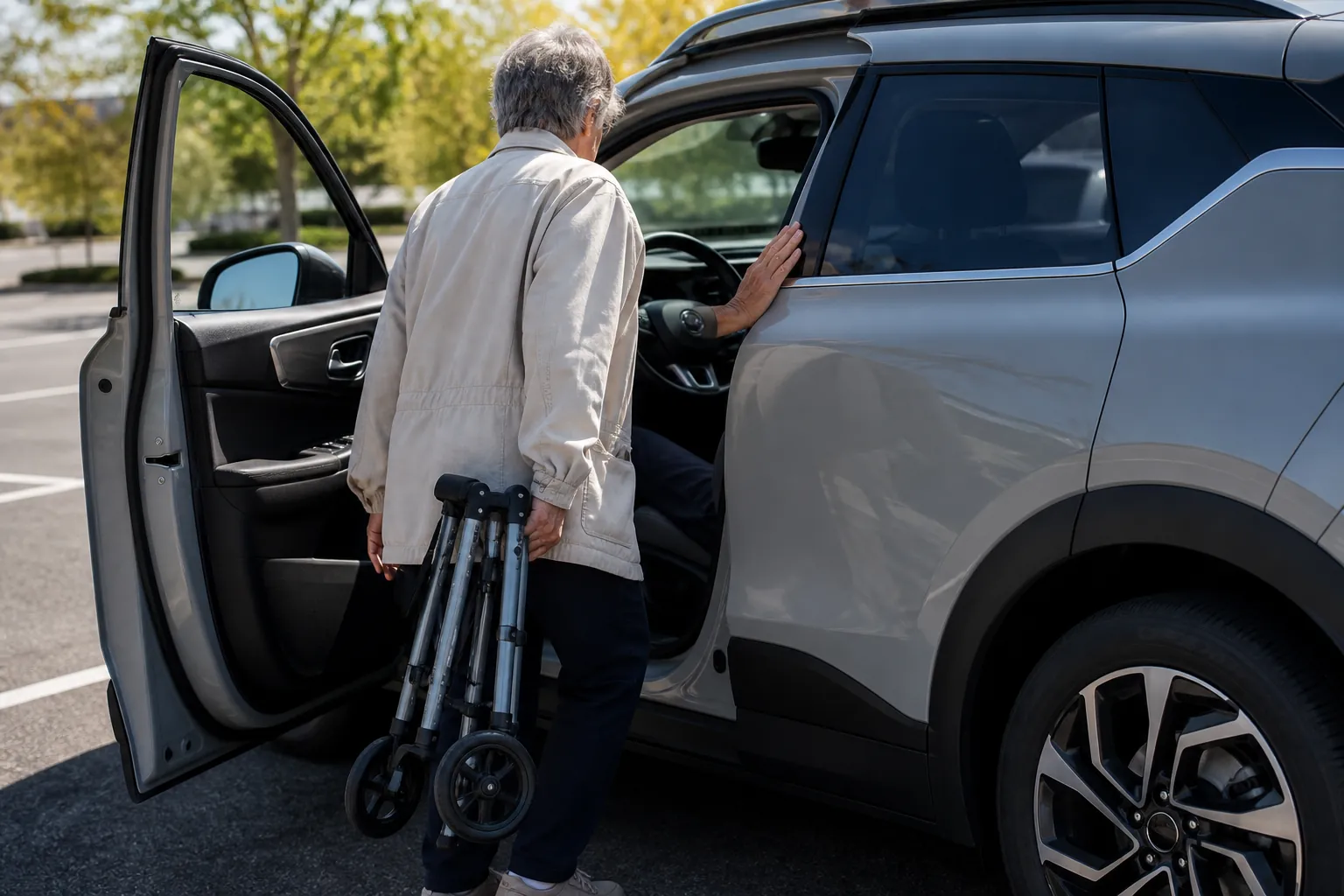
Start with the senior-fit scorecard, not the EV ranking
Most EV SUV lists begin with range, acceleration, charging speed, and cabin technology. Those details matter after the basic body mechanics work. For a senior with hip, knee, back, or balance limitations, the first screen should look more like a home-safety checklist than a car-magazine leaderboard.
Edmunds’ senior SUV criteria put useful weight on outward visibility, easy entry and exit, and physical knobs and buttons rather than touchscreen dependence [2]. Consumer Reports cautions that both very low and very high vehicles can be difficult to enter and exit, and it recommends features such as power seat adjustments, lumbar support, and tilt-and-telescope steering wheels for better driver positioning [3]. Consumer Reports also maintains an ease-of-access list, but the accessible portion of its material reinforces the same larger point: ease of entry is a fit question, not an SUV-size assumption [4].
| Senior-fit factor | What to verify in person | Why it matters |
|---|---|---|
| Entry and exit | The senior should get into and out of the driver seat and front passenger seat several times, in normal shoes, without being pulled by another person. | A vehicle can feel fine once seated and still create a fall risk during the transfer. |
| Seat height and seat shape | Look for a seat that lets the person back in, sit, and swing both legs without dropping down or climbing up. Do not rely on a universal inch range. | Published sources do not provide dependable per-model seat-to-ground measurements for this EV shortlist. |
| Door opening and grab points | Check whether the door opens wide enough in a real parking space and whether the person can find a stable place to hold without grabbing the steering wheel or a fragile trim piece. | A wide cabin does not help if the transfer requires twisting or reaching for a missing handhold. |
| Visibility | Confirm the driver can see over the hood, to the sides, and out the rear using mirrors and camera views, without craning the neck. | Reduced neck rotation and slower visual scanning can make blind spots and parking maneuvers more demanding. |
| Controls | Have the driver adjust temperature, fan speed, audio, mirrors, drive mode, wipers, lights, and safety alerts without coaching. | A quiet EV cabin is helpful; a buried touchscreen function during rain or traffic is not. |
| Walker or rollator loading | Bring the actual mobility aid. Fold it, lift it, angle it through the opening, and remove it again without assistance. | Cubic feet of cargo volume do not reveal lift-over height, opening width, floor shape, or whether the user must twist while lifting. |
| Crash-safety status | Use IIHS Top Safety Pick+ and Top Safety Pick status as a first screen, then confirm the exact model year and trim. | Older occupants are more vulnerable to serious injury, so crash protection deserves more weight than styling or brand prestige. |
| Driver-assistance features | Confirm blind-spot detection, lane departure warning, front crash prevention, rearview camera quality, rear parking sensors, and alert settings. | These systems are especially relevant when backing, changing lanes, or recovering from a missed hazard. |
| EV behavior | Try every regenerative-braking setting, creep behavior if available, brake-pedal feel, shifter layout, and charging-port workflow. | A senior who dislikes abrupt deceleration may find aggressive one-pedal driving tiring or jerky even in an otherwise excellent SUV. |
Why crash protection should narrow the field first
The first filter is not because safety ratings answer every mobility question. They do not. A Top Safety Pick+ badge will not tell anyone whether a 78-year-old with a stiff hip can clear the door sill in a grocery-store parking lot. It does, however, remove some wishful thinking from the purchase.
IIHS data gives specific reasons to care about modern crash-protection and avoidance technology for older drivers. Side airbags with head and torso protection reduce nearside-impact fatalities by 45% for front occupants age 70 and older, compared with 30% for occupants ages 13 to 49. IIHS also says front crash prevention, blind-spot detection, and lane departure warning together are relevant to roughly a fifth of older drivers’ crash involvements, and that rearview cameras and rear parking sensors are especially effective for drivers 70 and older in backing crashes [1].
For the 2026 model year, IIHS lists the Hyundai Ioniq 5, Genesis GV60, Kia EV9, Volvo EX90, and Rivian R1S as Top Safety Pick+ electric SUVs. The Ford Mustang Mach-E earns Top Safety Pick, which is useful, but it should not be treated as the same safety tier as Top Safety Pick+ [5].
The 2026 EV SUV shortlist, with the missing measurements left blank
Here is the uncomfortable part: the most important measurements for a mobility-limited buyer are not consistently published. Entry height, seat-to-ground height, sill height, lift-over height, door-opening angle, and the exact geometry of the transfer are not available in a dependable public table for these models. Reviewer comments about easy access can be useful clues, but they are not measurements.
| 2026 electric SUV candidate | Safety-screening status from available IIHS data | Why it belongs on the list | What cannot be assumed |
|---|---|---|---|
| Hyundai Ioniq 5 | IIHS Top Safety Pick+ [5] | Strong safety-screening result; EV packaging and a relatively open cabin make it worth testing for older drivers. | Do not assume the seat height, door opening, or cargo lift-over works until the senior repeats the transfer and loads the actual walker. |
| Genesis GV60 | IIHS Top Safety Pick+ [5] | Strong safety-screening result in a smaller luxury EV SUV format. | Luxury controls and design details still need a reach-and-read test; a premium cabin can still be too touchscreen-heavy or awkward. |
| Kia EV9 | IIHS Top Safety Pick+ [5] | Larger three-row option with strong safety-screening status; also appears in Car and Driver’s 2026 cargo-space ranking of electric SUVs with at least 60 cu ft behind the front seats with rear seats folded [7]. | Big cargo volume does not prove low lift-over, easy third-row avoidance, or simple rollator loading. |
| Ford Mustang Mach-E | IIHS Top Safety Pick [5] | Still a credible safety-screened candidate and widely cross-shopped among electric crossovers. | It should be treated as one tier below the Top Safety Pick+ models on safety status, and its sporty shape needs careful entry, visibility, and seat-comfort testing. |
| Volkswagen ID.4 | No Top Safety Pick+ status cited in the available 2026 IIHS shortlist used here | Appears in Car and Driver’s 2026 cargo-space ranking of electric SUVs with at least 60 cu ft behind the front seats with rear seats folded [7]. | Cargo volume is only a first-pass flag; the lift-over, opening shape, and control layout still decide daily usability. |
| Hyundai Kona Electric | No Top Safety Pick+ status cited in the available 2026 IIHS shortlist used here | Smaller and often easier to place in parking lots; appears in Car and Driver’s 2026 cargo-space ranking of electric SUVs with at least 60 cu ft behind the front seats with rear seats folded [7]. | A smaller footprint can help parking but does not guarantee an easier hip-and-knee transfer or enough usable space for a rollator. |
| Subaru Solterra | No Top Safety Pick+ status cited in the available 2026 IIHS shortlist used here | Worth testing because the 2026 Solterra offers five regenerative-braking settings via paddle shifters, giving drivers more ways to tune deceleration feel [6]. | Regen adjustability is useful only if the older driver can understand and operate it comfortably. |
| Volvo EX90 | IIHS Top Safety Pick+ [5] | Larger-budget safety-screened candidate; also appears in Car and Driver’s 2026 cargo-space ranking of electric SUVs with at least 60 cu ft behind the front seats with rear seats folded [7]. | Size, price, and safety branding do not prove easy entry, low cargo lift-over, or simple menu operation. |
| Rivian R1S | IIHS Top Safety Pick+ [5] | Strong safety-screening result and large-SUV capability for households that need more space. | A tall, adventure-oriented SUV can be exactly the wrong transfer height for some seniors; test the climb, step, and exit carefully. |
Cargo volume is a clue, not a walker test
Cargo-space rankings are useful only up to the point where someone has to lift metal and wheels through the hatch. Car and Driver’s 2026 electric SUV cargo-space ranking identifies models with at least 60 cu ft of cargo volume behind the front seats with the rear seats folded, including the Kia EV9, Volvo EX90, VW ID.4, and Hyundai Kona Electric among the models relevant to this discussion [7]. That is enough to put them on the loading-test list. It is not enough to say they are walker-friendly.
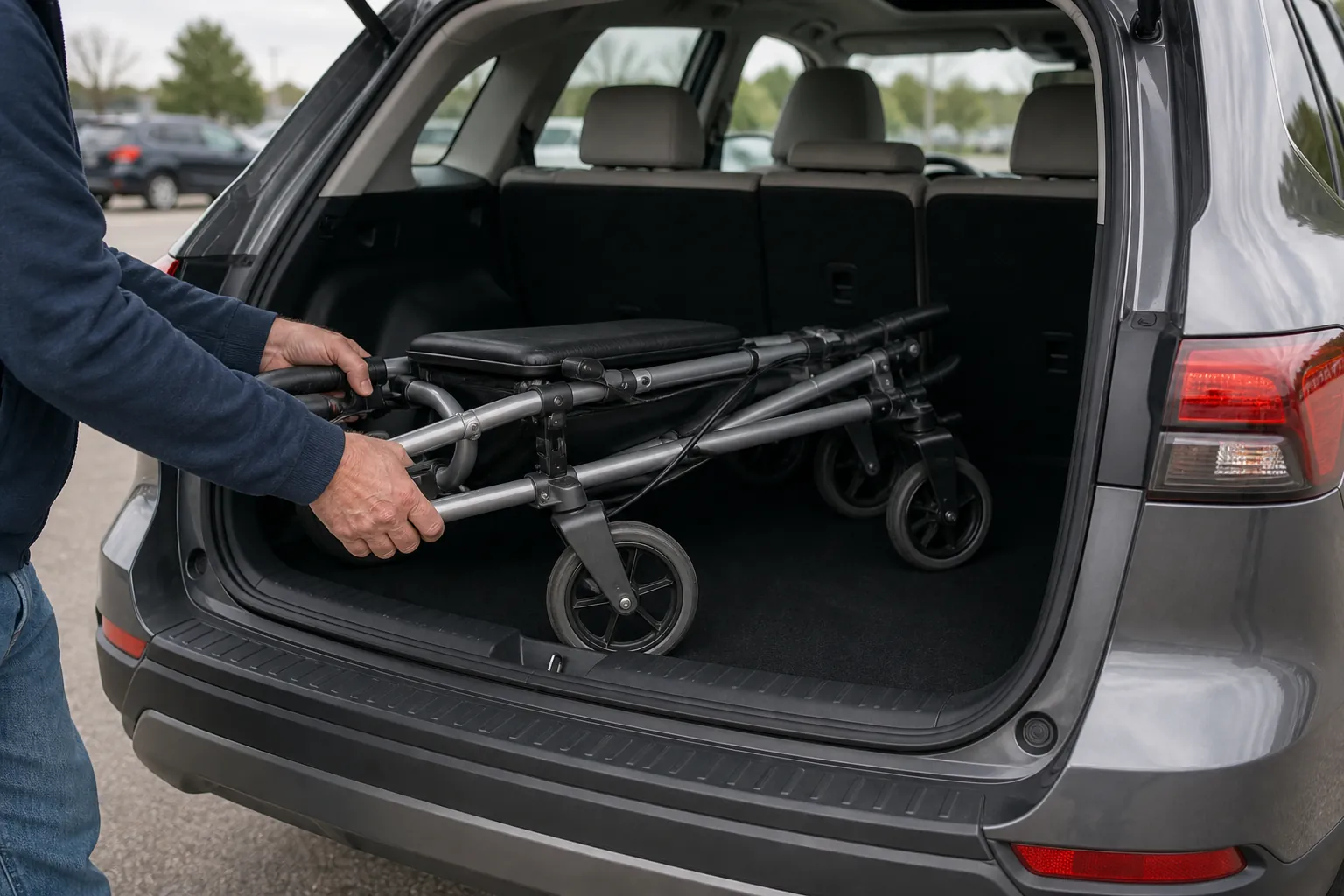
A rollator may fit only if the caregiver folds it, turns it diagonally, raises one wheel, and shoves it past a sloped cargo opening. That technically counts as fitting. It does not count as independence for the person who needs to use the vehicle alone.
During shopping, separate three questions that are often mashed together: whether the cargo area is large enough, whether the opening is forgiving enough, and whether the senior can lift and remove the mobility aid without losing balance. The third question is the one most spec sheets avoid.
Bigger is not automatically easier
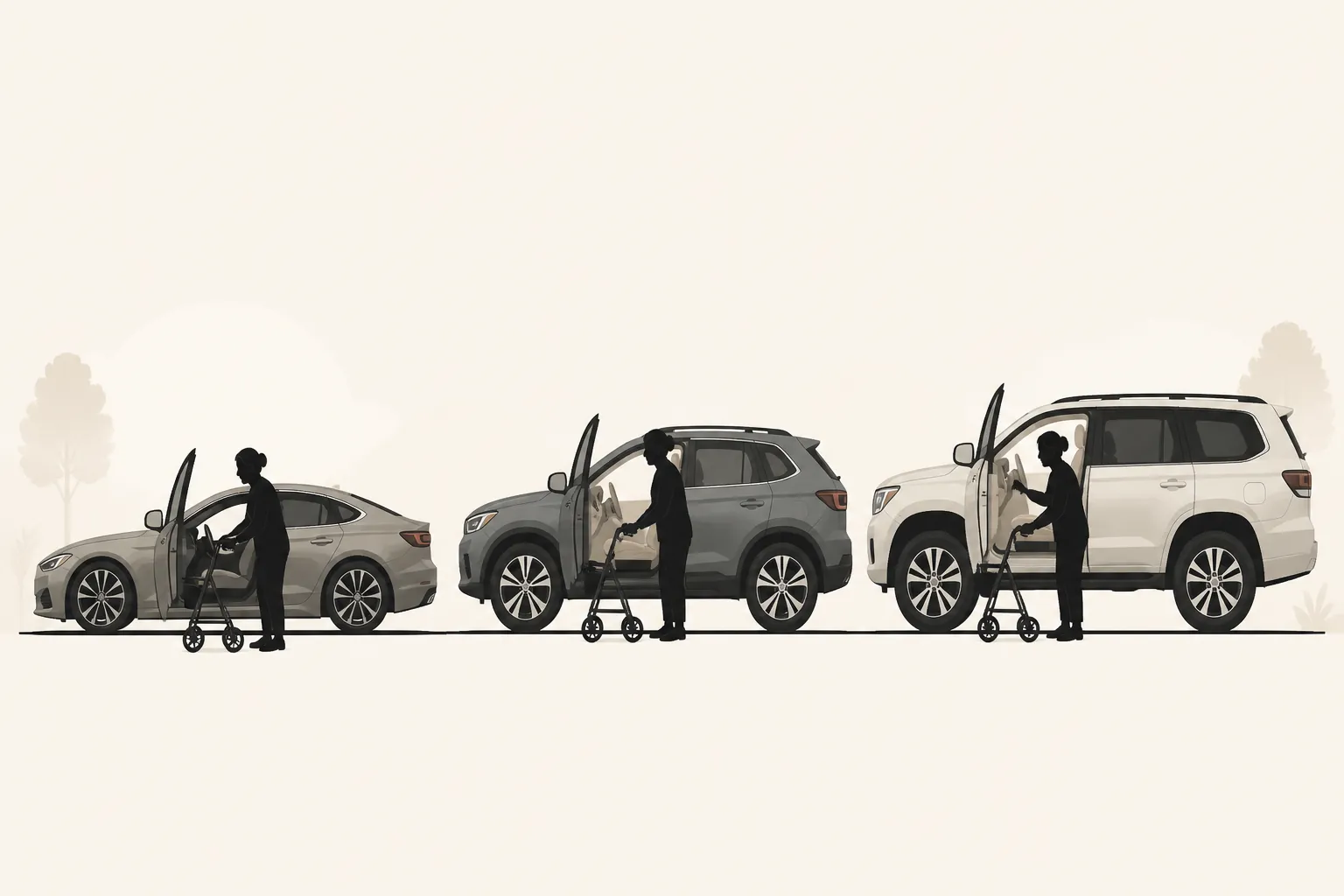
A low car can require a controlled drop into the seat and a harder push upward to get out. A tall SUV can require stepping up, balancing on one leg, and sliding down during exit. The middle ground is personal: one senior may need a seat that feels close to dining-chair height, while another may need more seat adjustment, a wider opening, or a lower sill. Because the public data does not supply a reliable ideal inch range for these EV SUVs, the only honest answer is to test the transfer with the person who will actually use the vehicle.
That test should include both front seats. Many families focus on the driver’s seat and forget that the same parent may later ride as a passenger after surgery, during medication changes, or when an adult child drives to appointments. A good driver fit with a bad passenger transfer is not a small problem if that passenger seat is the one used after a long medical visit.
The EV-specific fit layer: regenerative braking, one-pedal feel, and charging
Electric SUVs bring real advantages for older adults: quiet cabins, no gas-station fumes, flat floors in many models, and fewer routine maintenance stops. They also introduce behaviors that a gasoline-car shopper may not think to test. Regenerative braking is the big one.
MotorTrend’s 2025 survey of one-pedal and regenerative-braking behavior shows how different the experience can be across brands. Tesla’s one-pedal behavior is described as always-on with no adjustability, Porsche offers no one-pedal mode, Audi’s Q6 e-tron offers a B mode, GM EVs offer multiple control paths including a paddle, and the 2026 Subaru Solterra offers five regen settings via paddle shifters. MotorTrend also notes that aggressive regenerative braking can feel jerky, which is exactly the sort of sensation that may fatigue or unsettle some older drivers [6].
This is not a reason to reject EVs. It is a reason to stop treating one-pedal driving as a universal upgrade. For a driver with ankle stiffness, neuropathy, slower pedal transitions, motion sensitivity, or anxiety in stop-and-go traffic, the best setting may be a mild regen mode that behaves more like a familiar automatic vehicle. Another driver may love strong regen because it reduces brake-pedal use. The spec sheet cannot settle that.
- Try the lowest, middle, and strongest regenerative-braking settings, not just the default mode.
- Test creeping forward in a parking lot, easing into a garage, and stopping smoothly behind another car.
- Ask whether the vehicle remembers the preferred regen setting after restart.
- Confirm that the driver understands how to change the setting without looking away from the road for long.
- Check whether the brake pedal feels predictable when moving from regen to friction braking.
Charging deserves the same practical treatment. The question is not only whether the EV can charge quickly on a public fast charger. It is whether the older adult can open the charge door, reach the port, handle the cable, read the charger screen, manage an app if required, and back out of a charging stall without rushing. A home charger may solve much of that, but public charging should still be practiced if the driver will travel beyond routine local errands.
How to test-drive an electric SUV for a senior with mobility issues
A normal dealer test drive is too short and too polite. It favors the vehicle. A senior-fit test drive has to favor the body that will use it every week.
- Bring the senior who will drive or ride. Do not buy based on an adult child’s transfer, height, strength, or comfort.
- Bring the actual walker, rollator, cane, cushion, oxygen bag, or other equipment used on ordinary trips.
- Park between two vehicles or lines, not in an empty showroom-style space. Open the door as far as a real parking lot allows.
- Enter and exit the driver seat at least three times. Watch for leg dragging, twisting, grabbing unstable surfaces, breath-holding, or needing a pull.
- Repeat the same process in the front passenger seat.
- Adjust the seat, steering wheel, mirrors, and lumbar support. Confirm the driver can sit far enough from the wheel while still reaching pedals comfortably.
- Have the driver operate climate, defrost, wipers, headlights, audio, navigation basics, hazard lights, gear selection, and parking brake without coaching.
- Load and unload the mobility aid from the cargo area without assistance. If a caregiver is usually present, test both assisted and unassisted loading.
- Drive on local streets, a parking lot, and a short highway segment if appropriate. Try each regenerative-braking mode.
- Practice backing, parking, and lane changes using the mirrors, camera, sensors, blind-spot alerts, and rear cross-traffic warnings if equipped.
- Simulate charging. Open the port, handle the cable if one is available, read the charging screen, and confirm whether the app or payment process is realistic.
- Go home and repeat the parking test in the actual garage, driveway, carport, or curbside space if the dealer allows an extended test.
After a serious candidate passes that test, CarFit can be a useful second look. The program is a free, roughly 20-minute, 12-step fit check developed by AARP, AAA, and the American Occupational Therapy Association. It can help confirm positioning, mirror setup, seat belt fit, and control reach, but it is not a substitute for choosing a vehicle the senior can physically enter, exit, and load in the first place [8].
Sometimes the vehicle search also exposes a harder question. If the concern is not just fit but whether driving should continue at all, use a separate driving-safety conversation rather than hiding that decision inside an SUV purchase; this guide to signs an elderly parent should stop driving is the more direct branch. If the parent is still driving but may be stranded away from home, keep a practical car breakdown emergency checklist for older drivers with the vehicle. And if driving is no longer realistic, the better question may be whether self-driving cars can help seniors who cannot drive.
For 2026 shoppers, the strongest safety-screened electric SUV candidates include the Hyundai Ioniq 5, Genesis GV60, Kia EV9, Volvo EX90, and Rivian R1S, with the Ford Mustang Mach-E still worth considering as a Top Safety Pick. The VW ID.4, Hyundai Kona Electric, and Subaru Solterra may also deserve a place on the test list depending on budget, parking space, cargo needs, and regen preference. None earns the final answer on paper. The right EV SUV is the one the older adult can get into, get out of, control calmly, load realistically, and recover from safely when the day does not go as planned.
References
- Older drivers — IIHS
- What Are the 10 Best SUVs for Seniors? — Edmunds
- How to Make Your Car More Accessible — Consumer Reports
- Cars, SUVs, and Minivans That Are Easiest to Get Into and Out Of — Consumer Reports
- 2026 TOP SAFETY PICKs — IIHS
- One-Pedal Driving in EVs: What It Is, Pros, and Cons — MotorTrend, October 2025
- Electric SUVs With the Most Cargo Space — Car and Driver
- CarFit — CarFit
Questions to bring to a clinician or OT
This is not medical, legal, or a family's final decision — only a framework. Bring these questions to a clinician, occupational therapist, or your local Area Agency on Aging.
Find Local HelpRelated reading
Noticed something outdated or inaccurate on this page? Flag a correction. We review every report against CDC, NIA, and AARP HomeFit guidance before updating a page.