How to Build an Emergency Contact Binder for Your Aging Parents
This guide walks you through the six essential domains—medical, legal, financial, personal identification, insurance, and household—to include in an emergency contact binder for your elderly parents, and explains how to organize it so it works for first responders and family members under pressure.
By Editorial Team
new caregiver
experienced caregiver
long-distance caregiving
spousal caregiver
working caregiver
daily routines
medication management
personal hygiene
care coordination
first steps
ADLs
IADLs
The weak point usually shows up at the worst possible time: a fall, a sudden hospitalization, a power outage, a confused phone call from a neighbor. Someone is standing in an emergency department or talking to a paramedic and realizes the family does not actually know the medication names, the pharmacy, the insurance details, the doctor’s after-hours number, or where the legal papers are. Everyone knows “most of it somewhere.” That is not the same as being ready.
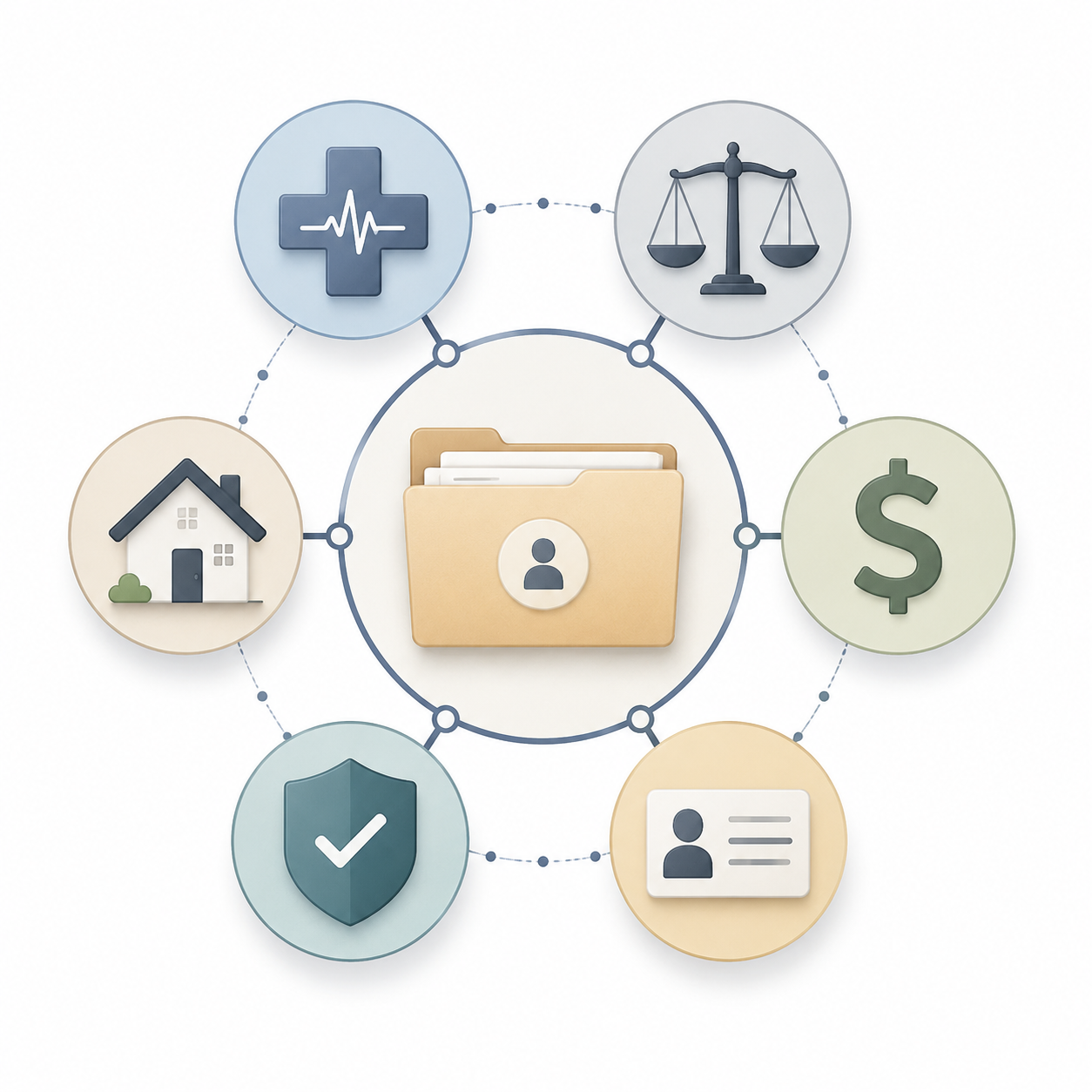
An emergency contact binder for elderly parents works only if it can be used by someone who is tired, frightened, or not the usual caregiver. It should cover six domains: medical, legal, financial, personal identification, insurance, and household information. The binder is not meant to turn a family member into a doctor, lawyer, or financial adviser. Its job is simpler and more urgent: help the next person make the next correct call.
The Six Domains Your Binder Needs
Start with the whole map before filling in details. In a crisis, some information matters in the first few minutes, some in the next few hours, and some over the next several days. Mixing all of it together is how a useful binder turns into a paper swamp.
Binder domain
What it answers
When it usually matters
Medical
What conditions, medications, allergies, doctors, pharmacies, mobility needs, and cognitive concerns should responders know?
Immediately
Legal
Who has authority to make decisions, and where are advance directives or powers of attorney kept?
Within hours, sometimes immediately
Financial
Which accounts, bills, income sources, and contacts keep the household stable?
Within days, sometimes sooner
Personal identification
How can your parent be identified and key records located?
Immediately to within hours
Insurance
What health, prescription, long-term care, home, auto, or other coverage exists?
At intake and during follow-up
Household
How does the home keep running if your parent cannot manage it?
Within hours to days
That order is deliberate. If your parent is in an ambulance or at triage, the binder’s medical and identification sections are not decorative. They are working pages. The rest protects continuity: authority, bills, insurance, pets, utilities, passwords, and the small household facts that become large problems when nobody knows them.
Why Families Underestimate What Belongs in the Binder
The mistake is usually not neglect. It is assuming that important information will be easy to retrieve because someone in the family “knows” it. But emergency information often lives in fragments: a medication photo in one sibling’s text thread, an insurance card in a wallet, the Wi-Fi password on a sticky note, a neighbor saved in a phone as “Bob next door,” and the health care proxy in a drawer no one can name.
For older adults, the medical piece is not optional. The National Council on Aging reported in 2025 that 93% of adults age 65 and older have at least one chronic condition, and many live with more than one.[1] That does not mean every emergency will be medical, but it does mean the odds are high that medication names, allergies, diagnoses, specialists, and baseline functioning will matter when care decisions are being made.
Preparedness also has a confidence problem. A 2023 AARP survey summary reported that 60% of adults age 50 and older felt prepared for a disaster, while only 29% had an actual emergency plan.[2] Because the accessible source is a summary rather than the full AARP report, the safest conclusion is narrow: many older adults may feel more prepared than their written plans show. A binder is one way to close that gap without pretending that confidence and readiness are the same thing.
Start With the First-Hour Pages
If completing the whole binder feels too big, do not start with bank statements or old tax files. Start with the pages that would matter if someone called you tonight. Put these at the front, before any tabbed sections.
One-page emergency summary: full legal name, preferred name, date of birth, home address, primary language, and emergency contacts.
Current medication list: medication name, dose, schedule, reason if known, prescribing clinician, and last updated date.
Allergies and adverse reactions: medications, foods, latex, contrast dye, or other known reactions, with reaction type if known.
Major diagnoses and baseline status: chronic conditions, recent hospitalizations, mobility equipment, hearing or vision needs, cognitive concerns, and what is normal for your parent.
Clinician and pharmacy contacts: primary care, key specialists, preferred hospital if relevant, pharmacy name, phone number, and location.
Decision-maker note: who should be contacted first, who has legal authority if documents exist, and where those documents are stored.
This first-hour packet is not the whole binder. It is the part that prevents the worst kind of family scrambling: five people searching old messages while a clinician waits for an answer.
Medical Information: The Section That Has to Be Fast
The medical section should be written for speed, not completeness for its own sake. A responder or intake worker does not need a family biography. They need accurate current facts, visible dates, and a way to reach the right clinician or caregiver.
Current Conditions and Baseline Function
List major chronic conditions in plain language, using the names your parent’s clinicians use when possible. Include conditions that affect emergency decisions: heart disease, diabetes, kidney disease, lung disease, stroke history, dementia or cognitive impairment, seizure history, bleeding disorders, serious infections, implanted devices, and anything else your parent’s medical team has told the family to mention in urgent care.
Baseline function deserves its own few lines. If your parent normally walks with a cane, uses a walker, needs help transferring, has hearing loss, wears dentures, becomes confused in unfamiliar settings, or usually knows the date and location, say so. In an emergency, “not acting like herself” is only useful if someone can explain what “herself” normally looks like.
Medication List
Medication lists go stale quickly, which is why every medication page needs an update date at the top. Include prescription medications, over-the-counter medicines, vitamins, supplements, inhalers, eye drops, injections, patches, and medications taken only as needed. Do not rely on “small white pill” descriptions. Use the medication name, dose, schedule, and prescribing clinician if known.
If your parent uses a pill organizer, do not assume the organizer explains itself. Put the medication list in the binder and keep a current copy in a wallet or go-bag if your parent is often out of the house. If the list is printed from a patient portal or pharmacy, check it against what your parent actually takes; portal lists can lag behind real-life changes.
Allergies, Reactions, and Safety Notes
Write down allergies and adverse reactions with enough detail to be useful. “Penicillin—rash” and “morphine—severe confusion” are more helpful than a bare allergy list. If a reaction is uncertain, label it that way rather than converting family memory into medical certainty. The binder should make communication cleaner, not more dramatic.
Doctors, Pharmacy, and Care Team
The care team page should include the primary care clinician, specialists who manage active conditions, dentist if relevant, pharmacy, home health agency, durable medical equipment company, and any regular paid caregiver agency. Add phone numbers, addresses, portal names if used, and after-hours instructions if the practice has given them.
This page is especially important for long-distance family members. A sibling in another state can be useful quickly if the binder tells them exactly which office to call and what information to have ready. If distance is already part of your family’s care reality, pair this binder with a long-distance caregiver emergency plan so the physical binder and remote response plan match.
Hospital Preferences and Advance Care Context
If your parent has a preferred hospital, specialist network, or important care history at a particular facility, include it. Do not write the page as if preferences can override emergency medical judgment. In a true emergency, responders may go where protocol and safety require. The binder’s role is to surface useful context once care is underway.
If your parent has advance care planning documents, the medical section can briefly point to them: “Health care proxy in Legal tab; original stored in fireproof box; copies provided to primary care office.” The National Institute on Aging’s checklist for getting affairs in order includes advance directives, wills, powers of attorney, and related records as documents to prepare for the future.[3] For condition-specific planning, especially with serious chronic illness, families may also need to understand how palliative care for chronic conditions fits into medical decision-making.
Legal Information: Identify Authority, Do Not Improvise It
The legal section should tell the family what documents exist, where they are, and who has authority. It should not be treated as a substitute for legal advice. Laws and document requirements vary, and families should work with qualified professionals for individualized decisions.
Health care proxy, medical power of attorney, or similar health decision-making document, if one exists.
Durable financial power of attorney, if one exists.
Advance directive, living will, POLST, MOLST, or state-specific medical order forms, if applicable.
Will or trust location, with attorney contact information if your parent has one.
Names and contact details for appointed agents, successor agents, attorney, executor, or trustee, if known.
Use copies in the binder unless an original is specifically needed for a particular document and your attorney advises storing it there. Originals should be protected and findable. A simple location note is often enough: “Original in labeled folder in home safe; combination held by named agent.” Do not put sensitive originals into a binder that many people may handle.
Identification and Insurance: The Intake Pages
Personal identification and insurance information often get treated as wallet contents, but wallets disappear, stay at home, or travel with the wrong person. The binder should include copies or clearly written details that help family members complete forms and answer intake questions accurately.
Section
Include
Personal identification
Full legal name, date of birth, address, phone number, Social Security number storage location rather than unnecessary broad copies, driver’s license or state ID copy if appropriate, veteran status if relevant, and key record locations.
Health insurance
Medicare, Medicare Advantage, Medigap, Medicaid, employer retiree coverage, prescription drug plan, dental, vision, and long-term care insurance details if applicable.
Other insurance
Homeowners or renters, auto, life insurance, umbrella, and any policies a family member may need to locate after an emergency.
Contacts
Insurance agent, benefits administrator, case manager, or plan customer service numbers.
Be careful with full Social Security numbers, account numbers, and copies of IDs. The binder should be useful, but it is also a sensitive document. If a number is not needed for immediate action, consider listing where to find it instead of placing it in a binder that could be opened by multiple helpers.
Financial Information: Enough to Keep Life From Unraveling
The financial section is not an invitation for every relative to inspect your parent’s private life. It is a continuity tool. If your parent is hospitalized for several weeks, someone may need to keep the mortgage, rent, utilities, insurance premiums, caregiver invoices, and phone bill from falling apart.
Primary bank and credit union names, with branch or customer service contacts.
Regular income sources, such as Social Security, pension, retirement accounts, or annuity contacts.
Recurring bills and how they are paid: autopay, paper check, online portal, or family assistance.
Mortgage, rent, property tax, homeowners association, or landlord contact information.
Financial adviser, accountant, tax preparer, or benefits counselor contacts if your parent uses them.
Location of recent tax returns and key financial records, rather than unnecessary copies of everything.
Keep this section access-limited. A neighbor who might feed the cat during a power outage does not need bank information. A legally authorized adult child handling bills may. That difference is one reason some families keep a main binder plus a smaller household emergency sheet.
Household Information: The Details Everyone Misses Until They Matter
Household information is where “we’ll figure it out” wastes hours. If your parent cannot come home right away, someone may need to enter the house, secure it, care for pets, find medical equipment, manage food in the refrigerator, or keep heat, cooling, and oxygen-related equipment running.
Home access: key location, lockbox instructions, alarm code handling, garage access, and who is allowed to enter.
Medical equipment at home: oxygen supplier, CPAP, hospital bed, mobility devices, hearing aid charger, wheelchair, or backup batteries.
Neighbors and local helpers: full names, phone numbers, relationship, and what they have agreed to do.
Home services: paid caregivers, house cleaner, meal delivery, lawn care, snow removal, transportation, or adult day program contacts.
For parents who are aging in place, this section is part of the safety system. It turns the home from a private maze into a place a trusted helper can manage for a few days without guessing.
Make the Binder Usable Under Pressure
A binder can contain every fact and still fail. The test is whether a person who did not build it can open it during a bad hour and find the right page quickly. That means plain labels, a ruthless front section, visible update dates, and no decorative system that requires explanation.
Use a Front-Page Emergency Summary
The first page should not be a table of contents. It should be an emergency summary. Put the most time-sensitive facts there: parent’s full name, address, date of birth, emergency contacts, major diagnoses, allergies, current medications note, primary doctor, preferred pharmacy, and where legal authority documents can be found. If the medication list is too long for the front page, write “See Medical tab, page 1—updated July 2026” or the current update month.
Put Tabs in Crisis Order
Tab order should follow likely use, not aesthetics: Emergency Summary, Medical, Identification, Insurance, Legal, Household, Financial. Some families may put Legal before Insurance if advance directives are central to current care. The point is not the exact order. The point is that no one should have to flip past old bank records to find allergies.
Date Every Page That Can Change
A medication list without a date is a trap. So is an emergency contact page from three phones ago. Put “Updated:” at the top of each changeable page. For pages that rarely change, such as document-location notes, the date still tells the next caregiver whether the information has been reviewed recently.
Use Copies and Location Notes Wisely
The binder should usually hold copies, summaries, and location notes, not every original document. Copies of insurance cards may be useful. A note identifying where the original power of attorney is stored may be safer than placing the original in the binder. For legal, financial, and clinical questions, the binder should point to the right professional rather than pretending to answer the question itself.
Store It Where Helpers Can Actually Find It
The best storage place is secure enough to protect sensitive information and obvious enough for authorized helpers to find. Many families choose a labeled binder in a consistent home location, with trusted family members told exactly where it is. If a neighbor is part of the plan, they may only need a one-page emergency contact sheet, not the full binder.
Emergency agencies also emphasize planning that fits the actual person and household. The American Red Cross advises older adults to prepare for emergencies with attention to support networks, medications, medical equipment, and communication needs.[4] FEMA’s caregiver preparedness resources similarly focus on planning for the needs of the person receiving care, including supplies, communication, and support arrangements.[5] A binder is not the whole emergency plan, but it gives that plan a place to live.
Pair Paper With a Secure Digital Backup
Paper matters because phones die, passwords fail, and the person with the login may be the person in the ambulance. Digital backups matter because a long-distance caregiver cannot open a kitchen binder from three states away. The practical answer is both: a physical binder in the home and a secure digital copy for the people who are authorized to use it.
Use a secure shared folder, encrypted storage, or another system your family can realistically maintain. Do not create a digital vault so complicated that nobody can access it during an emergency. Test access with the person most likely to get the call at midnight.
How to Assemble It Without Getting Stuck
Do not wait for a free weekend and a perfect template. Build the binder in passes. The first pass should make the next emergency less chaotic. Later passes can make it more complete.
Create the front emergency summary and current medication list.
Add emergency contacts, doctors, pharmacy, allergies, diagnoses, and baseline function.
Copy or summarize insurance cards and identification details.
Add legal document locations and names of authorized decision-makers.
Add household access, utilities, pets, equipment, and local helpers.
Add financial continuity information for bills, income, accounts, and professional contacts.
Scan or photograph key pages for the secure digital backup.
If your parent is newly hospitalized or you are in the first weeks of caregiving, the binder can sit inside a broader stabilization plan. A first-30-days caregiver roadmap can help sequence the other decisions so the binder does not become one more unfinished project.
A Practical Layout That Works
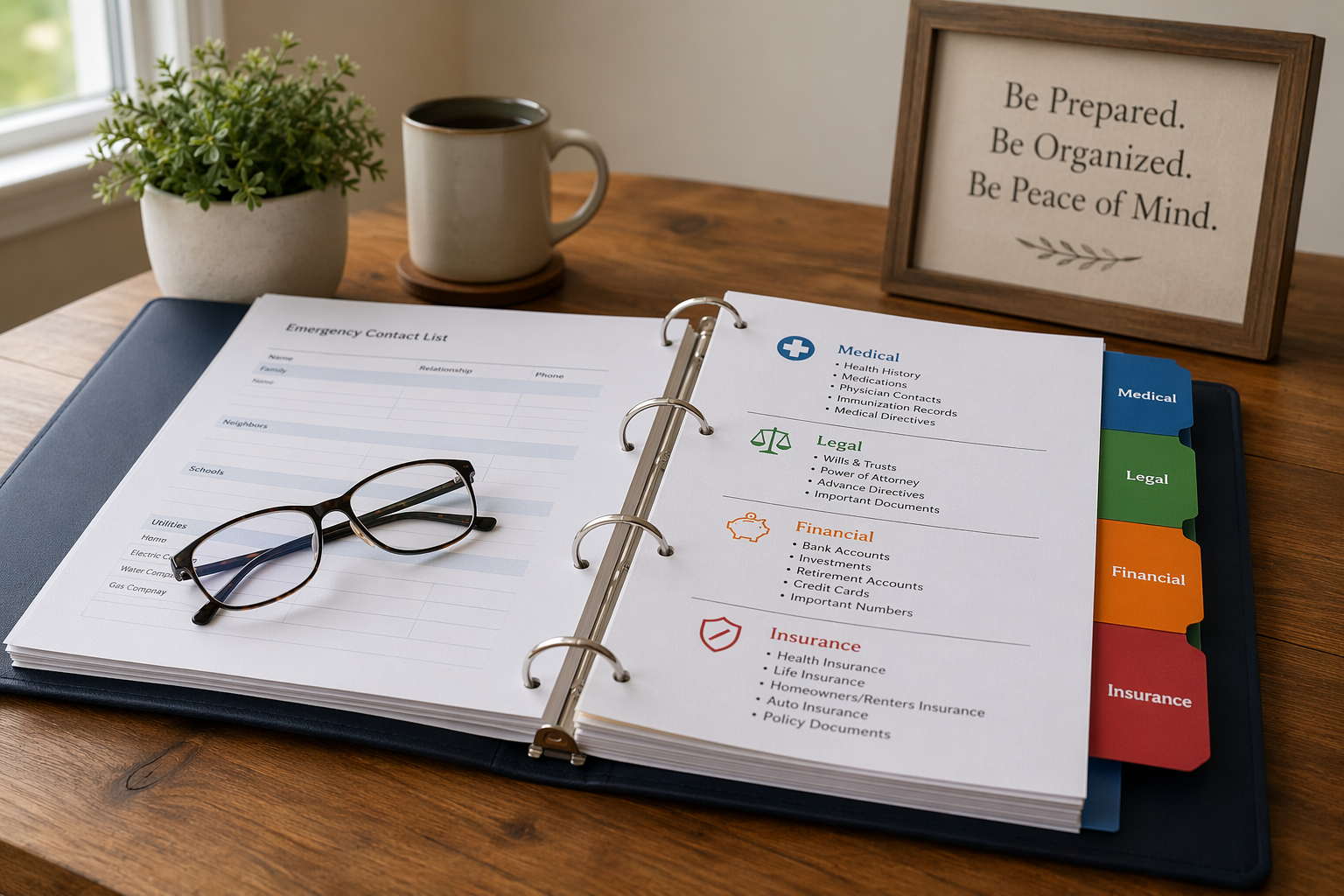
A plain three-ring binder is enough. Use large tab labels, sheet protectors only where they help, and printed pages that can be replaced instead of overwritten. If handwriting is hard to read, type the high-use pages. If your parent prefers paper and participates in the process, keep the format familiar rather than turning it into a technology lesson.
Binder position
Pages
Front pocket
Copy of emergency summary, current medication list, and a note saying who has the digital backup.
Tab 1: Emergency Summary
One-page summary, emergency contacts, decision-maker note, and review log.
Tab 2: Medical
Conditions, medications, allergies, doctors, pharmacy, equipment, baseline function, recent hospitalizations, and care team.
Tab 3: Identification
ID details, record locations, veteran status if relevant, and key personal information.
Tab 4: Insurance
Health, prescription, long-term care, home, auto, life, and agent or plan contacts.
Tab 5: Legal
Copies or location notes for advance directives, powers of attorney, will or trust, and attorney contact.
Tab 6: Household
Keys, utilities, pets, neighbors, home services, equipment suppliers, and access instructions.
Tab 7: Financial
Bills, accounts, income sources, professional contacts, and record locations.
Add a review log near the front with three columns: date reviewed, what changed, and who updated it. That small page prevents a familiar argument later: nobody can remember whether the binder was updated after the last medication change.
Who Should Know About the Binder
Tell the people who may actually be involved in an emergency. That might include your parent, spouse or partner, adult children, a nearby sibling, a trusted neighbor, a paid caregiver, and the person named in legal documents. Do not broadcast sensitive information widely. Share existence, location, and access level according to the person’s role.
Person
What they may need to know
Parent
What is in the binder, where it is stored, and how it supports their preferences.
Primary family caregiver
Full binder location, update responsibility, and digital backup access.
Long-distance sibling
Digital backup access, care team contacts, and when to step in.
Trusted neighbor
Emergency contacts, home access instructions if agreed, pet instructions, and whether a smaller sheet is more appropriate than the full binder.
Paid caregiver
Emergency summary, medical basics, agency protocol, and who to call first.
Legal decision-maker
Location of original authority documents and relevant medical contacts.
If several relatives assume someone else will update the binder, assign one owner and one backup. The owner does not have to do every task, but one person should know whether the medication page, emergency contacts, and legal-location notes are current.
When to Review and Update It
Review the binder after any event that changes the facts: hospitalization, new diagnosis, medication change, new doctor, move, change in insurance, death of a spouse, new caregiver, updated legal document, or changed phone number. Also set a routine review, such as every few months, because quiet changes are the ones families forget.
Medication list: check after every appointment that changes prescriptions.
Emergency contacts: check whenever phones, addresses, or caregiving roles change.
Insurance: check during open enrollment or after plan changes.
Legal document locations: check after any attorney visit or document update.
Household information: check after service changes, new locks, new equipment, or pet-care changes.
Digital backup: check access whenever passwords or shared-folder permissions change.
A binder that is 80% complete and recently reviewed is usually more useful than a perfect template abandoned after one afternoon. The standard is not beauty. The standard is whether the right person can find the right fact before the situation gets harder.
Connect the Binder to the Rest of the Emergency Plan
The binder should support, not replace, a household emergency plan. If a storm, wildfire smoke event, heat outage, evacuation, or caregiver illness disrupts normal routines, the same information becomes useful in a different way: who can pick up medications, who can check the house, where the insurance cards are, what equipment needs power, and who has authority to make decisions.
For immediate crisis preparation, use the binder alongside a 72-hour caregiver checklist. If the larger issue is that your parent’s needs are changing and the family is trying to decide what to do next, a broader action plan for helping elderly parents can put document organization in sequence with medical, home safety, and care decisions.
The working version is enough to begin: front summary, medical facts, contacts, insurance, legal-location notes, household basics, financial continuity, and a secure backup. Put it where authorized helpers can find it. Tell them it exists. Review it when facts change.

Comments
Join the discussion with an anonymous comment.