
Caregiver decision guide
What Word Games Can and Can't Do for Senior Memory
Crosswords and similar word games are linked to slower memory decline, but the research has real limits. Learn what the studies actually show, how to build a realistic weekly habit, and when a memory change warrants a clinician visit.
If your parent is forgetting more, “try a crossword” can feel either comfortingly practical or like a way to dodge the harder question. The honest answer is in the middle: word games for seniors are worth taking seriously, especially crosswords, but they are not dementia insurance and they are not a substitute for a medical visit when memory changes are new, rapid, or interfering with daily life.
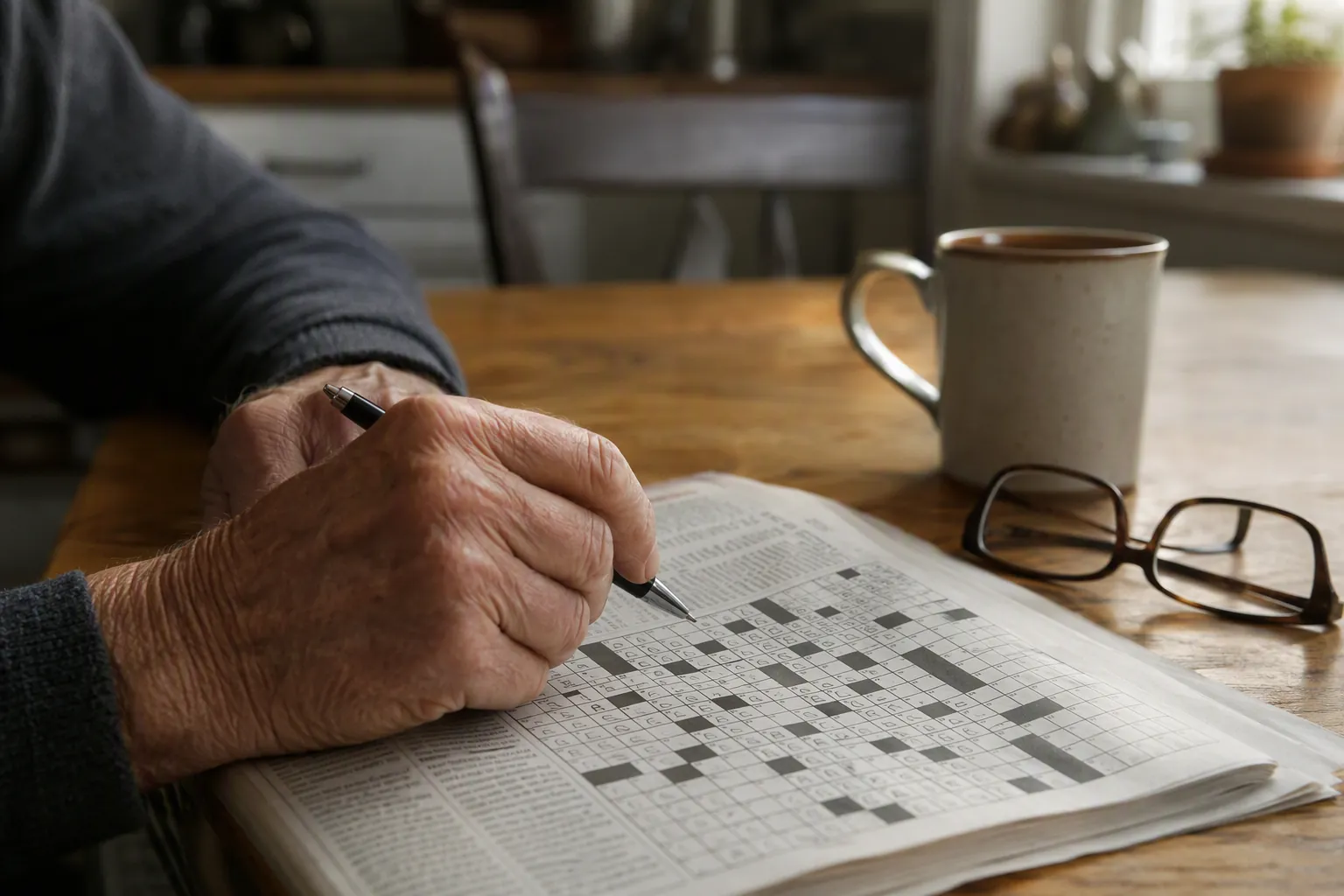
A puzzle can still be a good use of time. It can give an older adult a routine, a small success, and a reason to talk through clues over coffee. What it cannot do is turn a concerning pattern—missed appointments, repeated medication errors, getting lost, confusion with bills—into something harmless because there is a fresh puzzle book on the table.
The strongest evidence is about crosswords, not every “brain game”
The cleanest place to start is not with a list of pleasant games. It is with crosswords, because crosswords have unusually specific evidence compared with the broader pile of word searches, anagrams, trivia apps, and commercial brain-training products.
In the Bronx Aging Study, researchers followed 488 adults ages 75 to 85 who were cognitively intact at the start. Among those who later developed dementia, more frequent self-reported crossword participation was associated with a 2.54-year delay in the onset of accelerated memory decline, independent of education and verbal IQ. That is the kind of number people remember, and understandably so. But it came from an observational study, so it cannot prove that crosswords caused the delay. [1]
The same study also carries its own warning label. After accelerated decline began, the people who had done more crosswords declined faster, at 3.31 Selective Reminding Test points per year. The authors interpreted this as a pattern consistent with cognitive reserve: symptoms may appear later, but once the disease process is clinically visible, decline can look steeper. That is not the same as saying the puzzle prevented dementia. [1]
That distinction matters at the kitchen table. A crossword habit may be a sensible, low-cost way to support cognitive engagement. It is not a reason to wait six more months if your parent is suddenly repeating the same question every hour or has started making unsafe mistakes.
The head-to-head trial that makes crosswords hard to dismiss
The most useful randomized evidence is the COG-IT trial, because it did not merely ask whether people who like puzzles tend to score better. It randomly assigned 107 adults with mild cognitive impairment, with an average age around 71, to computerized crossword training or computerized cognitive games. The training lasted 12 weeks, with booster sessions extending follow-up to 78 weeks. [2]
Crosswords outperformed the computerized cognitive games on the ADAS-Cog at 12 weeks and 78 weeks. At 78 weeks, the crossword group also did better on the Functional Activities Questionnaire, a measure tied to daily functioning, and showed less MRI-measured brain shrinkage. [2]
For families deciding whether to buy an app subscription, that result is refreshing. The familiar, inexpensive activity held up better than the flashier computerized games in this trial. But it still needs to be read carefully. COG-IT did not include an inactive control group, about 15% of participants dropped out, and the researchers noted that older adults’ greater familiarity with crosswords may have helped explain the crossword advantage. [2]
So the sensible takeaway is not “apps are useless” or “crosswords treat MCI.” It is narrower and more useful: in one randomized trial of adults with mild cognitive impairment, computerized crosswords did better than computerized cognitive games on cognitive, daily-functioning, and MRI outcomes. That is enough to make crosswords worth considering before spending heavily on brain-training products. It is not enough to promise protection.
Why the “younger brain” headlines need a hard pause
Large observational studies add to the picture, but they are also where cheerful claims tend to get over-polished. In the PROTECT study, researchers analyzed 19,078 adults ages 50 to 93 and found that frequency of word-puzzle use was directly related to performance on all 14 cognitive measures, with people who never used word puzzles scoring lowest. [3]
A public-facing report of the PROTECT findings leaned into “younger brain” framing, describing puzzle users as having brain function years younger than their age on some tasks. [4] Independent experts responding through the Science Media Centre were more cautious: the studies were observational, could not show that puzzles improved cognition, and could not rule out the simpler possibility that people with stronger cognitive skills were more likely to do puzzles in the first place. [5]
That does not make the PROTECT findings worthless. It makes them what they are: a large cross-sectional association between puzzle use and cognitive test performance. Associations are useful clues. They are poor sales copy when they are rewritten as guarantees.
The evidence is also not perfectly consistent. A 1999 Michigan State University study, summarized by the Oklahoma Medical Research Foundation, found no evidence that doing crosswords at least twice a week was linked with less cognitive decline. [6] That older null finding should not erase newer work, but it should prevent the kind of certainty that makes every puzzle sound like medicine.
Crosswords, word searches, anagrams, and apps are not the same evidence bucket
Most family conversations use “word games” loosely. Research does not support them all equally.
| Activity | What is reasonable to say |
|---|---|
| Crosswords | Best-supported among common word games, with observational evidence in older adults and one randomized head-to-head trial in mild cognitive impairment. |
| Word searches | Fine if enjoyed, calming, or socially useful, but the specific memory evidence is weaker than for crosswords. |
| Anagrams, spelling games, Scrabble-like play | Plausibly engaging and often social, but should not be sold as proven memory protection. |
| Commercial brain-training apps | May train specific tasks, but claims about broad memory improvement or dementia prevention need caution; COG-IT favored crosswords over computerized cognitive games in adults with MCI. |
This is where money matters. A printed puzzle book, a library newspaper, or a free crossword is a low-risk experiment. A recurring subscription that promises a sharper brain deserves more skepticism, especially when the clearest head-to-head trial in mild cognitive impairment did not favor computerized cognitive games.
The Alzheimer’s Society reviewed 51 interventional brain-training studies and found that about three sessions per week of at least 30 minutes were linked with small improvements in thinking and memory. But the same review notes an important practical limit: gains were not seen in people training unsupervised at home. [7] That is a useful guardrail for anyone expecting a lonely app habit to do too much.
A realistic starter routine
The goal is not to turn a parent’s morning into cognitive boot camp. The better starting point is a routine that looks enough like the research to be sensible, but ordinary enough that the person will actually keep doing it.
- Start with crosswords if your parent likes them. If they dislike crosswords, choose another word game for enjoyment and routine, not because it has the same evidence.
- Aim for about 30 minutes per session. UCLA Health summarizes a practical crossword dose as roughly 1 to 4 puzzles per week, using medium difficulty comparable to New York Times Tuesday-to-Thursday puzzles. [8]
- Keep the difficulty in the middle. Too easy becomes busywork; too hard becomes a weekly reminder that something is wrong.
- Let hints, dictionaries, and partner-solving count. The point is sustained engagement, not proving independence on every clue.
- Stop before frustration takes over. A puzzle habit that leaves someone embarrassed or angry is not helping daily life.
A simple version might be Monday, Wednesday, and Saturday after breakfast, 20 to 30 minutes each time, with an easier puzzle available on tired days. If your parent prefers doing one puzzle slowly across several mornings, that is still a reasonable habit. There is no settled universal dose.
That uncertainty is not just a gap in advice columns. COGIT-2, a randomized trial protocol, is specifically studying different crossword doses—1 versus 4 crosswords per week—in older adults with mild cognitive impairment. [9] In other words, even researchers are still testing how much is enough.
Texas A&M researchers, using Health and Retirement Study data from 5,932 people age 50 and older with mild cognitive impairment, reported that higher engagement in games, puzzles, and reading was associated with better memory, working memory, attention, and processing speed. The authors suggested engaging in these activities about 3 to 4 times per week. [10] Treat that as a reasonable suggestion, not a medical prescription.
Make it a habit, not a test
Caregivers can accidentally ruin a perfectly good puzzle by turning it into surveillance. If you hover over every answer, correct every spelling error, or ask, “Do you remember this clue from yesterday?” the activity stops being a pleasant routine and starts feeling like an exam.
A better role is to remove friction. Keep the puzzle book and pen in the same place. Offer to read clues aloud if vision or arthritis makes the paper annoying. Save a half-finished puzzle instead of tossing it. Ask which clue was satisfying, not whether the puzzle “worked.”
If the older adult is still making their own choices, keep them in charge. The same principle applies beyond puzzles: preserving autonomy is part of helping a parent age well, not an optional courtesy. For more on that balance, see how to help your parents age gracefully.
Why memory support is also an independence issue
Memory is not only about names and crossword clues. It affects appointments, medication routines, kitchen safety, navigation, bill paying, and whether someone can follow a plan when something unexpected happens.
The ACTIVE trial is useful here because it looked beyond test performance. In 2,802 adults age 65 and older, cognitive training produced ability-specific gains that remained significant at 5 years, and trained groups reported less difficulty with instrumental activities of daily living. [11] ACTIVE was not a crossword study, so it should not be used as proof that word games preserve independence. It does show why families care about cognition in the first place: daily function is the outcome that matters.
If memory changes are already affecting home safety, puzzles are no longer the main intervention. A dementia-aware home review may be needed, especially if there is wandering, poor hazard recognition, or confusion in the bathroom, kitchen, or at night. A practical next step is a room-by-room safety checklist for Alzheimer’s caregivers, along with a clinician’s assessment.
When “try a puzzle” is the wrong next move

A crossword habit is reasonable for ordinary cognitive engagement. It is not the right response to new or worsening symptoms that are changing daily life.
Call the doctor instead of buying a bigger puzzle stack if you notice new, rapid, or worsening memory changes; missed appointments that are unusual for the person; repeated medication mistakes; confusion about familiar tasks; getting lost in familiar places; new trouble managing money; personality or judgment changes; or memory problems that arrive with weakness, speech changes, falls, severe headache, fever, dehydration, medication changes, or other physical symptoms.
That appointment does not have to mean the worst. Memory problems can have many contributors, including medication effects, sleep problems, mood changes, hearing loss, infections, metabolic issues, or neurological disease. The point is not to diagnose at the kitchen table. The point is to avoid treating a possible medical change as if it were merely boredom.
This article is for general education and is not a diagnosis or treatment plan. If you are unsure whether a memory change is normal aging, mild cognitive impairment, dementia, or something else, ask a licensed clinician who can evaluate the person directly.
The practical answer
Yes, crosswords are worth doing if your parent enjoys them. They are low-cost, familiar, and better supported than many activities marketed more aggressively. A few medium-difficulty sessions a week is a sensible starting routine, especially if it replaces passive time or adds confidence, structure, and conversation.
Just keep the promise modest. Crosswords may be associated with delayed decline in some studies, and they may perform better than computerized cognitive games for some adults with mild cognitive impairment. They have not been proven to prevent dementia, and the evidence is not broad enough to turn every word game into therapy.
The best plan is paired: keep the enjoyable cognitive activity, and keep watching honestly. If the person is changing in ways that affect appointments, medication, navigation, money, safety, or daily judgment, the next step is a clinician visit, not another stack of puzzles. For a broader healthy-aging frame—where cognitive activity sits alongside movement, sleep, food, and social connection—see longevity habits that support healthy aging for seniors.
References
- Association of Crossword Puzzle Participation with Memory Decline in Persons Who Develop Dementia — PMC, 2011
- Crossword Puzzles Superior to Computer Video Games in Slowing Memory Loss in Older Adults With Mild Cognitive Impairment — Columbia Psychiatry
- The relationship between the frequency of word puzzle use and cognitive function in a large online sample of adults aged 50 and over — PubMed, 2019
- Older adults who regularly do word and number puzzles have sharper brains — ScienceDaily, 2019
- Expert reaction to two studies on word and number puzzles improving adult cognitive function — Science Media Centre, 2019
- Bodywork: Do crosswords help prevent dementia? — OMRF
- Brain training — Alzheimer’s Society
- 4 worthwhile brain games for older adults — UCLA Health
- The COGIT-2 Study: A Randomized Controlled Trial Comparing Different Doses of Crossword Puzzle Training in Older Adults with Mild Cognitive Impairment — PMC
- Games, puzzles and reading can slow cognitive decline in the elderly — even in those with mild cognitive impairment — Texas A&M Stories, 2024-09-10
- The Advanced Cognitive Training for Independent and Vital Elderly Study: What We Have Learned and What is Next? — PMC
Questions to bring to a clinician or OT
This is not medical, legal, or a family's final decision — only a framework. Bring these questions to a clinician, occupational therapist, or your local Area Agency on Aging.
Find Local HelpRelated reading
Noticed something outdated or inaccurate on this page? Flag a correction. We review every report against CDC, NIA, and AARP HomeFit guidance before updating a page.