
Caregiver decision guide
What seniors should do during a river cruise evacuation
A river cruise evacuation follows a set sequence — life jacket, muster station, then transfer to shore or another vessel. This step-by-step guide shows seniors with limited mobility the three preparations that matter most before the alarm sounds: declaring needs at boarding, knowing the muster route and its stair-only sections, and assigning a helper for stairs and gangways.
For seniors, the useful river cruise safety question is not just whether the ship is safe. It is what to do during an evacuation, in order, when the alarm sounds and a real person has a cane, rollator, walker, or collapsible wheelchair to manage.
On a river ship, the basic sequence is usually simple: alarm or announcement, life jacket, muster station, crew instructions, then movement to shore, another vessel, or sometimes a small boat. The hard part is not remembering the words “go to muster.” The hard part is knowing which stairs, gangways, elevators, rafted ships, and handholds stand between the cabin and the safe side of the route.
Recent river incidents show why the sequence matters without turning every evacuation into a disaster scene. On July 28, 2026, Viking Ullur grounded on the Danube with 186 passengers and 52 crew; passengers were evacuated in daylight by small boat to another ship and then bused onward to Bucharest, with no injuries reported.[1] In June 2026, a galley fire aboard CroisiEurope’s MS Botticelli in Honfleur led to all 132 passengers and 31 crew being evacuated before dawn, also with no injuries reported.[2]
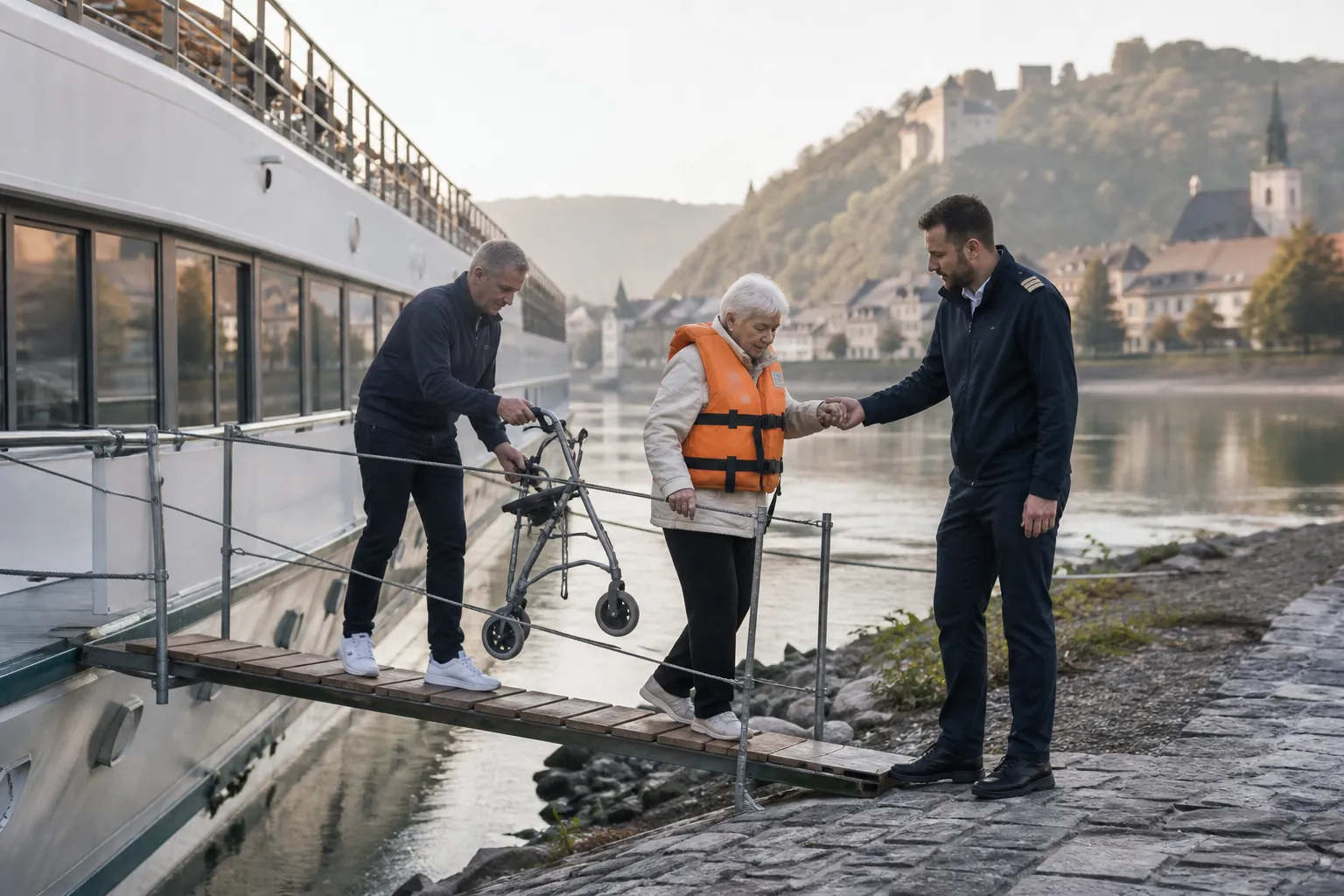
Those are the kinds of evacuations to prepare for: orderly, crew-directed, and very physical at the last few feet. A cruise evacuation sequence commonly includes putting on a life jacket, going to the assigned muster station, following crew instructions, not returning to the cabin, and taking only essential medication if it is immediately available.[3] River evacuations are different from ocean-cruise lifeboat scenes because passengers may be moved directly to shore, to another vessel, or by another short transfer method depending on where the ship is.[4]
The three things to arrange before the alarm
A senior passenger does not need a dramatic emergency plan. They need three arrangements that are clear enough for a tired person to follow at night and specific enough that an adult child can ask about them before sailing.
| Before the alarm | Why it matters during evacuation |
|---|---|
| Declare mobility limits at boarding | The crew needs to know whether the passenger can use stairs, stand without support, cross a narrow gangway, or move without a wheelchair. |
| Walk or mentally trace the muster route | The passenger needs to know whether the route includes stairs, an elevator gap, a sun-deck detour, or a rafted crossing through another ship. |
| Name the helper for stairs and transfers | Crew can direct and assist, but the passenger should not discover at the gangway that no one has agreed who steadies, carries the folded walker, or manages the bag. |
This is also where the adult-child caregiver can be useful without hovering. The questions are awkward only if they are left vague: “Can she do stairs?” is too broad. “If the elevator is unavailable, who helps her down one flight while I carry the folded rollator?” is the question that changes the outcome.
Declare mobility limits as soon as you board
Do not wait for the safety drill to mention limited mobility. After boarding, go to Guest Services, the hotel desk, the cruise director, or the crew member handling muster information and state the practical limits plainly. Passenger reports on Cruise Critic describe disabled guests being directed to identify themselves to staff and, in some cases, to use an assistance muster location rather than trying to manage a standard crowd route without notice.[5][6] Those forum posts are passenger experience, not official policy, but they point to the right operational habit: make the crew’s list before anyone needs the list.
The declaration should be physical, not diagnostic. The crew does not need a family history at the desk. They need to know how the passenger moves.
- “I use a rollator and can walk about one short corridor, but I need a railing on stairs.”
- “I can stand and pivot, but I cannot step into a small boat without two steady handholds.”
- “I can climb five or six steps slowly, but I cannot carry my walker while doing it.”
- “If the elevator is not available, I need a crew member to direct us to the correct route and my daughter will assist me on the stairs.”
- “I use a collapsible wheelchair for distance. I can transfer to a chair or bench, but I cannot be lifted.”
Ask the crew to repeat back the evacuation arrangement in plain language: assigned muster station, route from the cabin, whether the elevator is part of the normal route, and what to do if the elevator is not usable. If the passenger is traveling with a companion, say that too. If they are traveling alone, say that very clearly.
This is not about being difficult. It is about removing guesswork from the first five minutes after an alarm, when crew are managing the whole vessel and passengers are moving at different speeds.
Walk the muster route before you settle in
Once you know the assigned muster station, go there from the cabin while the ship is calm. If walking the full route is too much, walk the difficult portions and mentally trace the rest with the caregiver. The point is not to memorize décor. The point is to find the spots where a mobility plan can fail: the threshold, the stair, the elevator gap, the narrow corridor, the wet gangway, or the crossing through another ship.
River ships are smaller than ocean ships, but smaller does not always mean easier. Accessibility guides for river cruising note several recurring limits: elevators may not serve every deck, sun decks are often reached only by stairs, cabins and corridors can be compact, and rafted moorings may require passengers to cross through or over another vessel using gangways that are not the same as a flat hotel lobby.[7][8][9]
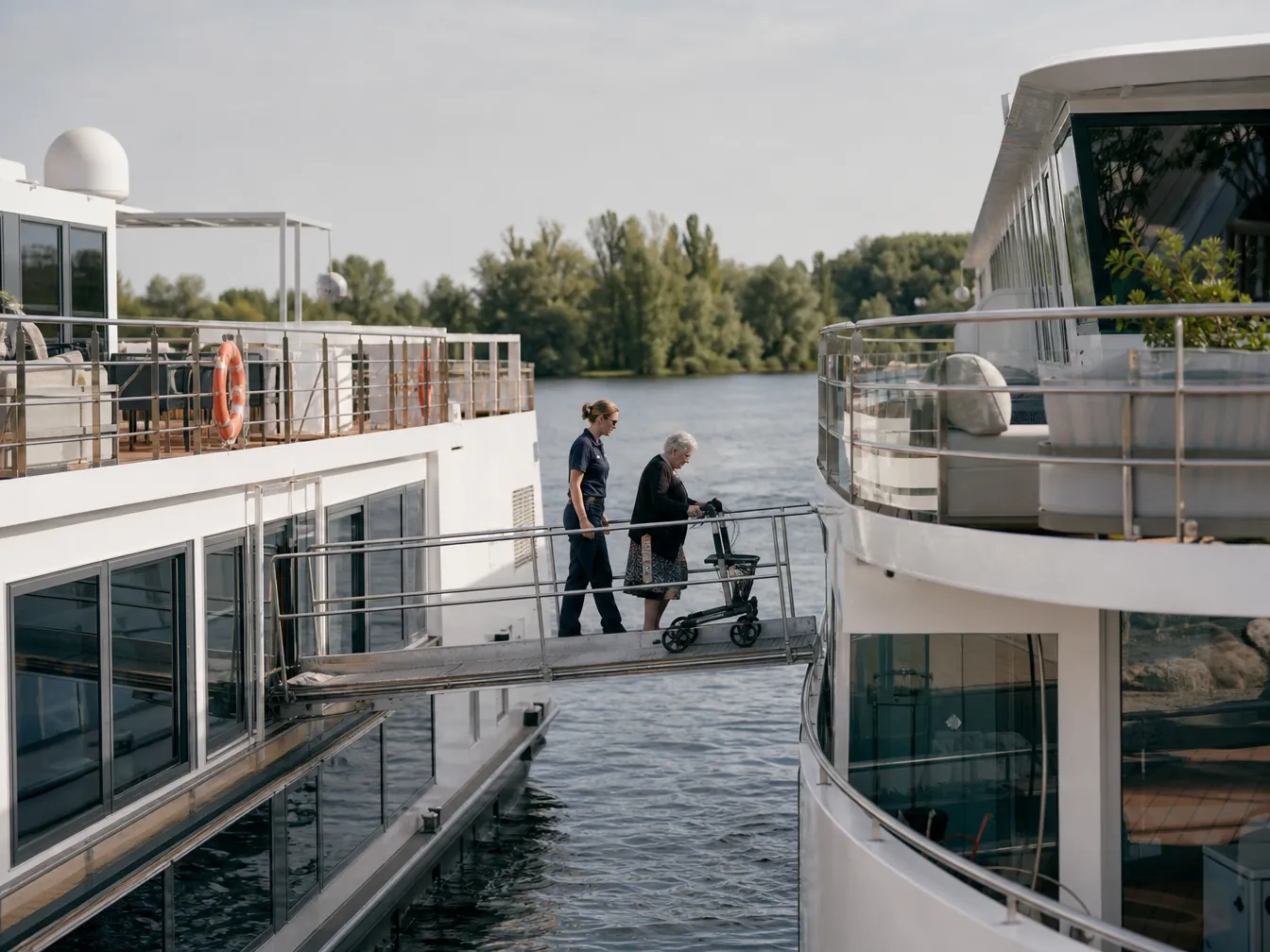
When you test the route, look at it as a sequence of hand placements.
- Cabin door: Can the passenger open it while holding a cane or wearing a life jacket?
- Corridor: Is there room for the walker or rollator if other passengers are moving past?
- Stairs: Which side has the railing? Can the passenger descend with one hand on the rail and the other hand free?
- Elevator: Does it serve the deck you need, and what is the crew-directed alternative if it is not used during an emergency?
- Muster station: Is there a place to sit or brace? Where does the mobility aid go so it does not block the route?
- Gangway or rafted crossing: Is it level, sloped, narrow, wet, or interrupted by a threshold?
If the sun deck is part of the day’s routine, check whether it is stair-only before you treat it as part of the passenger’s safe space. A pleasant afternoon route and an evacuation route are not always the same route. The room-by-room fall-prevention habits in this cruise safety companion pair well with this step because the same obstacles—thresholds, shoes, night lighting, and where the walker is parked—matter more when people are moving quickly.
Decide who helps before anyone reaches the stairs
“The crew will assist” is not a complete plan. Assistance can mean giving directions, controlling passenger flow, steadying at a transfer point, carrying a folded mobility aid, or assigning crew attention to someone who has already been identified. It should not be assumed to mean lifting a passenger, pushing a wheelchair, or inventing a stair-chair procedure that the river ship has not told you it uses.
Transport Canada’s passenger evacuation safety bulletin treats crew training and procedures for passengers with impaired mobility as part of passenger-vessel evacuation planning.[10] That is useful because it confirms that reduced mobility belongs in the safety conversation. It still does not replace a personal helper decision for the passenger’s body, balance, and mobility aid.
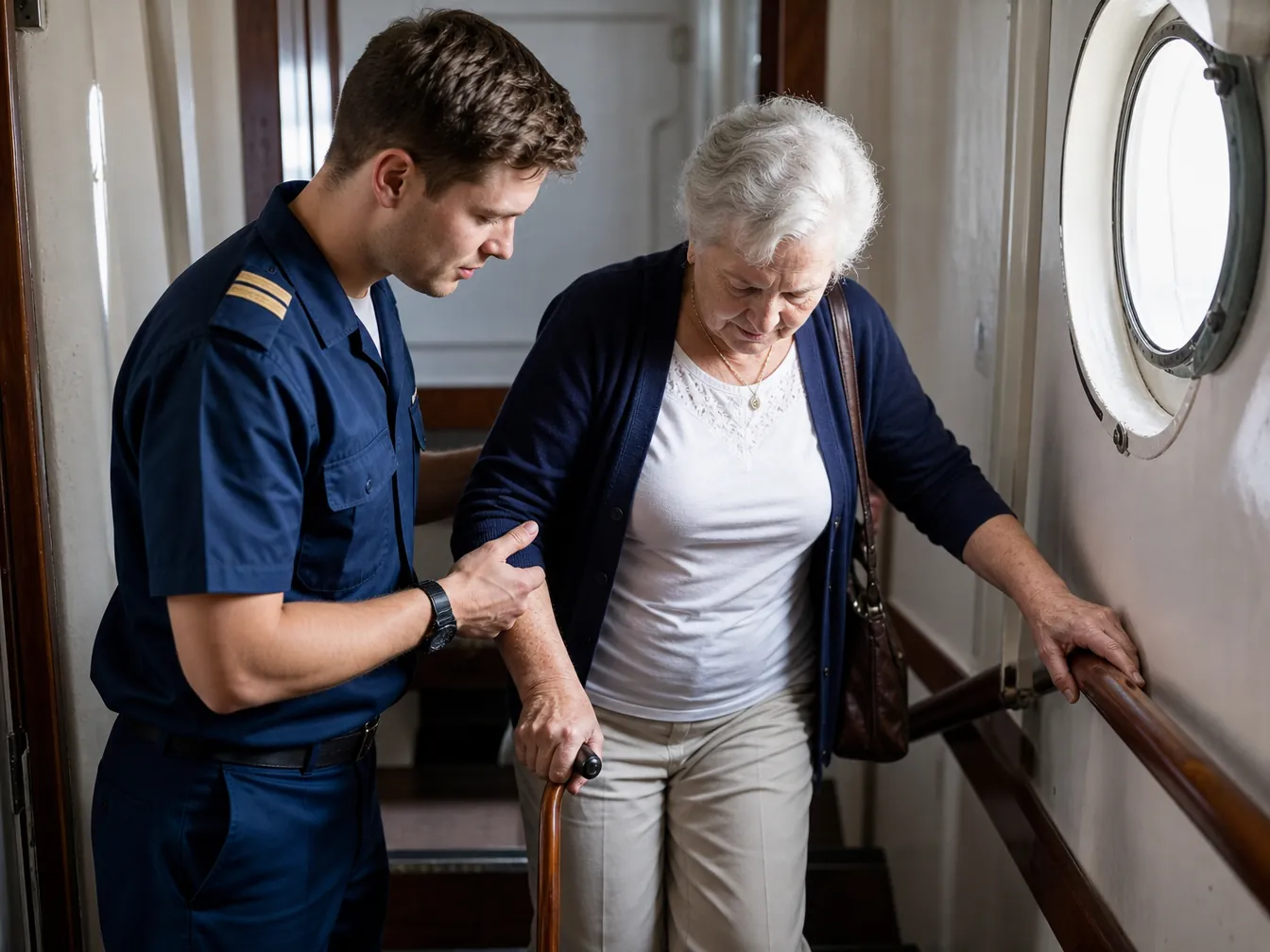
Make the helper roles boringly specific:
- Who walks on the passenger’s stronger side?
- Who carries or folds the rollator, walker, cane seat, or collapsible wheelchair?
- Who holds the medication pouch or phone if the passenger needs both hands free?
- If a stair is involved, does the helper go one step below, beside, or behind, based on what is actually safest for that passenger?
- If the caregiver is not in the same cabin, where do they meet: cabin door, stair landing, or muster station?
For many families, this is the moment to be honest about whether the adult child is physically able to help. A loving helper who cannot safely steady a parent on a sloped gangway is not a safe transfer plan. If the passenger needs more than light steadying, ask the cruise line before departure what assistance is available and what is specifically not provided. For broader caregiver planning around mobility and independence, use this guide to helping aging parents maintain mobility as the slower, non-emergency companion to this conversation.
Keep the bedside grab-bag small enough to actually grab
Emergency-preparedness advice for older adults emphasizes medication access, medical information, communication, and support networks.[12][13] On a river cruise, that does not mean building a heavy emergency kit that competes with the walker. It means keeping the few items that matter within reach at night.
- Essential medication for the next dose or two, in a small pouch.
- Phone, charged enough to leave the cabin with you.
- Written medical list with conditions, allergies, medications, emergency contacts, and mobility limits.
- Glasses, hearing aids, or other devices the passenger cannot safely follow instructions without.
- Walking aid parked where it can be reached from the bed without crossing the cabin.
Do not put the medication pouch in a deep suitcase or under the bed. Do not park the rollator where another bag blocks it. If travel warnings, itinerary changes, or medication access are part of the bigger trip plan, the medication buffer and fallback checklist is the better place to handle those details before departure.
When the alarm sounds: one action at a time
During an evacuation, the passenger’s job is not to diagnose the incident. It is to enter the sequence and stay in it.
- Stop and listen. Listen for the alarm, announcement, or direct instruction from crew. If the passenger uses hearing aids, put them in if they are immediately at hand.
- Put on the life jacket. If the straps are confusing, ask the nearest crew member or helper. Do not delay the whole route trying to make it perfect in the cabin.[3]
- Take only what is immediately at hand. Essential medication pouch, phone, glasses, and medical list are reasonable if they are reachable. Do not search drawers, repack bags, or look for extra clothing.[3]
- Use the agreed mobility aid. If the plan is cane to the stair landing and folded rollator carried by the helper, do that. If the plan is wheelchair to muster and assisted standing transfer later, do that. This is not the time to test a new method.
- Go to the assigned muster station. Follow the route the crew gave you at boarding or during the drill. Do not return to the cabin once you have left it unless crew specifically directs you.[3]
- State the mobility limit in one sentence if needed. “I cannot descend stairs without a railing.” “I can stand and pivot but cannot step down into a boat alone.” Short information is easier for crew to use.
- Wait for the transfer instruction. On a river ship, the transfer may be to shore, across a gangway, through a rafted vessel, or to a smaller craft, depending on the location and incident.[4]
- Move only when directed. At the gangway, stair, or small-boat step, wait until crew control the timing. The last ten feet are exactly where crowding, wet surfaces, and an unsecured walker can turn an orderly evacuation into a fall.
What the transfer may feel like on a river ship
A river evacuation often stays close to land or another vessel, but “close” can still involve an awkward transfer. The Viking Ullur evacuation is a useful example because passengers were moved by small boat to a second ship before continuing by bus.[1] That is a very different physical problem from walking down a hotel hallway. A person with a rollator may need the rollator folded and passed separately. A cane user may need both hands free for a rail. A wheelchair user may need to stand and pivot if the chair cannot be rolled across the transfer point.
Rafting adds another version of the same problem. River ships sometimes moor side by side, requiring passengers to cross another ship to reach shore. Accessibility guides warn that these crossings and gangways can be narrow or difficult for travelers with mobility limitations.[7][8] In calm conditions, that may be merely inconvenient. In an evacuation, it becomes a place where the passenger should already know who carries the mobility aid and who steadies the passenger.
This is why it is unhelpful to import ocean-cruise assumptions into a river-cruise plan. Do not assume lifeboats, evacuation chairs, or a long descent through a large ship unless your river line has actually briefed that equipment and route. Ask about the vessel you are on, the river you are sailing, and the transfer methods the crew expects to use.
About the 30-minute evacuation idea
You may see references to a 30-minute evacuation capability in passenger-vessel safety material. Use that carefully. Transport Canada’s Ship Safety Bulletin 04/2022 discusses passenger evacuation safety requirements, including procedures, training, and evacuation capability in the Canadian passenger-vessel context.[10] UK guidance tied to EU Regulation 1177/2010 also addresses assistance and rights for disabled passengers and passengers with reduced mobility when traveling by ship.[11]
That does not make “30 minutes” a universal U.S. river-cruise promise, and it does not tell you whether your parent can manage the gangway in front of them. Treat official timing standards as background. Treat the actual route, helper, and mobility aid as the plan.
If conditions change before departure
A new fall, worse balance, a medication change, or a travel warning can change the evacuation plan even if the cruise booking stays the same. Before final payment or departure, use a practical go/modify/cancel framework rather than trying to decide by optimism alone. The travel warning decision framework is built for that kind of decision.
This article is general travel-safety information, not medical or legal advice. For medical fitness to travel, equipment choice, or a passenger’s need for hands-on assistance, involve the appropriate clinician, mobility professional, cruise line, and travel insurer before the trip.
The moment that still belongs to you
The most useful evacuation work happens before the alarm and in the first few minutes after it. Declare the mobility limits at boarding. Know the route to muster, including stairs, elevator gaps, sun-deck limits, and rafted gangways. Decide who helps at stairs and transfers. Keep medication, phone, medical list, and walking aid reachable.
Then, if the alarm sounds, do the next instructed thing: life jacket, essential items only if already at hand, agreed mobility aid, assigned muster station, crew-directed transfer. That is how an evacuation becomes a practiced sequence instead of a scramble.
References
- Viking River Cruise Ship Evacuated After Grounding on the Danube, The Maritime Executive
- Fire aboard CroisiEurope's MS Botticelli: 132 passengers evacuated, PAX
- What Happens During a Cruise Ship Evacuation?, Rivkind Margulies & Rivkind
- How is safety maintained on passenger river cruises?, Feron
- Evacuation Question, Cruise Critic
- Muster Drills and guests with disabilities, Cruise Critic
- A Guide to Accessible River Cruises, Cruise Critic
- A Guide To Accessible River Cruises: 7 Things To Consider, RiverVoyages
- River Cruise 101: Scooters, Wheelchairs & The Mobility-Impaired Traveler, River Cruise Advisor
- Requirements for passenger evacuation safety – SSB No. 04/2022, Transport Canada
- Guidance for disabled passengers and passengers with reduced mobility when travelling by ship: guidance note 5, GOV.UK
- Older Adults, Ready.gov
- Older Adults Emergency Preparedness, American Red Cross
Questions to bring to a clinician or OT
This is not medical, legal, or a family's final decision — only a framework. Bring these questions to a clinician, occupational therapist, or your local Area Agency on Aging.
Find Local HelpRelated reading
Noticed something outdated or inaccurate on this page? Flag a correction. We review every report against CDC, NIA, and AARP HomeFit guidance before updating a page.