
Caregiver decision guide
How to Talk to an Aging Parent About Elderly Monitoring Systems
This guide provides evidence-based conversation strategies for adult children whose older parent resists monitoring technology, turning resistance into acceptance by focusing on independence and using proven communication techniques.
The first conversation about elderly monitoring systems often goes badly because everyone in the room is talking about a different thing. The adult child is talking about the fall, the stove left on, the missed call, the long stretch of silence that felt like disaster. The parent is hearing something colder: you are no longer trusted alone.
That is why a sentence like “we just need to keep an eye on you” can land as an insult, even when it comes from love. It turns the parent from the owner of the home into the subject of observation. If the answer is “I’m not wearing one of those things,” the refusal may not be about a pendant, watch, sensor, or app. It may be a defense of adulthood.
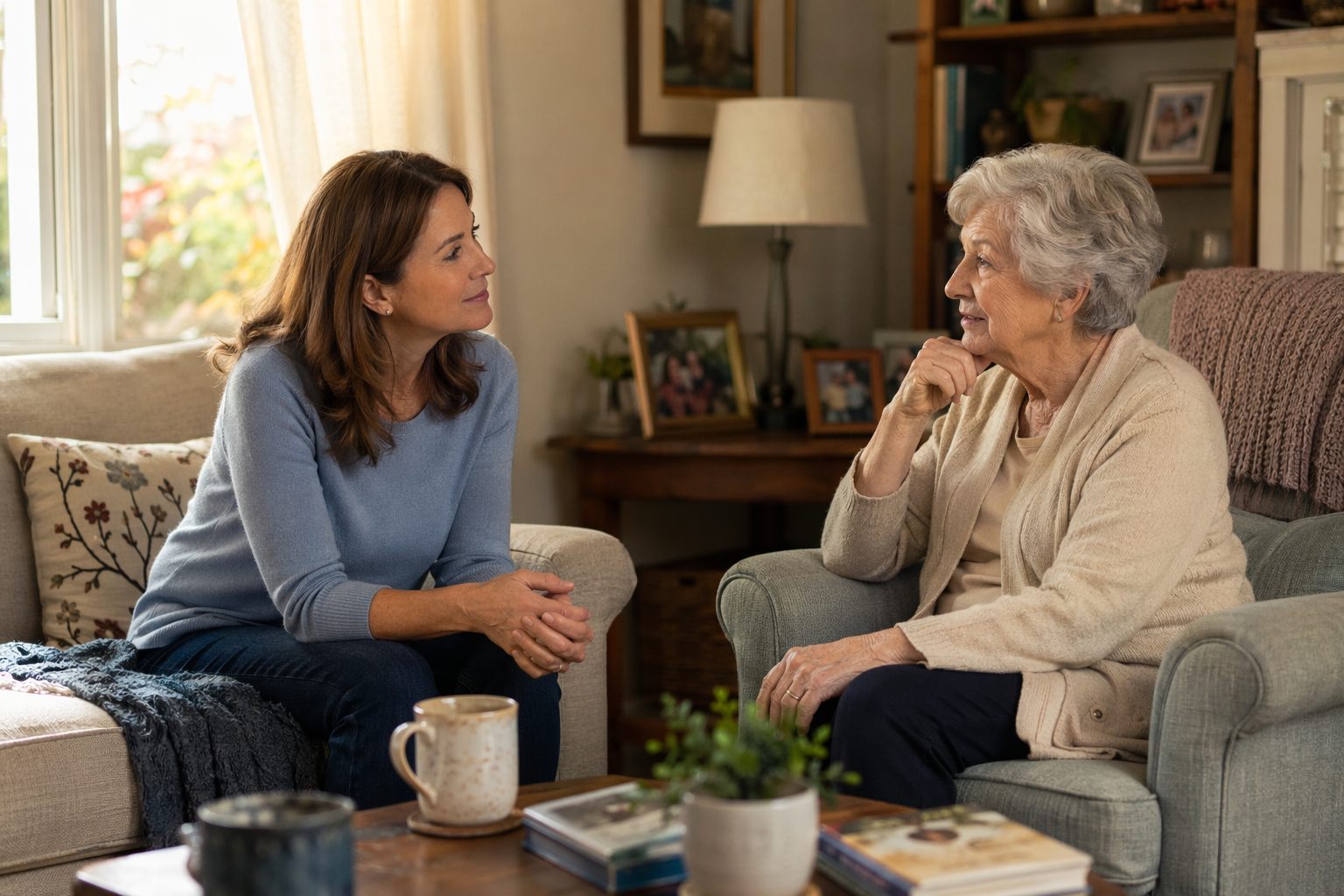
The conversation has a better chance when it stops sounding like a campaign for monitoring and starts sounding like what it actually should be: a plan for staying safely at home longer. That shift does not mean pretending risk is not real. It means refusing to use fear as the only language.
Start by listening for what the device represents
The National Council on Aging’s guidance on talking about medical alert systems starts in the right place: active listening. Sarah Milanowski, LMSW, is quoted in NCOA’s guidance saying, “Caregivers need to be willing to listen to their care recipient and take feedback about their concerns.” The point is not to let the conversation drift forever. It is to hear the objection before trying to defeat it. [1]
A useful first move is not “Mom, you need this.” It is closer to: “When I brought this up last time, I think it sounded like I don’t trust you. I’m sorry. Can you tell me what bothers you most about the idea?”
Then wait. The first answer may be a joke, a brush-off, or a line meant to end the conversation: “I’m fine.” “Those are for old people.” “I don’t need a babysitter.” Treat that as information, not defiance. A parent who says “I don’t want to be watched” has given the family a very different problem to solve than a parent who says “I’ll forget to charge it.”
| If you were going to say | Try saying instead |
|---|---|
| We need to monitor you. | I want to understand what would help you feel safe at home without feeling watched. |
| You could fall and no one would know. | The part that worries me is what happens if you need help and cannot reach the phone. |
| You have to wear this. | Would you be willing to look at a few options and tell me which ones feel unacceptable? |
| This is for your own good. | I know staying in your home matters. I’m trying to find support that protects that, not takes it away. |
Those wording changes may look small on paper. In a living room, they change who has authority. The parent is no longer being managed into compliance. They are being asked to help define the terms under which safety support would be acceptable.
Name the safety concern without turning it into a threat
NCOA also recommends sharing specific safety concerns rather than speaking in vague alarm. That distinction matters. “You’re not safe anymore” is a verdict. “Last Tuesday, you said you were on the floor for a while before you could get to the chair” is a fact the two of you can discuss. [1]
Stay with what happened, what could happen next, and what the proposed system would do in that specific gap. If the concern is a fall, the gap may be getting help when a phone is across the room. If the concern is wandering, the gap may be noticing a door opening at an unusual hour. If the concern is missed medication or visible decline, the gap may be a check-in routine rather than a device at all.
The numbers can help, but they can also become a club. NCOA cites research reporting that 75% of people age 65 and older who fall need help getting up from the floor. That statistic supports a concrete concern about being unable to reach help after a fall; it does not prove that one particular parent is helpless or that every older adult needs the same device. Individual risk still depends on health, mobility, medications, home layout, and recent history. [2]
A calmer version sounds like this: “I’m not saying you can’t live alone. I am saying that if you did fall in the kitchen and your phone was charging in the bedroom, I don’t like that the plan is just hoping you can reach it.”
Make independence the purpose, not the prize for cooperating
NCOA’s guidance emphasizes focusing on benefits, especially the possibility of remaining independent at home longer, rather than leading with limitations. [1] This is not a trick. It is the honest reason many families consider elderly monitoring systems in the first place. The goal is not to make the home feel like a facility. The goal is to avoid reaching a crisis where everyone suddenly has fewer choices.
That means avoiding the bargain that sounds like a threat: “If you don’t agree to this, we’ll have to talk about moving you.” Sometimes housing or care changes really do need to be discussed, but using them as leverage usually confirms the parent’s fear that the device is the first step in losing control.
A better frame is: “You’ve been clear that you want to stay here. I want that too. Can we talk about what would make that safer, in a way you could actually live with?”
Some commercial monitoring companies suggest a version of “it’s for me, not for you” when families are trying to reduce defensiveness. Used gently, it can be true: adult children do lose sleep when no one answers the phone. But it should not become emotional pressure. The parent’s home is still the parent’s home. Peace of mind for the family is a benefit, not the only vote that counts. [3]
Give real choices, including the choice to reject a bad fit
Involving the older adult in device selection is another NCOA recommendation, and it should be taken literally. [1] Not “Which color button do you want?” after the family has already decided. Real involvement means asking what the parent will and will not tolerate.
- Would a wearable feel acceptable, or would it feel like a label?
- Would passive, no-camera sensors feel less intrusive than a pendant?
- Who should receive an alert: a monitoring center, one adult child, a neighbor, or someone else?
- Are there rooms where monitoring would feel unacceptable?
- Would a short trial feel better than a long commitment?
This is where many families get distracted by product categories. The categories matter eventually: wearables, passive sensors, cameras, smart speakers, check-in services, and professionally monitored systems solve different problems. But the first filter is not technical. It is whether the parent can imagine living normally with the support in place.
For a parent who hates the look of a medical pendant, a watch-style option may reduce stigma. One vendor-linked example reported that about 90% of UnaliWear Kanega Watch users wore the device round-the-clock, with the watch form presented as one reason for better acceptance. That is useful as a design clue, not as independent proof that a watch will solve compliance for every family. [4]
For a parent who objects to being watched, the more important distinction may be cameras versus no-camera sensors. Some systems detect motion patterns, door activity, or routine changes without streaming video. That does not erase privacy questions, but it changes the conversation from “someone will be looking at me” to “what information is collected, who sees it, and when?”
When the family dynamic is stuck, borrow trust
Some parents can hear the same sentence from a doctor that they cannot bear to hear from an adult child. AARP suggests starting with the loved one’s physician when safety conversations are difficult, and commercial guidance also commonly recommends bringing in a doctor, occupational therapist, or trusted peer who already uses a system. [5][3]
This should not be staged as an ambush. The cleaner version is: “Would you be willing to ask Dr. Patel what kinds of safety supports make sense after a fall like that? I’ll go with you if you want, but I don’t need to run the conversation.”
An occupational therapist may be especially helpful when the question is not simply “Which device?” but “What is making the home risky?” Sometimes the answer includes grab bars, lighting, medication review, footwear, physical therapy, or a different emergency plan. Monitoring can shorten the time between trouble and help. It does not remove every hazard that creates the trouble.
How to answer the objections without cornering your parent
NCOA recommends directly addressing common objections. [1] Directly does not mean aggressively. The aim is to answer the concern underneath the sentence, not to win a debate on the surface.
“I’m fine.”
Try: “I know you are managing a lot well. I’m not arguing with that. I’m thinking about the few minutes after something unexpected happens.” If there has been a fall, this is where the 75% statistic can be mentioned carefully: many older adults who fall need help getting up, but the reason to discuss monitoring is the parent’s actual situation, not a general number used as a scare tactic. [2]
“It makes me look old.”
Try: “Then let’s rule out anything that feels humiliating.” Some devices are designed to look less medical, including watch-style or jewelry-style options. The available compliance example for the Kanega Watch is vendor-linked, so it should be treated as a sign that design affects acceptance, not a guarantee. [4]
“I don’t want to be watched.”
Try: “I wouldn’t want a camera pointed at me either. Can we look only at options that do not use cameras?” Then talk about what data is collected, who receives alerts, whether information is stored, and whether the parent can pause or remove the system. A privacy-first choice is not just a nicer sales pitch; it may be the condition that makes consent meaningful.
“It costs too much.”
Try: “Let’s price the whole thing before deciding.” The real cost is not only the monthly fee. It may include equipment, activation, fall detection, cellular service, cancellation terms, replacement accessories, and whether there is a trial period. Some sources describe a single fall hospitalization as costing more than $30,000, but that figure should not be used to imply that any one family will face that bill or that a monitoring system prevents hospitalization. [6]
Coverage also has to be verified plan by plan. Medicare Advantage benefits vary, and families should not assume a device will be covered because a neighbor’s plan paid for one.
“I’ll forget to wear it.”
Try: “That is a practical objection, not a failure.” If the parent will not reliably wear or charge a device, no-wearable options may be more realistic. Some commercial systems use passive sensors to notice changes in movement or routine, though families still need to ask exactly what is monitored and how alerts are handled. [7]
“I’ll set it off by accident.”
Try: “False alarms happen. Let’s ask what the company does when one happens.” Bay Alarm Medical says operators handle false alarms without penalty, which is helpful to know, though it is still company-provided information and should be confirmed in the service terms before purchase. [8]
“I have my cell phone.”
Try: “Your phone helps when it is charged, nearby, and easy to use. I’m worried about the moments when one of those isn’t true.” Bay Alarm Medical cites Pew data saying 67% of Boomers own phones, but ownership is not the same as emergency reliability. A phone can be in another room, out of battery, locked, dropped, or hard to use during pain, confusion, or panic. [8]
If the answer is still no
A refusal does not always mean the conversation is finished. MedicalAlert.com puts it plainly: refusal “rarely means the conversation is over. In most cases, it means the approach needs to change.” Because that source is commercial, it should not be treated as neutral research. Still, the advice fits what many families discover the hard way: pushing harder often makes the device stand for exactly what the parent fears. [3]
When the first conversation stalls, lower the barrier instead of raising the pressure.
- Agree on a daily check-in call or text for a few weeks.
- Try a low-cost emergency voice service if the parent already uses a compatible smart speaker. One cited option, Alexa Emergency Assist, is listed at $5.99 per month. [9]
- Ask the parent to choose one room or one risk to address first, such as nighttime bathroom trips or being outside alone.
- Use a trial period if available, with an agreed date to review whether the system feels helpful or intrusive.
- Revisit the topic after a health change, medication change, fall, near fall, or new recommendation from a clinician.
There is an ethical line here. Encouragement, information, and repeated calm conversations are appropriate. Secretly installing technology, disguising surveillance, or treating consent as an inconvenience can damage trust and dignity. If cognitive impairment, wandering, repeated falls, unsafe driving, medication errors, or self-neglect are part of the picture, the family may need professional guidance rather than another round of persuasion.
Safety crises are different from ordinary resistance. If someone is in immediate danger, emergency help, medical evaluation, adult protective services guidance, or a formal care assessment may be necessary. Monitoring is a tool inside a care plan, not a substitute for one.
The next conversation
Choose a calm time, not the hour after a scare. Start with repair if the last conversation went badly: “I think I came at this wrong before.” Ask what your parent fears losing. Listen long enough to hear whether the fear is privacy, cost, stigma, inconvenience, or the feeling of being demoted in their own home.
Then connect the discussion to the thing they still want: staying home, keeping routines, deciding who comes in and out, calling family on their own terms. Offer two or three options that you could accept and that they are allowed to criticize. End with a small next step: looking at no-camera choices, asking the doctor, pricing one trial, or agreeing on a check-in plan for now.
Resistance is usually not a feature problem. A better pendant, prettier watch, or quieter sensor may help later, but the first repair is the conversation itself: less “we need to watch you,” more “how do we protect the independence you are trying not to lose?”
References
- How to Talk about Medical Alert Systems — National Council on Aging
- Kubitza et al., 2023 fall-help research cited by NCOA — European Review of Aging and Physical Activity, 2023
- Medical alert conversation guidance — MedicalAlert.com
- UnaliWear Kanega Watch compliance information — SeniorSite.org
- Family caregiving guidance on involving a physician — AARP
- Medical alert cost and fall-cost guidance — MedicalAlert.com
- Passive sensor monitoring information — envoyatHome and CarePredict
- Medical alert objections and cell phone emergency limitations — Bay Alarm Medical
- Alexa Emergency Assist pricing — Amazon
Questions to bring to a clinician or OT
This is not medical, legal, or a family's final decision — only a framework. Bring these questions to a clinician, occupational therapist, or your local Area Agency on Aging.
Find Local HelpRelated reading
Noticed something outdated or inaccurate on this page? Flag a correction. We review every report against CDC, NIA, and AARP HomeFit guidance before updating a page.