
Caregiver decision guide
Medical Alert Systems vs. Remote Patient Monitoring: What Family Caregivers Need to Know
Many family caregivers conflate medical alert systems with remote patient monitoring, leading to mismatched solutions and missed health signals. This article clarifies the fundamental differences — reactive emergency response versus proactive clinical monitoring — to help you choose the right elderly monitoring system.
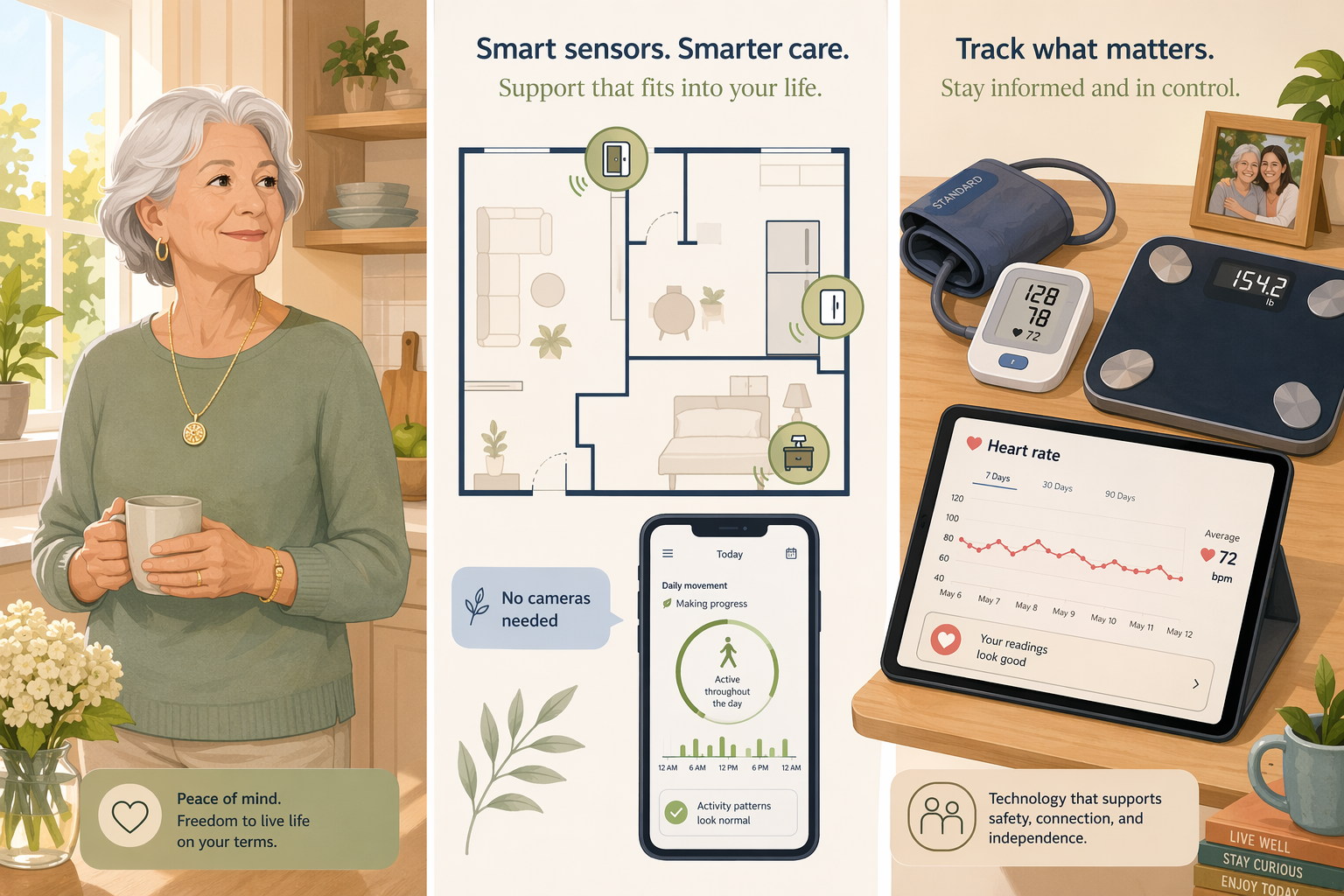
Three months after her mother’s hip replacement, Sarah bought a medical alert pendant. The fall that landed her mother in the hospital was sudden, terrifying, and the only thing she could think about. Three out of four families do exactly that: buy a medical alert system right after a fall or emergency. Sarah was not wrong to react. But she was wrong about what her mother needed.
The pendant sat on the nightstand. Her mother never wore it. And six weeks later, she was back in the ER – not for a fall, but for a blood pressure reading so high the hospitalist later described it as a stroke waiting to happen. The pendant could not have helped. It does not measure blood pressure, does not track trends, and does not send anything to a doctor. It waits for a button press that never came.
Sarah’s story is not rare. It is the reason I wrote this article. I watched it happen for years as a hospital discharge planner: family caregivers conflate two completely different tools – medical alert systems and remote patient monitoring – and end up with the wrong one.
Two Different Tools, Two Different Risks
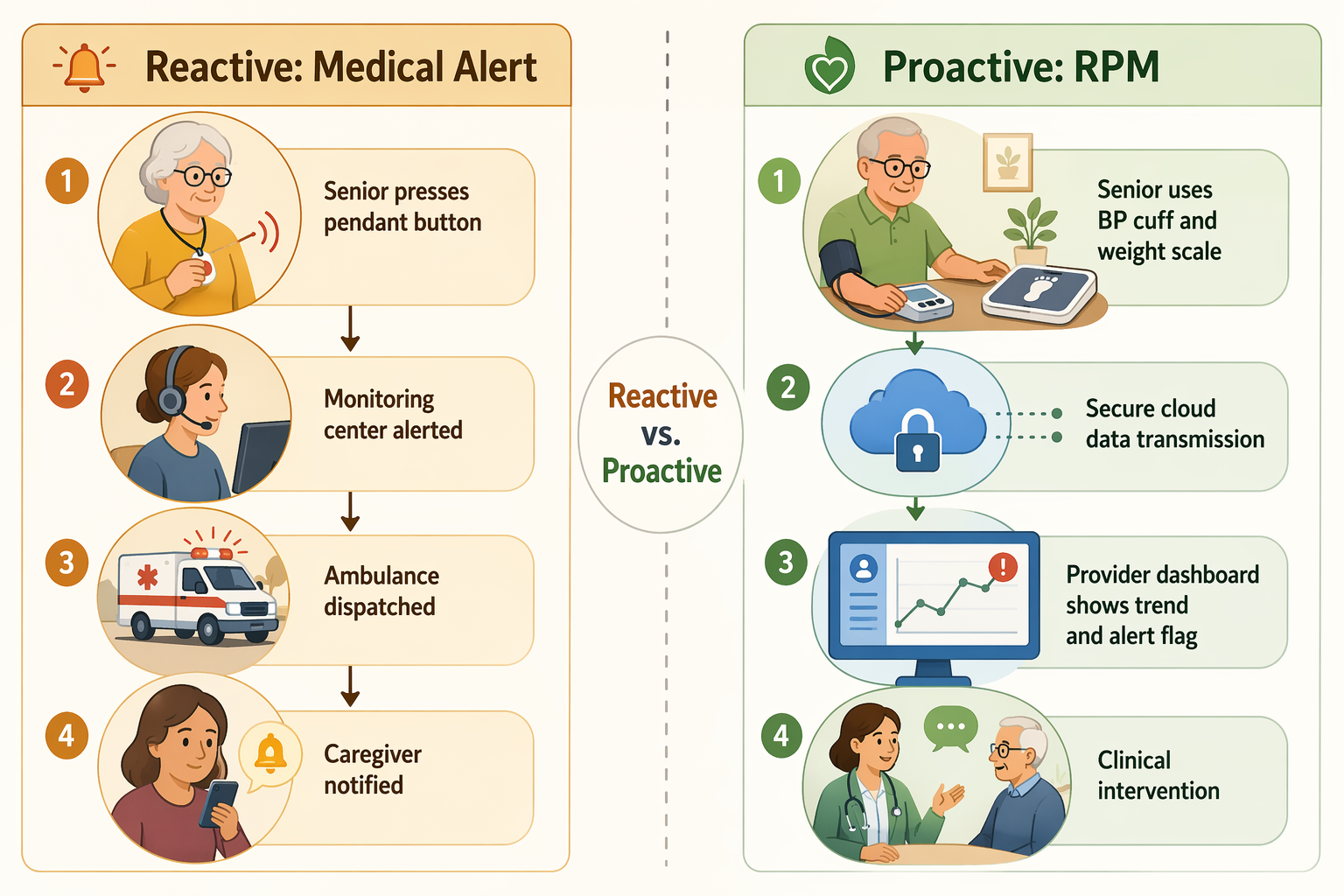
A medical alert system is a panic button. You press it, someone answers, and if needed, emergency services are dispatched. It is reactive. It works after something bad has happened. Remote patient monitoring (RPM) is the opposite: it collects health data – blood pressure, weight, oxygen saturation, glucose – and sends it to a provider who can see trouble coming and intervene before a crisis. One is for falls. The other is for chronic conditions like hypertension, diabetes, or heart failure. Families use them interchangeably. The industry adds a third category — activity/wellness monitoring — that tracks motion but no vital signs. The table below keeps the focus on the two that matter.
| Medical Alert System (PERS) | Remote Patient Monitoring (RPM) | |
|---|---|---|
| Primary purpose | Emergency response after an incident | Continuous clinical monitoring to prevent incidents |
| Hardware | Wearable pendant or wristband with button | FDA-cleared devices: BP cuff, scale, glucometer, pulse oximeter |
| Data collected | None (button press only) | Physiologic data (BP, weight, glucose, SpO2) |
| Who responds | Monitoring center → EMS or caregiver | Healthcare provider (nurse, care coordinator, physician) |
| Monthly cost | $25 – $48 + fall detection add-on $5–$12 | Often $0 to patient under Medicare (if enrolled) |
| Best fit | Senior living alone with fall risk, no unmanaged chronic conditions | Senior with hypertension, diabetes, heart failure, or post-discharge monitoring need |
What $25–$48 a Month Buys You
A monitored medical alert works like this: you press the button, a call connects to a response center within 22 to 51 seconds, the operator identifies themselves and asks what’s wrong. If there is no answer or they confirm an emergency, EMS is dispatched and your phone rings. It is a well-oiled reactive machine. But it collects exactly zero health data.
That is fine if the risk is a sudden fall and the person is otherwise stable. But if the person has a chronic condition that could cause gradual decline – or trigger a fall in the first place – the pendant is a bandage on a leaking pipe.
What RPM Does That a Pendant Can’t
At the University of Pittsburgh Medical Center, a remote monitoring program cut hospital readmissions by 76% and pushed patient satisfaction above 90%.
I have to stop here, because that number gets repeated a lot. The 76% figure comes from a hospital-based program with an integrated care team – it was not just mailing a blood pressure cuff to someone’s home. RPM’s effectiveness depends on provider engagement. If the doctor does not review the data, the device is a pretty paperweight.
That said, the clinical results are real. A separate analysis of an RPM hypertension program showed a 9.1% reduction in systolic blood pressure and 9.7% in diastolic among stage 2 hypertensive patients. And RPM is no longer experimental: claim volume under Medicare’s CPT 99454 jumped 82% from 2021 to 2023. Forty-two states now cover RPM under Medicaid. The market is projected to grow from $14 billion to $42 billion by 2028 – but that last number comes from a market research firm that sells RPM software, so read it as trend direction, not precision.
The Cost Trap: Medicare Pays for RPM, Not the Pendant
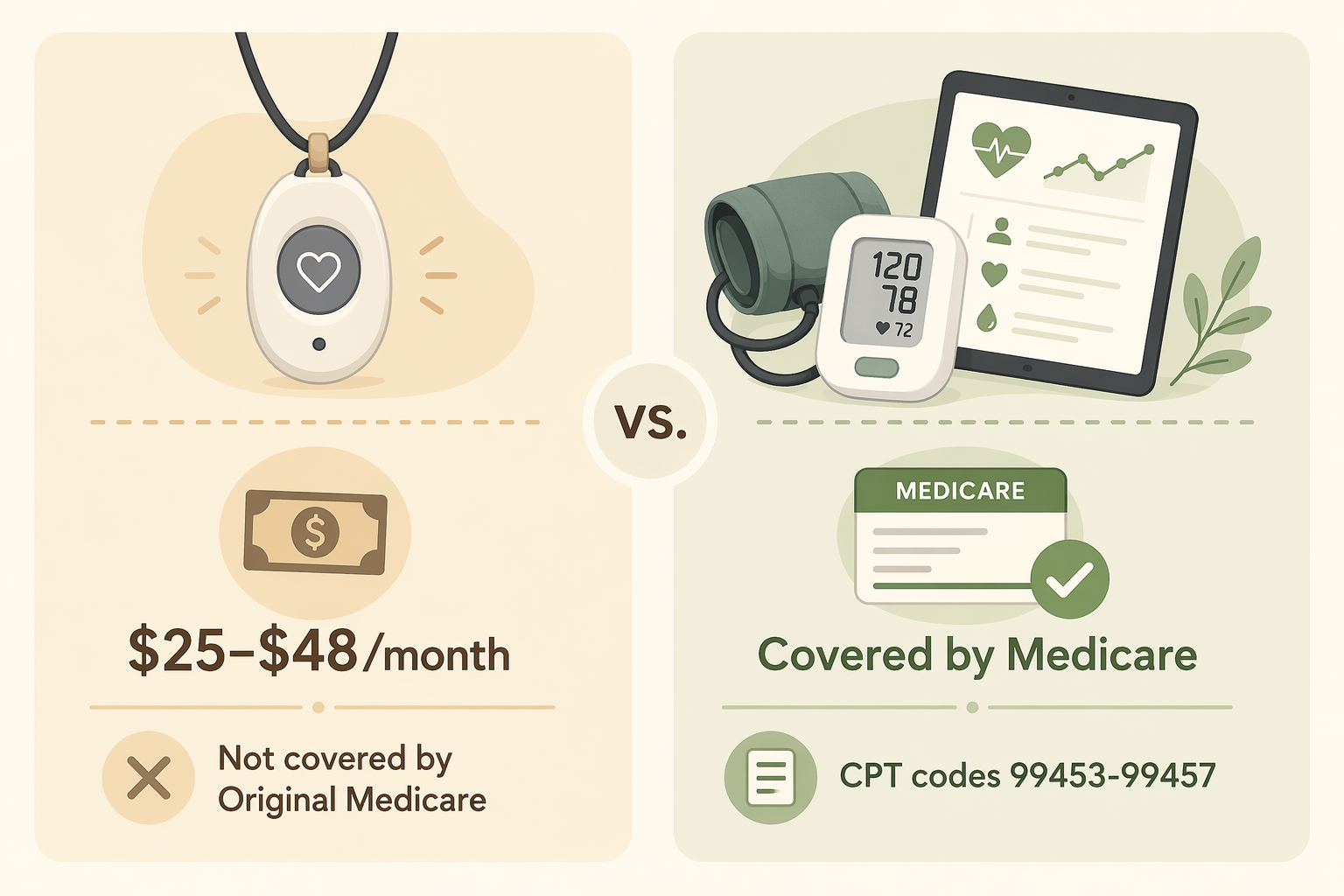
Here is the practical lever most families miss: Medicare generally does not cover medical alert systems. You pay $25–$48 per month out of pocket, plus the equipment cost and any activation fees. Some Medicare Advantage plans offer discounts or allowances, but Original Medicare – which covers the majority of beneficiaries – treats a medical alert as a convenience device, not a medical necessity.
RPM is the opposite. Medicare reimburses it under CPT codes 99453, 99454, and 99457. That means the device and the monitoring service can be provided at no cost to the patient – but only if three conditions are met: the patient has a qualifying chronic condition (hypertension, diabetes, heart failure, COPD, etc.), their provider enrolls in the program, and the patient transmits data at least 16 days per month (that’s the requirement for CPT 99454).
The catch: not every doctor’s office has an RPM program set up. And those that do may not actively review the incoming data. The technology works; the implementation is uneven. But for the family that finds a motivated provider, the financial comparison is stark: $0 for RPM versus $300–$600 per year for a medical alert.
Can You Use Both?
Yes. A senior can wear a medical alert pendant for falls and also use RPM for hypertension. But the decision should be intentional, not default. If the only risk is a sudden fall, a pendant is enough. If the primary risk is a chronic condition like diabetes that can cause gradual deterioration, RPM is the right starting point. If both risks are high – an elderly parent with a history of falls and uncontrolled heart failure – then combine them.
The mistake is buying a medical alert because it sounds like “monitoring” and then discovering, after a preventable hospitalization, that it monitored nothing at all. I have seen that story more times than I can count.
How to Get RPM Started with the Doctor
Schedule an appointment and ask directly: “Does this practice offer remote patient monitoring for my parent’s condition?” Do not ask for a “smart device” or “a way to track vitals at home” – use the term remote patient monitoring, because that is what Medicare recognizes.
- Confirm your parent has a qualifying chronic condition that the provider already manages.
- Ask who enrolls the patient – the provider or a third-party RPM service – and whether the provider actively reviews the data (weekly, monthly, or only when an alert triggers).
- Clarify what device is provided. Cellular-enabled devices are easier for seniors because they transmit automatically without Wi-Fi or app troubleshooting.
- Confirm the commitment: at least 16 days of readings per month to satisfy Medicare billing requirements.
- If the practice does not offer RPM, ask for a referral to a provider that does, or check with the parent’s cardiologist, endocrinologist, or pulmonologist – specialists often have RPM programs.
For tech setup details, see our guide on the Remote Monitoring Tech Stack for Long-Distance Caregiving.
Match the Tool to the Primary Risk
A medical alert is a reactive safety net. RPM is a proactive clinical shield. They are not substitutes, and they are not automatically better together. The right choice depends on your parent’s primary risk: a history of falls with no chronic disease, or a chronic disease that needs surveillance. If both are present, combine them – but do not reach for a pendant just because it is the first thing you see on the shelf.
And if you are still deciding, look at what the payment system will actually cover. For most families, that single factor will tilt the balance. Read more about the total cost of ownership and the top health risks that monitoring technology can address.
Questions to bring to a clinician or OT
This is not medical, legal, or a family's final decision — only a framework. Bring these questions to a clinician, occupational therapist, or your local Area Agency on Aging.
Find Local HelpRelated reading
Noticed something outdated or inaccurate on this page? Flag a correction. We review every report against CDC, NIA, and AARP HomeFit guidance before updating a page.