
Caregiver decision guide
Beyond the Panic Button: Why Passive, Sensor-Based Monitoring Is Replacing Wearables for Elderly Safety
For older adults with early cognitive decline or resistance to wearing devices, traditional medical alert pendants can create a dangerous illusion of safety. This article explains why passive, sensor-based monitoring — requiring no user action — is emerging as a more reliable alternative for long-distance caregivers.
The 50-Year-Old Pendant That Fails When You Need It Most
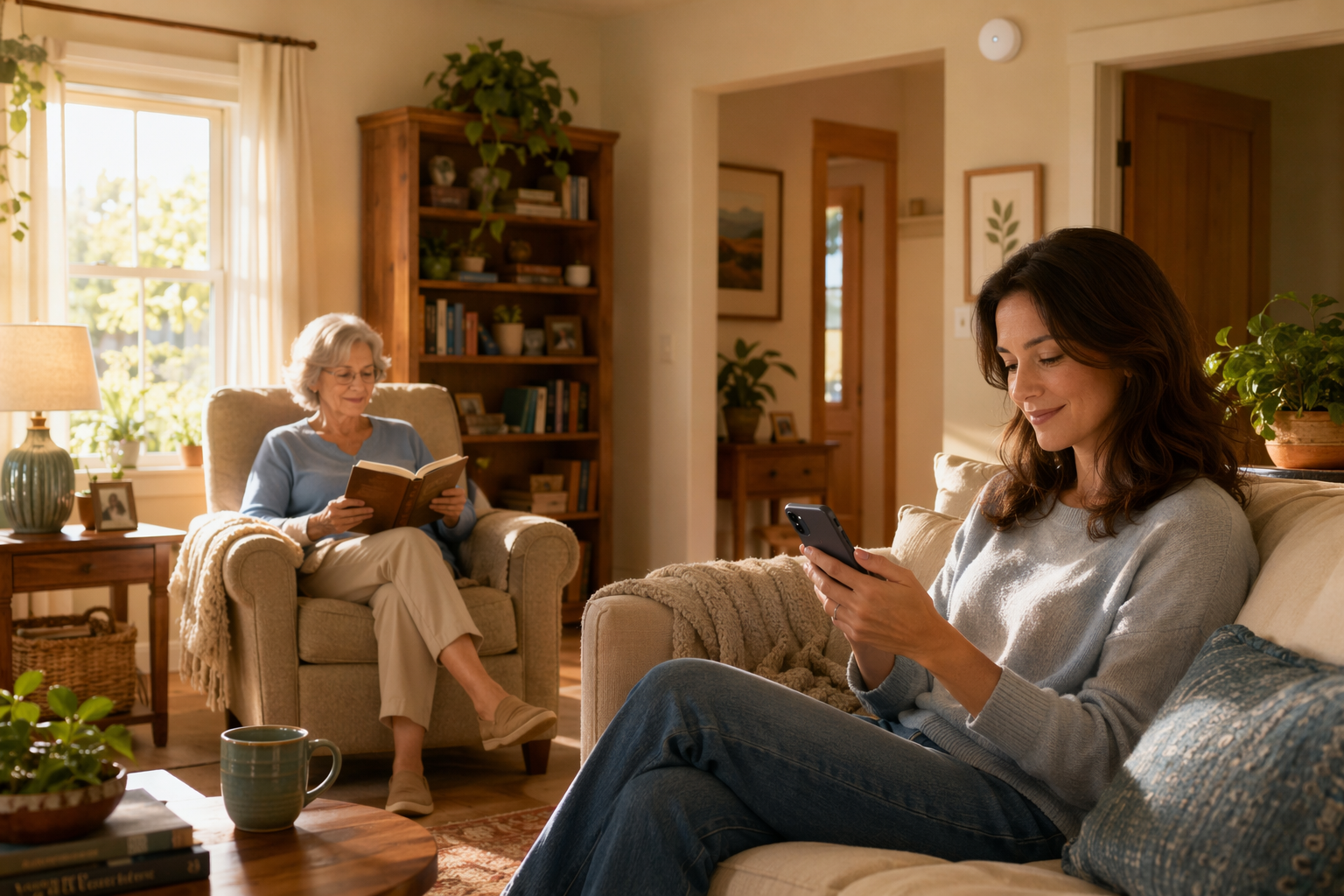
For nearly half a century, the medical alert pendant has been the default answer to a family caregiver's most persistent fear: "What if my parent falls and I'm not there?" The logic seems sound — press a button, get help. But this model rests on a fragile assumption: that the person wearing it will remember to put it on, keep it charged, and have the presence of mind to press it in a crisis. For a growing population of older adults — particularly those with early-stage cognitive decline — that assumption is breaking down.
The stakes are well documented. The CDC reports that over 14 million, or 1 in 4, older adults (age 65+) fall each year, making falls the leading cause of fatal and nonfatal injuries in this age group. The age-adjusted fall death rate rose 21% from 64.7 per 100,000 in 2018 to 78.4 per 100,000 in 2024. About 37% of those who fall report an injury requiring medical treatment or restricted activity for at least one day. These numbers represent real people — parents, spouses, neighbors — who need a safety net that actually works when they cannot call for help themselves.
The traditional pendant was designed for a different era — when the typical user was an otherwise healthy older adult who simply wanted a backup in case of emergency. Today, the population aging in place includes more people living with mild cognitive impairment, early-stage dementia, and the cumulative effects of chronic conditions. For them, the pendant's requirement for consistent wear, charging, and cognitive recall is not a minor inconvenience — it is a fundamental design flaw.
The Compliance Problem: Why Wearables Fail the People Who Need Them Most
The failure modes of wearable alert systems are not hypothetical. They follow predictable patterns that any long-distance caregiver will recognize:
- Forgetting to put it on. The pendant sits on the nightstand, the dresser, or the bathroom counter. The older adult intends to wear it but the habit never forms, or the device is uncomfortable, or it simply slips their mind — especially if short-term memory is already unreliable.
- Not charging it. Battery-powered wearables require a charging routine. For someone who already struggles to manage medications or keep track of appointments, remembering to dock a device every night is another cognitive load that often goes unmet.
- Not pressing the button during a fall. This is the most dangerous failure mode. A fall can cause loss of consciousness, stroke symptoms, confusion, or simply the inability to reach the pendant. As the AARP noted in its 2020 CES coverage, traditional emergency call buttons are "of no use if a loved one can't press the button because of losing consciousness in a fall or having a stroke."
- Cognitive demands of recall. Even when the device is worn and charged, the user must recognize that an emergency is happening, remember that the pendant is the tool for that situation, and execute the action of pressing the button. Each step is a cognitive gate that can fail independently.
The research community has taken note. The 2022 NIH scoping review by Kim et al. explicitly excluded wearable sensors from its analysis of in-home monitoring technology for aging in place. The reason? Older adults with cognitive impairment "may forget to wear or charge them." This is not a marginal concern — it is a methodological decision by researchers who recognized that wearable compliance cannot be assumed in the population that most needs monitoring.
How Passive Monitoring Works: Sensors That Watch Without Being Worn
Passive monitoring systems solve the compliance problem by removing the wearable entirely. Instead of relying on the older adult to carry or activate a device, these systems use a network of stationary sensors placed throughout the home that detect movement, activity patterns, and environmental changes — all without requiring any action from the person being monitored.
The NIH scoping review identified six core functions of in-home monitoring technology: tracking daily activities, detecting abnormal behaviors, assessing cognitive impairment, detecting falls, indoor positioning, and monitoring sleep quality. Across the 30 studies reviewed, the most common non-wearable sensor technologies were:
- Passive infrared (PIR) motion sensors — used in 21 of 30 studies. These detect body heat and movement, creating a baseline of normal activity patterns throughout the day.
- Contact sensors — used in 19 of 30 studies. These are placed on doors, cabinets, and refrigerator doors to detect when they are opened or closed, providing insight into daily routines like meal preparation and coming and going.
- Pressure mats — placed under mattresses, chairs, or rugs near the bed to detect presence, restlessness, or extended inactivity.
- Radar-based sensors — a newer category that uses millimeter-wave technology to detect falls with 98.74% accuracy and a prediction time of 51.4 milliseconds, according to the review.
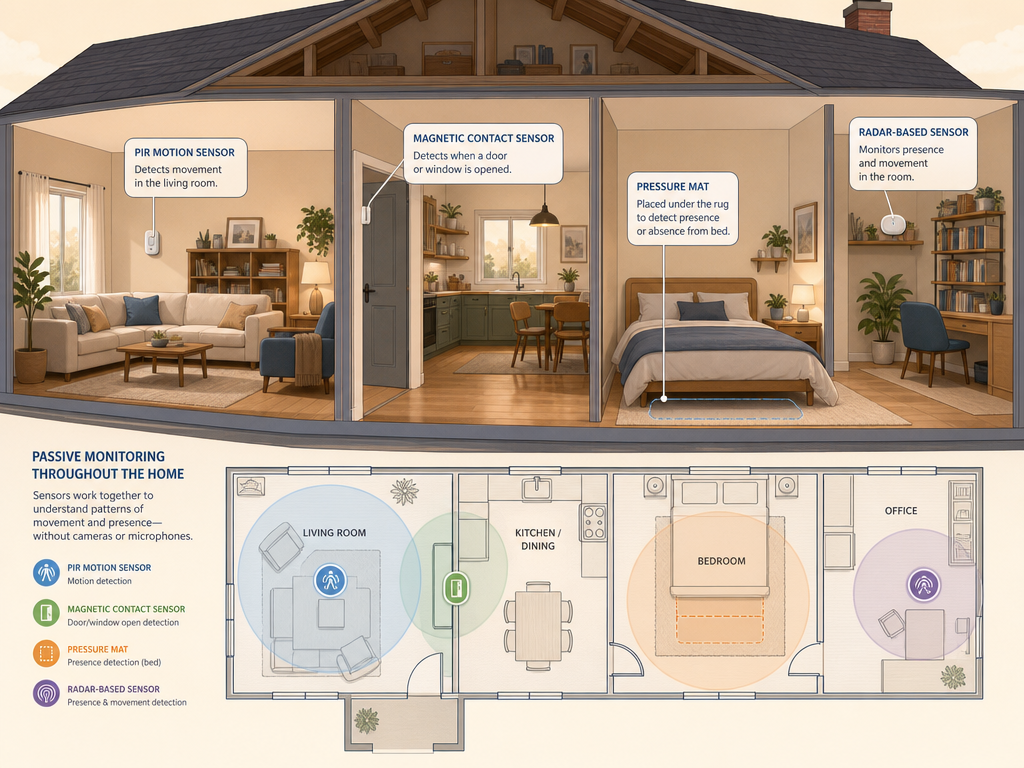
These sensors work together to establish a baseline of normal activity. The system learns when the person typically wakes up, how often they visit the bathroom, when they prepare meals, and when they go to bed. Once that baseline is established, the system can detect deviations — a missed morning trip to the kitchen, an unusually long period of inactivity in the bathroom, or a sudden motion pattern that suggests a fall — and send an alert to a designated caregiver.
The key distinction from wearables is that the older adult does nothing. They do not wear a device, charge a battery, or press a button. The sensors work continuously in the background, and the caregiver receives information only when something is wrong. For someone with early cognitive decline who cannot reliably manage a wearable, this is not a convenience — it is the difference between a system that works and one that creates a false sense of security.
The 'Long Lie' After a Fall: Why Every Minute Counts
The most feared scenario for any family caregiver is the "long lie" — a fall where the older adult cannot get up and cannot call for help. Emergency rooms, as the envoyatHome guide notes, are "full of patients who thought they'd be fine for a quick trip to the bathroom" and ended up on the floor for hours. The consequences of a prolonged lie on the floor are severe: dehydration, pressure injuries, hypothermia, muscle breakdown, and in some cases, fatal complications.
This is the scenario where passive monitoring's advantage is most stark. A wearable pendant is useless if it is on the nightstand or if the person cannot press the button. A passive system, by contrast, detects the fall through radar or motion pattern analysis and alerts the caregiver automatically — without any action from the person on the floor.
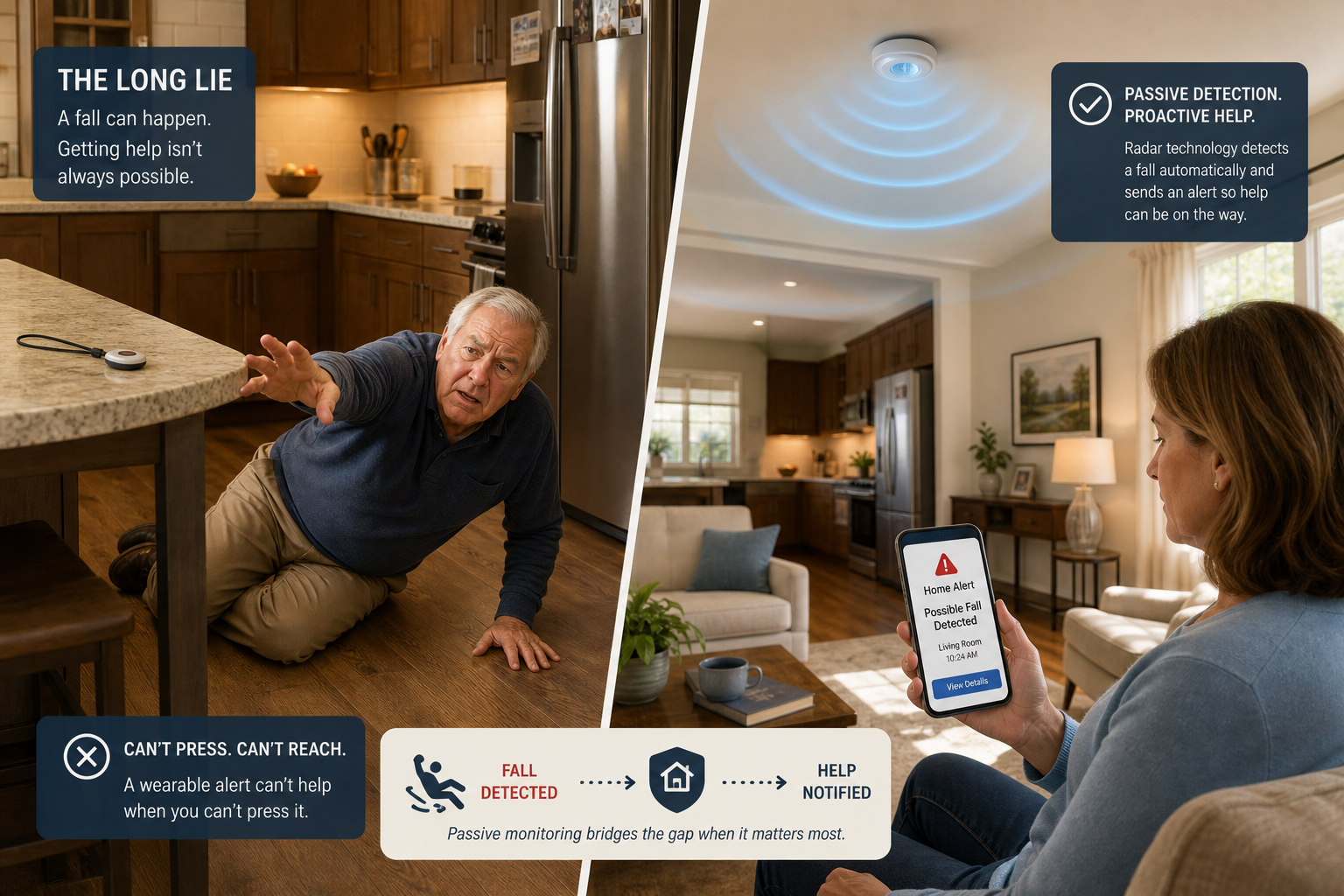
The envoyatHome guide highlights that passive monitoring can detect "the subtle slide off the couch while reaching for the remote" as it happens — not minutes or hours later when someone happens to call and gets no answer. This real-time detection capability, combined with the radar-based accuracy of 98.74% documented in the NIH review, means that the window between fall and response shrinks from hours to minutes.
Privacy Without Cameras: Why Sensor Systems Win Trust
When families first consider monitoring technology, the conversation often stalls on one word: cameras. The idea of being watched — even by well-meaning adult children — can feel like a violation of dignity and independence. This resistance is not irrational. It is a deeply human response to the loss of privacy that aging already imposes.
The AARP's 2020 CES coverage captured this tension perfectly. Ryan Herd of Caregiver Smart Solutions set up a camera system for his 73-year-old father, only to find that his father had covered the camera with a dish towel. The message was unmistakable: "People don't want anybody watching them." That experience led Herd's company to develop systems that forgo cameras entirely, using movement sensors instead.
"People don't want anybody watching them." — Ryan Herd, Caregiver Smart Solutions, as reported by AARP (2020)
Passive sensor systems address this concern directly. They detect activity patterns, not images or conversations. A PIR motion sensor knows that someone walked through the hallway at 2:00 AM — but it does not know who it was, what they were wearing, or what they looked like. A contact sensor knows the refrigerator door was opened at 8:00 AM — but it does not record what was taken out or how it was prepared. This distinction matters enormously for acceptance.
For the older adult, the trade-off is clear: the system knows when you are active and when you are not, but it does not see you, hear you, or record your private moments. For the caregiver, the trade-off is equally clear: you receive alerts about deviations from normal patterns, but you cannot pull up a live video feed to check on your parent in real time. This is not a limitation — it is the feature that makes the system acceptable to people who would otherwise reject monitoring entirely.
What Passive Monitoring Cannot Do (And Why That Matters)
Honesty about limitations is essential for making an informed decision. Passive monitoring is not a universal solution, and understanding its gaps prevents the same kind of false security that plagues the wearable pendant model.
- No video verification. When an alert comes in — say, an unusual period of inactivity — the caregiver cannot look at a video feed to assess the situation. They must call, visit, or rely on a neighbor to check in person. This adds a step between alert and response that some families find frustrating.
- No two-way communication. Unlike a wearable pendant with a built-in speaker and microphone, passive sensors cannot talk to the person who has fallen. The caregiver must use a separate phone call or intercom system to communicate.
- Dependency on established activity patterns. The system learns what "normal" looks like for a specific person in a specific home. Unusual but harmless behavior — a late-night visitor, a change in medication schedule, a bout of insomnia — can trigger false alarms. Over time, the system adapts, but the initial setup period can produce more alerts than expected.
- No coverage outside the home. Passive sensors are installed in the home. They cannot detect a fall at the grocery store, on a walk, or at a doctor's appointment. For an active older adult who spends significant time away from home, a wearable with GPS and fall detection may still be necessary for out-of-home safety.
These limitations do not negate the value of passive monitoring — they define its appropriate use case. The goal is not to find a perfect system that covers every scenario. It is to match the technology to the person's actual needs, cognitive abilities, and daily routines.
When Passive Monitoring Is the Right Choice — and When It Isn't
The decision between passive monitoring and a wearable system should be driven by one question: Can this person reliably wear, charge, and activate a device? If the answer is no — or if you are not sure — passive monitoring is likely the safer choice. The table below summarizes the key scenarios.
| Situation | Recommended approach | Why |
|---|---|---|
| Early cognitive decline; forgets to wear or charge devices | Passive sensor system | Removes the compliance burden entirely; works without user action |
| Resists wearables or cameras due to privacy concerns | Passive sensor system | No cameras, no microphones; detects activity patterns without recording images or conversations |
| Cognitively intact, active, spends time away from home | Wearable with GPS and fall detection | Provides coverage outside the home; user can reliably manage the device |
| Lives alone with significant mobility or balance issues | Passive sensor system (primary) + wearable (supplemental) | Passive covers in-home falls when the wearable is not worn; wearable provides out-of-home coverage |
| Specific safety concern requiring visual confirmation (e.g., stove left on, wandering) | Camera system with full consent | Cameras provide visual verification that sensors cannot; requires explicit consent and clear purpose |
The 2026 Wirecutter guide reflects this shift in thinking. It recommends the UnaliWear Kanega watch ($300 + $80/month) for on-the-go care, noting its fall detection and medication reminders. But it also highlights passive systems like the Caregiver Smart Solutions Core Kit ($899 + $59/month) that forgo cameras for movement sensors — addressing both privacy and compliance. The coexistence of both recommendations in a single guide underscores the point: there is no one-size-fits-all solution, but for the growing population of older adults who cannot reliably manage a wearable, passive monitoring is not just an alternative — it is the safer choice.
The traditional medical alert pendant served a generation well. But the population aging in place today is different — older, more likely to live alone, and more likely to be managing cognitive changes that make wearable compliance unreliable. Passive, sensor-based monitoring is not a futuristic concept. It is a practical, evidence-supported solution that is available now, and for many families, it is the difference between a system that creates real safety and one that only creates the illusion of it.
Questions to bring to a clinician or OT
This is not medical, legal, or a family's final decision — only a framework. Bring these questions to a clinician, occupational therapist, or your local Area Agency on Aging.
Find Local HelpRelated reading
- The Monitoring Conversation: How to Talk to an Aging Parent About Safety Technology Without Damaging Trust or Autonomy
- When Is 24/7 Care Actually Necessary? A Decision Framework for Using Monitoring Technology as a Safe Alternative
- Elderly Monitoring Systems: Camera-Free vs. Camera-Based Options for Your Parent's Safety
Noticed something outdated or inaccurate on this page? Flag a correction. We review every report against CDC, NIA, and AARP HomeFit guidance before updating a page.