Overnight Care for Elderly: Comparing Human Care vs. Technology Monitoring
PERSPrivacy & Consent CoveredReviewed: 2026-06-20
Overnight Care for Elderly: Comparing Human Care vs. Technology Monitoring
A practical guide for family caregivers weighing the costs of professional overnight caregivers against technology-based monitoring solutions. Learn how a tiered, risk-based approach can help you choose the right combination of human care and monitoring for your parent's safety and your peace of mind.
Features Covered in This Explainer
fall detection, battery life, range, response time
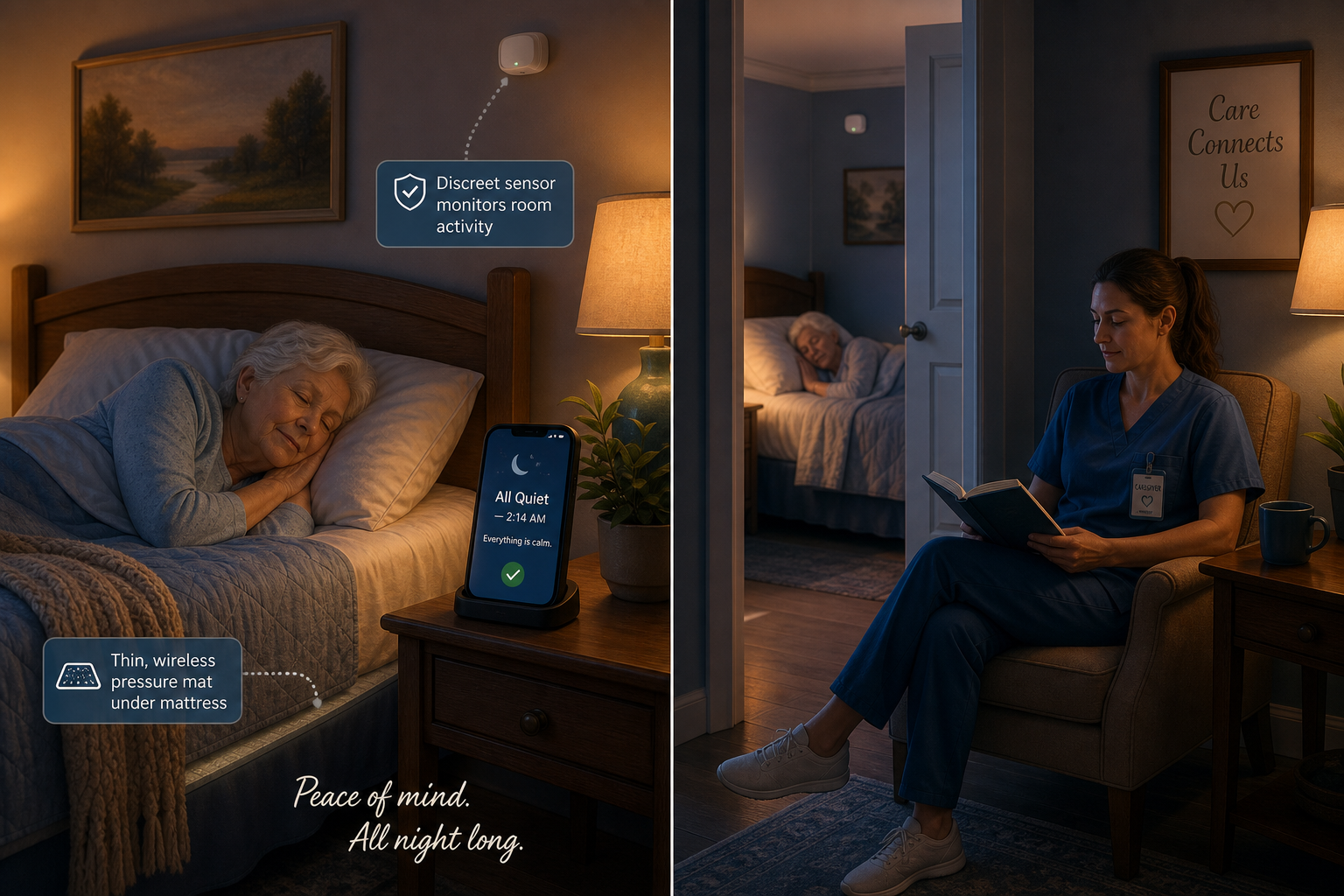
Two approaches to overnight safety: passive monitoring technology vs. professional human care.
The Nighttime Vulnerability Problem: Why Overnight Care Matters
Nighttime is the most dangerous period for many older adults living at home. The combination of darkness, disorientation, and the natural urge to use the bathroom creates a perfect storm for falls, injuries, and unattended home exits. For family caregivers, the question of how to keep a parent safe through the night is often the one that keeps them awake.
The numbers are sobering. Sleep problems affect between 40% and 70% of seniors, according to a 2025 report from SeniorSite. A study from the University of Alabama at Birmingham found that older adults who need to get up to use the bathroom at night — a condition called nocturia — are nearly 30% more likely to fall. For families caring for someone with dementia, the stakes are even higher. More than half of persons with dementia will experience night-time wandering, which is a major predictor of caregiver burnout and one of the leading causes of early institutionalization, according to a 2020 pilot study by Ault et al.
These risks create a difficult choice for adult children in their 40s and 50s: hire a professional overnight caregiver at significant cost, rely on technology monitoring, or try to manage the nights themselves — often at the expense of their own health and job performance. The good news is that this does not have to be an all-or-nothing decision.
Option A: Professional Overnight Caregivers — Costs and Considerations
Professional overnight care is the gold standard for hands-on assistance. A trained caregiver can help with toileting, repositioning in bed, medication administration, and immediate response to falls or wandering. But that level of support comes at a price.
Nationally, overnight care costs between $25 and $35 per hour, according to SeniorSite's 2025 data. However, overnight shifts are often surcharged due to the scarcity of caregivers willing to work those hours, with rates reaching $50 or more per hour in some markets. The structure of the shift also matters.
Estimated costs for professional overnight care options (2025 data from SeniorSite and Care.com).
Care Type
Typical Cost
What It Includes
Sleeping night care
$120–$200 per night (10–12 hrs)
Caregiver sleeps but is available for emergencies; toileting and repositioning assistance
Waking night care
~$250 per night (10–12 hrs)
Caregiver stays awake; full assistance with transfers, medication, and monitoring
Live-in care
$200–$350 per day
24-hour presence; caregiver sleeps at night but is on call for emergencies
Agency caregiver
20–30% more than independent
Bonded, insured, with backup coverage; higher hourly rate
Independent caregiver
Lower hourly rate
Direct hire; no agency markup; less formal backup
The Fair Labor Standards Act allows employers to exclude up to 8 hours of sleep time from a caregiver's pay, provided the caregiver receives at least 5 hours of uninterrupted sleep. This is why "sleeping night care" shifts are often offered as a flat rate rather than an hourly wage. However, if the caregiver is awakened frequently, the entire shift may need to be paid at the hourly rate.
State-by-state variation is significant. A Place for Mom's 2026 report shows median home care costs ranging from $25 per hour in Mississippi to $44 per hour in South Dakota. In major cities, Care.com data from September 2025 shows posted starting rates ranging from $20.52 per hour in Atlanta to $29.55 per hour in Seattle. These figures are for general home care, and overnight shifts typically command a premium.
Option B: Monitoring Technology — What It Can and Cannot Do
Monitoring technology offers a dramatically lower-cost alternative, but it is important to understand its capabilities and limitations. These systems do not provide hands-on care — they provide alerts, data, and peace of mind. For the right situation, that can be enough.
A 2022 NIH scoping review by Kim et al. identified 30 studies on in-home monitoring technology for older adults and found six core functions: monitoring daily activities, detecting abnormal behaviors, identifying cognitive impairment, detecting falls, tracking indoor person positioning, and assessing sleep quality. The most common sensor technologies were passive infrared motion sensors (used in 21 of 30 studies) and contact sensors (used in 19 of 30 studies).
For overnight safety, the most relevant technology categories include:
Passive infrared motion sensors: Placed in hallways and bathrooms to detect movement patterns. If your parent normally gets up at 2 AM to use the bathroom but no motion is detected, the system can alert you.
Contact sensors: Placed on doors and cabinets. These can alert you if an exterior door is opened (wandering risk) or if a medicine cabinet is accessed at an unusual hour.
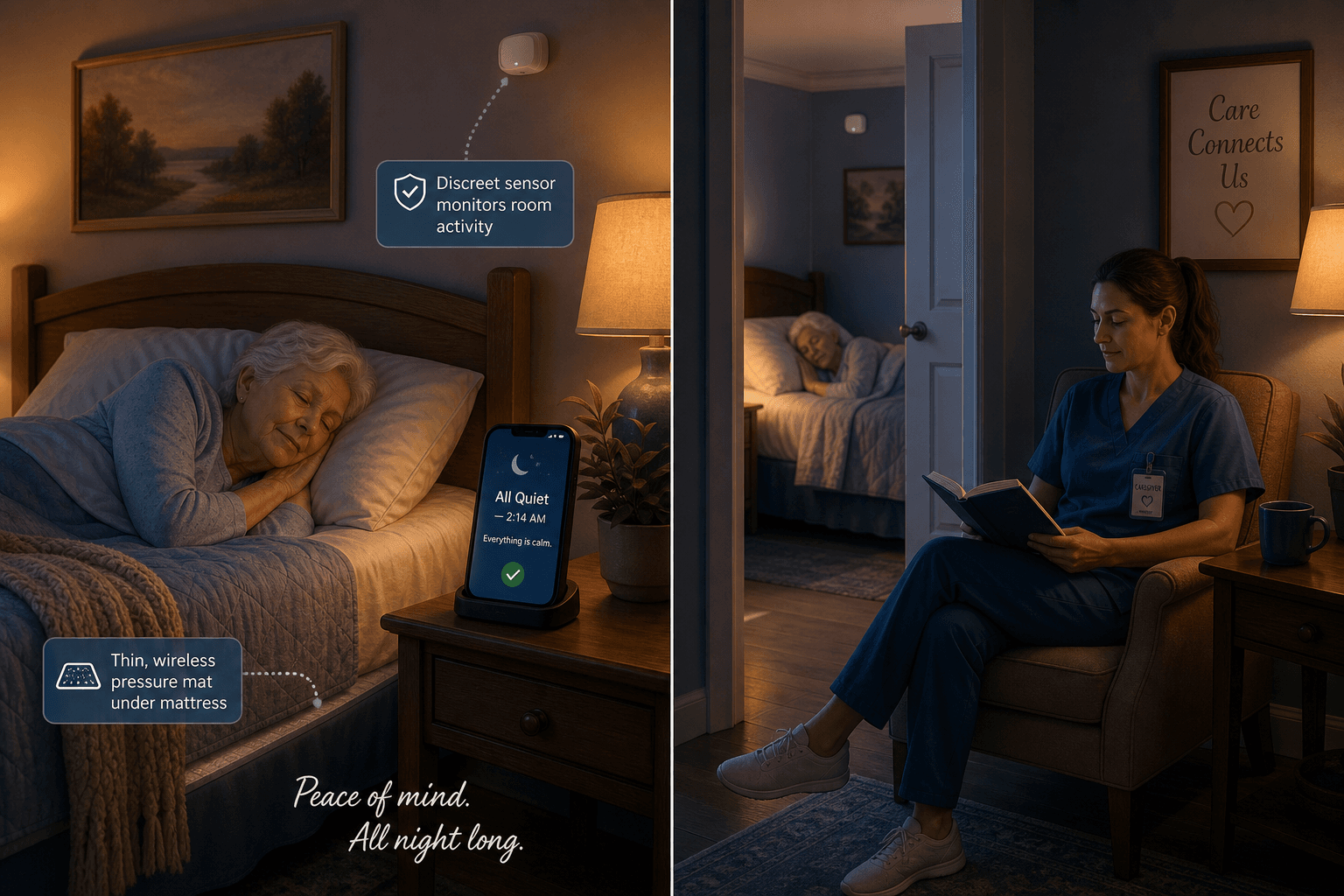
Pressure mats: Placed beside the bed or on a chair. These detect when your parent gets up, which is especially useful for fall risk monitoring during the night.
Smart lighting: Motion-activated nightlights that illuminate the path to the bathroom, reducing the risk of tripping in the dark.
Fall detection systems: Using millimeter-wave radar or WiFi-based sensing, these systems can detect falls with high accuracy. The NIH review noted that one millimeter-wave radar system achieved 98.74% accuracy, and a WiFi-based DeFall system achieved approximately 95% detection rates.
The 2020 pilot study by Ault et al. tested an off-the-shelf smart home system combining pressure mats, motion sensors, smart lights, and speakers specifically for night-time wandering in persons with dementia. In the 12-week pilot with five dyads, average caregiver depression scores decreased from 5.2 to 3.6, and anxiety scores from 6.8 to 5.8. The system was designed to cue lighting to guide the person to the bathroom and only alert the caregiver if an exit door was opened — a model that balances safety with minimal disruption.
How different monitoring technologies address specific overnight risks.
Technology
Overnight Risk Addressed
Hands-On Assistance?
Passive motion sensors
Nocturia path monitoring, missed routines
No — provides alerts only
Pressure mats (bed exit)
Fall risk during bed exits
No — provides alerts only
Contact sensors (doors)
Wandering, unattended home exits
No — provides alerts only
Smart lighting
Tripping in the dark
No — passive environmental modification
Fall detection systems
Falls in bedroom or bathroom
No — detects falls but cannot help the person up
The cost of these systems is typically $99 to $150 per month, plus a one-time equipment fee that can range from $200 to $400. For example, one passive monitoring system using motion, door, and cabinet sensors costs $99 per month with a $399 equipment fee. This represents a 40- to 60-fold cost reduction compared to full-time overnight human care.
Cost Comparison: Human Care vs. Technology Monitoring
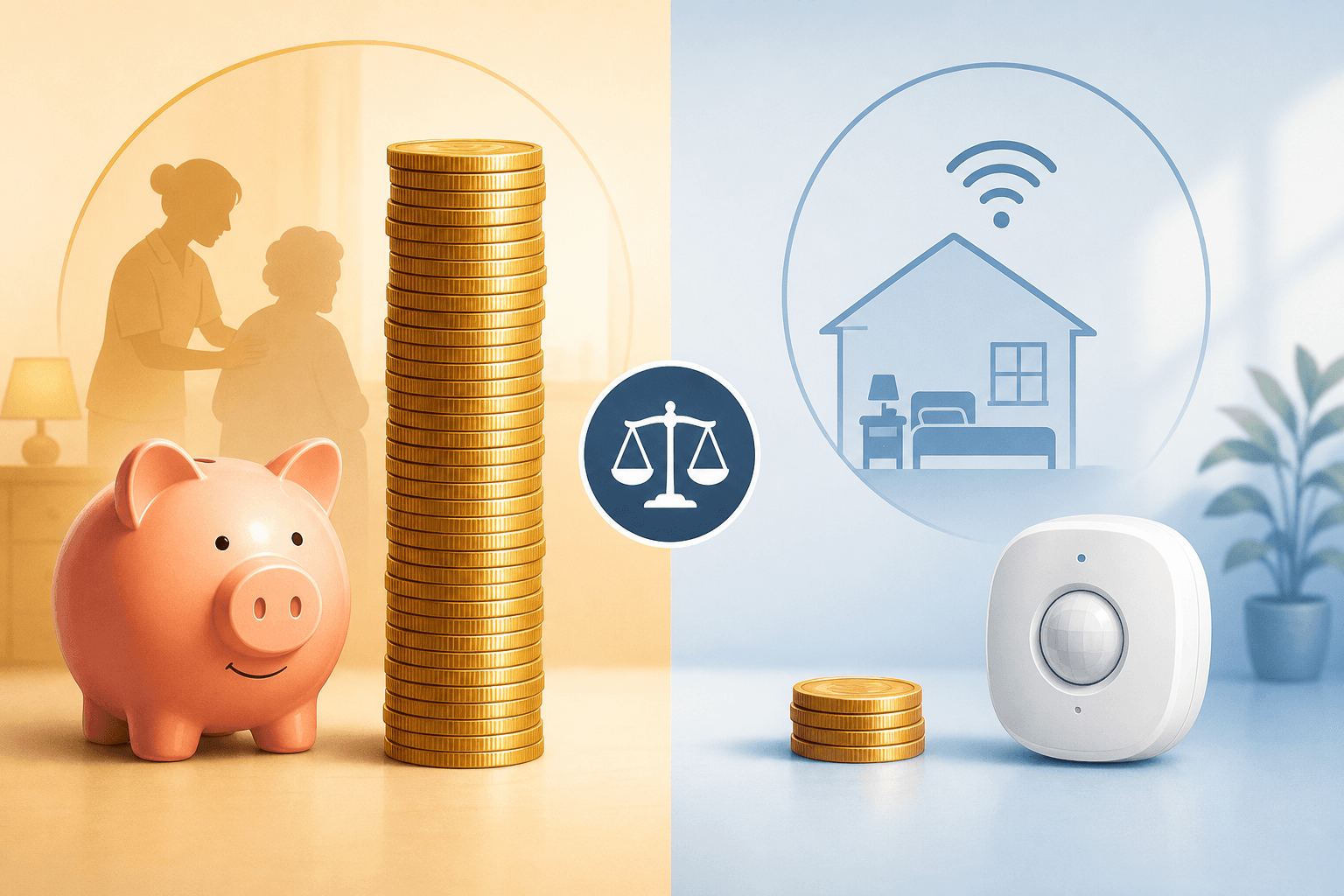
The cost gap between human care and technology monitoring is dramatic — but must be weighed against the hands-on assistance gap.
The cost difference between professional overnight care and technology monitoring is not small — it is transformative for most family budgets. But the gap in what each option provides is equally significant.
Monthly cost comparison: professional home care vs. monitoring technology (2025–2026 data).
Care Scenario
Hours per Week
Estimated Monthly Cost
Minimal home care (A Place for Mom 2026 median)
7 hrs/week
~$1,031/mo
Part-time home care (A Place for Mom 2026 median)
15 hrs/week
~$2,208/mo
Half-time home care (A Place for Mom 2026 median)
30 hrs/week
~$4,416/mo
Full-time home care (A Place for Mom 2026 median)
44 hrs/week
~$6,478/mo
Sleeping night care (7 nights/week, SeniorSite 2025)
70–84 hrs/week
~$4,200–$6,000/mo
Waking night care (7 nights/week, SeniorSite 2025)
70–84 hrs/week
~$7,000–$8,750/mo
Passive monitoring technology
24/7 coverage
$99–$150/mo
Monitoring + equipment fee (first year amortized)
24/7 coverage
~$130–$180/mo
The table makes the arithmetic clear: full-time home care at 44 hours per week costs approximately $6,478 per month at the national median rate. Passive monitoring technology costs $99 to $150 per month — a 40- to 60-fold difference. However, the monitoring system cannot help your parent out of bed, guide them to the bathroom, or provide a steadying arm when they are unsteady on their feet.
A Decision Framework: Matching Nighttime Risk to the Right Intervention
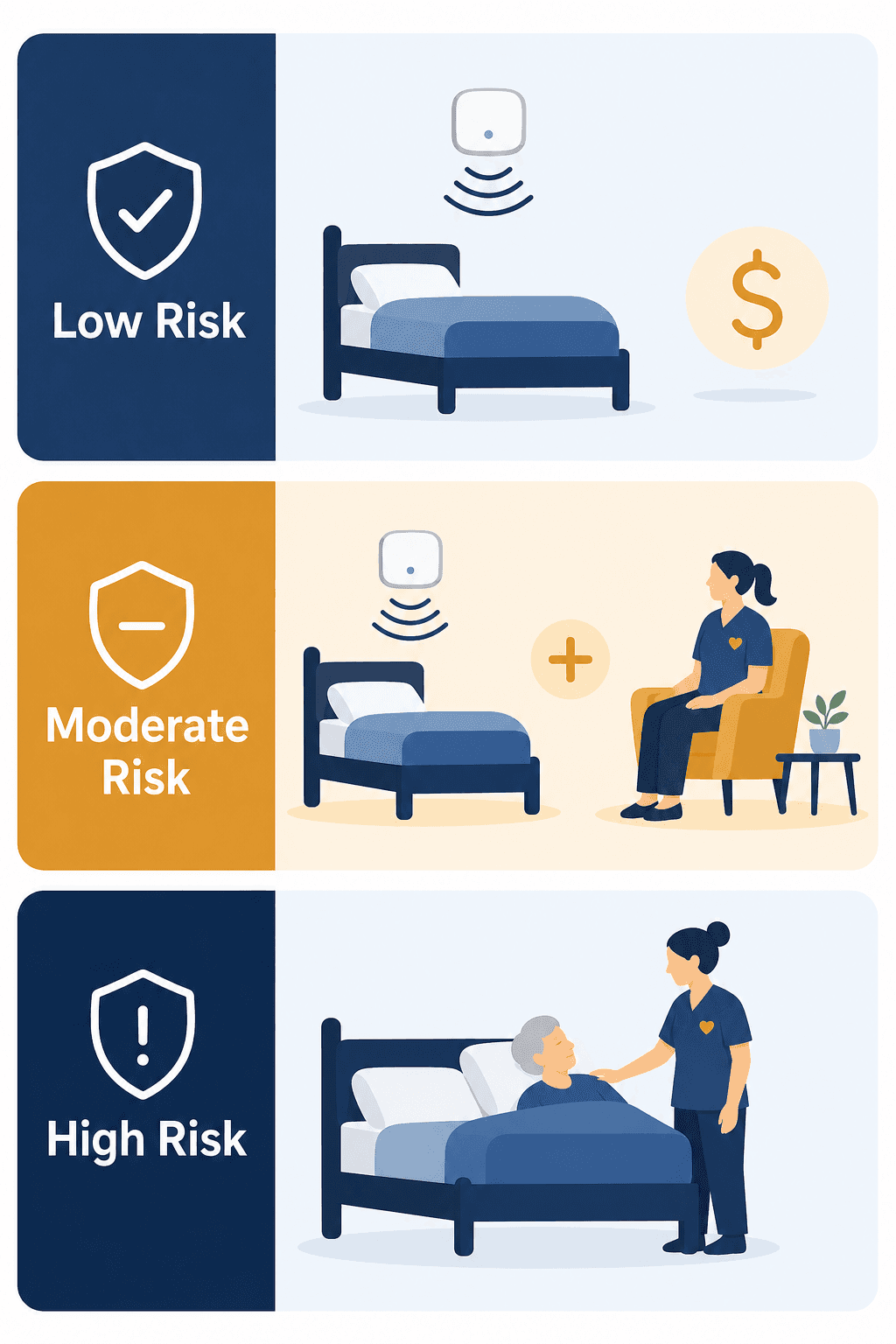
A tiered approach to overnight care: matching the level of intervention to the level of risk.
The most effective strategy is not to choose between human care and technology — it is to match the level of intervention to your parent's specific nighttime risk profile. Here is a framework to help you assess where your parent falls.
A tiered decision framework for matching nighttime risk to the appropriate care intervention.
Risk Level
Typical Profile
Recommended Approach
Estimated Monthly Cost
Low Risk
Independent with daily activities; no dementia; rare nocturia (0–1 trips per night); no history of nighttime falls
Passive monitoring technology (motion sensors, smart lighting, bed exit mat). No human care needed.
$99–$150/mo
Moderate Risk
Some fall risk; mild cognitive impairment; frequent nocturia (2+ trips per night); uses a walker or cane; history of one nighttime fall
Monitoring technology + part-time human backup (e.g., family member on call, or hired caregiver 2–3 nights per week). Smart lighting and pressure mats are essential.
$200–$2,500/mo depending on backup hours
High Risk
Dementia with wandering or sundowning; incontinence; high fall risk; history of multiple nighttime falls; recent unattended home exit
Waking professional caregiver or live-in care. Monitoring technology can supplement but cannot replace hands-on assistance.
$6,000–$12,000+/mo
To assess your parent's risk level, start with these questions:
How many times does your parent get up to use the bathroom at night? (Nocturia frequency is the single strongest predictor of nighttime fall risk.)
Has your parent fallen at night in the past 12 months? Even one nighttime fall warrants moving to at least the moderate-risk tier.
Does your parent have dementia or another cognitive impairment? If yes, add wandering and sundowning to the risk assessment.
Is your parent able to call for help after a fall? If not, a fall detection system with automatic alerting is critical.
Does your parent wear incontinence briefs at night? If so, they may need assistance with changing, which technology cannot provide.
Hybrid Approaches: Combining Technology with Part-Time Human Care
For most families, the most practical and sustainable solution is a hybrid model that combines the affordability of technology monitoring with the safety net of part-time human care. This approach acknowledges that the choice is not binary — it is a spectrum.
Here are three common hybrid scenarios that families have found effective:
Technology during the week, human care on weekends: Passive monitoring covers Monday through Thursday nights. A professional caregiver is hired for Friday and Saturday nights, giving the family caregiver a break and providing hands-on support during the highest-risk weekend period.
Monitoring with family on call: The monitoring system sends alerts to a family member who lives nearby or to a long-distance caregiver via smartphone. The family member only responds when an alert indicates a problem — a fall, an open exterior door, or an extended period of immobility. This can reduce the need for hired care to a few nights per month.
Technology to reduce overnight shift frequency: If your parent currently has a waking caregiver every night, monitoring technology may allow you to reduce coverage to every other night or to a sleeping caregiver arrangement. The system provides a safety net on the nights without human care.
The key insight is that monitoring technology does not replace human care — it extends it. By providing continuous surveillance at a fraction of the cost, it allows families to deploy expensive human care hours where they are most needed: during the highest-risk periods and for the most vulnerable individuals.
Privacy, Dignity, and Consent Considerations
Introducing overnight monitoring — whether human or technological — raises important questions about privacy and dignity. These concerns are especially acute when the older adult has cognitive impairment and may not fully understand or consent to the monitoring.
The most privacy-preserving approach is to use passive sensor systems that do not use cameras, wearables, or listening devices. Passive infrared motion sensors, contact sensors, and pressure mats can detect movement, bed exits, and door openings without recording images or audio. This means your parent can go about their nighttime routine without feeling watched.
When choosing a monitoring system, consider these privacy-related questions:
Does the system use cameras or audio recording? If so, who has access to the recordings, and how are they stored?
Can the system be configured to only alert you during specific hours (e.g., 10 PM to 6 AM) to avoid unnecessary notifications during the day?
Is the data stored locally or in the cloud? If cloud-based, what is the data retention policy?
Can the older adult easily disable the system if they feel uncomfortable? (This is especially important for cognitively intact individuals who value their autonomy.)
Involving the older adult in the decision-making process is critical, even when cognitive impairment is present. Explain what the system does and why it is being installed. If possible, let them choose where sensors are placed and which alerts they are comfortable with. For individuals with dementia, the conversation may need to be repeated and simplified, but the effort to include them respects their dignity.
Next Steps for Families: How to Start the Conversation and Take Action
Making a decision about overnight care can feel overwhelming, but you do not need to have all the answers today. Here is a practical sequence of steps to move from uncertainty to a plan.
Assess nighttime risks. Use the questions in the decision framework above to determine your parent's risk level. Be honest about fall history, nocturia frequency, and any wandering or sundowning behaviors.
Discuss options with your parent. Have a calm, collaborative conversation about safety at night. Frame it as a way to help them stay at home longer, not as a loss of independence. If cognitive impairment makes this conversation difficult, involve their primary care provider or a geriatric care manager.
Consult their primary care provider. Ask about fall risk assessment, medication adjustments that might reduce nocturia, and whether an occupational therapy home evaluation would be beneficial. An OT can recommend specific environmental modifications and monitoring solutions.
Research monitoring technology categories. Focus on understanding the types of systems available — passive sensors, bed mats, door alarms, fall detection — rather than specific brands. Compare features like battery life, range, fall detection accuracy, response time, and privacy model.
Get cost estimates from local home care agencies. Ask specifically about overnight shift rates, sleeping vs. waking care options, and whether they have caregivers available for the hours you need. Get quotes from at least two agencies.
Start with a trial period. If possible, begin with monitoring technology for two to four weeks. Review the data and alerts to understand your parent's actual nighttime patterns. You may discover that their risk is lower than you feared — or that it is higher, in which case you can escalate to a hybrid or full human care model.
The goal is not to find the perfect solution on day one. It is to start with a reasonable approach, observe what happens, and adjust as needed. Many families find that a hybrid model — technology monitoring with a carefully calibrated amount of human backup — provides the best balance of safety, cost, and peace of mind.
For individualized recommendations:An occupational therapist or your primary care provider can assess your specific situation and recommend the monitoring category and feature set that best fits the person's functional level, living environment, and caregiver availability. This explainer provides educational context, not a personalized recommendation.

Comments
Join the discussion with an anonymous comment.