
Caregiver decision guide
Short-Term Care for Elderly: A Complete Guide to Options, Costs, and Medicare Coverage in 2026
A decision-oriented guide for adult children facing a parent's recent hospitalization, fall, or functional decline. Compares five short-term care options — respite care, short-term assisted living, skilled nursing/rehab, adult day care, and in-home care — with 2026 cost data, Medicare coverage rules, and a framework for choosing the right option under time pressure.

Introduction: The Crisis Moment When Most Caregivers Default to the First Option
When a parent is discharged from the hospital after a fall or a sudden health crisis, the clock starts ticking. You have hours — sometimes less than a day — to figure out where they will go next. In that pressure cooker, most families reach for the first facility that has an open bed. It is a completely understandable response, and it is also one of the most expensive mistakes a caregiver can make.
The problem is not a lack of options. It is a lack of awareness. According to the ARCH National Respite Network, 87% of family caregivers receive no respite services at all, even though nearly 4 in 10 rank respite as their greatest unmet need. Meanwhile, a 2025 survey of over 1,000 family caregivers found that 78% report feeling burned out, and the average caregiver spends $7,200 per year out of pocket on care-related expenses. With 63 million family caregivers in the U.S. providing an estimated $1 trillion in unpaid care annually, the stakes are enormous — and the financial consequences of a rushed decision are growing.
This guide is built for that crisis moment. It lays out five distinct short-term care options side by side — what they cost in 2026, how Medicare does (and does not) pay for each, and how to match the right option to your parent's specific medical and personal needs. The goal is not to recommend one option over another. It is to make sure you know the full landscape before you sign anything.
The Five Short-Term Care Options at a Glance
Short-term care is not a single product. It is a category that spans five fundamentally different service models, each designed for a different combination of medical need, duration, and setting. Before diving into the details, here is what each one is and when it typically gets used.
- Respite care: Temporary relief for the primary caregiver, lasting from a few hours to several weeks. Can happen at home, in a facility, or at an adult day center. Often used when the caregiver needs to travel, recover from illness, or simply prevent burnout.
- Short-term assisted living: A residential stay of days to weeks in an assisted living community. Provides help with daily activities (dressing, bathing, eating), meals, medication management, and social activities. Often used for post-surgery recovery or as a trial run before a permanent move.
- Skilled nursing facility (SNF) / rehab: The most common post-hospitalization option. Provides 24/7 skilled nursing care and daily therapy (physical, occupational, speech). This is the only option that Medicare covers on a short-term basis, but strict qualifying rules apply.
- Adult day care: A structured daytime program offering social activities, meals, personal care, and health services. The senior returns home each evening. Best for caregivers who work during the day or need a regular break.
- In-home care: Professional caregivers come to the senior's home to assist with activities of daily living (ADLs), medication reminders, meal preparation, and companionship. Suitable for lower-intensity needs where the senior does not require 24/7 medical oversight.
Each of these options is explored in depth later in this guide. But first, a side-by-side comparison of the dimensions that matter most when you are making a decision under time pressure: duration, daily cost, medical oversight, and insurance coverage.
Side-by-Side Comparison: Duration, Daily Cost, Medical Oversight, and Insurance Coverage
The table below distills the five options into the four decision factors that matter most in a crisis. Use it to quickly eliminate options that do not fit your parent's medical needs or your budget, then read the deep-dive sections for the details that will determine whether a given option actually works.
| Option | Typical Duration | Daily Cost Range (2026) | Medical Oversight | Primary Insurance Coverage |
|---|---|---|---|---|
| Respite care | Hours to several weeks | $150–$300 (in-home or facility) | Low to moderate | Medicare only under hospice benefit; some Medicare Advantage plans; VA up to 30 days |
| Short-term assisted living | Days to weeks | $150–$350 | Moderate | Long-term care insurance (if needs 2+ ADLs); rarely covered by Medicare |
| Skilled nursing / rehab | Up to 100 days per benefit period | $250–$500 | High (24/7 skilled nursing) | Medicare Part A (days 1–20: $0; days 21–100: $217/day) |
| Adult day care | Daytime hours, 5 days/week | $75–$125 (~$95/day national median) | Low to moderate | Medicaid HCBS waivers; Veterans benefits; long-term care insurance |
| In-home care | Hours to weeks | $150–$300 | Low to moderate | Medicare generally does not cover custodial care; may cover home health (skilled nursing/therapy) |
Deep Dive: Respite Care — Short-Term Relief for Caregivers
Respite care is the only option on this list whose primary beneficiary is the caregiver, not the care recipient. Its entire purpose is to give the family caregiver a temporary break — a few hours to run errands, a weekend to rest, or a week to handle a personal emergency — while ensuring the older adult continues to receive support.
Despite being the most commonly needed service, respite is the least used. The ARCH National Respite Network reports that 87% of family caregivers receive no respite services, even though 39% rank it as their greatest need. The gap is not due to lack of demand — it is due to lack of awareness, limited availability, and confusing coverage rules.
Where Respite Care Happens
- In-home respite: A professional caregiver comes to the home for a scheduled block of time. The senior stays in familiar surroundings, and the caregiver can focus on a specific task or simply provide companionship.
- Facility-based respite: A short stay in an assisted living community or nursing home. The senior receives room, board, meals, and personal care for a set period. Less than 50% of assisted living communities offer respite stays, and those that do typically have only 1–2 apartments available.
- Adult day center respite: The senior attends a structured daytime program while the caregiver works or rests. This is often the most affordable respite option.
How to Pay for Respite Care
Coverage for respite care is limited and often misunderstood:
- Medicare: Original Medicare covers respite care only under the Part A hospice benefit. If the care recipient is enrolled in hospice, Medicare will cover most of the cost for up to five consecutive days of inpatient respite care. Outside of hospice, Medicare generally does not pay for respite.
- Medicare Advantage: Some Medicare Advantage plans offer respite care as a supplemental benefit. Plan details vary widely — you must check the specific plan's Summary of Benefits.
- Veterans benefits: The VA may cover up to 30 days of respite care per year in a VA facility or through a community provider. Eligibility depends on the veteran's service-connected disability status and level of care need.
- National Family Caregiver Support Program: Administered through local Area Agencies on Aging, this program may provide funding or vouchers for respite services. Availability and amounts vary by state.
- Long-term care insurance: Some policies include a respite care benefit. Review the policy's terms carefully — many require the care recipient to need assistance with at least two ADLs.
Deep Dive: Short-Term Assisted Living — A Trial Run or Recovery Stay
Short-term assisted living stays — sometimes called "respite stays" or "trial stays" — allow an older adult to live in an assisted living community for a period of days to weeks. The resident receives help with daily activities (dressing, bathing, eating), three meals a day, housekeeping, laundry, medication management, and access to social activities and on-site therapy services.
This option serves two distinct purposes. First, it provides a structured recovery environment after a hospitalization or surgery — the on-site therapy can reduce complications and shorten recovery time compared to recovering at home without professional support. Second, it functions as a trial period: many families use a short-term stay to evaluate whether a particular community is a good fit before committing to a permanent move.
Availability and Cost
Short-term assisted living is not universally available. Industry estimates suggest that less than 50% of assisted living communities offer respite or short-term stays, and those that do typically reserve only one or two apartments for this purpose. Availability is often seasonal — communities may fill short-term beds during peak moving seasons.
Daily costs range from $150 to $350, depending on the region and level of care needed. In high-cost areas like Washington D.C. and surrounding states, rates can reach $250–$350 per day. These costs are almost always private-pay, though long-term care insurance policies may cover short-term assisted living stays if the care recipient meets the policy's eligibility criteria (typically needing assistance with at least two ADLs).
When to Consider Short-Term Assisted Living
- The senior needs moderate assistance with daily activities but does not require 24/7 skilled nursing care.
- The caregiver needs a planned break (vacation, medical procedure, family event) and wants the senior in a supervised setting.
- The family is considering a permanent move to assisted living and wants to test the community before committing.
- The senior is recovering from surgery and would benefit from on-site therapy and structured meals.
Deep Dive: Skilled Nursing Facility (SNF) / Rehab — Medicare's Short-Term Benefit
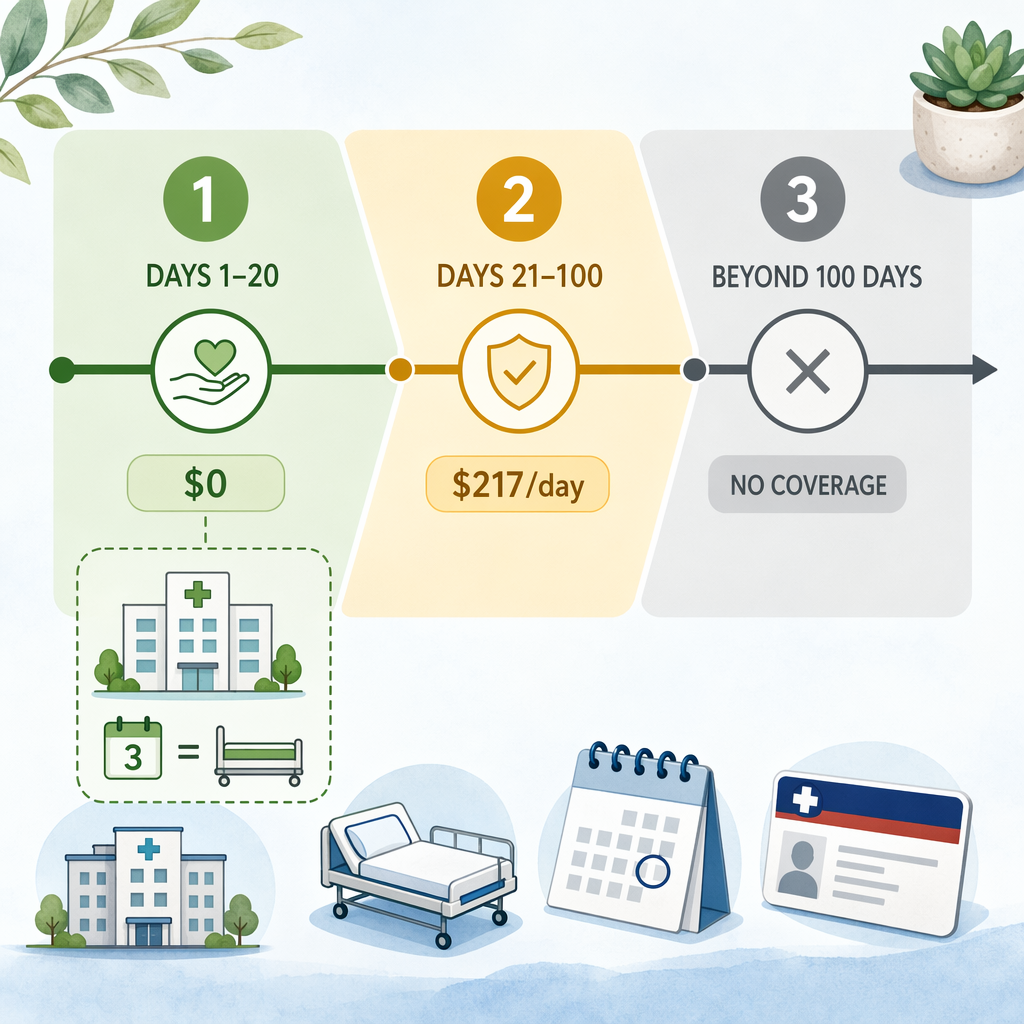
The skilled nursing facility (SNF) benefit is the most common post-hospitalization option for seniors who need daily skilled care — IV therapy, physical therapy, occupational therapy, or wound care — before they can safely return home. It is also the only short-term care option that Medicare Part A covers on a systematic basis. But the coverage rules are precise, and getting them wrong can be financially devastating.
The Three Qualifying Rules
Medicare will cover a short-term SNF stay only if all three of the following conditions are met:
- The patient had a qualifying inpatient hospital stay of at least 3 consecutive days. Observation time in the emergency room does not count toward this requirement. This is the most common reason families are surprised by a denial — they assume a multi-day hospital visit qualifies, but if the patient was under "observation status" rather than formally admitted as an inpatient, the clock never starts.
- The patient must enter the SNF within 30 days of leaving the hospital. If the patient goes home first and then needs skilled care more than 30 days later, the benefit period resets.
- The patient must need daily skilled care (nursing or therapy) that can only be provided in a skilled nursing facility. Custodial care — help with bathing, dressing, eating — does not qualify on its own.
2026 Cost Structure
Once the qualifying rules are met, Medicare Part A covers SNF care in three phases:
| Days | What You Pay (2026) | What Medicare Pays |
|---|---|---|
| Days 1–20 | $0 (after the $1,736 Part A deductible is met for the benefit period) | Full cost of covered services |
| Days 21–100 | $217 per day | Everything above $217/day |
| Beyond day 100 | Full cost (no Medicare coverage) | $0 |
The 2026 SNF coinsurance of $217 per day for days 21–100 represents a significant increase from $209.50 in 2025. For a patient who needs the full 100 days, the out-of-pocket cost for days 21–100 alone totals $17,360 — and that is on top of the $1,736 Part A deductible.
What Medicare Advantage Plans Change
Medicare Advantage (Part C) plans must cover at least the same SNF benefit as Original Medicare, but many plans impose different rules. Some require prior authorization for SNF admissions. Others use narrower provider networks — the SNF your parent wants to use may not be in-network. Some plans have eliminated the 3-day inpatient stay requirement entirely, allowing direct admission from home. Always verify the specific plan's rules before making arrangements.
Deep Dive: Adult Day Care — The Most Affordable Option for Daytime Supervision
Adult day care centers provide structured daytime programs for older adults who need supervision, social engagement, and personal care during the day but can return home each evening. Services typically include meals, social activities, exercise programs, medication management, and personal care assistance. Some centers also offer basic health services such as blood pressure monitoring and glucose checks.
According to CareScout's Cost of Care Survey, the national median cost of adult day care is approximately $95 per day ($2,058 per month), assuming full-time weekday attendance. This makes it the most affordable senior care option tracked by CareScout — significantly less expensive than in-home care, assisted living, or skilled nursing.
Who Pays for Adult Day Care?
- Private pay: Most families pay out of pocket. At $95/day, a full month of weekday care costs roughly $2,058 — a fraction of the cost of a facility-based option.
- Medicaid: Many states cover adult day care through Home and Community-Based Services (HCBS) waivers for individuals who meet the nursing home level of care but choose to remain in the community. Eligibility and waitlists vary by state.
- Veterans benefits: The VA may cover adult day health care for eligible veterans through the VA's Adult Day Health Care program.
- Long-term care insurance: Some policies include adult day care as a covered service. Check the policy's benefit schedule.
- Original Medicare: Generally does not pay for adult day care. Some Medicare Advantage plans may offer an adult day care benefit as a supplemental service.
Beyond Cost: The Hidden Benefits
Adult day care offers benefits that go beyond affordability. Research cited by U.S. News indicates that regular attendance can reduce social isolation, delay cognitive decline, and lower fall risk. For caregivers, it provides predictable, scheduled relief — the ability to work, rest, or handle personal responsibilities knowing their parent is in a supervised, engaging environment.
Deep Dive: In-Home Care — Professional Care at Home for Short-Term Needs
In-home care brings a professional caregiver into the senior's home to provide assistance with activities of daily living — bathing, dressing, toileting, eating, and transferring — as well as medication reminders, meal preparation, light housekeeping, and companionship. For short-term needs, it offers a critical advantage: the senior remains in familiar surroundings, which can reduce confusion, anxiety, and the risk of hospital readmission.
Daily costs for in-home care typically range from $150 to $300, depending on the region and the number of hours needed. For lower-intensity needs — a few hours of companionship and meal preparation each day — in-home care can be significantly more affordable than a facility-based option. For round-the-clock care, the costs can exceed those of a skilled nursing facility.
Medicare and In-Home Care: What Is and Is Not Covered
This is where many families get confused. Original Medicare does not cover in-home custodial care — the kind of help with daily activities that most seniors need. However, Medicare Part A or Part B may cover home health services (skilled nursing care, physical therapy, occupational therapy, speech-language pathology) if the following conditions are met:
- The patient is under a doctor's care and the doctor certifies that they need skilled nursing care or therapy on an intermittent basis.
- The patient is homebound — leaving home requires considerable and taxing effort.
- The care is provided by a Medicare-certified home health agency.
If these conditions are met, Medicare covers the skilled services but does not pay for 24-hour-a-day care, meal delivery, or custodial assistance (bathing, dressing) unless it is provided alongside skilled care. For a detailed breakdown of service types and cost ranges, see our complete guide to in-home care options.
How to Choose the Right Option: A Decision Framework Based on Care Needs and Duration
When you are in crisis mode, the natural instinct is to grab the first option that seems to fit. But a structured decision process — even one that takes only 30 minutes — can save thousands of dollars and lead to a better outcome for your parent. Here is a framework built around the four factors that matter most.
Step 1: Determine the Level of Medical Oversight Needed
- High (24/7 skilled nursing): The senior needs daily IV therapy, wound care, or intensive rehabilitation. → Skilled nursing facility (SNF) is the only appropriate option.
- Moderate: The senior needs help with ADLs, medication management, and some therapy but does not require round-the-clock nursing. → Short-term assisted living or in-home care with a home health aide.
- Low: The senior needs supervision, social engagement, and help with a few daily tasks but is medically stable. → Adult day care or in-home companionship care.
Step 2: Estimate the Duration
- A few hours to a few days: Respite care (in-home or facility-based) or adult day care.
- One to four weeks: Short-term assisted living, in-home care, or SNF (if skilled care is needed).
- One to three months: SNF (up to 100 days under Medicare) or in-home care with a home health agency.
Step 3: Check Your Insurance Coverage
Before you call any facility, verify what your parent's insurance actually covers. Call the insurance company directly and ask:
- "Does my parent's plan cover short-term skilled nursing facility stays? What are the qualifying requirements?"
- "Is there a prior authorization requirement for SNF admissions?"
- "Does the plan offer any respite care or adult day care benefits?"
- "What is the daily coinsurance or copay for days 21–100?"
Step 4: Consider the Caregiver's Needs
If you are the primary caregiver and you are approaching burnout, factor your own needs into the decision. The 2025 caregiver survey found that 78% of family caregivers report burnout, and 64% also hold full- or part-time jobs. Choosing an option that gives you regular, predictable breaks — even if it costs slightly more — may be the difference between sustaining care for the long term and crashing entirely. For a complementary framework that helps match care intensity to hours of need, see our senior care options by hours of need guide.
Printable Checklist: Your Short-Term Care Decision Toolkit
Use this checklist to gather the information you need before calling any facility or agency. Print it, save it, or share it with a family member who can help with the research.
Questions to Ask Each Facility or Provider
- Do you have a short-term or respite stay available right now? How many beds/apartments do you have for short-term stays?
- What is the daily or weekly rate? Are there any additional fees (assessment fee, medication management, laundry)?
- Do you accept Medicare, Medicare Advantage, Medicaid, or long-term care insurance? Do you require prior authorization?
- What level of medical oversight do you provide? Is a nurse on-site 24/7? Do you have a therapy department?
- Can we tour the facility today or tomorrow? Can my parent visit before deciding?
- What is your discharge planning process? How do you coordinate with the hospital or primary care doctor?
Documents to Gather
- Medicare card (and Medicare Advantage plan card, if applicable)
- Hospital discharge summary and any doctor's orders for skilled care or therapy
- Complete list of medications, including dosages and schedules
- Long-term care insurance policy (if applicable)
- Power of attorney or healthcare proxy documents
Key Medicare Rules to Verify
- Was my parent formally admitted as an inpatient for at least 3 consecutive days? (Observation time does not count.)
- Will the SNF admission happen within 30 days of hospital discharge?
- Does the SNF accept Medicare assignment? Is it in-network for my parent's Medicare Advantage plan?
- What is the daily coinsurance for days 21–100? (2026 rate: $217/day for Original Medicare.)
Key Resources
- Hospital social worker or discharge planner — your first and most important resource. They know the local options and can help navigate Medicare rules.
- Eldercare Locator (eldercare.acl.gov) — connects you to your local Area Agency on Aging, which can provide information on adult day care, respite programs, and Medicaid waivers.
- ARCH National Respite Locator (archrespite.org/respitelocator) — the best resource for finding respite care providers, including state-sponsored programs and veteran-specific services.
- Medicare.gov — for verifying current SNF coverage rules and finding Medicare-certified facilities in your area.
Questions to bring to a clinician or OT
This is not medical, legal, or a family's final decision — only a framework. Bring these questions to a clinician, occupational therapist, or your local Area Agency on Aging.
Find Local HelpRelated reading
Noticed something outdated or inaccurate on this page? Flag a correction. We review every report against CDC, NIA, and AARP HomeFit guidance before updating a page.