
Caregiver decision guide
Why the Panic Button Isn't Enough: How Passive Elderly Monitoring Systems Catch What Wearables Miss
For long-distance caregivers of a parent with early cognitive decline, traditional medical alert pendants create a false sense of security. This article explains why pendants fail for seniors with memory issues, how passive monitoring systems solve the compliance problem, and what to consider when making the switch.
The 50-Year-Old Technology Problem: Why Pendants Fail for Cognitive Decline
The classic medical alert pendant — the "I've fallen and I can't get up" device — was designed for a specific reality: an older adult who is physically frail but cognitively intact. That model assumes the person will wear the device at all times, remember what it does, and have the presence of mind to press the button after a fall. For the growing population of seniors with memory decline, every one of those assumptions breaks down.
As one remote monitoring guide puts it, help buttons were a good idea when they first appeared 50 years ago, but they were built for a world where aging meant physical frailty, not memory loss. That distinction matters more now than ever. The elderly monitors market was valued at $4.66 billion in 2026 and is projected to reach $7.19 billion by 2030, according to Research and Markets. Much of that growth is driven not by better pendants, but by a fundamental shift toward systems that do not require the user to actively participate in their own protection.
Consider what happens in a typical scenario. A parent with early-stage Alzheimer's is given a pendant and told to wear it at all times. For the first few weeks, they comply. Then the pendant starts feeling uncomfortable at night, so it comes off before bed. Then it gets left on the bathroom counter after a shower. Then it sits in the same spot for days. The adult child, checking in from three states away, assumes the parent is protected. But the device is not being worn, and the parent no longer remembers why it matters.
This is not a fringe scenario. The National Council on Aging's February 2025 survey of recent medical alert system buyers found that almost 75% of respondents decided to buy a device after a fall or medical emergency. That means the vast majority of pendant purchases are reactive — they come after the damage is done. And for families dealing with cognitive decline, the pendant often provides nothing more than a false sense of security.
The Compliance Data: Why Pendants Create a False Sense of Security
The numbers tell a sobering story about how medical alert pendants perform in real-world conditions — especially for seniors with memory issues.
- 75% of buyers purchase a pendant after a fall has already occurred (NCOA February 2025 survey). The device is reactive, not preventive.
- Even when worn, the pendant only works if the user can press the button. After a fall, a senior may be unconscious, disoriented, or physically unable to reach the pendant.
- Emergency rooms regularly treat patients who fell while their pendant was in another room, on the nightstand, or in the bathroom — what one monitoring guide calls the "just stepped away" problem.
- According to AARP's latest research, about 9 in 10 adults ages 50+ now own smartphones, up 35% since 2016. Yet device compliance for wearables among cognitively impaired seniors remains low — owning a device and consistently wearing it are two very different things.
The term "long lie" describes what happens when a senior falls and cannot get up or call for help. A person who lies on the floor for an hour or more after a fall faces significantly higher risks of dehydration, pressure injuries, hypothermia, and muscle damage. The pendant was supposed to prevent this. But if the senior cannot press the button — because they are unconscious, because the pendant is across the room, or because they simply forgot they were wearing it — the device provides no protection at all.
For long-distance caregivers, the situation is especially painful. You pay $30 to $50 per month for a device you believe is protecting your parent. You check in by phone and your parent says everything is fine. But you have no way of knowing whether the pendant is actually being worn, charged, or even in the same room. The monthly bill arrives like clockwork, but the protection it promises may not exist.
How Passive Monitoring Solves the Compliance Problem
Passive monitoring systems take a fundamentally different approach. Instead of requiring the senior to wear a device, remember to charge it, and press a button in an emergency, these systems use sensors placed around the home to detect activity patterns automatically. The senior does not need to do anything differently. The system works whether they remember it exists or not.
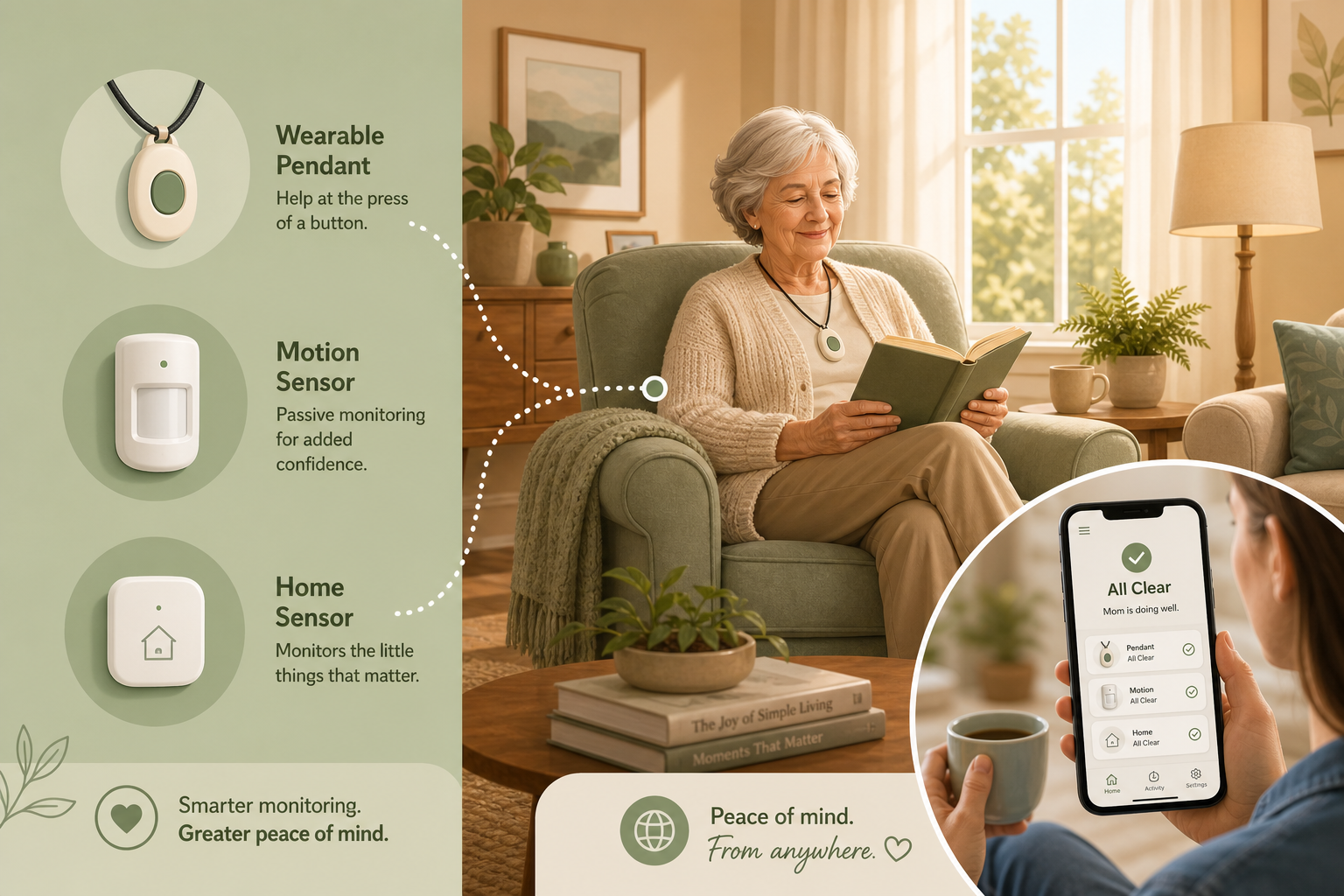
Here is how a typical passive monitoring setup works:
- Motion sensors placed in key rooms (bedroom, bathroom, kitchen, hallway) detect movement and establish a baseline of normal activity patterns.
- Door sensors on exterior doors and sometimes interior doors detect when someone enters or leaves a room.
- Bed sensors or pressure mats detect when someone gets in or out of bed, and how long they have been in bed.
- The system learns what "normal" looks like for that specific person — when they wake up, how often they visit the bathroom at night, when they typically prepare meals.
- When the system detects a deviation from the normal pattern — prolonged inactivity, an unexpected bathroom trip pattern, a door opened at 3 AM — it sends an alert to the caregiver's phone.
The critical difference is that the senior never has to interact with the system. There is nothing to wear, nothing to charge, nothing to remember. For a parent with cognitive decline who cannot reliably manage a pendant, passive monitoring provides protection that does not depend on their cooperation.
What Passive Systems Actually Detect: Falls, Nocturia, Wandering, and Missed Meals
Passive monitoring systems are not just fall detectors. They track a range of behaviors and patterns that provide early warning of emerging problems — often before a crisis occurs.
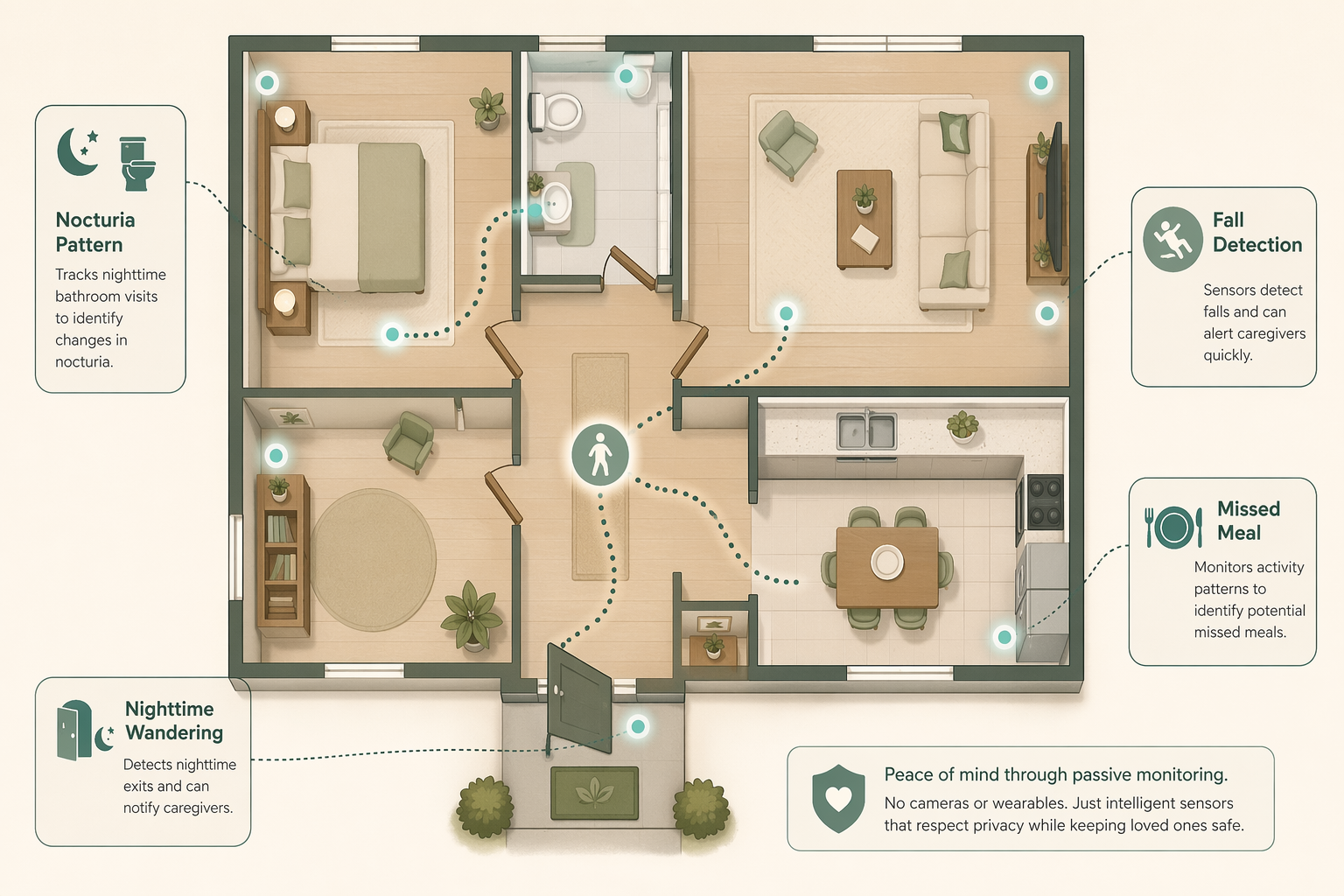
- Falls and the long lie: When motion sensors detect no movement in a room for an extended period during waking hours, the system can alert the caregiver. This catches the scenario where a senior has fallen and cannot press a button.
- Nocturia patterns: Two or more bathroom trips per night are associated with higher fall risk, sleep disturbance, and cognitive decline. A passive system can detect when nighttime bathroom visits increase or change pattern — information a pendant cannot provide.
- Nighttime wandering: For seniors with dementia who experience sundowning, passive sensors on exterior doors can alert caregivers when a door is opened during nighttime hours. This is a critical safety feature that no pendant can offer.
- Missed meals: If the kitchen sensor detects no activity during typical meal times, the system can flag a potential issue — the senior may have forgotten to eat, may be too weak to prepare food, or may be ill.
- Unusual inactivity: When a normally active senior stops moving through the house at their usual times, it can signal a health change — a urinary tract infection, a medication side effect, or the onset of a new cognitive symptom.
For long-distance caregivers, these pattern-based alerts are invaluable. Instead of calling your parent and getting a vague "I'm fine," you receive objective data about what is actually happening in the home. If you are building a complete remote monitoring setup, passive sensors are one component of a broader tech stack that can also include video doorbells, smart plugs, and medication dispensers.
If your parent experiences sundowning or nighttime wandering, passive monitoring combined with a structured safety plan can make the difference between a peaceful night and a crisis. For actionable guidance on managing wandering behaviors, see our guide on building a nighttime safety plan.
Privacy Considerations: Sensor-Based vs. Camera-Based Approaches
Privacy is the most common concern families raise when considering home monitoring — and rightly so. No one wants their parent to feel surveilled in their own home. The good news is that passive sensor-based monitoring and camera-based monitoring are fundamentally different technologies with very different privacy implications.
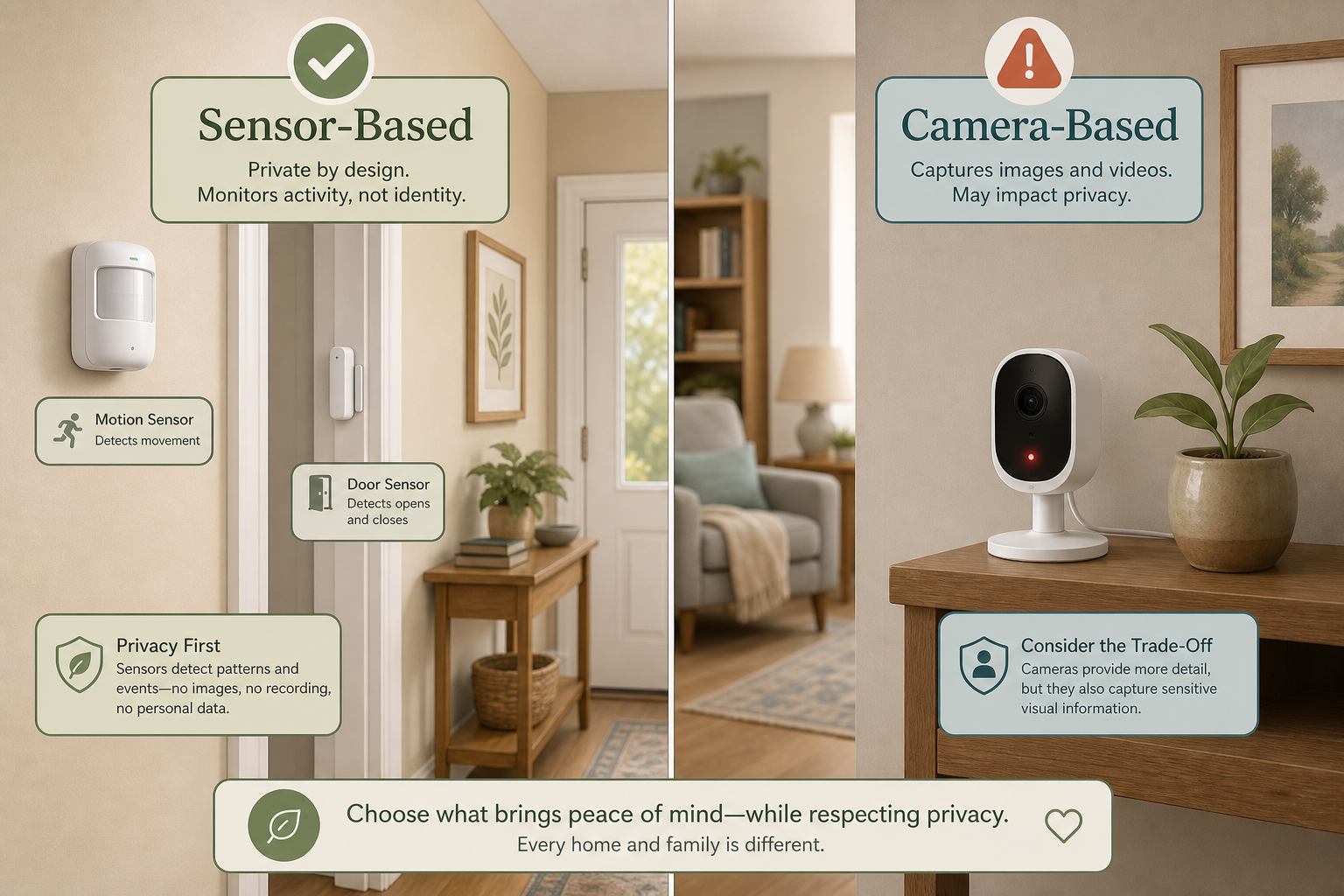
Here is the key distinction:
- Sensor-based monitoring uses motion sensors, door sensors, and bed sensors. These devices detect whether movement occurred, but they do not capture images, audio, or video. They cannot see what the person is doing — only that they are (or are not) moving through a space.
- Camera-based monitoring uses indoor cameras that transmit live video. These systems can see exactly what the person is doing, what they are wearing, and who is in the room. They raise significantly higher privacy concerns, especially for cognitively impaired individuals who may not understand they are being recorded.
For families dealing with cognitive decline, the privacy calculus is especially delicate. A parent with dementia may not be able to give meaningful consent to video monitoring. They may become agitated or paranoid if they notice a camera. And even if they initially agreed, their ability to understand and reaffirm that consent may diminish over time.
The best passive monitoring systems are designed with privacy as a core feature, not an afterthought. They use no cameras, no microphones, and no wearables. The data they collect is limited to motion events and sensor triggers — enough to detect meaningful patterns, but not enough to intrude on the senior's dignity. For many families, this balance between safety and privacy is what makes passive monitoring acceptable where camera-based systems would not be.
Real Cost Comparison: Passive Monitoring vs. Pendants vs. In-Person Care
When families compare costs, they often look only at the monthly subscription fee. But the true cost of a monitoring solution includes the hidden expenses of false reassurance — the ER visit that a pendant failed to prevent, the hospital stay after a long lie, the missed diagnosis that could have been caught earlier.
| Option | Monthly Cost | Equipment/Setup | What It Covers | Hidden Costs |
|---|---|---|---|---|
| Medical alert pendant | $24.95 – $47.95 (NCOA 2026) | $0 – $199.95 | Emergency call button; fall detection add-on $5–12/mo | False reassurance if not worn; ER visit after missed fall |
| Passive monitoring service | ~$99/month (envoyatHome) | ~$399 one-time | Motion, door, bed sensors; pattern alerts; no wearables | Lower — system works even if senior forgets it exists |
| In-person home care | $20–30/hour | None | Hands-on assistance, companionship, safety supervision | High — 24/7 care costs $14,000–$22,000/month |
The monthly cost of a pendant ($25–$48) looks cheaper than passive monitoring ($99). But that comparison misses the critical question: is the pendant actually providing protection? For a senior with cognitive decline who does not consistently wear the device, the effective cost per protected hour is infinite — you are paying for nothing.
Passive monitoring, at roughly $99 per month with a one-time equipment fee, provides continuous protection that does not depend on the senior's compliance. For long-distance caregivers, this often represents the most cost-effective option between the false economy of an unused pendant and the prohibitive expense of round-the-clock in-person care.
For families exploring how to reduce the cost of 24-hour care at home, passive monitoring is often the first step in a hybrid model that combines technology with limited human care hours. Instead of paying for 24/7 in-person supervision, you can use passive monitoring to cover the hours when the senior is alone, and bring in paid caregivers only for the hours when hands-on assistance is actually needed.
Research Evidence: What the Science Says About Passive Monitoring for Dementia Caregivers
The shift toward passive monitoring is not just a market trend — it is supported by a growing body of research on how remote activity monitoring benefits both seniors with dementia and their caregivers.
NIH/PMC research on remote activity monitoring (RAM) systems has found that these technologies benefit caregivers of relatives with Alzheimer's disease by providing behavioral insights without requiring active participation from the person with dementia. Instead of relying on the senior to report symptoms or press a button, RAM systems passively collect data on activity patterns, sleep quality, and daily routines — giving caregivers objective information they can act on.
The broader market context reinforces this direction. An MSI International survey found that 80% of Americans favor using remote patient monitoring, and between 65% and 70% would participate in an RPM program. As of December 2024, 42 states have adopted Medicaid coverage for RPM, signaling that both consumers and policymakers see value in remote monitoring approaches.
- The elderly monitors market was valued at $4.66 billion in 2026 and is projected to reach $7.19 billion by 2030, growing at a CAGR of 11.5% (Research and Markets).
- The global RPM market was valued at $14 billion in 2023 and is projected to reach $42 billion by 2028 (20% CAGR) per MarketsandMarkets Research.
- RPM claim volume under Medicare CPT 99454 increased 82% from 2021 to 2023, indicating rapid clinical adoption of remote monitoring.
- Major trends in the elderly monitors market include fall detection and prevention technologies, integration with smart home ecosystems, and a shift toward wearable-based and passive monitoring solutions (Research and Markets).
The research consistently points in one direction: the future of elderly monitoring is passive, non-wearable, and pattern-based. The industry is moving away from the reactive "press the button" model and toward proactive systems that detect problems before they become emergencies.
When to Transition from a Pendant to a Passive System
Pendants are not useless. For a senior who is cognitively intact, has good mobility, and is at risk of falls, a pendant with automatic fall detection remains a reasonable choice. The argument here is not that all pendants should be thrown away — it is that they are the wrong tool for a specific and growing population: seniors with cognitive decline.
Here are the scenarios where a family should seriously consider transitioning from a pendant to a passive monitoring system:
- After a dementia diagnosis: Once cognitive decline is confirmed, the window of reliable pendant compliance is limited. Transition early, while the senior can still participate in the setup and understand the system.
- When the senior forgets to wear the pendant: If you visit and find the pendant on the nightstand, in the bathroom, or in a drawer, the system is already failing. Do not wait for a fall to confirm what the empty charging dock is telling you.
- After a fall where the button was not pressed: This is the clearest signal that the pendant model has broken down. If your parent fell and could not or did not press the button, the device provided zero protection. A passive system would have detected the prolonged inactivity and alerted you.
- When nighttime wandering becomes a concern: Pendants cannot detect wandering. Passive door sensors can alert you the moment an exterior door is opened during nighttime hours — a critical safety feature for sundowning behaviors.
- When you are a long-distance caregiver and cannot verify compliance: If you live in another city or state and rely on phone calls to confirm your parent is safe, you have no way to know whether the pendant is actually being worn. Passive monitoring gives you objective data, not reassurances.
Making the switch does not have to be all-or-nothing. Some families keep the pendant as a backup while installing passive sensors as the primary monitoring layer. Others find that once the passive system is in place, the pendant becomes irrelevant — the sensors catch everything the pendant was supposed to catch, plus a range of patterns the pendant never could.
Questions to bring to a clinician or OT
This is not medical, legal, or a family's final decision — only a framework. Bring these questions to a clinician, occupational therapist, or your local Area Agency on Aging.
Find Local HelpRelated reading
Noticed something outdated or inaccurate on this page? Flag a correction. We review every report against CDC, NIA, and AARP HomeFit guidance before updating a page.