
Caregiver decision guide
Adult Day Care for Dementia: How Day Programs Benefit Both Your Loved One and You
This evidence-backed guide explains how adult day programs provide structured cognitive and social stimulation that can slow functional decline for people with dementia, while offering critical respite that reduces caregiver stress and improves sleep. Learn about the research, costs, how to choose a dementia-ready center, and when day care is no longer enough.
Why Adult Day Care Is Especially Suited for Dementia
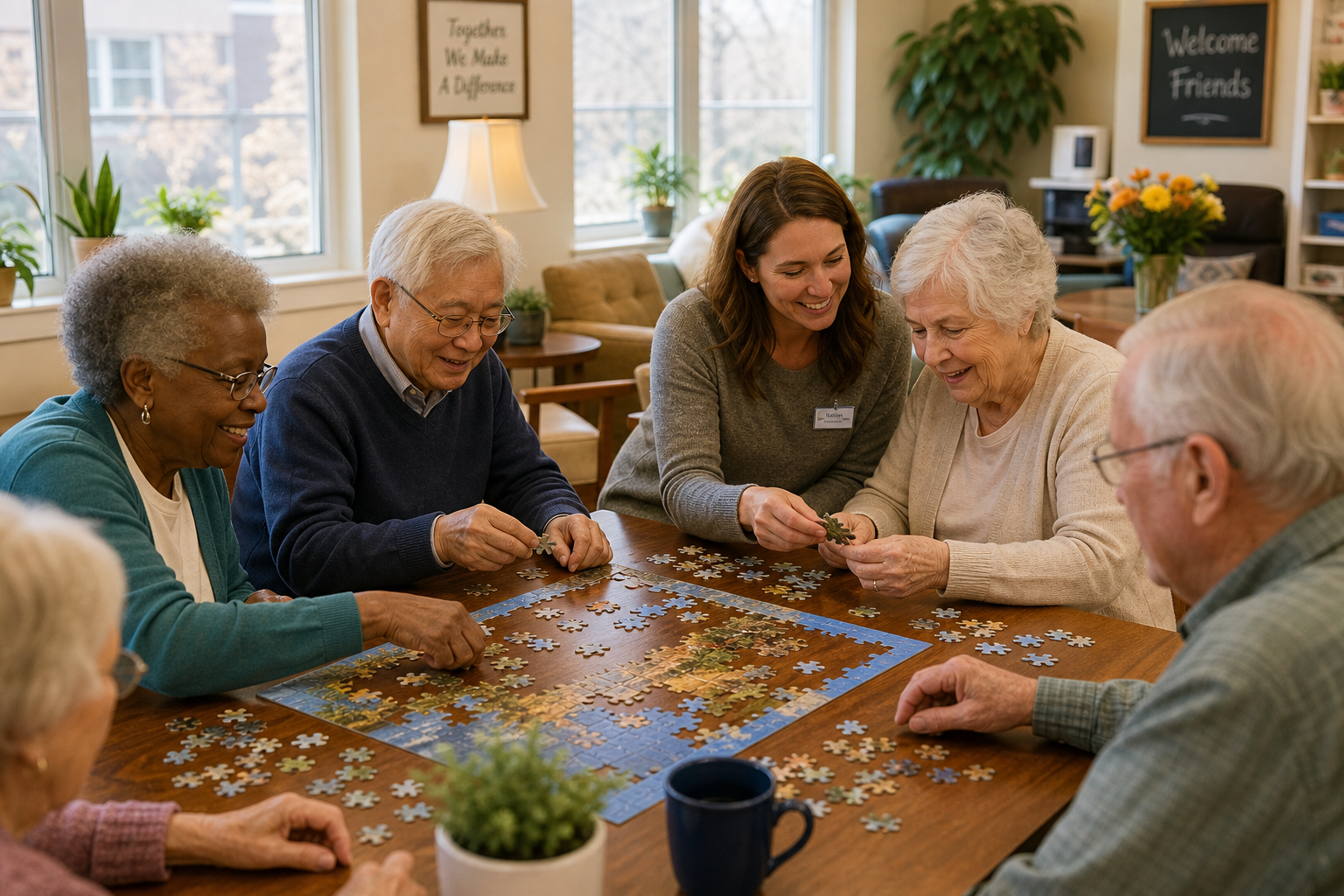
When a parent or spouse receives a dementia diagnosis, the immediate question is often about safety and meaningful engagement during the day. Adult day centers are designed to address both concerns simultaneously. Unlike general senior centers, dementia-ready programs provide a structured daily routine, a secure environment, and staff trained specifically in dementia care. The Alzheimer's Association notes that these centers offer people with dementia the opportunity to be social and participate in activities in a safe environment — two elements that become increasingly difficult to provide at home as the disease progresses.
The structured nature of a day program is itself therapeutic for someone with dementia. A consistent schedule reduces confusion and anxiety, while supervised group activities — music, gentle exercise, memory games, art — provide cognitive stimulation that is difficult to replicate in a one-on-one home setting. More than half of older attendees at adult day care facilities have cognitive impairment such as dementia, according to AARP, meaning these programs are built around a population with similar needs.
What the Research Says: Evidence for Cognitive and Behavioral Benefits
The evidence base for adult day programs in dementia care is substantial, though not yet fully synthesized into a single definitive conclusion. The most comprehensive effort to date is the ADAPT-DemCare realist synthesis, a 2024 protocol paper that systematically analyzed 14 literature reviews covering 329 references published between 1975 and 2021. The paper reports that, compared to non-attendees, people with dementia who attended adult day programs showed better cognition, quality of life, subjective health, physical functioning, and fewer mental health issues such as depression and loneliness.
A particularly compelling piece of evidence comes from a 2021 study published in Aging & Mental Health, cited by AARP. The study found that both dementia patients and their caregivers slept better on nights before the patient attended adult day care, with fewer sleep disturbances. This finding is striking because sleep disruption is one of the most common and exhausting challenges in dementia caregiving — a problem that affects the health of both the person with dementia and the person caring for them.
There is also evidence that adult day programs can delay nursing home placement. A 2013 case study published in PMC followed an 84-year-old woman with dementia named Edna who attended adult day services for 14 years before eventually moving to a nursing home. The delay saved Missouri Medicaid an estimated $500,000, based on the difference between the daily cost of nursing home care ($139) and adult day care ($70.20) at the time. While individual outcomes vary, this case illustrates the potential for day programs to support aging in place far longer than many families assume possible.
The Caregiver Benefit: Respite, Sleep, and Sustained Caregiving
The benefits of adult day care for the person with dementia are only half the story. The other half — arguably the more urgent half for many families — is what these programs do for the caregiver.
A 2017 review in The Gerontologist, referenced by AARP, found that adult day care had a positive impact on dementia caregivers' mood, health, and relationships, and significantly reduced what researchers call "role overload" — the feeling that caregiving demands exceed personal capacity. The ADAPT-DemCare synthesis similarly reports that caregivers of attendees experienced reduced stress, conflicts, worries, and depression.

The sleep benefit from the 2021 Aging & Mental Health study deserves emphasis here. Caregivers of people with dementia are at high risk for sleep disorders, which in turn increase the risk of depression, cardiovascular disease, and cognitive decline. Knowing that a single day of adult day care attendance measurably improves sleep for both parties is the kind of concrete, actionable evidence that can help a hesitant caregiver make the decision to try a program.
Social Model vs. Medical Model: Choosing the Right Fit for Dementia Stage
Not all adult day programs are the same, and the distinction between the two main models matters enormously for dementia care.
| Feature | Social Model (Adult Day Care) | Medical Model (Adult Day Health Care) |
|---|---|---|
| Primary focus | Recreation, socialization, and minimal assistance | Skilled nursing, medication management, and therapy |
| Staff qualifications | Activity coordinators, aides | Registered nurses, licensed therapists, social workers |
| Best suited for | Early to middle-stage dementia; mobile and mostly independent | Middle to late-stage dementia; complex medical needs |
| Typical cost | $70–$100 per day | $120–$200 per day |
| Services included | Meals, activities, supervision, transportation | All social model services plus medication administration, wound care, PT/OT, incontinence care |
For someone in the early stages of Alzheimer's who is still socially engaged and physically mobile, a social model program may provide sufficient structure and stimulation. As the disease progresses into the middle and late stages — when medication management, incontinence care, and wandering prevention become daily concerns — a medical model program is typically more appropriate. Some centers operate hybrid programs that can accommodate a range of needs, but it is important to ask explicitly about the center's capacity to handle dementia-related behaviors before enrolling.
Key Program Services That Matter for Dementia Care
When evaluating a center for a loved one with dementia, certain services are non-negotiable. The Alzheimer's Association lists the following as core services that dementia-ready centers should provide:
- Behavior management: Staff trained to redirect agitation, repetitive questioning, and sundowning behaviors without medication.
- Medication administration: Licensed staff who can manage complex medication schedules, including Alzheimer's drugs like donepezil and memantine.
- Physical and occupational therapy: Especially important for maintaining mobility and slowing functional decline.
- Memory-stimulation activities: Structured cognitive engagement such as reminiscence therapy, music therapy, and simple games.
- Incontinence care: Discrete, dignified assistance with toileting and adult brief changes.
- Wandering prevention: Secure entrances and exits, door alarms, and staff protocols for monitoring participants who are prone to wandering.
The Harvard Health article adds that regular structured activities and being with others can enhance quality of life for older people with long-term health conditions. For someone with dementia, the social engagement component is not just pleasant — it is a form of cognitive stimulation that may help slow the rate of decline.
Costs, Coverage, and the Utilization Gap
The national median cost for adult day care is approximately $100 per day, or about $2,123 per month, according to Genworth's 2024 Cost of Care Survey as reported by SeniorLiving.org. Medical model programs with extensive nursing needs range from $120 to $200 per day. For context, this is roughly one-third the cost of a home health aide ($214/day) and one-quarter the cost of a nursing home ($350/day).
| Care Option | National Median Daily Cost (2024) | Monthly Cost |
|---|---|---|
| Adult day care (social model) | $100 | $2,123 |
| Adult day health care (medical model) | $120–$200 | $2,600–$4,333 |
| Home health aide | $214 | $6,483 |
| Assisted living | $194 | $5,900 |
| Nursing home (semi-private) | $350 | $10,646 |
Understanding how to pay for adult day care requires navigating a patchwork of options:
- Original Medicare does not cover adult day care. The only exception is for individuals enrolled in hospice, who may receive up to 5 days of adult day care coverage.
- Medicare Advantage plans may offer limited coverage for adult day health care, but this varies by plan and region.
- Medicaid Home and Community-Based Services (HCBS) waivers cover adult day care in many states, but eligibility and covered services vary significantly.
- VA benefits cover adult day health care for eligible veterans with a physician's order.
- Many centers offer sliding-scale fees, which can reduce costs to $25–$40 per day for qualifying families.
- The federal dependent care tax credit offers up to $3,000 for one qualifying person or $6,000 for two or more.
Perhaps the most striking statistic in this entire discussion is the utilization gap. Despite more than 4,100 adult day centers operating in the United States (AARP, citing 2020 NCHS data), fewer than 50,000 individuals nationally use these services, according to a 2013 PMC article. (The CDC's 2022 NPALS survey reports a higher figure of 197,700 participants across 3,100 centers, but even that number represents a fraction of the millions of families caring for someone with dementia at home.) The gap between available services and actual utilization suggests that many families simply do not know adult day care is an option, or they have misconceptions about what it offers.
Helping Your Loved One Adjust: The Transition Challenge
Resistance to adult day care is normal — and often temporary. The Alzheimer's Association recommends starting with two visits per week for a full month before making a final decision. They note that resistance is common in the first few weeks but often resolves within 2 to 4 weeks, after which many attendees begin looking forward to their visits.
Practical strategies for easing the transition include:
- Visit the center together beforehand so the environment feels familiar.
- Start with shorter days (half-day attendance) and gradually extend to full days.
- Send a familiar object from home — a favorite blanket, photo, or sweater — to provide comfort.
- Speak positively about the center in front of your loved one; your attitude sets the tone.
- Coordinate with staff on arrival and departure routines; many centers have experience with first-day anxiety.
If you are in the early weeks after a dementia diagnosis and feeling overwhelmed, our 30-day timeline for setting up aging in place services can help you prioritize next steps without becoming paralyzed by the volume of decisions ahead.
How to Evaluate a Center for Dementia Readiness
Not every adult day center is equipped to care for someone with dementia. Use the following checklist when touring potential programs.
| Evaluation Criteria | What to Look For | Red Flags |
|---|---|---|
| Staff-to-participant ratio | At least 1 staff per 6 participants for dementia programs | 1 staff per 10+ participants; staff appear overwhelmed |
| Dementia-specific training | All staff complete annual dementia care training; certified dementia practitioners on site | Staff cannot describe their dementia training; no written protocols |
| Separation vs. inclusion | Separate programming for early vs. late-stage dementia; quiet spaces available | All participants in one room regardless of stage or behavior |
| Wandering prevention | Secured entrances/exits, door alarms, enclosed outdoor area | No visible security measures; doors open directly to parking lot or street |
| Behavior management approach | Non-pharmacological redirection techniques; staff demonstrate patience | Staff use loud voices or physical restraint; cannot describe redirection strategies |
| Emergency protocols | Written plan for medical emergencies, elopement, and behavioral crises | Staff cannot produce written protocols; no emergency contact system |
| Activities offered | Memory-stimulation activities (reminiscence, music, simple games) scheduled throughout the day | TV is the primary activity; no structured programming visible |
For a broader view of how adult day care fits into the full continuum of dementia care options, see our guide on choosing home care for a parent with dementia, which compares companion care, personal care, adult day programs, and skilled nursing.
When Dementia Outgrows Day Care: Recognizing the Transition Signs
Adult day care is not a permanent solution for every stage of dementia. At some point, the disease may progress to a point where the center can no longer safely or effectively meet your loved one's needs. Recognizing this transition is not a failure — it is a natural part of the disease trajectory.
Common signs that dementia has outgrown day care include:
- Frequent wandering that exceeds the center's security measures.
- Aggression toward staff or other participants that cannot be managed with redirection.
- Complete incontinence that the center is not equipped to handle.
- Difficulty swallowing or eating that requires one-on-one supervision.
- Frequent calls from the center asking you to pick up your loved one early due to behavioral issues.
- Your loved one no longer seems to benefit from or engage with the activities.
When these signs appear, it is time to consider a higher level of care. Our guide on 24-hour home care can help you evaluate whether around-the-clock support is the right next step, and how to plan for the transition without guilt.
Questions to bring to a clinician or OT
This is not medical, legal, or a family's final decision — only a framework. Bring these questions to a clinician, occupational therapist, or your local Area Agency on Aging.
Find Local HelpRelated reading
Noticed something outdated or inaccurate on this page? Flag a correction. We review every report against CDC, NIA, and AARP HomeFit guidance before updating a page.