
Caregiver decision guide
From Crisis to Plan: A 30-Day Timeline for Setting Up Aging in Place Services After a Parent's Fall or Diagnosis
After a parent's health crisis, families have a critical window to establish foundational aging-in-place services. This day-by-day action plan guides adult children through the essential sequence of safety, assessments, care decisions, home modifications, and financial steps in the order that actually matters.
Introduction: Why the First 30 Days Matter Most
The phone call comes on a Tuesday. Your mother fell in the kitchen. Your father was hospitalized after a dizzy spell. The new dementia diagnosis arrived yesterday. In that moment, the world shrinks to the immediate crisis — the emergency room, the discharge papers, the scramble to figure out what happens next.
What most families don't realize is that the 30 days following a health crisis are a window of maximum leverage. During this period, hospital discharge planners are still involved, Medicare's post-hospitalization home health benefit is accessible, and the urgency is fresh enough to cut through the inertia that normally delays critical decisions. Miss this window, and families often find themselves paying out of pocket for services that could have been covered, installing modifications in the wrong order, or burning through savings on care arrangements that don't match their parent's actual needs.
This timeline sequences the actions that matter most — not in the order vendors present them, but in the order that actually protects your parent's safety, preserves their independence, and protects your family's finances. Each section covers a specific time window, with concrete steps you can take today, this week, and this month.
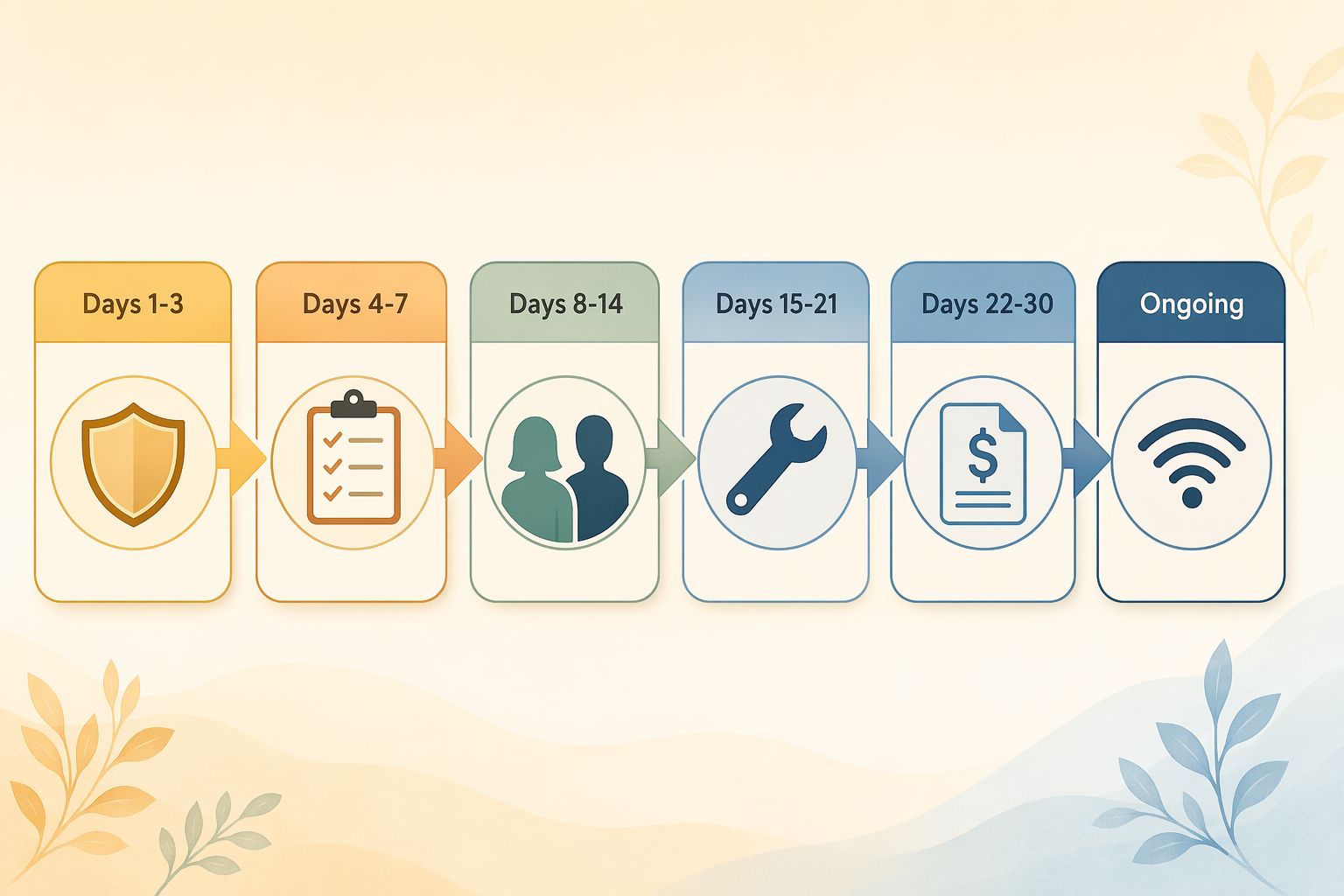
Days 1–3: Immediate Safety and Hospital Discharge Planning
The first 72 hours are about two things: making the home safe enough for your parent to return to, and ensuring the hospital discharge plan includes the services Medicare will actually pay for. These two tracks run in parallel.
Conduct a Room-by-Room Fall Prevention Check
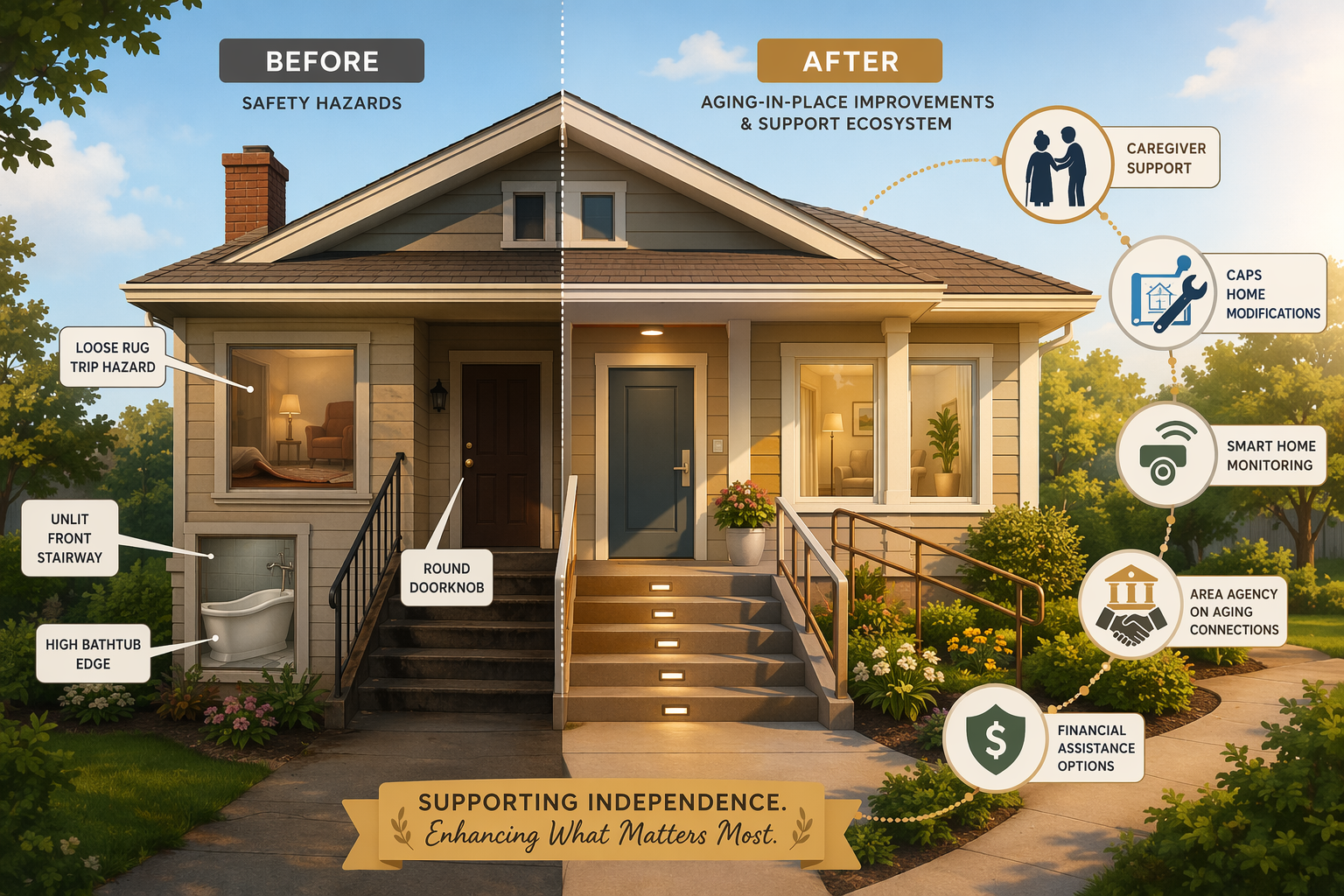
Falls are the leading cause of fatal and non-fatal injuries among older adults. The home that was safe last week may not be safe for a parent who is now weaker, on new medications, or recovering from surgery. Before your parent comes home, walk through every room with a critical eye.
- Bathroom: Are there grab bars near the toilet and in the shower? Is there a non-slip mat or adhesive strips in the tub? Can your parent step over the tub edge safely?
- Bedroom: Is there a clear path from the bed to the bathroom? Are nightlights installed along the route? Is the bed at a height that makes standing up easy?
- Stairs: Are handrails present on both sides? Are steps free of clutter? Are the top and bottom steps clearly visible (contrasting tape or paint helps)?
- Kitchen: Are frequently used items within easy reach without stretching or using a step stool? Are floor mats non-slip and flat?
- Entryways: Are there loose rugs or door thresholds that could catch a walker or cane? Is outdoor lighting adequate for evening arrivals?
For a detailed room-by-room guide with printable checklists, see our Home Fall Prevention Checklist for Older Adults.
Set Up a Medical Alert or Personal Emergency Response System (PERS)
If your parent lives alone or is alone for significant portions of the day, a medical alert system is not a luxury — it is a safety essential. A basic PERS device with a wearable help button and a base unit that connects to a 24/7 monitoring center can be ordered online and activated within a day. Many systems now include automatic fall detection, which can be a literal lifesaver if your parent falls and cannot press the button.
Do not wait to research brands. Order a system on Day 1 or 2. You can always upgrade or switch later. The cost — typically $20–$40 per month — is negligible compared to the peace of mind and the potential consequences of a fall going undiscovered for hours.
Work the Hospital Discharge Window for Medicare Home Health
This is the single most financially consequential step in the first three days. Medicare covers home health services — including skilled nursing, physical therapy, occupational therapy, and speech therapy — but only if the patient is homebound, needs intermittent skilled care, is under a doctor's care, and receives services from a Medicare-approved agency. The key: this benefit requires a doctor's order, and the most effective time to get that order is during the hospital stay or immediately at discharge.
Speak directly with the hospital discharge planner or case manager. Tell them your parent will need home health services after discharge. Ask them to coordinate a referral to a Medicare-certified home health agency. If you wait until after discharge to call the doctor's office, you may lose days or weeks of covered care.
Days 4–7: Professional Assessments That Prevent Costly Mistakes
Once the immediate safety net is in place, the next step is to bring in professionals who can assess your parent's situation holistically — before you spend any money on modifications, care, or equipment. The most common mistake families make in the first month is buying solutions before they understand the problem.
Call Your Local Area Agency on Aging (AAA)
Every community in the United States has an Area Agency on Aging. These organizations provide free, unbiased local service navigation. A single phone call can connect you to:
- Information about Medicaid Home and Community-Based Services (HCBS) waivers in your state
- Local meal programs (including Meals on Wheels)
- Transportation services for medical appointments
- Adult day health programs
- Caregiver support groups and respite programs
- Eligibility screening for state and federal benefits
To find your local AAA, call the Eldercare Locator at 1-800-677-1116 or visit the USAging website. This call should happen on Day 4, not Day 30. The AAA can also direct you to the NCOA's BenefitsCheckUp tool, which screens for over 2,500 benefit programs.
Schedule a CAPS or Occupational Therapy Home Evaluation
Before you call a contractor, call a Certified Aging-in-Place Specialist (CAPS) or an occupational therapist who does home assessments. A CAPS home evaluation costs approximately $500 and can prevent thousands of dollars in modification mistakes. The specialist assesses the home's current layout, identifies the specific modifications needed for your parent's mobility and safety, obtains contractor quotes, and coordinates the renovation work.
Why does this matter so early? Because less than 4% of U.S. homes are aging-in-place ready, according to CAPS professionals. And 85% of seniors planning to stay home don't believe they'll need significant modifications — a dangerous gap between expectation and reality. A professional assessment tells you exactly what needs to change, in what order, and at what cost, before you start buying grab bars or calling remodelers.
For a deeper explanation of why a CAPS is the right call before any contractor, read Your Parent's Home Isn't Safe — But You're Calling the Wrong Person First. For a detailed cost breakdown and budget planning, see How Much Does a CAPS Home Modification Cost?.
Consider a Geriatric Care Manager
If you are a long-distance caregiver or if your parent's situation is complex (multiple chronic conditions, cognitive decline, limited family support), a geriatric care manager — also called an aging life care professional — can be invaluable. They conduct a comprehensive assessment, develop a care plan, coordinate services, and monitor your parent's condition over time. Their fees typically range from $100 to $200 per hour, but for families who cannot be on-site, they often pay for themselves by preventing costly emergency room visits and inappropriate care placements.
Days 8–14: Making In-Home Care Decisions
By the second week, you have a clearer picture of what your parent needs. Now comes the decision that causes the most confusion and anxiety: arranging in-home care. The key is understanding the difference between two fundamentally different types of care.
Personal Care vs. Skilled Nursing: Know the Difference
| Care Type | What It Includes | Who Provides It | Medicare Coverage |
|---|---|---|---|
| Personal care (custodial) | Help with bathing, dressing, toileting, eating, transferring, medication reminders, meal preparation, light housekeeping | Home health aides, personal care aides, certified nursing assistants (CNAs) | Not covered by Medicare (except as part of a skilled home health plan of care) |
| Skilled nursing | Wound care, medication injections, IV therapy, catheter care, monitoring of unstable health conditions | Registered nurses (RNs) or licensed practical nurses (LPNs) | Covered by Medicare Part A or B for homebound patients with a doctor's order |
| Therapy services | Physical therapy, occupational therapy, speech therapy | Licensed therapists (PT, OT, SLP) | Covered by Medicare Part A or B for homebound patients with a doctor's order |
The most common financial mistake families make is assuming Medicare will pay for the personal care their parent actually needs day-to-day. It will not. Medicare covers skilled care only. For ongoing personal care, families pay out of pocket, rely on Medicaid HCBS waivers (if eligible), or use long-term care insurance.
Hiring Directly vs. Using an Agency
Once you know you need personal care, the next decision is whether to hire a caregiver directly or go through a home care agency. Each approach has trade-offs.
| Factor | Hiring Directly | Using an Agency |
|---|---|---|
| Cost | Lower hourly rate (typically $20–$28/hr) | Higher hourly rate (typically $30–$40/hr, national median $35/hr) |
| Screening and training | You are responsible for background checks, verifying credentials, and training | Agency handles screening, bonding, insurance, and training |
| Coverage for time off | You must find and pay backup caregivers when your caregiver is sick or on vacation | Agency provides replacement caregivers |
| Payroll and taxes | You become a household employer — responsible for payroll taxes, workers' comp, and unemployment insurance | Agency handles all payroll, taxes, and insurance |
| Continuity | Higher potential for a consistent, long-term relationship with one caregiver | May experience more turnover or different caregivers on different days |
For a step-by-step guide on setting up in-home nursing care, including interview questions and credential verification, see How to Set Up In-Home Nursing Care for an Elderly Parent. For a full cost breakdown including hidden expenses, see In-Home Senior Care Cost in 2026.
Days 15–21: Prioritizing Home Modifications
By week three, you should have the CAPS or OT assessment report in hand. Now the question is: what gets done now, and what can wait? The answer depends on your parent's immediate mobility and safety needs, your budget, and the timeline for any planned renovations.
Immediate Fixes (Days 15–21)
These modifications can be completed in a day or a weekend, often by a handyman or a capable family member. They address the most common hazards identified in the initial safety check and the professional assessment.
- Install grab bars in the shower, tub, and next to the toilet. These are not towel bars — they must be anchored into wall studs or blocking.
- Add non-slip adhesive strips or a non-slip mat inside the shower or tub.
- Replace round doorknobs with lever handles for easier opening.
- Install a raised toilet seat or a toilet safety frame.
- Add a shower chair or transfer bench.
- Improve lighting in hallways, stairways, and the path from bed to bathroom. Use motion-activated nightlights.
- Install threshold ramps at exterior doors to eliminate tripping hazards and accommodate walkers or wheelchairs.
- Remove or secure all loose rugs and runners.
Planned Renovations (Require More Time and Budget)
These projects require contractors, permits, and significant budget. They should be planned based on the CAPS assessment, not rushed. Common planned renovations include:
- Bathroom remodel: walk-in shower with no-step entry, grab bars, hand-held shower head, non-slip flooring
- Stair lift installation (typically $3,000–$10,000)
- Widening doorways to at least 32 inches for wheelchair access
- Ramp installation for exterior entryways (average cost $1,110)
- Creating a main-floor bedroom and bathroom if none exists
Home modifications for accessibility can cost from $10,000 to $100,000 depending on the scope. Only about 10% of U.S. homes are aging-ready, and 9 in 10 homes are not ready to accommodate aging adults. Starting with a professional assessment ensures you spend money on the modifications that actually matter, not on what a contractor suggests first.
For detailed cost ranges on specific modifications, see Home Modification Costs for Aging in Place.
Days 22–30: Building Your Financial Foundation
The final week of the first month is when you shift from immediate crisis response to building a sustainable financial plan. The first 30 days post-crisis are when families have maximum leverage for insurance and benefit applications — application windows are open, documentation is fresh, and the urgency justifies fast-tracking paperwork that normally takes months.
Check Eligibility for These Key Programs
| Program | What It Covers | Key Eligibility | Maximum Benefit (FY2026) |
|---|---|---|---|
| Medicare Home Health | Skilled nursing, PT, OT, speech therapy, medical social services | Homebound, need intermittent skilled care, doctor's order, Medicare-approved agency | $0 for covered services (80% of DME costs) |
| Medicaid HCBS Waivers | Personal care, home modifications, adult day health, respite care | State-dependent; typically requires financial eligibility (income and asset limits) | Varies by state |
| VA SAH Grant | Home modifications for service-connected disabilities | Veteran with qualifying service-connected disability (loss of limb, blindness, severe burns, etc.) | $126,526 |
| VA SHA Grant | Home modifications for specific service-connected disabilities | Veteran with loss of use of both hands, severe burns, or respiratory injuries | $25,350 |
| USDA Section 504 Grant | Removing health and safety hazards | Very-low-income homeowner, age 62+, unable to obtain affordable credit elsewhere | $10,000 (plus $40,000 loan at 1% interest) |
Steps to Take in This Window
- Confirm that the hospital discharge planner submitted the doctor's order for Medicare home health. If not, call the doctor's office immediately.
- Call your local Area Agency on Aging to screen for Medicaid HCBS waiver eligibility. These waivers are state-dependent and often have waiting lists — the sooner you apply, the better.
- If your parent is a veteran, contact the VA to begin the SAH or SHA grant application process. The application can take 30–60 days, so starting in week three or four is critical.
- If your parent is a very-low-income homeowner age 62+, contact your local USDA Rural Development office to inquire about the Section 504 grant and loan program.
- Use the NCOA BenefitsCheckUp tool to screen for additional state and local programs your parent may qualify for.
- Set up a system for tracking care expenses. If your parent may eventually need Medicaid, you will need to document all transfers and spending. Consider consulting an elder law attorney for Medicaid planning.
For a complete program-level guide to all major government assistance programs, see The Complete Guide to Government Help for Elderly and Disabled Adults.
Ongoing: Monitoring Technology, Community Programs, and Respite Planning
The 30-day timeline gets the foundation in place, but aging in place is a living plan that evolves with your parent's needs. After the first month, shift your focus to the systems that will sustain safety and independence over the long term.
Install Monitoring Technology
Beyond the basic medical alert system you installed in the first week, consider additional monitoring technology based on your parent's specific risks:
- Passive home sensors: Motion sensors, door sensors, and stove monitors that alert you to unusual patterns (no movement for hours, door opened at 2 AM, stove left on)
- GPS trackers: For a parent with dementia who is at risk of wandering, a GPS-enabled device can provide real-time location tracking
- Wearable health monitors: Devices that track heart rate, blood pressure, oxygen levels, and sleep patterns — useful for managing chronic conditions
- Telehealth platforms: For remote consultations with doctors and therapists, reducing the need for transportation to appointments
When evaluating any monitoring technology, consider privacy and consent — especially for a parent with cognitive impairment. The technology should support independence, not erode dignity. Discuss the purpose and boundaries of monitoring with your parent and involve them in the decision to the extent possible.
Enroll in Community Programs
Community-based programs reduce the burden on family caregivers and provide social connection for older adults. Your local Area Agency on Aging can help you enroll in:
- Meals on Wheels: Delivers nutritious meals to homebound seniors
- Adult day health programs: Provide supervised care, activities, and meals during the day, giving caregivers a break
- Senior transportation services: Door-to-door rides for medical appointments, grocery shopping, and social activities
- Caregiver support groups: In-person or online groups where family caregivers share experiences and resources
Plan for Caregiver Respite
Family caregivers provide an estimated $873 billion of unpaid labor annually, and those living with the care recipient spend over 37 hours per week on caregiving. Burnout is not a sign of failure — it is a predictable outcome of sustained care without support. Respite care is not optional; it is essential for the caregiver's own health and for the quality of care your parent receives.
Respite options include: in-home respite (a caregiver comes to the home for a few hours or days), adult day health programs, short-term stays at assisted living or skilled nursing facilities, and family or friend backup care. Some Medicaid HCBS waivers and VA benefits cover respite care. Ask your AAA about local respite programs and funding.
Your 30-Day Checklist at a Glance
Use this printable summary to track your progress through the first month. Each action is linked to the detailed guidance in the sections above.
| Time Window | Key Actions | Completed? |
|---|---|---|
| Days 1–3 | Conduct room-by-room fall prevention check; order medical alert system; speak with hospital discharge planner about Medicare home health referral | ☐ |
| Days 4–7 | Call Area Agency on Aging (1-800-677-1116); schedule CAPS or OT home evaluation (~$500); consider geriatric care manager | ☐ |
| Days 8–14 | Determine personal care vs. skilled nursing needs; decide hire directly vs. agency; interview and select caregiver(s) | ☐ |
| Days 15–21 | Install immediate fixes (grab bars, lighting, ramps, lever handles); plan renovations based on CAPS assessment | ☐ |
| Days 22–30 | Confirm Medicare home health order; apply for Medicaid HCBS waiver; start VA grant application; check USDA Section 504 eligibility; set up expense tracking | ☐ |
| Ongoing | Install monitoring technology; enroll in community programs (Meals on Wheels, adult day health); plan caregiver respite | ☐ |
Questions to bring to a clinician or OT
This is not medical, legal, or a family's final decision — only a framework. Bring these questions to a clinician, occupational therapist, or your local Area Agency on Aging.
Find Local HelpRelated reading
Noticed something outdated or inaccurate on this page? Flag a correction. We review every report against CDC, NIA, and AARP HomeFit guidance before updating a page.