
Caregiver decision guide
Choosing Home Care for a Parent with Dementia: Companion, Personal, Adult Day, or Skilled Care
A stage-based decision framework for adult children choosing among companion care, personal care, adult day care, and skilled home health for a parent with dementia — including when each type fits, what it costs, and how to evaluate dementia-trained providers.

Why Dementia Changes the Home Care Calculus
When a parent receives a dementia diagnosis, the instinct is often to find a single care solution and lock it in. But dementia is not a static condition. According to the National Institute on Aging, individuals live an average of 4 to 8 years after an Alzheimer's diagnosis, with some living up to 20 years. Over that span, functional abilities decline, behaviors change, and the type of help needed shifts in ways that a one-time care arrangement cannot accommodate.
The stakes are high. Research published in the Delaware Journal of Public Health notes that 83% of help provided to older adults comes from family and unpaid caregivers, and nearly half (48%) of those caregivers are providing assistance to someone with Alzheimer's or another dementia. In 2020 alone, dementia caregivers provided an estimated 15.3 billion hours of unpaid care, valued at $256.7 billion. Professional home care is not a luxury — it is often the bridge that keeps families from collapsing under that weight.
The challenge is that the home care market offers several distinct service types — companion care, personal care, adult day care, and skilled home health — and each one serves a different purpose at a different stage of the disease. Choosing the wrong type wastes money, fails to meet the person's needs, and accelerates caregiver burnout. Choosing the right type at the right time preserves independence, delays unnecessary facility placement, and keeps care sustainable.
Companion Care: Social Engagement and IADL Support for Early-Stage Dementia
In early-stage dementia, the person can still manage most activities of daily living (ADLs) — bathing, dressing, toileting — but may struggle with instrumental activities of daily living (IADLs): meal preparation, medication reminders, transportation, housekeeping, and managing finances. This is where companion care fits.
The Alzheimer's Association defines companion services as including supervision, recreational activities, and visiting. A companion aide might prepare a meal and eat with the person, drive them to a doctor's appointment, remind them to take medications, or simply provide conversation and mental stimulation. The key boundary: companion care does not include hands-on assistance with bathing, toileting, or dressing.
Typical costs for companion care range from $25 to $30 per hour, though rates vary significantly by region. This makes it the most affordable professional care option, and for early-stage dementia, it is often sufficient. The companion provides the social engagement and task support that keeps the person safe and connected while the family caregiver continues to manage the more intensive needs.
- Best for: Early-stage dementia where the person needs supervision, social interaction, and help with IADLs but not hands-on ADL assistance.
- Typical tasks: Meal preparation and companionship, medication reminders, light housekeeping, transportation to appointments, recreational activities.
- What it does not include: Bathing, dressing, toileting, wound care, injections, or any skilled nursing services.
- Cost range: $25–$30 per hour (industry estimates; verify against local rates).
Personal Care: Hands-On ADL Assistance with Dementia-Trained Cueing for Middle-Stage Dementia
As dementia progresses to the middle stage, the person typically begins needing help with basic ADLs: bathing, dressing, toileting, eating, and transferring. This is where personal care (also called personal care services or home health aide services) becomes necessary.
The Alzheimer's Association describes personal care services as including assistance with bathing, dressing, toileting, eating, and exercising. But for a person with dementia, the difference between a generic personal care aide and a dementia-trained aide is profound. The PMC article notes that caregivers who have dementia training understand how to keep a client engaged, cue them through activities, and manage unpredictable behaviors through redirection — skills that generic training does not cover.
For example, a dementia-trained aide does not simply tell the person to take a bath. They use validation techniques to acknowledge the person's anxiety, cue them step by step ("Let's start by washing your hands"), and redirect if the person becomes agitated. This approach reduces resistance and preserves the person's dignity in ways that a task-focused aide cannot replicate.
- Best for: Middle-stage dementia where the person needs hands-on help with bathing, dressing, toileting, eating, or transferring.
- Typical tasks: Bathing and grooming assistance, dressing and undressing, toileting and incontinence care, feeding assistance, mobility and transfer support.
- Dementia-trained aides use: Cueing, redirection, validation techniques, and behavior management strategies that generic aides may not have.
- Cost range: $30–$35 per hour (industry estimates; verify against local rates).
Adult Day Care: Structured Cognitive Engagement and Caregiver Respite
Adult day care is not a replacement for home care — it is a complementary service that serves two distinct purposes: providing structured cognitive and social engagement for the person with dementia, and giving the family caregiver a predictable break.
The National Institute on Aging describes adult day care centers as offering social activities, exercise, meals, personal care, and basic health services, with some providing transportation. For a person with early- to middle-stage dementia, a specialized memory-care day program can provide the structured activities, social interaction, and cognitive stimulation that one-on-one home care alone may not offer.
However, adult day care has limitations. It operates during fixed daytime hours, typically Monday through Friday. It is a group setting, which can be overstimulating or confusing for someone with advanced dementia. And it requires the person to be comfortable in an unfamiliar environment — not everyone with dementia can tolerate that.
- Best for: Early- to middle-stage dementia as a complement to home care, providing social engagement and caregiver respite.
- Typical services: Group activities, meals, exercise, personal care assistance, basic health monitoring, some transportation.
- Limitations: Fixed daytime hours (Mon-Fri), group setting may overstimulate, requires comfort with unfamiliar environments.
- Cost: National median is approximately $195 per day according to the Genworth Cost of Care Survey, though rates vary significantly by region and program type.
- Medicare coverage: Medicare does not cover adult day care. Some state Medicaid programs and long-term care insurance policies may cover part of the cost.
Skilled Home Health: When Behavioral or Medical Needs Exceed Non-Medical Care
Skilled home health is fundamentally different from companion or personal care. It is a medical benefit, not a custodial service. It covers services provided by licensed professionals — registered nurses, physical therapists, occupational therapists, speech-language pathologists — and is typically initiated after a hospitalization or when a physician certifies that the patient needs intermittent skilled care.
According to Medicare.gov, covered services include medically necessary part-time or intermittent skilled nursing care (wound care, patient and caregiver education, IV or nutrition therapy, injections, monitoring serious illness), physical therapy, occupational therapy, speech-language pathology, and medical social services. A home health aide may also provide personal care, but only if the patient is also receiving skilled care.
For a person with dementia, skilled home health becomes relevant in specific scenarios: post-hospitalization recovery (e.g., after a fall or surgery), wound care management, medication management for complex regimens, or behavioral complications that require nursing assessment and intervention. The key eligibility criteria are that the patient must be homebound (leaving home requires considerable effort or assistance) and must need intermittent skilled services.
- Medicare coverage: $0 for covered services (after Part B deductible for medical equipment). Covers up to 8 hours per day combined, max 28 hours per week (up to 35 hours for short periods if necessary).
- Eligibility: Patient must be homebound, need intermittent skilled nursing or therapy, have a physician's certification, and receive care from a Medicare-certified home health agency.
- What Medicare does not cover: 24-hour-a-day care, home meal delivery, homemaker services unrelated to the care plan, or custodial/personal care when that is the only care needed.
- When dementia patients qualify: Post-hospitalization recovery, wound care, medication management for complex regimens, behavioral complications requiring nursing assessment.
Decision Matrix: Matching Disease Stage to Care Type
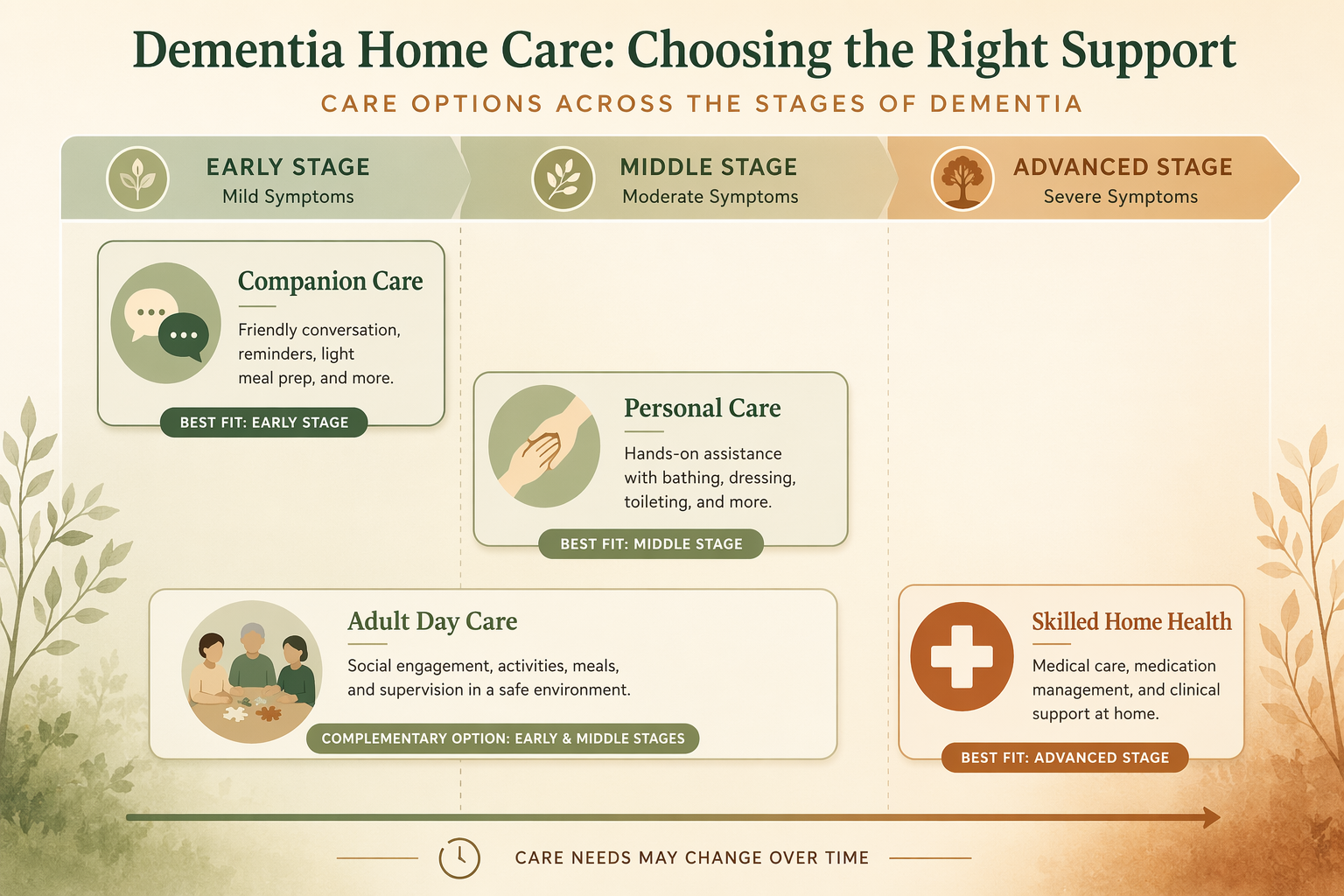
The following table maps dementia stages to the appropriate care types. Use it as a starting point for discussions with your parent's physician, a geriatric care manager, or home care agencies.
| Disease Stage | Primary Needs | Recommended Care Type(s) | Typical Cost Range | Medicare Coverage? |
|---|---|---|---|---|
| Early Stage | IADL support (meal prep, transportation, medication reminders), social engagement, supervision | Companion care; adult day care (as complement) | Companion: $25–30/hr; Adult day: $50–195/day | No (for companion or adult day) |
| Middle Stage | ADL assistance (bathing, dressing, toileting, eating), dementia-trained cueing, behavior management | Personal care; adult day care (if tolerated); consider live-in care for full-time needs | Personal care: $30–35/hr; Live-in: varies | No (personal care alone is custodial) |
| Advanced Stage | 24/7 supervision, skilled nursing for medical complications, palliative or hospice care | Skilled home health (if homebound and needs skilled care); hospice (if eligible); 24-hour personal care or live-in care | Skilled home health: $0 (Medicare-covered); 24-hour care: varies significantly | Yes (skilled home health if eligible); hospice covered under Medicare Part A |
| Any Stage (Post-Hospitalization) | Recovery, wound care, therapy, medication management | Skilled home health (nursing, PT, OT, speech therapy) | $0 for covered services (after Part B deductible for equipment) | Yes (if homebound and needs intermittent skilled care) |
How to Evaluate an Agency or Caregiver for Dementia-Specific Training
Not all home care agencies are equipped to care for someone with dementia. Generic personal care training does not cover the communication techniques, behavior management strategies, and safety considerations that dementia care requires. The Alzheimer's Association recommends asking every prospective provider the following questions.
- Are you trained in dementia care? Ask for specifics: what training program, how many hours, and whether it is ongoing.
- Do you have experience working with someone with dementia? Experience with one stage does not mean experience with all stages.
- Are you able to manage specific health and behavioral care needs? Be specific about the behaviors you are seeing — wandering, sundowning, agitation, resistance to care.
- What happens if the caregiver you send is not a good fit? Ask about the process for requesting a replacement without penalty.
- Do you conduct background checks and ongoing supervision? For dementia care, unannounced supervisory visits are a sign of a quality agency.
It is also important to understand that dementia training requirements vary by state. The PMC article notes that Delaware, for example, requires annual dementia-specific training for all home care agency staff, covering communication with persons with Alzheimer's and dementia, psychological, social, and physical needs, and safety measures. But not all states have equivalent mandates. When evaluating an agency, ask whether their training meets or exceeds state requirements — and if your state has no specific requirement, consider that a red flag requiring extra diligence.
Warning Signs That Current Care Is Insufficient
Dementia is a progressive disease. The care arrangement that worked six months ago may no longer be adequate. Recognizing the signs that it is time to escalate care is critical to preventing crises — falls, wandering incidents, hospitalization, or caregiver collapse.
- Caregiver burnout: You are experiencing physical exhaustion, irritability, sleep disruption, or feeling resentful toward the person you are caring for. This is not a personal failing — it is a signal that the current care level is unsustainable.
- Safety incidents: The person has fallen, wandered outside the home, or had a near-miss with the stove or another hazard. These events often precede more serious incidents.
- Weight loss or dehydration: The person is not eating or drinking enough, and current caregivers are unable to manage mealtime challenges or refusal to eat.
- Missed medications: The person is forgetting to take medications, or the current care arrangement does not provide the level of medication management needed.
- Escalating behavioral issues: Agitation, aggression, sundowning, or repetitive questioning is increasing in frequency or intensity, and current caregivers are not equipped to manage it.
- The person needs more help than the current care type provides: For example, a companion aide cannot help with bathing, but the person now needs bathing assistance. This is a clear signal to transition to personal care.
If you are seeing one or more of these signs, it is time to reassess. Talk to your parent's physician, consult with a geriatric care manager, and consider whether a different care type — or a combination of types — would better meet the current needs.
Choosing home care for a parent with dementia is not a single decision you make and forget. It is a series of decisions that evolve as the disease progresses. By understanding the differences between companion care, personal care, adult day care, and skilled home health — and by knowing which stage each type serves — you can make informed choices that preserve your parent's dignity, protect your own wellbeing, and keep care sustainable over the long arc of the disease.
For a comprehensive overview of funding sources to pay for the care you choose, see our guide How to Pay for In-Home Senior Care: 9 Funding Sources Every Family Should Know.
Questions to bring to a clinician or OT
This is not medical, legal, or a family's final decision — only a framework. Bring these questions to a clinician, occupational therapist, or your local Area Agency on Aging.
Find Local HelpRelated reading
- Is Adult Day Care Right for My Parent? A Complete Decision Guide for Family Caregivers
- Is Companion Care Enough? A Decision Framework for Choosing Between Companion Care, Personal Care, and a Home Health Aide
- Home Care vs. Home Health Care: A Decision Framework for Seniors With Chronic Conditions in 2026
Noticed something outdated or inaccurate on this page? Flag a correction. We review every report against CDC, NIA, and AARP HomeFit guidance before updating a page.