
Caregiver decision guide
Does Medicare Cover Companion Care? A Family Guide to Paying for Elder Companion Services
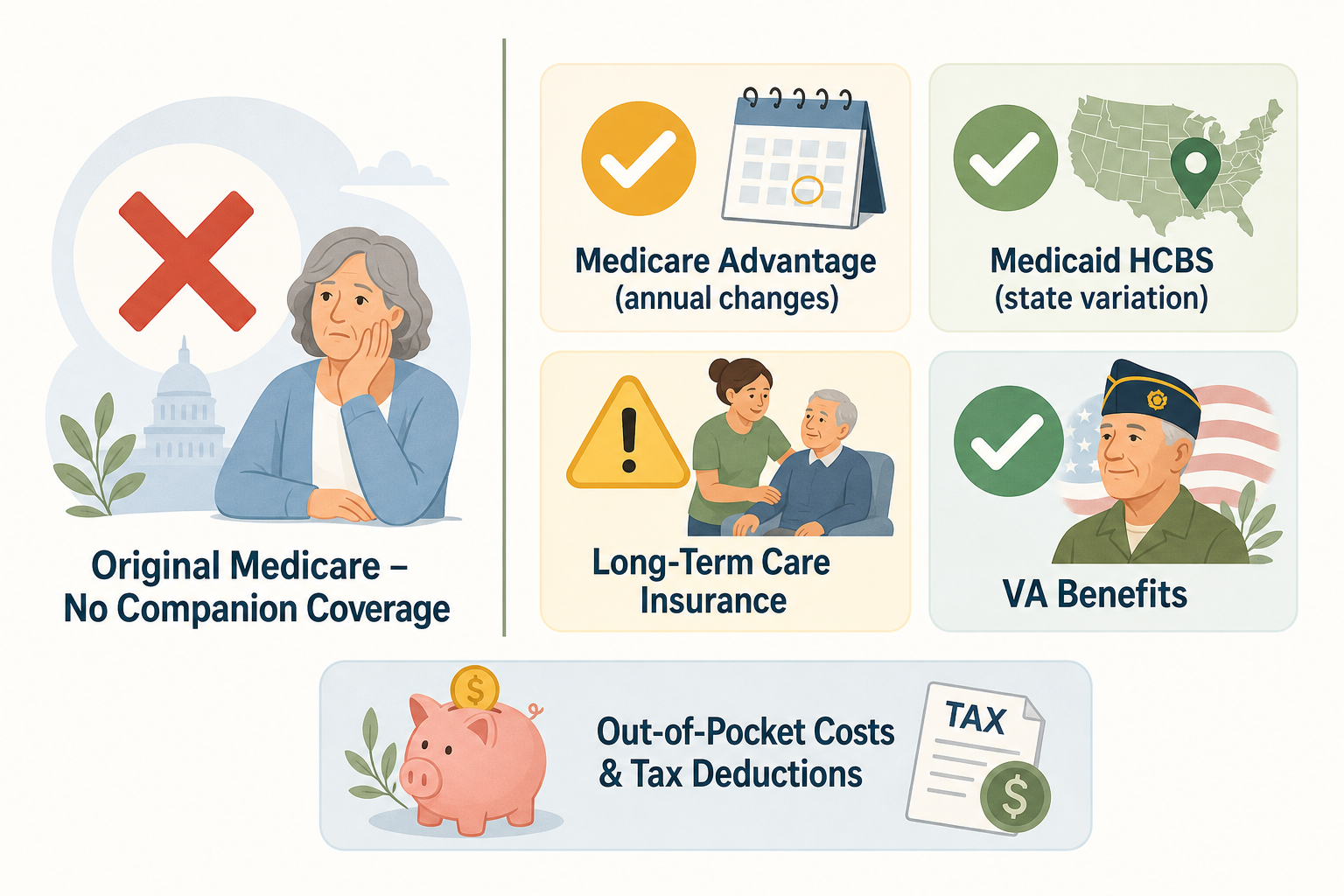
Many families are surprised to learn that Medicare does not cover companion care. This guide explains what Medicare, Medicare Advantage, Medicaid, long-term care insurance, and VA benefits actually pay for — and what you’ll need to budget out of pocket.

The Core Problem: Companion Care Is Non-Medical, So Insurance Usually Excludes It
When a family first realizes that an aging parent needs regular companionship — someone to sit with them, drive them to appointments, prepare meals, and make sure they are not alone all day — the first question is almost always the same: "Does Medicare cover this?" The answer, for the vast majority of families, is no. And that gap between expectation and reality is the single biggest financial surprise in the companion care journey.
Companion care is classified as a non-medical, custodial, or social service. It includes light housekeeping, meal preparation, medication reminders, transportation, and — most importantly — emotional support and supervision. It does not include skilled nursing, wound care, physical therapy, or any service that requires a licensed medical professional. Because the American health insurance system is built around treating illness and injury, not around preventing loneliness or maintaining daily routines, companion care falls outside nearly every standard coverage model.
Understanding which programs might help — and which almost certainly will not — is essential before you make a care decision. The sections below walk through each potential funding source, what it actually covers, and what you need to do to access it.
Original Medicare (Part A and Part B): What It Does and Does Not Cover
Original Medicare — the federal program that covers hospital stays (Part A) and doctor visits, outpatient care, and medical equipment (Part B) — has a very narrow definition of home health coverage. It will pay for part-time skilled nursing care, physical therapy, speech-language pathology services, or continued occupational therapy, but only if you are homebound and the care is ordered by a doctor and provided by a Medicare-certified agency.
What Medicare explicitly does not cover includes:
- Stand-alone homemaker services such as shopping, cleaning, and laundry
- Stand-alone personal care such as bathing, dressing, or toileting when this is the only care needed
- 24-hour-a-day care at home (unless monitoring for a serious illness)
- Meals delivered to the home
- Companionship or supervision services of any kind
A home health aide may be covered on a part-time or occasional basis, but only if the person is also receiving skilled care — for example, a nurse visiting to change a wound dressing or a physical therapist working on post-surgery recovery. The moment skilled care ends, Medicare coverage for the aide ends too. This means that for a senior who simply needs companionship and light help around the house, Original Medicare offers no financial assistance.
Medicare Advantage (Part C): Some Plans Offer Companion Care — But Check Annually
Medicare Advantage plans (Part C) are private insurance policies that replace Original Medicare. Because they are offered by private insurers, they have more flexibility to include supplemental benefits that Original Medicare does not cover. In recent years, a growing number of Medicare Advantage plans have begun offering a "home care benefit" that may include companion-level services such as non-medical in-home support, meal delivery, or transportation.
This is the one area where families have the most reason for cautious optimism. According to AARP and SeniorLiving.org, some Medicare Advantage plans do cover companion care through extra benefit packages. However, there are two critical caveats:
- Benefits change every year. A plan that covered companion care in 2025 may drop it in 2026, or change the number of visits or hours allowed.
- Coverage varies enormously by plan and by region. A Medicare Advantage plan in one county may offer a generous home care benefit, while an otherwise identical plan in the next county may not.
If your parent has a Medicare Advantage plan — or is considering enrolling in one — the only way to know whether companion care is covered is to call the insurer directly and ask. Do not rely on the plan's marketing materials or summary of benefits alone. Ask specifically: "Does this plan include a home care benefit that covers non-medical companion services? If so, what is the annual limit on visits or hours?"
Medicaid Home and Community-Based Services (HCBS) Waivers: State-Dependent Coverage
Medicaid is a joint federal and state program that covers health care costs for people with limited income and assets. Unlike Medicare, Medicaid does cover long-term services and supports — including in-home personal care and, in some cases, companion-level services — but only through specific waiver programs.
The most relevant pathway is the Home and Community-Based Services (HCBS) waiver program. HCBS waivers allow states to use Medicaid funds to pay for in-home care that helps seniors remain in their own homes rather than moving to a nursing facility. Covered services may include personal care assistance, homemaker services, respite care, and — in some states — companion services.
However, there are significant barriers:
- Eligibility is income- and asset-based. Most states require the senior to have very limited financial resources — often below $2,000 in countable assets — to qualify.
- Coverage varies by state. Some states have generous HCBS programs that cover companion-level services; others have long waiting lists or narrow definitions of covered care.
- Some states offer "participant-directed services" or "cash and counseling" programs that allow seniors to hire a person of their choosing — including a family member — for in-home services. Contact your local Area Agency on Aging to ask whether such a program exists in your state.
If your parent has limited income and assets, contacting the state Medicaid agency is worth the effort. But be prepared for a complex application process and, in many states, a waiting period.
Long-Term Care Insurance: Usually Requires Hands-On Care Needs
Long-term care (LTC) insurance policies are designed to cover the cost of assistance with activities of daily living (ADLs) — bathing, dressing, toileting, transferring, continence, and eating. Most policies have a benefit trigger: they will begin paying only when the insured person needs hands-on help with at least two ADLs, or has a cognitive impairment such as dementia.
Companion care alone — supervision, companionship, meal preparation, transportation — does not typically meet this threshold. If your parent is physically independent but socially isolated, their LTC insurance policy will almost certainly not pay for a companion.
That said, some newer LTC insurance policies and hybrid life insurance/LTC policies have broader definitions of covered care. A few may cover companion visits or adult day care services. The only way to know is to read the policy's benefit triggers carefully. Look for the section that defines "benefit eligibility" or "benefit triggers." If it requires hands-on assistance with ADLs, companion-only care will not qualify.
VA Benefits: Aid & Attendance and the Program of Comprehensive Assistance for Family Caregivers
For veterans and their surviving spouses, the Department of Veterans Affairs offers two programs that may help cover the cost of companion-level care.
The Aid & Attendance benefit is a monthly stipend added to an existing VA pension. It is designed for veterans who need the regular assistance of another person to perform daily activities — including supervision to protect from hazards of daily living. This can include companion care. The benefit is not paid directly to a caregiver; it is paid to the veteran, who can then use it to hire a companion, pay a family caregiver, or cover adult day care costs.
The Program of Comprehensive Assistance for Family Caregivers (PCAFC) provides a monthly stipend, health insurance, and other support to family members who serve as primary caregivers for eligible veterans. While this program is designed for hands-on caregiving, it can apply to veterans who need supervision due to a serious injury or illness — including dementia.
Basic eligibility requirements for Aid & Attendance include:
- The veteran must have served at least 90 days of active duty, with at least one day during a wartime period
- The veteran must meet certain income and asset limits (though medical expenses can reduce countable income)
- The veteran must need help with daily activities or be bedridden, a patient in a nursing home, or have significantly reduced eyesight
Applying for VA benefits can be a lengthy process — often taking several months. If you believe your parent may qualify, start the application as early as possible. The VA's website and local Veterans Service Organizations (such as the American Legion or VFW) can provide application assistance.
Out-of-Pocket Costs and Tax Deductions: What You Can and Cannot Deduct
For the majority of families, the reality is that companion care will be paid out of pocket. The national median cost of non-medical in-home care in 2026 is $34 per hour (A Place for Mom). At 15 hours per week — a common starting point for companion care — that works out to roughly $2,208 per month. At 30 hours per week, it is approximately $4,416 per month.
These costs add up quickly, and most families are not prepared for them. However, there is one potential relief valve that is often overlooked: the medical expense tax deduction.
Under IRS Publication 502, you may deduct medical expenses that exceed 7.5% of your adjusted gross income. The key distinction for companion care is this: you can include wages paid for nursing-type services — such as administering medications, changing dressings, bathing, and grooming — as medical expenses. But you cannot deduct the cost of household help, even if a doctor recommends it. This means that the purely social and homemaker components of companion care (conversation, meal preparation, light housekeeping) are generally not deductible, while personal care tasks performed by the same companion may be.
If you are hiring a companion privately (rather than through an agency), you may also have obligations as a household employer — including paying Social Security and Medicare taxes. A Place for Mom notes that families hiring a private caregiver should consult an attorney or financial expert about worker status and tax obligations.
Practical Action Steps for Families
Navigating the payment landscape for companion care can feel overwhelming, but a systematic approach helps. Here is a step-by-step checklist to follow:
- Verify Medicare Advantage benefits. If your parent has a Medicare Advantage plan, call the insurer and ask whether the plan includes a home care benefit that covers non-medical companion services. Ask about annual limits on visits or hours. Do this every year during open enrollment, because benefits change.
- Contact the state Medicaid agency. If your parent has limited income and assets, ask about HCBS waiver programs and whether they cover in-home companion or personal care services. Also ask about participant-directed services that may allow hiring a family member.
- Review the LTC insurance policy. Find the section on benefit triggers. If the policy requires hands-on assistance with two or more ADLs, companion-only care will not qualify. If the policy has a broader definition, ask the insurer for written confirmation of what is covered.
- Apply for VA benefits if eligible. If your parent is a veteran or surviving spouse, start the Aid & Attendance application process as early as possible. Contact a Veterans Service Organization for help with the paperwork.
- Budget for out-of-pocket costs. Assume that most companion care will be paid privately. Use the national median of $34/hour as a starting point, but check rates in your area — they range from $25/hour in Mississippi to $44/hour in South Dakota (A Place for Mom, 2026).
- Consult a tax professional. Ask whether any portion of the companion care costs — particularly personal care tasks — may qualify as deductible medical expenses under IRS Publication 502. Also ask about household employer tax obligations if you are hiring privately.
For a broader overview of payment options across all types of senior care, see our guide to paying for senior care in 2026. For a detailed breakdown of hourly costs and layered funding strategies, read our elderly care cost per hour analysis. And for help navigating the broader health care system, our senior health care system navigation guide offers practical tips for working with insurers, agencies, and government programs.
Questions to bring to a clinician or OT
This is not medical, legal, or a family's final decision — only a framework. Bring these questions to a clinician, occupational therapist, or your local Area Agency on Aging.
Find Local HelpRelated reading
Noticed something outdated or inaccurate on this page? Flag a correction. We review every report against CDC, NIA, and AARP HomeFit guidance before updating a page.