
Caregiver decision guide
Elderly Care Cost Per Hour: How to Afford $34–$35/hr Care with a Layered Funding Strategy
At $34–$35 per hour, 30 hours of weekly in-home care costs over $4,400 a month — far exceeding most seniors' Social Security income. This guide shows adult children and spousal caregivers how to layer private pay, VA Aid & Attendance, Medicaid HCBS waivers, long-term care insurance, and home equity into a sequenced, timeline-driven plan to close the gap.

The Cost Reality: What $34–$35/hr Means for Your Monthly Budget
The national median cost for non-medical in-home care in 2026 is $34 to $35 per hour, according to data from A Place for Mom's 2026 Costs of Long-Term Care and Senior Living Report and CareScout's 2025 Cost of Care Survey. That single hourly figure is the most important number you will encounter in this planning process, because it determines everything else about your budget.
To understand what that means for your family, consider how the hours add up. A common starting point for many families is 30 hours per week of in-home care — enough to cover weekday daytime needs while family members work. At $34 per hour, that comes to $4,416 per month. At 44 hours per week — roughly the equivalent of a full-time work week — the monthly cost climbs to $6,478.
| Weekly Hours | Monthly Cost at $34/hr | Monthly Cost at $35/hr | Annual Cost at $34/hr |
|---|---|---|---|
| 7 hrs/week (daily check-in) | $1,031 | $1,061 | $12,376 |
| 15 hrs/week (part-time) | $2,208 | $2,275 | $26,496 |
| 30 hrs/week (half-time) | $4,416 | $4,550 | $52,992 |
| 44 hrs/week (full-time) | $6,478 | $6,671 | $77,736 |
Now compare those figures to the average Social Security retirement benefit, which is approximately $1,900 per month. Even at the lowest care level shown above — 7 hours per week — the cost exceeds a typical Social Security check by several hundred dollars. At 30 hours per week, the gap is roughly $2,500 per month. This is not a problem that one funding source can solve. It requires a layered strategy.
The rest of this guide walks through seven funding sources, from the most immediate (private pay) to those that require advance planning (VA benefits, Medicaid waivers). Each section explains how that source can help close the gap between what you have and what care costs. The final section shows you how to sequence them into a timeline-driven plan.
Funding Source #1: Private Pay — Stretching Your Savings and Income
Private pay — paying for care out of pocket from savings, pensions, retirement accounts, or family contributions — is the most immediate funding option. It requires no applications, no waiting periods, and no eligibility determinations. But it is also the fastest way to deplete savings if not managed carefully.
The single most effective strategy for stretching private-pay dollars is to hire a private caregiver directly rather than going through an agency. Home care agencies typically charge families $35 to $45 per hour while paying caregivers $14 to $20 per hour, according to Alula's 2026 cost comparison. That markup of 20 to 30 percent covers the agency's overhead: worker's compensation insurance, payroll taxes, background checks, scheduling, and backup coverage.
Private caregivers, by contrast, average around $25 per hour. At 30 hours per week, the monthly savings from hiring privately can exceed $1,000. However, private hire comes with responsibilities: you become the employer, which means handling payroll taxes, verifying insurance, and arranging backup coverage when the caregiver is unavailable.
- Reduce hours where possible. Can a family member cover mornings and evenings, reducing paid care to 20 hours per week instead of 30? That alone saves $1,472 per month at $34/hr.
- Use a sliding-scale or shared-care model. Some agencies offer reduced rates for off-peak hours or for clients who can share a caregiver with a neighbor in the same building.
- Consider a private caregiver for non-medical tasks only. Reserve agency care for skilled needs like wound care or medication management, which agencies are better equipped to handle.
For families who need practical steps on finding and vetting private caregivers, our step-by-step guide to finding home help covers background checks, interview questions, and payroll setup.
Funding Source #2: VA Aid & Attendance — Up to $2,295/Month for Veterans and Spouses
For veterans and their surviving spouses, the VA Aid & Attendance pension benefit is one of the most valuable funding sources available. It is a tax-free monthly payment added to an existing VA pension, designed to help cover the cost of in-home care, assisted living, or nursing home care.
The 2026 maximum monthly rates are as follows:
| Recipient Category | Maximum Monthly Benefit (2026) |
|---|---|
| Veteran with a spouse | $2,295 |
| Veteran alone (no dependents) | $1,936 |
| Surviving spouse | $1,244 |
To put that in context: a veteran with a spouse receiving the maximum $2,295 per month could cover roughly half the cost of 30 hours per week of in-home care at $34/hr ($4,416/month). Combined with other sources, this benefit can close a significant portion of the funding gap.
Eligibility requires three things: (1) the veteran must have served at least 90 days of active duty, with at least one day during a wartime period; (2) the veteran must meet an income and asset test (though medical expenses can reduce countable income); and (3) the veteran must need assistance with activities of daily living such as bathing, dressing, or mobility.
The benefit can be used to pay a home care agency, a private caregiver, or even a family member who provides care, as long as the care is prescribed by a VA primary care provider. This flexibility makes it a powerful component of a layered funding strategy.
Funding Source #3: Medicaid HCBS Waivers — 20–40 Hours/Week of In-Home Care
Medicaid Home and Community-Based Services (HCBS) waivers are state-specific programs that can authorize 20 to 40 hours per week of in-home personal care for seniors who meet financial and functional eligibility criteria. Unlike Medicaid nursing home coverage, which is an entitlement in most states, HCBS waivers are not guaranteed — they have limited slots and often involve waiting lists.
The key facts every family should know:
- Waiting lists range from 6 months to more than 3 years, depending on the state and the specific waiver program. Some states have frozen enrollment for certain waivers entirely.
- Eligibility is based on both income and assets. Most states require the senior's income to be below a certain threshold (often 300% of the Supplemental Security Income federal benefit rate) and assets below $2,000 for an individual (though some states have higher limits).
- Services covered typically include personal care assistance, homemaker services, respite care, and adult day health care. The specific services vary by state.
- The senior must have a functional need for assistance with activities of daily living, as determined by a state assessor.
Because Medicaid planning involves complex rules about asset transfers and look-back periods, families should consult with a certified elder law attorney before making any financial moves that could affect eligibility.
Funding Source #4: Long-Term Care Insurance — $100–$250/Day for In-Home Care
Long-term care (LTC) insurance policies are designed specifically to cover the cost of in-home care, assisted living, and nursing home care. A typical policy pays a daily benefit of $100 to $250 for in-home care, with a 30- to 90-day elimination period (the waiting period before benefits begin).
At $150 per day — a middle-range benefit — a policy would pay $4,500 per month, which covers the full cost of 30 hours per week at $34/hr. Even a $100-per-day benefit ($3,000/month) covers more than two-thirds of that cost.
| Daily Benefit | Monthly Benefit (30 days) | % of $4,416/month Covered |
|---|---|---|
| $100/day | $3,000 | 68% |
| $150/day | $4,500 | 102% |
| $200/day | $6,000 | 136% |
| $250/day | $7,500 | 170% |
However, there is a significant caveat: only about 7 to 8 percent of older adults have an active long-term care insurance policy, according to AARP. Most people either never purchased a policy or let one lapse. If the senior in your family does have a policy, now is the time to pull it out and review the details.
- Check whether the policy covers in-home care specifically. Some older policies only cover nursing home care.
- Confirm the elimination period. If it is 90 days, you will need to cover the first three months of care out of pocket.
- Look for inflation protection. A policy purchased 10 or 15 years ago may have a daily benefit that is now far below actual costs.
- Contact the insurance company to start the claims process as soon as care begins. Most policies require documentation from a physician confirming the need for assistance with ADLs.
Funding Source #5: Medicare — What It Covers (and What It Doesn't)
This section is intentionally brief because the answer is straightforward: Original Medicare does not cover custodial care or companion care — the type of non-medical assistance that makes up the vast majority of in-home care hours. Medicare covers home health aide services only when they are paired with skilled nursing or therapy services, and only for a limited time.
According to AARP, PayingForSeniorCare, and Senioridy, Medicare's home health benefit requires: (1) a doctor's order for skilled nursing or therapy; (2) the senior must be homebound; and (3) the care must be provided by a Medicare-certified home health agency. Even then, the home health aide services are typically limited to a few hours per day, a few days per week, for a short duration.
The key takeaway: do not plan your funding strategy around Medicare for non-medical care. It will not cover the $4,416 monthly gap. Focus your energy on the other six funding sources in this guide.
Funding Source #6: Life Insurance Conversions and Living Benefits
Life insurance policies can be converted into funds for home care through three mechanisms: viatical settlements, life settlements, and accelerated death benefits. These options are often overlooked but can provide significant funds — sometimes enough to cover several years of care.
- Accelerated death benefit: Many life insurance policies include a rider that allows the policyholder to receive a portion of the death benefit early if they are diagnosed with a terminal illness or require long-term care. This is typically tax-free and does not affect Medicaid eligibility in most states.
- Viatical settlement: The policy is sold to a third party for a lump sum that is less than the death benefit but more than the cash surrender value. This option is generally used when the policyholder has a life expectancy of less than two years.
- Life settlement: Similar to a viatical settlement, but available to seniors who are not terminally ill. The policy is sold for a lump sum, which can then be used to pay for care.
According to PayingForSeniorCare, life insurance conversions can be structured to preserve Medicaid eligibility, which is important for families who may also be pursuing Medicaid HCBS waivers. However, the proceeds from a settlement may count as income or assets for Medicaid purposes depending on how they are received (lump sum vs. periodic payments).
The pros and cons of each option depend on the policy's value, the senior's health status, and the family's overall financial plan. Consulting with a financial advisor or elder law attorney is strongly recommended before pursuing any life insurance conversion.
Funding Source #7: Reverse Mortgages and Home Equity
For seniors who own their home, home equity is often the largest untapped asset. The median home equity for older adults is approximately $250,000, according to AARP. A reverse mortgage or home equity line of credit (HELOC) can convert that equity into cash to pay for in-home care.
Senioridy provides a useful example: a home worth $300,000 for a 75-year-old homeowner could yield $180,000 to $225,000 in available funds through a reverse mortgage. At $4,416 per month for 30 hours per week of care, that would cover roughly 40 to 50 months — more than three years of care.
A HELOC is a less drastic alternative: it allows the homeowner to borrow against equity as needed, paying interest only on the amount drawn. However, HELOCs typically have variable interest rates and may require a minimum credit score and income, which can be barriers for retired seniors.
Building Your Layered Payment Strategy: A Timeline-Driven Plan
No single funding source is likely to cover the full cost of care. The solution is a layered strategy that combines multiple sources, sequenced according to their application timelines and availability.
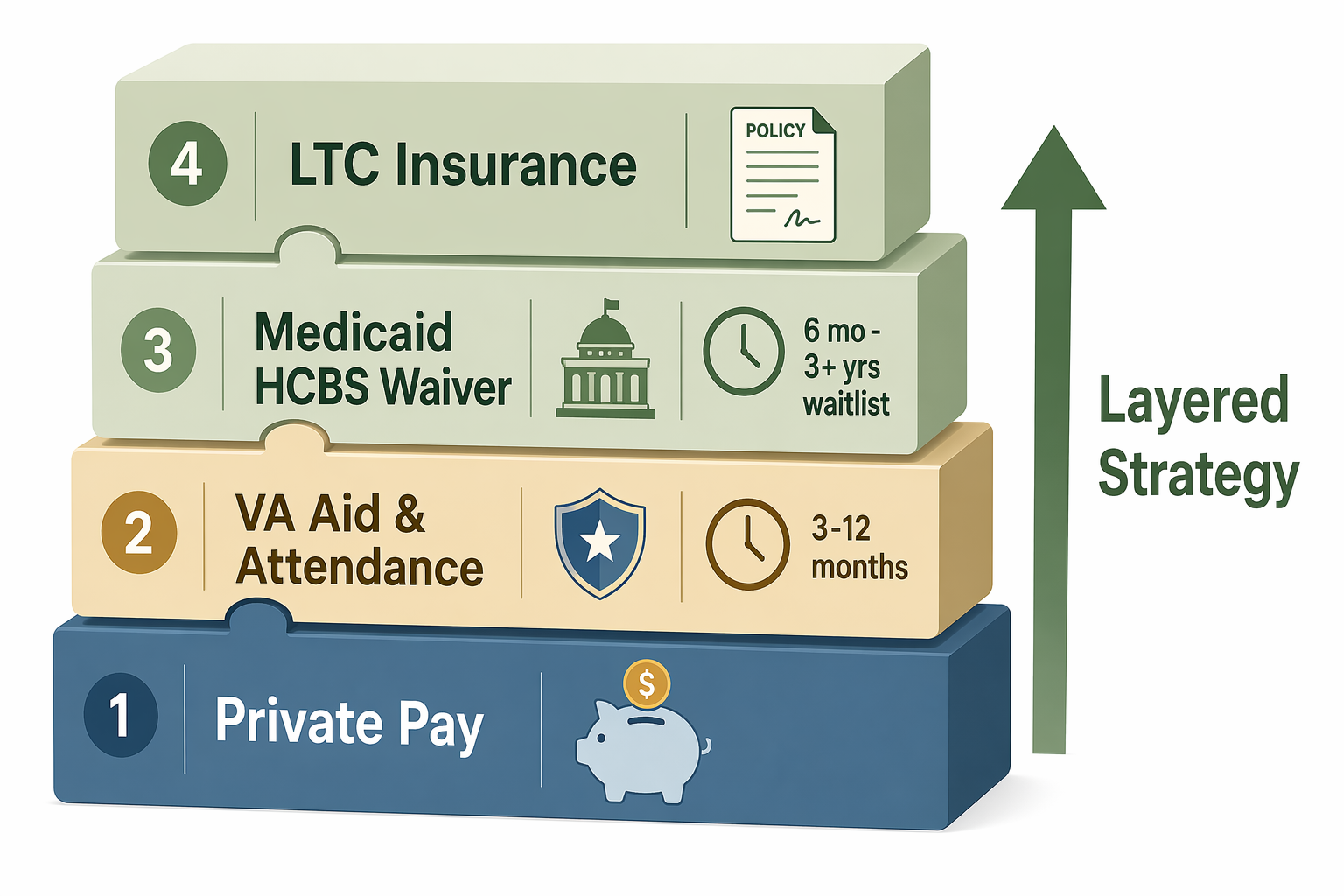
Here is a sequenced action plan organized by time horizon:
| Time Horizon | Action | Funding Source | What It Can Cover |
|---|---|---|---|
| Immediately (this week) | Start private pay; review LTC insurance policy; contact Area Agency on Aging | Private pay, LTC insurance | Covers care while other applications are pending |
| Within 1 month | Submit VA Aid & Attendance application; file LTC insurance claim | VA benefits, LTC insurance | VA covers 3-12 months out; LTC insurance covers after elimination period |
| Within 3-6 months | Apply for Medicaid HCBS waiver; explore life insurance conversion | Medicaid waiver, life insurance | Medicaid covers 20-40 hrs/week once approved; life insurance provides lump sum |
| Within 6-12 months | Evaluate reverse mortgage or HELOC if needed | Home equity | Provides medium-to-long-term funding bridge |
| Ongoing | Check PACE program eligibility; explore state-specific assistance | PACE, state programs | Additional support layers to reduce out-of-pocket costs |
- Start with private pay and LTC insurance. These are the most immediate sources. Use them to cover care while you wait for other applications to process.
- Apply for VA Aid & Attendance and Medicaid HCBS waivers immediately — even if care is not needed yet. The application timelines (3-12 months for VA, 6 months to 3+ years for Medicaid) mean that waiting until care is needed will leave you without those benefits when you need them most.
- Explore life insurance conversions and home equity as medium-term bridges. These can provide significant funds but require careful planning and professional advice.
- Layer in state and local resources. Area Agencies on Aging, PACE programs (serving approximately 80,000 participants across 33 states), and state-specific financial assistance programs can provide additional support that reduces the burden on your primary funding sources.
For a step-by-step action plan that walks you through what to do now, next week, and next month, see our senior care assistance triage guide. It is designed to help families who feel overwhelmed by the complexity of applications and decisions.
State and Local Resources: Where to Get Help Now
Beyond the major funding sources covered above, every state has a network of local organizations that can help families navigate the system, find affordable care, and identify additional financial assistance.
- Area Agencies on Aging (AAA): Your local AAA is the single most useful resource for benefit counseling, caregiver support, and referrals to local services. Call the Eldercare Locator at 1-800-677-1116 to find your local AAA.
- PACE (Program of All-Inclusive Care for the Elderly): PACE programs provide comprehensive medical and social services — including in-home care, adult day health, and transportation — to seniors who are eligible for nursing home care but want to remain at home. PACE serves about 80,000 participants in 33 states. Eligibility requires being 55 or older, living in a PACE service area, and meeting state nursing home level-of-care criteria.
- State-specific financial assistance programs: Some states offer supplemental in-home care programs funded through state general funds or Medicaid demonstration waivers. These programs have different names in different states — for example, California's In-Home Supportive Services (IHSS) program or New York's Consumer Directed Personal Assistance Program (CDPAP). Contact your state Medicaid office or AAA to learn what is available in your state.
For a comprehensive look at how each of these programs works in practice — including application steps, documentation requirements, and real-world tips from families who have been through the process — read our complete guide to paying for senior caregiver services. It complements this article by providing deeper detail on each funding source's application process.
The cost of in-home care at $34 to $35 per hour is a daunting number. But when you break it down into a layered strategy — private pay for the short term, VA benefits and LTC insurance for the medium term, Medicaid waivers and home equity for the long term — the problem becomes manageable. The key is to start now, apply early, and use every resource available to you.
Questions to bring to a clinician or OT
This is not medical, legal, or a family's final decision — only a framework. Bring these questions to a clinician, occupational therapist, or your local Area Agency on Aging.
Find Local HelpRelated reading
Noticed something outdated or inaccurate on this page? Flag a correction. We review every report against CDC, NIA, and AARP HomeFit guidance before updating a page.