A step-by-step guide for families hiring a senior home caregiver, covering needs assessment, agency vs. independent hiring, caregiver types, interview questions, and legal obligations—with 2026 national median costs explained.
By Editorial Team
new caregiver
experienced caregiver
long-distance caregiving
spousal caregiver
working caregiver
daily routines
medication management
personal hygiene
care coordination
first steps
ADLs
IADLs
The first real hiring conversation often happens before anyone is ready for it. A parent says they are fine. An adult child has seen the missed meals, the near fall, the unopened mail, or the confusion around medication. Someone at the kitchen table starts looking up senior home caregivers, and within minutes the family is comparing hourly rates without knowing what job they are pricing.
That order is backwards. Before you ask for references, compare agencies, or interview a caregiver, you need to know what kind of help is actually needed, how often it is needed, what tasks are included, and who will manage the arrangement after the first shift.
There is an emotional reason families rush this step. Most older adults who live at home would prefer to stay there with support: Pew Research Center reported in 2026 that 60% of older adults want to age at home with a caregiver, but only 37% think that is likely to happen.[1] The gap between wanting care at home and believing it can actually work is where better planning matters.
Decision
What you are trying to prevent
Assess the need
Hiring companionship when the real issue is bathing, transfers, dementia supervision, or medication reminders
Choose agency or independent hiring
Comparing hourly rates without understanding payroll, insurance, backup coverage, and legal responsibility
Match the caregiver type to the task
Expecting clinical or hands-on care from someone whose role does not include it
Vet candidates around the actual care plan
Asking generic interview questions that miss the parent’s real risks
Put costs and duties in writing
Disputes over schedules, mileage, household tasks, taxes, or who pays for a missed shift
Manage the first month closely
Letting small reliability or fit problems become the new normal
Start by naming the help, not the helper
“Mom needs help” is not a care plan. It is a signal to slow down and separate the tasks. Senior home caregivers can help with very different things, and the wrong match usually shows up later as a safety problem, a billing problem, or a burned-out daughter or son trying to patch every gap.
Build the first version of the care profile around two categories: activities of daily living and instrumental activities of daily living. The names are clinical, but the questions are plain.
Bathing: Can your parent get in and out of the shower safely? Do they need cueing, standby support, or hands-on help?
Dressing and grooming: Are buttons, compression socks, shaving, hair care, or choosing weather-appropriate clothes becoming difficult?
Toileting and continence: Is help needed with getting to the bathroom, changing briefs, cleaning up, or managing nighttime trips?
Transfers and mobility: Can your parent rise from a chair, get into bed, use a walker, climb stairs, or get into a car without unsafe pulling or lifting?
Meals and hydration: Are groceries in the house? Is food being prepared and eaten? Are there swallowing concerns or diet instructions?
Medication routine: Does your parent need a reminder, an opened pill organizer, pharmacy pickup, or clinical medication administration?
Transportation: Who drives to appointments, errands, worship, social visits, or therapy? Is the caregiver expected to use their own car?
Memory and judgment: Is there wandering, stove risk, repeated calling, missed appointments, suspicion, agitation, or unsafe decision-making?
Household tasks: Is the need light housekeeping, laundry, dishes, pet care, mail sorting, or full household management?
Coverage hours: Is help needed for two mornings a week, every evening, overnight supervision, post-hospital recovery, or live-in support?
The difference between “remind Dad to take his pills” and “manage Dad’s medication” is not a wording detail. It can change the caregiver type, the agency’s rules, the family’s liability, and the cost. The same is true for mobility. A caregiver who is wonderful at conversation and meal prep may not be trained or physically able to assist with transfers after a stroke.
If siblings disagree, use the care profile instead of arguing from impressions. One person may notice the refrigerator. Another may notice falls. Another may only hear the parent sound cheerful on the phone. The profile turns scattered worry into a list of shifts, tasks, and risks someone must cover.
Set a 2026 budget range before choosing a hiring path
Cost should come early, but it should not be the only decision. In 2026, A Place for Mom reports a national median in-home care cost of $34 per hour, while SeniorLiving.org, using CareScout data, reports $35 per hour.[2][3] Those figures are close enough to give families a budget anchor, but they should not be averaged into one fake-perfect number.
Source
2026 national median hourly cost
What to notice
A Place for Mom
$34/hr [2]
Useful as a national planning benchmark for in-home care
SeniorLiving.org / CareScout
$35/hr [3]
Shows state variation, including medians from $25 in Mississippi to $44 in South Dakota
The practical step is to price the weekly schedule, not just the hourly rate. Ten hours a week at a median rate is a very different decision from seven evenings a week or overnight coverage. If the parent needs bathing help three mornings a week, transportation twice a week, and dementia supervision every afternoon, those are separate cost drivers.
Availability also affects price and fit. The U.S. has more than 2.9 million paid in-home personal care workers, and that workforce has more than doubled since 2014, but the country still needs about 740,000 additional home care workers over the next decade.[4] For families, that does not mean panic. It means start with realistic expectations: the first available person may not be the right person, and the right person may still need a backup.
Choose between an agency and an independent caregiver
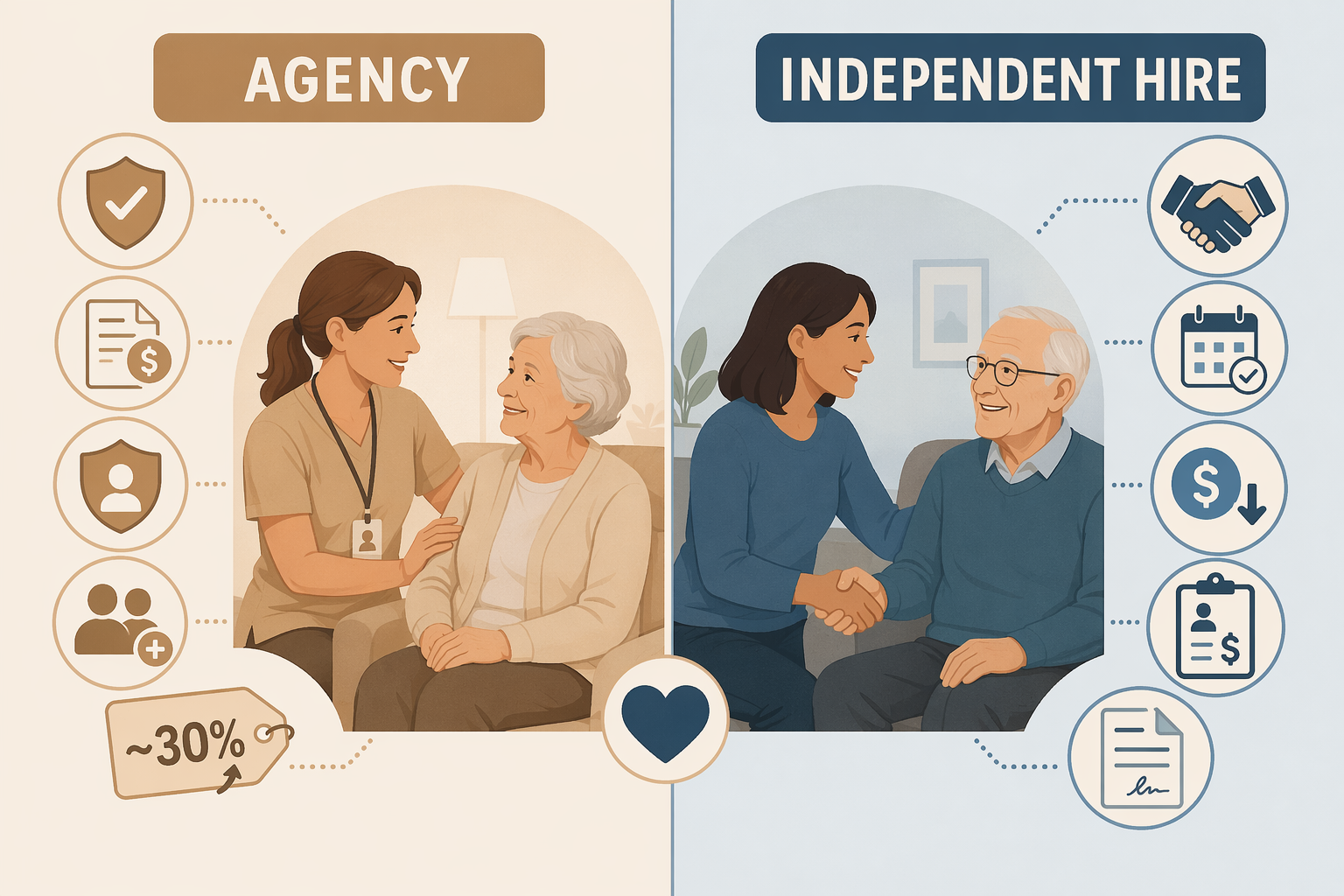
The agency-versus-independent decision is where many families focus on the wrong number. Agencies often cost 20% to 30% more than hiring privately, but that premium may cover background checks, payroll taxes, worker’s compensation, insurance, scheduling, supervision, and backup staffing.[5][6] If you hire independently, those duties do not disappear. They move to the family.
Question
Agency route
Independent route
Who recruits and screens?
The agency usually recruits, checks qualifications, and may run background checks.
The family finds candidates, screens them, checks references, and decides what background checks to use.
Who handles payroll and taxes?
The agency generally pays the worker and handles payroll administration.
The family may become the household employer and must handle payroll obligations.
Who carries worker’s compensation or liability coverage?
Often built into the agency structure, though families should confirm details.
The family must investigate and obtain appropriate coverage.
What happens if the caregiver is sick?
The agency may send a replacement, depending on staffing and the service agreement.
The family needs its own backup plan.
How much control does the family have?
Less direct control over the individual worker and agency rules.
More control over selection, schedule, duties, and relationship.
What can go wrong?
Higher cost, inconsistent substitutes, or a poor match if the agency does not understand the care plan.
Payroll mistakes, legal exposure, lack of backup, and blurred boundaries if the agreement is vague.
An agency can be worth the premium when the family needs speed, backup staffing, administrative help, or a higher level of oversight. It can also be the safer first route when no one in the family has time to manage hiring, payroll, and coverage.
An independent caregiver can be a good fit when the family has a strong candidate, wants more schedule flexibility, and has someone willing to act as the manager. That person must be named. “We’ll all help” usually becomes one sibling receiving the cancellation texts, tracking hours, handling conflicts, and filling the shift when the caregiver cannot come.
A simple test for the hiring path
Use an agency if missed shifts would create immediate safety risk and the family has no reliable backup.
Consider independent hiring if the parent’s needs are stable, the candidate is known or well vetted, and one family member can manage the employment details.
Be cautious with independent hiring if the care includes dementia behaviors, transfers, toileting, overnight supervision, or rapidly changing medical needs.
Do not choose the lower hourly rate until you have priced the time, paperwork, insurance, and backup coverage the family will provide.
Match the caregiver type to the work
Caregiver titles are easy to blur when you are hiring in a hurry. They are not interchangeable. The National Institute on Aging describes several types of home-based support for older adults, and families should use role and training differences as a matching tool, not as a vocabulary lesson.[7]
Role
Typical fit
Limits to clarify
PCA, or personal care aide
Companionship, meals, light housekeeping, errands, reminders, and some personal assistance depending on state rules and employer policy
No universal formal training requirement; do not assume clinical skills
HHA, or home health aide
Hands-on personal care such as bathing, dressing, and basic health-related support under applicable rules
Federal minimum training is 75 hours; scope still depends on state rules and agency policy
CNA, or certified nursing assistant
More structured hands-on care, mobility help, toileting support, and observation of condition changes
State-certified; training is often 120 or more hours, but CNAs are not nurses
LPN, or licensed practical nurse
Certain nursing tasks, wound care support, medication-related services, and monitoring within state scope
Usually trained through a one-year diploma program; more costly than aide-level care
RN, or registered nurse
Clinical assessment, care planning, complex medication or treatment oversight, and higher-level nursing care
Typically has a two- to four-year degree; not usually needed for routine companion care
A parent who mainly needs meals, errands, and conversation may not need a nurse. A parent who needs help transferring after a fall may need someone trained and physically capable of safe mobility support. A parent with dementia may need a caregiver who understands cueing, agitation, redirection, and supervision even if the task list looks simple on paper.
This is also where families should be careful about medication. Many home caregivers can remind someone that it is time to take medication. That is different from deciding what should be taken, filling pill organizers, giving injections, or managing changes after a physician visit. Ask the agency or candidate exactly what they can and cannot do under their role.
Interview for the actual Tuesday morning
Generic questions produce generic confidence. The interview should sound like the job. Family Caregiver Alliance recommends asking about experience, availability, transportation, and willingness to perform specific care tasks; those questions become much stronger when tied to the parent’s daily routine.[6]
“My mother needs standby help getting in and out of the shower. What is your experience with bathing support?”
“My father uses a walker and sometimes forgets it. How would you handle that without arguing with him?”
“Have you worked with someone who repeats questions, becomes suspicious, or wants to leave the house unsafely?”
“Are you comfortable with toileting assistance or changing briefs if that becomes part of the care plan?”
“Can you drive to appointments? If yes, whose car is used, and how is mileage handled?”
“Which days and hours are truly available, and what notice do you need for schedule changes?”
“What would make you call the family during a shift?”
“What tasks are you not willing, trained, or legally allowed to do?”
If the caregiver will be alone with a parent who has dementia, do not settle for “I’m patient.” Ask for examples. How did they respond when someone refused a shower? What did they do when a person accused them of stealing? How do they redirect without escalating? A calm answer matters more than a polished answer.
For mobility needs, ask candidates to describe what they would do, not to demonstrate on the spot with your parent. Unsafe trial lifts are not an interview technique. If transfers are a major issue, consider an agency assessment, an occupational therapy recommendation, or a caregiver with appropriate hands-on experience.
Check references, background, and boundaries
References matter after the job is defined. A glowing reference for companionship does not prove someone can manage incontinence care, wandering, or a parent who refuses help. Ask references about reliability, honesty, communication, the level of care provided, and why the arrangement ended.
Confirm identity, work eligibility, and any license or certification the person claims.
Ask agencies what background checks they perform, how often they repeat them, and what would disqualify a worker.
For independent hires, decide what background check process the family will use before making an offer.
Call references by phone when possible, and ask about punctuality, absences, communication, and fit with the older adult.
Clarify boundaries around visitors, phone use, social media, gifts, borrowing money, smoking, pets, and use of the parent’s car.
The parent’s opinion still matters. A caregiver can be technically qualified and still be a poor fit for the person receiving care. At the same time, a parent who resists help may reject everyone at first. Watch the interaction closely: Does the caregiver speak to the parent rather than around them? Do they rush? Do they overpromise? Do they notice safety issues without embarrassing the parent?
Put the money and legal duties where everyone can see them
Private pay is common because many families do not have a dedicated insurance benefit for long-term home care. Pew reported in 2026 that only 21% of adults age 65 and older have long-term care insurance.[1] If a policy exists, read the elimination period, benefit triggers, daily or monthly maximums, covered provider rules, and documentation requirements before assuming it will pay for the caregiver you want.
Medicaid home- and community-based services may help eligible low-income seniors receive care at home, but waiver rules, waiting lists, covered services, and consumer-directed options vary by state. The useful next call is usually the state Medicaid office or the local Area Agency on Aging, not a national guess about eligibility.
For independent hiring, the family may become a household employer. AARP and One Medical both flag obligations that first-time families often miss: obtaining an employer identification number, handling payroll taxes, considering worker’s compensation insurance, and documenting the arrangement in writing.[5][8]
Hourly rate, overtime rules, pay schedule, and whether taxes are withheld
Expected days, start and end times, cancellation rules, and holiday coverage
Specific duties, including bathing, toileting, meals, transportation, medication reminders, housekeeping, and errands
Mileage reimbursement, use of the caregiver’s car, and proof of driver’s license and insurance if transportation is included
Emergency contacts, when to call 911, and when to call the family
Confidentiality, keys, alarm codes, visitors, pets, smoking, and household rules
Process for changing duties if the parent’s condition changes
A written agreement is not cold. It protects the parent, the caregiver, and the family member who otherwise has to settle every misunderstanding by text message at 9 p.m.
Manage the first month as part of the hire
The hire is not finished when the caregiver accepts the shift. The first month is when the care plan meets the house, the parent’s habits, the caregiver’s judgment, and the family’s availability.
Before the first shift, leave a short written care sheet in the home. Include the parent’s preferred name, mobility limits, fall risks, meal preferences, allergies, medication reminder routine, emergency contacts, bathroom setup, dementia-related triggers if relevant, and any household rules. Do not rely on a rushed verbal handoff.
After the first few shifts, ask the caregiver what worked, what was harder than expected, and whether the schedule allows enough time for the assigned tasks.
Ask the parent concrete questions: Did the caregiver arrive on time? Did you feel rushed? Did you eat? Did you get help with the task we hired for?
Watch for early reliability patterns, including lateness, frequent schedule changes, unclear communication, or tasks quietly being skipped.
Keep a backup plan for illness, weather, transportation trouble, and caregiver turnover.
Revise the care plan when the parent’s needs change instead of stretching the original job into something it no longer covers.
A good caregiver relationship can feel natural once it is working, but it rarely starts by luck alone. It usually starts because the family made the decisions in the right order: what help is needed, who is qualified to provide it, which hiring path fits the family’s capacity, what the true cost includes, and how the arrangement will be managed after the first shift.


Comments
Join the discussion with an anonymous comment.