
Caregiver decision guide
Is It Time for Overnight Care? Recognizing the Red Flags in Your Aging Parent
A diagnostic framework for family caregivers to identify when an aging parent may need overnight help — covering physical, cognitive, and caregiver red flags before a crisis occurs.
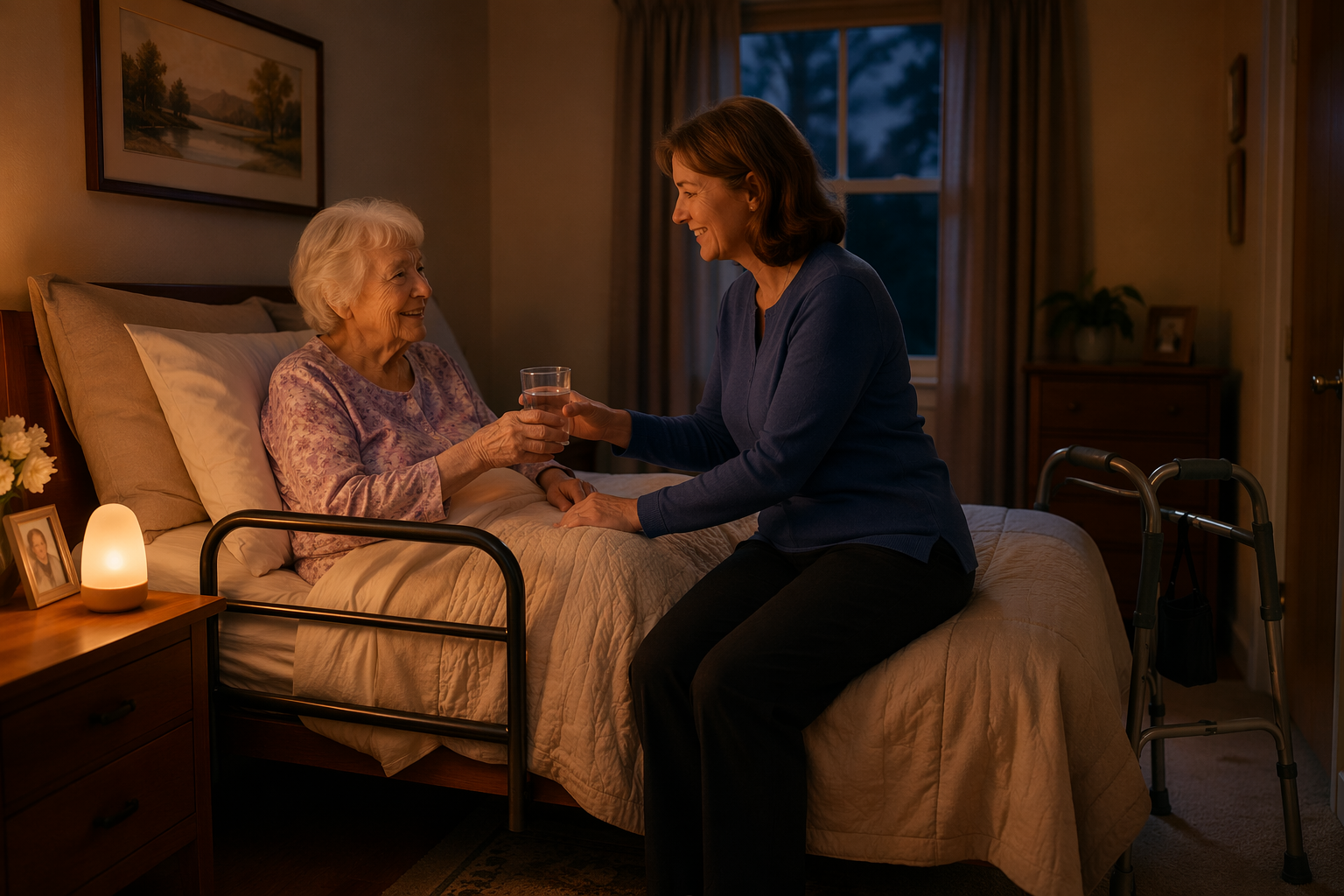
Why Nighttime Is the Most Dangerous Time for Older Adults
When the lights go out, the risk profile for an older adult living alone shifts dramatically. The combination of darkness, fatigue, slower reaction times, and the urgent need to use the bathroom creates a perfect storm for injury. The numbers bear this out: the CDC reports that more than one out of four people aged 65 and older falls each year, and a single fall doubles the chances of falling again. These falls send approximately 3 million older adults to emergency departments annually and are the leading cause of traumatic brain injuries.
For families caring for someone with dementia, the nighttime danger is compounded by wandering. The Alzheimer's Association estimates that 6 in 10 people living with dementia will wander at some point, and nearly half of those who wander risk serious injury if they are not found within 24 hours. Nighttime wandering is especially dangerous because the person may leave the house unnoticed, encounter stairs or uneven terrain in the dark, or become disoriented in cold weather.
Yet most families do not seek overnight help until after a crisis — a fall that breaks a hip, a wandering episode that requires a police search, or a hospitalization. The central argument of this guide is that the red flags appear months before the catastrophe. Learning to recognize them is the first step toward preventing the crisis altogether.
Physical Red Flags: What Your Parent's Body Is Telling You
The body sends clear signals before a nighttime crisis occurs. The challenge is that many of these signals are easy to miss or explain away — especially when your parent is reluctant to admit they are struggling. Here are the physical red flags that warrant attention.
Nocturia: The Bathroom Trip That Changes Everything
Getting up to use the bathroom in the middle of the night is the single highest-risk activity an older adult performs after dark. A study from the University of Alabama at Birmingham found that older adults who experience nocturia — the need to urinate two or more times per night — are nearly 30% more likely to fall than those who sleep through the night. The risk comes from the combination of urgency (rushing to the bathroom while half-asleep), low lighting, and the distance between the bed and the toilet.
If your parent is making two or more bathroom trips per night, or if you notice them shuffling rather than walking on those trips, the risk is elevated. This is not a normal part of aging that you should accept — it is a modifiable risk factor.
Unexplained Bruising and Near-Miss Incidents
Bruises on the arms, hips, or thighs that your parent cannot explain are often evidence of a fall they did not report. The same goes for a parent who suddenly starts gripping furniture or walls when walking through the house — a behavior known as "furniture surfing" that signals declining balance or strength.
Pay attention to what your parent describes as a "near miss" — a stumble they caught themselves from, a moment they grabbed the doorframe to stay upright. These are not false alarms. They are the body's way of saying that the margin for error is shrinking.
Observable Mobility Decline
Has your parent stopped walking to the mailbox? Do they avoid stairs they used to manage? Are they holding onto the wall or furniture more than they did three months ago? These are not just signs of aging — they are signs of functional decline that directly increase nighttime fall risk. A person who is unstable during the day is exponentially more dangerous at night, when visual cues are reduced and reaction times are slower.
- Two or more nighttime bathroom trips (nocturia) — associated with a ~30% higher fall risk
- Unexplained bruises on hips, arms, or thighs
- Reports of "near misses" — stumbles or grabs to avoid falling
- Furniture surfing or wall-hugging when walking through the house
- Avoidance of stairs or previously routine walking routes
Cognitive Red Flags: Sundowning, Wandering, and Nighttime Confusion
For older adults with Alzheimer's disease or another form of dementia, the nighttime hours bring a distinct set of dangers. The Alzheimer's Association describes sundowning as increased confusion, anxiety, agitation, and disorientation that begins in the late afternoon and extends through the night. This is not a disease itself but a set of symptoms that can include pacing, hallucinations, and difficulty sleeping.
Sundowning is often triggered by a combination of factors: mental and physical exhaustion from the day, a disrupted internal body clock, low lighting that creates confusing shadows, and the caregiver's own end-of-day stress, which the person with dementia can sense. When these factors converge, a person who was calm and oriented during the morning may become confused, fearful, and prone to wandering by evening.
Exit-Seeking Behavior and Disorientation Upon Waking
Wandering is not random. It is often purposeful from the perspective of the person with dementia — they may be looking for a bathroom, a deceased spouse, or a childhood home. The danger is that they may attempt to leave the house, descend stairs, or open a door to the outdoors without understanding the consequences. The Alzheimer's Association notes that nearly half of people with dementia who wander risk serious injury if not found within 24 hours.
Another cognitive red flag is disorientation upon waking. A person who wakes from a nap or nighttime sleep and does not immediately recognize their surroundings — who calls out, becomes agitated, or tries to "go home" while already at home — is experiencing a level of confusion that makes independent overnight stays unsafe.
- Regular sundowning episodes: increased confusion, agitation, or pacing from late afternoon through night
- Exit-seeking behavior: attempting to leave the house, especially after dark
- Disorientation upon waking: not recognizing the home environment or calling out in confusion
- Hallucinations or paranoia that intensify in low-light conditions
- Difficulty settling down to sleep or sleeping in short, fragmented cycles
Caregiver Red Flags: When Your Own Health Signals the Need for Help
One of the most overlooked indicators that overnight care is needed is the caregiver's own health. If you are the primary family caregiver and you are not sleeping, that is not a personal failing — it is a data point. The Family Caregiver Alliance reports that approximately 70% of caregivers for people with dementia report sleep problems, and 60% report sleeping fewer than seven hours per night. Among those surveyed by California Caregiver Resource Centers, 41% said they are awakened during the night by the person they care for.
Chronic sleep deprivation in caregivers is not just unpleasant — it is dangerous. Research by Rowe and colleagues found that sleep disruption is one of the most common reasons a caregiver decides to place a loved one in a facility. In other words, the decision to seek overnight care is often driven not by a single dramatic event, but by the accumulated exhaustion of months or years of broken sleep.
Signs That Your Sleep Debt Is Driving the Decision
If you recognize any of the following patterns in yourself, consider them a signal that the current arrangement is not sustainable — and that overnight help may be needed for your sake as much as your parent's.
- You dread nightfall because you know you will be up multiple times
- You are irritable, short-tempered, or tearful during the day
- You have developed new or worsening health problems (high blood pressure, frequent illness, weight changes)
- You rely on caffeine, alcohol, or sleep medication to get through the day or night
- You have missed work, social events, or medical appointments due to exhaustion
How to Assess Risk at Home: A 3-Night Observation Framework
The following framework is designed to help you gather objective information about what happens during the night in your parent's home. It is not a clinical diagnostic tool — it is a practical caregiver assessment that can help you decide whether to take the next step toward professional overnight care.
To use this framework, you will need to either stay overnight at your parent's home or set up a temporary observation system. If you cannot be physically present, passive home monitoring sensors — motion detectors, door sensors, and bed occupancy monitors — can provide the same data without requiring you to sleep in the next room.
| Night | What to Observe | Key Questions to Answer |
|---|---|---|
| Night 1 | Bathroom trip frequency and safety | How many times does your parent get up? Do they use a light? Do they hold the wall or furniture? Do they seem steady on their feet? |
| Night 2 | Signs of confusion or agitation | Does your parent seem disoriented upon waking? Do they call out, pace, or attempt to leave the bedroom? Do they recognize their surroundings? |
| Night 3 | Sleep quality for both of you | How many hours of uninterrupted sleep does your parent get? How many hours do you get? Are you both waking up rested? |
After three nights, review your notes. If you observed two or more bathroom trips per night, any signs of confusion or disorientation, or if your own sleep was severely disrupted, the evidence suggests that the current level of independence at night is not safe.
Matching Red Flags to Care Levels: From Safety Checks to Professional Overnight Care
Not every red flag requires a professional overnight caregiver. The appropriate level of intervention depends on the severity, frequency, and combination of the signs you have observed. The table below provides a general framework for matching red flags to care levels.
| Red Flag Profile | Recommended Level of Intervention | Example Actions |
|---|---|---|
| Occasional nocturia (1 trip/night), no falls, no confusion | Environmental modifications only | Install nightlights, clear pathways, add a bedside commode. See the Nighttime Fall Prevention guide. |
| Frequent nocturia (2+ trips), near misses, mild mobility decline | Monitoring technology + periodic safety checks | Install motion sensors and bed occupancy monitors. Have a family member or neighbor check in nightly. |
| Sundowning, wandering, or disorientation upon waking | Professional overnight supervision recommended | A trained overnight caregiver can provide supervision, redirection, and assistance with transfers. |
| Caregiver sleep deprivation with health decline | Professional overnight care strongly recommended | Overnight care protects both the older adult and the caregiver's health. See the Caregiver Sleep Crisis guide. |
| Recent fall with injury or hospitalization | Immediate professional assessment | Contact a home care agency for an in-home assessment. Do not wait for a second fall. |
When to Call a Doctor vs. When to Call a Home Care Agency
A common point of confusion for family caregivers is whether a particular red flag requires a medical evaluation or a caregiving service. The distinction matters because the wrong first call can delay the right intervention.
Call the Doctor When You See:
- Sudden or rapid onset of confusion (not the gradual progression of dementia)
- A fall that resulted in a head injury, loss of consciousness, or inability to get up
- Sudden mobility decline — a parent who was walking independently and suddenly cannot
- New or changed medications that may be causing dizziness, sedation, or increased confusion
- Signs of infection (UTI, pneumonia) that can cause sudden confusion in older adults
Call a Home Care Agency When You See:
- A pattern of nighttime bathroom trips that your parent cannot manage safely alone
- Sundowning or wandering that requires supervision but not medical intervention
- Your own sleep deprivation has reached a point where you cannot function safely during the day
- Your parent needs assistance with transfers (getting in and out of bed) but not skilled nursing
- You need a consistent, reliable presence overnight so you can sleep
How to Talk to a Resistant Parent About Overnight Care
The most difficult part of this process may not be recognizing the red flags — it may be convincing your parent that help is needed. For an older adult who values their independence, the suggestion of overnight care can feel like a threat to their autonomy. The way you frame the conversation matters enormously.
Frame It as a Safety Assistant, Not a Babysitter
Avoid language that implies your parent is incapable or a burden. Instead, frame overnight care as a practical safety measure — the same way you would frame a nightlight or a grab bar. Use phrases like:
- "I worry about you getting up in the dark. Having someone here at night would mean I can sleep without worrying."
- "The doctor recommended we have someone here at night just as a precaution, like a safety net."
- "This is not about taking away your independence. It is about making sure you can stay in your home safely."
Use a Clinical Recommendation as Cover
Many older adults are more receptive to a recommendation from a doctor than from a family member. If your parent's physician agrees that overnight supervision is warranted, ask the doctor to raise the topic. A clinical recommendation can depersonalize the conversation and reduce the sense that you are imposing your will.
Start With a Trial Period
The idea of a permanent overnight caregiver can feel overwhelming. Propose a trial — one week, or even just a few nights — to see how it feels. Many older adults who resist the idea initially find that they actually appreciate the company and the sense of security. A trial period gives everyone permission to adjust without making a permanent commitment.
This conversation is emotionally difficult, and it may take several attempts before your parent is willing to accept help. That is normal. The goal is not to win an argument — it is to keep your parent safe while preserving their dignity and your relationship.
Questions to bring to a clinician or OT
This is not medical, legal, or a family's final decision — only a framework. Bring these questions to a clinician, occupational therapist, or your local Area Agency on Aging.
Find Local HelpRelated reading
- What Caring for an Aging Parent Actually Looks Like Day-to-Day: A Realistic Breakdown of Family Caregiver Responsibilities
- When Is It Time for Senior Care? A Proactive Checklist for Recognizing the Signs and Choosing the Right Option
- The Signs Families Miss: Why Most Senior Residential Home Decisions Happen in a Crisis and How to Recognize Normalized Decline Before It's Too Late
Noticed something outdated or inaccurate on this page? Flag a correction. We review every report against CDC, NIA, and AARP HomeFit guidance before updating a page.