A neutral, evidence-based review of Home Instead's services, costs, franchise structure, and dementia care training — and why you need to evaluate your local office, not the national brand.
By Editorial Team
new caregiver
experienced caregiver
long-distance caregiving
spousal caregiver
working caregiver
daily routines
medication management
personal hygiene
care coordination
first steps
ADLs
IADLs
If you are deciding whether to call a local Home Instead home care office, the short answer is: it may be a strong candidate, especially if your parent needs non-medical help at home or dementia-related support. But the national name cannot answer the questions that matter most on a Tuesday morning: whether this office can staff the hours you need, send a caregiver your parent accepts, handle a call-out, stay inside your budget, and explain exactly how its dementia training works.
Start with the service boundary. Home Instead is generally described as a non-medical in-home care provider offering personal care, companionship, meal preparation, transportation, light housekeeping, and dementia care. It is not the same thing as home health care. If your parent needs wound care, injections, therapy, skilled medication management, or nursing oversight, you are in a different category of care and may need a Medicare-certified home health agency instead of, or in addition to, a non-medical home care agency.[1][2]
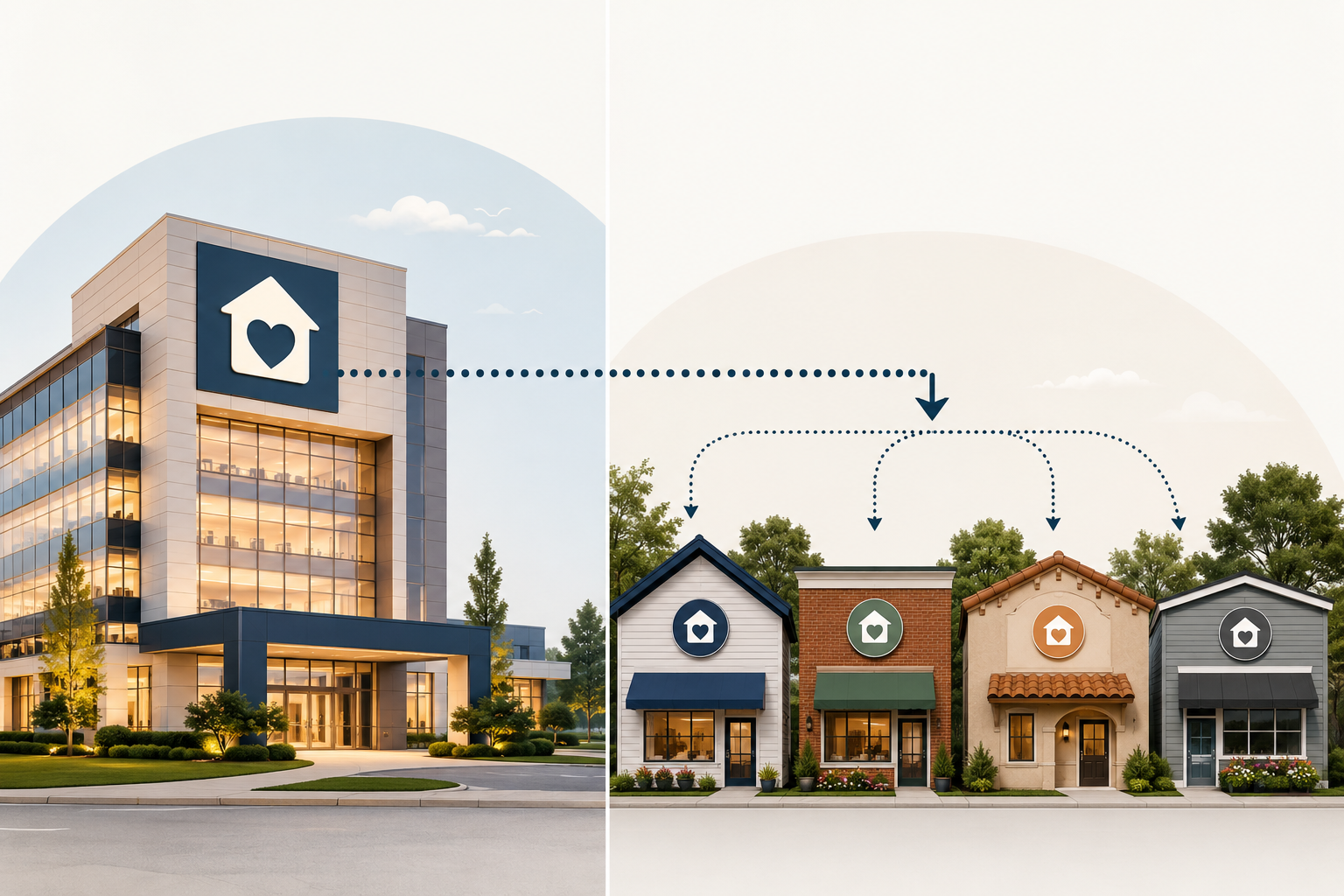
The second boundary is just as important: Home Instead is a franchise network. The brand can set standards, provide training infrastructure, and give families a familiar place to start. It cannot make every local office equally responsive, affordable, or well managed. A good decision is less about whether Home Instead is good in the abstract and more about whether the office near your parent can meet your parent's actual care needs.
What Home Instead Can Usually Help With
For many families, the useful part of Home Instead's model is that it sits in the gap between family caregiving and clinical care. A caregiver might help a parent bathe, dress, prepare lunch, get to an appointment, change bed linens, take a walk, or stay engaged during the day. Those tasks are not small. They are often the difference between a parent staying at home and a daughter or son quietly rearranging work, sleep, and weekends around care.
The fit is strongest when the problem is functional support: your parent is unsafe showering alone, forgets meals, no longer drives, becomes anxious when alone, or needs regular supervision because of memory loss. It is weaker if the main need is clinical. A home care aide can remind, observe, assist, and report within the agency's allowed scope; that is not the same as a nurse assessing a wound, changing a care plan, or administering skilled treatment.
Need at home
Home Instead may fit?
What to verify locally
Bathing, dressing, toileting, mobility support
Often, as personal care
Whether the caregiver is trained for your parent's transfer, fall, or dementia-related resistance risks
Whether driving record review, insurance rules, and mileage charges apply
Memory-loss supervision and routines
Often, as dementia care
How dementia training is delivered and whether the assigned caregiver has completed it
Wound care, injections, therapy, skilled medication management
No, not as non-medical home care
Whether you also need a home health agency or clinician-directed services
The Brand Is Large, But the Office Is Local
Home Instead is not a small operation. The company was founded in Omaha in 1994, was acquired by Honor Technology in 2021 in a deal described as creating a combined entity with about $2.1 billion in revenue, and operates through more than 1,200 U.S. locations with roughly 100,000 caregivers.[2][3] That size helps explain why families recognize the name before they recognize any local competitors.
Scale is context, not proof. A national network can create shared materials and minimum expectations, but home care is delivered by a specific aide, scheduled by a specific coordinator, supervised by a specific local office, and felt by one household. The person who matters to your parent is not the brand executive or the award page. It is the caregiver who arrives, the scheduler who notices a pattern of missed shifts, and the manager who decides whether a poor match gets replaced quickly.
That is why national review scores should be read carefully. SeniorLiving.org reports a mixed review landscape for Home Instead, including Trustpilot at 2.2 out of 5, Yelp at 3.8 out of 5 across 1,434 reviews, and ConsumerAffairs at about 2.1 out of 5.[2] Newsweek also named Home Instead to its America's Best Customer Service 2026 list.[4] Both kinds of information can be true and still tell you very little about the office five miles from your mother's house.
Aggregated reviews mix different cities, owners, schedulers, caregiver labor markets, and family expectations. Some negative reviews describe exactly the failure a family fears: missed shifts, poor communication, inconsistent caregivers. Some positive reviews may reflect a strong local manager and a caregiver who stayed for years. The useful lesson is not that the brand is good or bad. It is that you have to evaluate the local franchise directly.
Screening and Training: A Real Baseline, Still Worth Verifying
The most reassuring brand-level material is not the logo. It is the reported caregiver screening and training structure. The Senior List's 2026 review describes Home Instead standards that include state and federal background checks, FBI fingerprint searches, sex-offender registry checks, pre-employment and random drug testing, driving record review, and multi-phase training with dementia-specific modules.[1]
Those safeguards matter. A family hiring privately may have to build that vetting process from scratch. A large agency with documented screening gives you a better starting point, especially if your parent needs help bathing, toileting, transferring, or riding in a caregiver's car. But the next question is local enforcement. Ask the office how it verifies completed checks, whether all caregivers who drive clients have a driving record review, and what happens if a caregiver's background or drug screen creates a concern after hiring.
Dementia training deserves separate attention. Home Instead's Person-Centered Care Training for Alzheimer's Disease and Other Dementias appears on the Alzheimer's Association's list of recognized dementia care training programs. The Association states that recognition is not an endorsement, so the fact should not be inflated into a guarantee. Still, recognition means the program has met the Association's listed training recognition criteria, and that is more concrete than a vague promise that caregivers are compassionate or experienced.[5]
If your parent has dementia, do not stop at asking whether the office offers dementia care. Ask how the training is delivered, whether the caregiver assigned to your parent has completed the dementia-specific program, whether the office trains caregivers on resistance to bathing or dressing, and how supervisors support a caregiver when a parent becomes suspicious, frightened, or verbally aggressive. Dementia care is not just memory-friendly conversation. It is the skill of getting necessary care done without turning every morning into a battle.
Cost: The Hourly Rate Is Only the First Number
Home Instead does not publish one national price list, and that is appropriate for a franchise network operating in different labor markets. The figures families see online are third-party estimates, not official national rates. The Senior List reports Home Instead at about $35 to $55 per hour in 2026, with specialized dementia care often toward the upper end at about $50 to $55 per hour.[1] A Place for Mom lists the 2026 national median for non-medical home care at $34 per hour, which places those reported Home Instead rates about $1 to $21 above that median depending on location and care complexity.[6]
That comparison is useful, but it is not a quote. A local office in a high-wage area may be higher. A nearby competitor may be lower but have weaker backup coverage. Dementia care may cost more if it requires a more experienced caregiver or a tighter staffing match. Transportation, short-notice scheduling, weekend hours, holidays, or higher personal-care needs may change the final bill.
The bigger surprise for many families is not the hourly rate. It is the minimum. Third-party reviews report that many Home Instead locations require 4-hour minimum shifts and weekly minimums commonly around 12 to 20 hours.[1][7] That matters if what you imagined was two hours on Tuesday for a shower and lunch. A 4-hour minimum turns that into a longer visit. A 12-hour weekly minimum may require three 4-hour shifts. At $35 per hour, that is $420 per week before any added fees; at $55 per hour, it is $660 per week. If the office requires 20 hours, the weekly cost rises to $700 at $35 per hour or $1,100 at $55 per hour.
Minimums are not automatically unreasonable. Agencies use them because short shifts are harder to staff, caregivers need viable work hours, and constant one- or two-hour visits can make scheduling unstable. But minimums can make paid help impractical for a family that needs only sporadic coverage. Before you compare agencies, ask each one for the same information: hourly rate, shift minimum, weekly minimum, weekend or holiday premiums, assessment fees, cancellation rules, and whether dementia care changes the rate.
Question
Why it changes the real cost
What is your hourly rate for my parent's level of care?
A general companion rate may not apply to hands-on personal care or dementia support.
What is the shortest shift you will schedule?
A 4-hour minimum can double the cost of a family that expected 2-hour visits.
Do you require a weekly minimum?
A 12- to 20-hour minimum may determine whether the service is affordable at all.
Are weekends, holidays, transportation, or short-notice starts priced differently?
The quoted weekday rate may not match the schedule your family actually needs.
What happens financially if my parent refuses care that day?
Dementia-related refusal can create cancellation or minimum-hour problems.
How to Evaluate the Local Home Instead Office
The first call should feel less like asking for a brochure and more like interviewing the office that may soon be inside your parent's home. A polished answer is not enough. You are listening for whether the person on the phone understands scheduling pressure, dementia behavior, caregiver matching, and backup coverage in practical terms.
Ask what services this office will and will not provide for your parent's specific needs, especially if bathing, transfers, incontinence, dementia symptoms, or transportation are involved.
Ask how caregiver screening is verified locally, including background checks, FBI fingerprinting, sex-offender registry checks, drug testing, and driving record review.
Ask how dementia training is assigned, documented, and matched to clients, not just whether the brand has a dementia program.
Ask what happens when a caregiver calls out: who phones you, how quickly a replacement is found, and whether backup caregivers have already been briefed on your parent's care plan.
Ask whether the same caregiver or small caregiver team can be scheduled consistently, and what the office does when the match is not working.
Ask for the exact hourly rate, shift minimum, weekly minimum, cancellation policy, and any higher rates for dementia care, weekends, holidays, or transportation.
Then look locally. Read reviews for that office, not just the national brand. Notice whether complaints repeat: missed shifts, poor communication, billing confusion, caregiver turnover, or weak dementia handling. One angry review may not mean much. A pattern does. If the office can provide references within the limits of privacy and policy, ask for families whose care needs resemble yours.
Caregiver consistency is worth pressing on because turnover is not an abstract industry problem when your parent has memory loss. The Bureau of Labor Statistics projects 34% job growth for home health and personal care aides, a sign of continuing demand for this workforce.[8] High demand can be good for employment, but families feel the strain when offices cannot retain enough caregivers to cover shifts reliably. A parent with dementia may tolerate one familiar aide and refuse care from a rotating cast of strangers.
It is also fair to ask how the office supports caregivers. Families sometimes treat caregiver turnover as if it is only an agency inconvenience. It is also a worker problem: low-paid, physically and emotionally demanding work often lands on the aide who is expected to keep everyone calm. An office that trains, supervises, and retains caregivers well is more likely to give your parent continuity.
What National Awards and Franchise Financials Can, and Cannot, Tell You
Brand-level recognition has some value. It can suggest that a company has invested in customer service systems, training materials, and visibility. Newsweek's 2026 customer service recognition belongs in that category.[4] It is a signal, not a staffing report for your ZIP code.
Franchise financial data has the same limitation. Franchise Chatter and 1851 Franchise cite 2023 franchise disclosure data showing median annual revenue of about $2.1 million across 603 Home Instead locations.[9][10] That may interest someone studying the business model. It does not tell you whether your local office has a stable caregiver roster, whether the scheduler answers the phone after 5 p.m., or whether the owner invests in supervision.
For a family, the useful test is narrower. Can this office explain its process without hiding behind the brand? Can it give you a written care plan, pricing terms, and minimums? Can it describe backup coverage concretely? Can it say what kind of dementia behaviors its caregivers are prepared to handle and what would require a different level of care?
When Calling Home Instead Makes Sense
Calling a local Home Instead office makes sense when your parent needs non-medical support, the likely cost and minimum hours are within reach, and you want the structure of an agency rather than hiring privately. It is especially reasonable to include Home Instead on the call list if dementia care is part of the picture, because the brand has a named dementia training program recognized by the Alzheimer's Association, with the important caveat that recognition is not endorsement.[5]
It makes less sense if your parent primarily needs skilled nursing, therapy, or medical care. It may also be a poor fit if the local office's minimums are far above what you need, if the office cannot explain backup coverage, or if local reviews show a repeated pattern of missed shifts and weak communication.
The most practical path is to call Home Instead and at least one other local agency with the same care description and the same questions. Compare the answers side by side. A national brand can get Home Instead onto the list. The local office has to earn the decision.

Comments
Join the discussion with an anonymous comment.