How to Choose a Senior Citizen Home: A Step-by-Step Decision Framework
For: adult childReviewed: 2026-06-27
How to Choose a Senior Citizen Home: A Step-by-Step Decision Framework
A step-by-step framework helps families navigate the overwhelming process of selecting a senior living facility — from assessing the older adult's functional needs and understanding 2026 costs to touring with a checklist and verifying quality through Medicare Care Compare and state surveys.
By Editorial Team
new caregiver
experienced caregiver
long-distance caregiving
spousal caregiver
working caregiver
daily routines
medication management
personal hygiene
care coordination
first steps
ADLs
IADLs
Once a family has admitted that home is no longer safe, the temptation is to start touring immediately. That is usually the wrong first move. A senior citizen home should be chosen only after the family has translated the older adult’s actual needs into a care level, a realistic budget, and a short list of facilities that can handle what is likely to happen after move-in—not just what looks manageable on tour day.
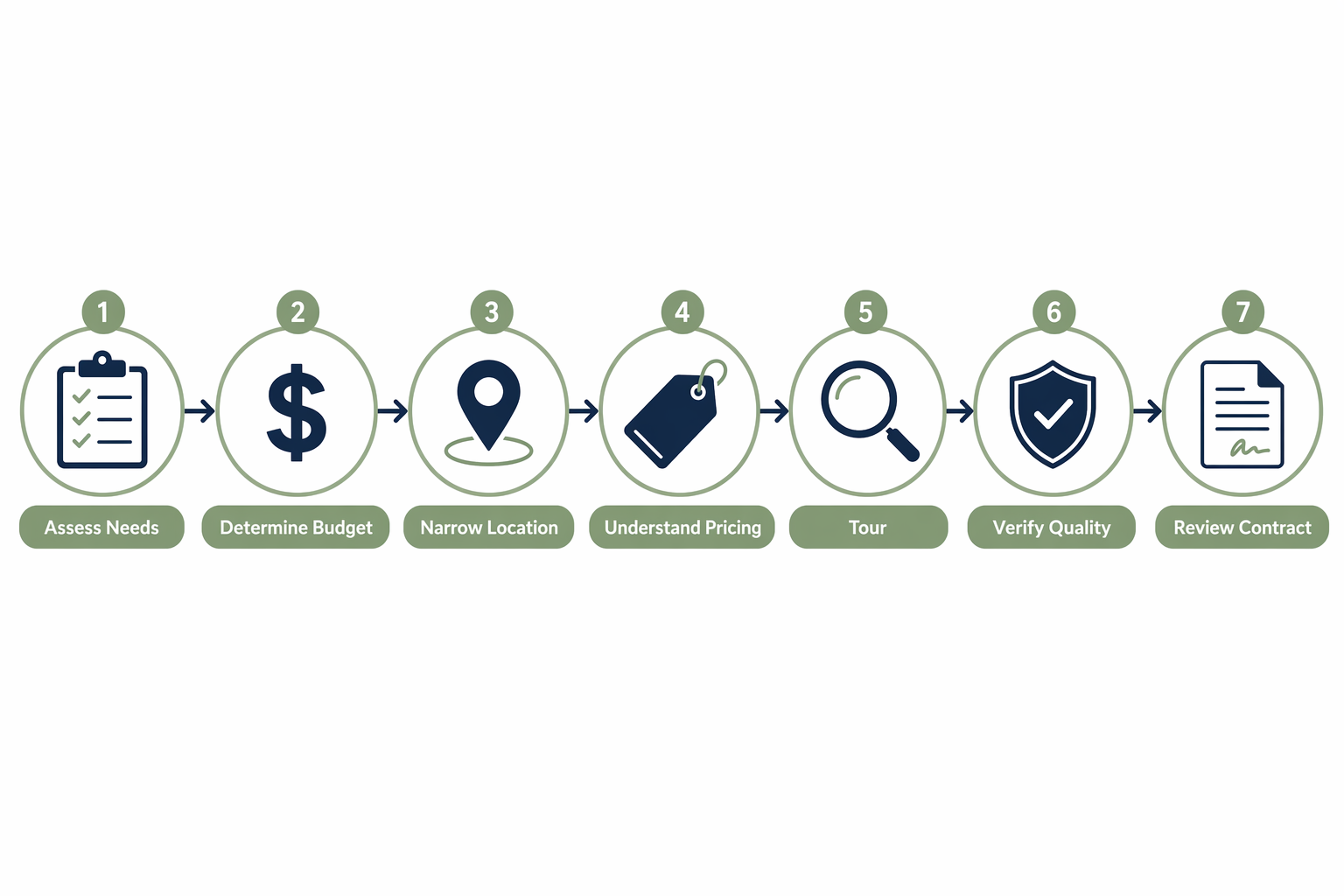
The basic sequence is simple. It is not emotionally easy, but it keeps families from comparing the wrong things.
Step
Decision to make
Assess needs
What help is required with ADLs, cognition, supervision, mobility, medications, and safety?
Match care level
Is this independent living, assisted living, memory care, nursing home care, or a continuing-care model?
Model the budget
What is the full monthly cost after care fees, second-person fees, community fees, and likely increases?
Narrow by location
Who can visit, respond to calls, attend care conferences, and get there after a fall or hospitalization?
Tour deliberately
Can the staff explain how care is actually delivered, especially when the resident refuses help or declines?
Verify quality
What do Medicare Care Compare, state survey reports, and accreditation records show?
Read the contract
What triggers rate increases, discharge, transfer, or a higher level of care?
Start with care needs, not with tours
A good tour can make three very different settings look equally plausible. That is why the first question is not whether the dining room is pleasant. It is whether the place is licensed, staffed, and organized for the kind of help your parent actually needs.
The National Institute on Aging distinguishes long-term care facilities by the level and type of support they provide. Assisted living generally offers help with personal care and daily activities; nursing homes provide a higher level of medical and nursing care; continuing care retirement communities combine multiple levels of care on one campus or within one organization.[1]
For families, the practical dividing line is usually not the label. It is the care burden. Make a written inventory before any sales appointment:
Bathing: Can the person bathe safely, remember to bathe, and accept help?
Dressing and grooming: Are clothes weather-appropriate and clean? Is cueing enough, or is hands-on help needed?
Toileting and continence: Are there accidents, skin concerns, nighttime urgency, or unsafe transfers?
Eating: Is the person eating enough, losing weight, choking, or forgetting meals?
Transfers and mobility: Can the person get out of bed, rise from a chair, use the bathroom, and walk without unsafe assistance?
Medication management: Who fills the pillbox, notices side effects, and responds when prescriptions change?
Cognition and judgment: Is there wandering, stove risk, paranoia, repeated calls, missed bills, or inability to summon help?
Supervision: Is the need intermittent, daily, overnight, or continuous?
This list should be filled out by someone who has seen the parent on an ordinary bad day, not only during a doctor visit or family lunch. If siblings disagree, ask each person to document what they have personally observed: falls, missed medications, spoiled food, unpaid bills, wandering, caregiver exhaustion, or the spouse sleeping in a chair because nighttime confusion has become unmanageable.
Match the care level before comparing facilities
Independent living is usually for older adults who can manage personal care but want meals, social opportunities, maintenance-free housing, transportation, or a simpler setting. It is not built around hands-on daily care. A parent who needs help bathing three times a week, medication administration, and someone watching for confusion at night is usually beyond ordinary independent living unless outside care is added and the building permits it.
Assisted living sits in the middle: more support than independent living, less medical intensity than a nursing home. Seniors in assisted living typically need help with at least two activities of daily living, and the average resident is 87 years old.[2] That matters because assisted living is not simply an apartment with meals. It is a care setting, and families should ask whether the building can handle the specific ADLs that are already failing.
Memory care is usually appropriate when dementia-related risks—not just forgetfulness—require a more structured and supervised environment. Wandering, exit-seeking, aggression during care, unsafe cooking, nighttime disorientation, or repeated emergency calls change the decision. If dementia is the central issue, use a more detailed transition screen such as 10 Signs It’s Time for Memory Care before deciding that standard assisted living will be enough.
A nursing home belongs on the list when the person needs skilled nursing care, significant medical monitoring, complex transfers, rehabilitation after hospitalization, or a level of physical care an assisted living community cannot provide. Families often resist this category because it sounds final. The more useful question is whether the parent’s needs can be safely met in a less medical setting without creating a revolving door of falls, hospitalizations, and emergency transfers.
A continuing care retirement community, or CCRC, may make sense when a person can enter at a lower level of independence but wants access to assisted living, memory care, or nursing care later. It is usually a larger financial commitment and should be evaluated as both a housing decision and a long-term care risk decision.
Build the budget around total cost, not advertised rent
The number on the brochure is often the cleanest number in the whole conversation. It may be the apartment rent. It may not include care. It may not include medication management, incontinence supplies, escorting to meals, a second resident, move-in fees, annual increases, or the higher rate that begins after the first care assessment.
As of mid-2026, A Place for Mom reports a national median assisted living cost of $5,419 per month, based on proprietary data from more than 24,000 actual moves within its network.[3] The same source places independent living around $3,200 per month and memory care at $6,690 per month.[3] SeniorLiving.org reports a 2026 median nursing home cost of $11,294 per month for a private room and $9,842 for a semi-private room, using a different underlying data approach.[4]
Those figures are useful planning anchors, not promises. They should not be treated as a perfectly consistent national price sheet across all care types, because no single source in the available data compares independent living, assisted living, memory care, nursing homes, and CCRCs with one shared methodology.
Care setting
2026 planning figure
Important caution
Independent living
About $3,200/month
Often does not include hands-on care; added services can change the comparison.
Assisted living
$5,419/month national median
Care fees, second-person fees, and community fees can raise the actual monthly and upfront cost.
Memory care
$6,690/month
Higher supervision and dementia-specific staffing often drive higher costs.
Nursing home, private room
$11,294/month
A different source methodology is used, so compare cautiously across categories.
CCRC
$300,000–$402,000 average entrance fee plus roughly $3,000–$5,000/month
The financial commitment depends heavily on contract type, refund provisions, and care access.
Geography can be as important as care level. A Place for Mom’s 2026 state-level assisted living data ranges from about $3,983 per month in Louisiana to $8,960 per month in Washington, D.C.[3] A family comparing one parent’s town with an adult child’s city may be comparing two entirely different markets.
Ask which pricing model the facility uses
Before a family decides that one community is cheaper than another, it needs to know how the bill is built. Assisted living and memory care communities commonly use one of three pricing approaches:
All-inclusive pricing: one monthly fee covers housing, meals, and a defined package of care services. This is easier to budget, but the family still needs to ask what is excluded.
Tiered pricing: the resident is assigned to a level of care, with higher levels carrying higher monthly rates. The key question is what triggers movement from one tier to the next.
A la carte pricing: the base rent is lower, and services such as bathing help, medication management, escorts, laundry, or incontinence care are added separately. This can look affordable until real care needs are priced in.
Second-person fees and community fees deserve direct questions. A Place for Mom reports a median second-person fee of about $1,200 per month and a median community fee of about $3,000.[3] For a couple, the second-person fee can be the difference between a workable plan and a budget that fails by the second year.
Annual increases also need to be modeled. SeniorLiving.org reports assisted living cost increases of about 5% annually and projects nursing home costs rising 12.5% by 2030.[4] Even if a family can manage the first month, it should run the numbers for the second and third year, especially if the parent is likely to need more care rather than less.
Length of stay is another pressure point. The National Center for Assisted Living reports a median assisted living stay of 22 months, a figure that should be treated as an industry planning marker rather than a prediction for one resident.[2] Some residents move in late and decline quickly; others live in assisted living for years. The contract and budget need to survive both possibilities.
CCRCs require a separate financial review. SeniorLiving.org cites CCRC entrance fees averaging roughly $300,000 to $402,000, and US News describes monthly fees commonly in the $3,000 to $5,000 range.[2][5] The value depends on what the entrance fee buys, whether any portion is refundable, how health care access is guaranteed, and what happens if the resident exhausts assets.
Payment sources—private funds, home sale proceeds, long-term care insurance, Veterans benefits, Medicaid where applicable, and other family resources—can get complicated quickly. For a deeper funding review, use Options for Elderly Care: A Complete Guide to Paying. US News also outlines common senior living payment options and the limits families should understand before assuming a program will cover a particular setting.[6]
Narrow by location, but do not let convenience overrule care
Location matters because someone will need to visit, notice changes, attend care-plan meetings, respond to hospital calls, bring missing eyeglasses, and decide whether a complaint is a one-time issue or a pattern. The best location is not always the closest building to the adult child’s house, but the building that can be monitored by the people who will actually show up.
A practical location screen should include:
Drive time for the primary family contact during normal traffic, not only on a quiet weekend.
Distance to the preferred hospital, specialists, dialysis center, or memory clinic, if relevant.
Whether the spouse, close friend, or sibling can visit without becoming exhausted.
How transportation to medical appointments is handled and billed.
Whether the community is in a market where staffing is especially tight or where occupancy pressures may affect room availability.
In 2026, NIC MAP reported that senior housing occupancy in its 31 Primary Markets was approaching 90%, and that nearly half of inventory had been built before 2000.[7] That does not describe every rural or suburban market, but it is a useful warning for families in major metro areas: the preferred building may not have the preferred room when the family is finally ready.
Tour for care behavior, not hospitality polish
Dining rooms, courtyards, and activity calendars are not irrelevant. People deserve pleasant spaces. But a senior citizen home is being hired to manage vulnerability. The tour should therefore test how the community responds when life is not pleasant: a fall, a medication change, a resident who refuses a shower, a daughter who is worried about weight loss, or a man with dementia who starts looking for the door at 9 p.m.
Questions that reveal the operating reality
Staffing: What is the staffing pattern during the day, evening, overnight, and weekends? Who is in the building overnight, and what are they trained to do?
Response time: How are call bells or pendants monitored? Who reviews unanswered calls or repeated calls?
Bathing resistance: If a resident refuses bathing, how many attempts are made, who is notified, and how is skin integrity monitored?
Medication management: Who administers medications, how are changes from physicians handled, and how are missed doses documented?
Falls: What happens after a fall? Who assesses the resident, who calls the family, and what changes are made to the care plan?
Dementia care: How does the staff handle wandering, exit-seeking, agitation during personal care, sundowning, or repeated questions?
Care-plan updates: How often is the care plan reviewed, and what triggers an earlier review?
Communication: Will the family have one main contact, or will every problem go through a general front desk?
Increasing needs: Which needs can the community manage, which require outside private-duty help, and which would trigger a transfer or discharge?
Listen for specifics. “We meet residents where they are” is not an answer to a bathing problem. “The aide documents refusal, tries again later with a different approach, alerts the nurse after repeated refusals, and calls the family if hygiene or skin risk becomes a concern” is closer to an operating procedure.
Also watch the residents. Are people clean, appropriately dressed, and engaged at least some of the time? Are call lights ringing without visible response? Do staff speak to residents by name? Does anyone appear parked in a hallway without purpose? One visit cannot prove quality, but it can show whether the building’s daily rhythm feels attentive or merely staged.
Verify quality after the tour
A tour is a sales encounter, even when the people are kind. Quality verification is the second look. Do it after the tour, when you have names, license types, and specific claims to check.
For nursing homes, Medicare Care Compare is the obvious starting point. It allows families to review federal nursing home information, including inspection results and other quality indicators. It does not tell the whole story, but it is far better than relying on a brochure or a single family review.
For assisted living and memory care, state oversight matters because licensing and inspection systems vary by state. Ask the community for its exact licensed name, license number if available, and the state agency that surveys it. Then look for recent inspection reports, complaint investigations, enforcement actions, and recurring patterns.
Accreditation can be useful when it applies, including Joint Commission accreditation in relevant settings, but it should be treated as an additional layer rather than a substitute for state surveys, federal nursing home data where applicable, and your own contract review. A beautiful lobby does not erase a regulatory history.
Read the contract as if care will change
The contract is where many families first discover that the facility’s warm promises have boundaries. Read it before the deposit becomes emotionally impossible to walk away from. If the parent has dementia, unstable mobility, incontinence, diabetes, Parkinson’s disease, behavioral symptoms, or a recent hospitalization, read it with those issues in mind.
At minimum, confirm these points in writing:
What is included in the base monthly fee?
What services are billed separately, and at what rate?
How is the level of care assessed before move-in, and when can it be reassessed?
How much notice is required for rate increases?
What happens after hospitalization or rehab?
Under what conditions can the resident be discharged or required to move to another level of care?
Are private caregivers allowed if needs exceed the community’s usual staffing model?
What fees are refundable if the resident dies, moves out, or is transferred soon after move-in?
Who signs financially, and does the document create any personal responsibility for an adult child?
Do not rely on verbal reassurance for discharge conditions, dementia behaviors, two-person transfers, incontinence care, medication administration, or end-of-life limitations. If the sales director says, “We can usually handle that,” ask where the contract or service plan says so.
The right senior citizen home is not necessarily the one with the nicest lobby, the lowest advertised rent, the longest activity calendar, or the shortest drive. It is the setting whose care level, staffing reality, total cost, quality record, and contract terms match the older adult’s actual needs.
No framework removes the grief from the decision. It does, however, reduce the chance of a panicked second move after a fall, a preventable hospital return, a surprise bill, or a discharge notice the family did not know was possible. Assess first. Price honestly. Tour deliberately. Verify independently. Sign only after everyone understands what will happen when care needs change.


Comments
Join the discussion with an anonymous comment.