
Caregiver decision guide
What Caring for an Aging Parent Actually Looks Like Day-to-Day: A Realistic Breakdown of Family Caregiver Responsibilities
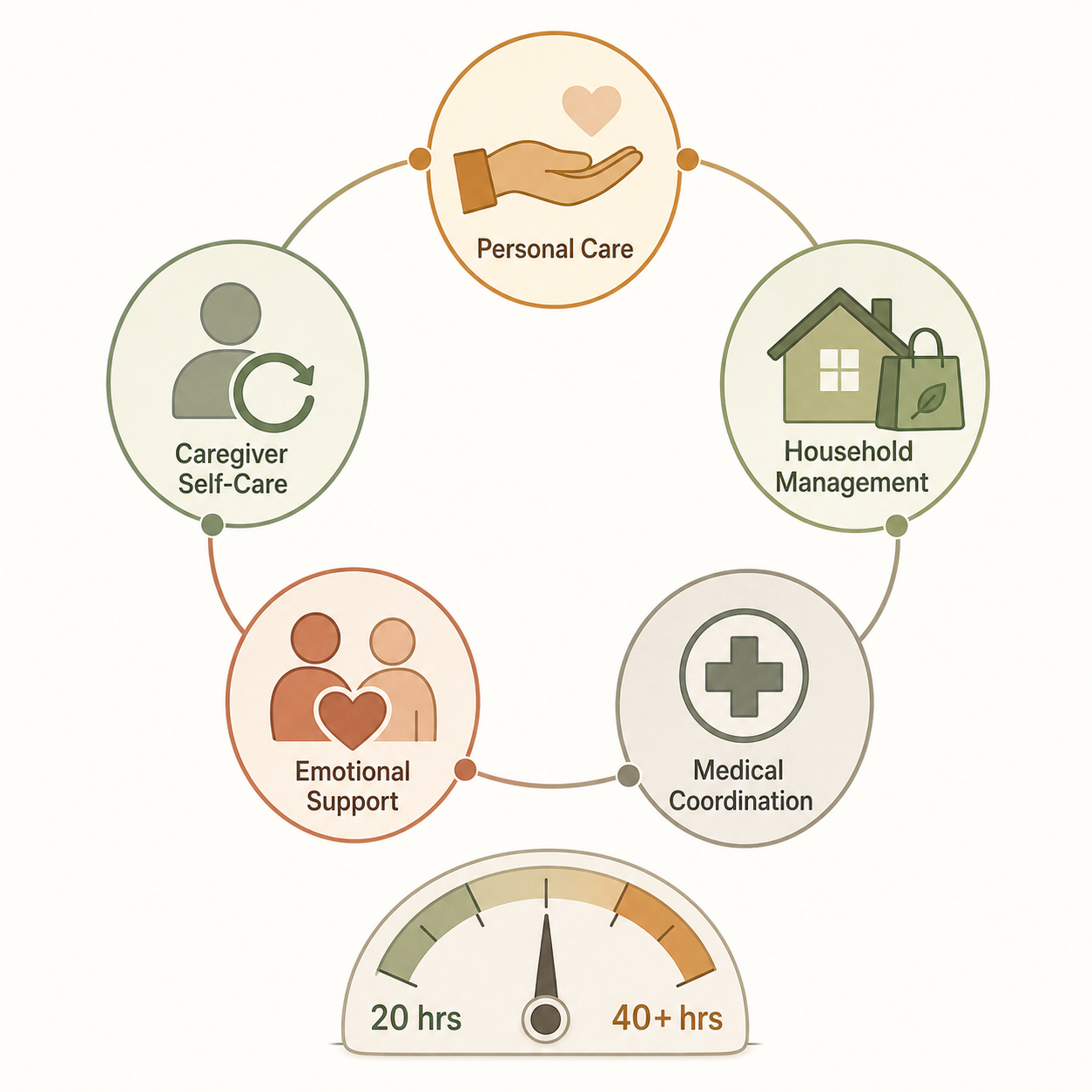
A concrete, task-level guide for new family caregivers (adult children in their 40s and 50s) that breaks down the five domains of daily care — personal care, household management, medical coordination, emotional support, and caregiver self-care — with hourly time estimates, common challenges, and clear thresholds for when to bring in professional help.

The Gap Between Expectation and Reality
If you have just started helping an aging parent, you have probably heard some version of "it is a lot of work." What that phrase does not convey is the sheer scale of the role. According to a 2025 AARP-NAC report, 63 million Americans now provide unpaid care to an adult — that is roughly 1 in 4 adults in the country, up from 43 million a decade ago. The economic value of that unpaid work exceeded $1 trillion in 2024, according to AARP's Valuing the Invaluable report.
For a new caregiver — typically an adult child in their 40s or 50s, often still working and raising their own family — the gap between what they expect and what caregiving actually demands is where burnout begins. Most people imagine occasional errands and a few phone calls. The reality is closer to a part-time or full-time job that includes bathing assistance, medication reconciliation, insurance battles, and the emotional weight of watching a parent decline.
If you are in the earliest stage of recognizing that your parent needs help, you may also want to read You've Noticed Your Parent Needs Help — Here's Exactly What to Do First, which covers the very first steps of assessment and conversation.
Domain 1: Personal Care (ADLs) — Bathing, Dressing, Toileting, and More
Activities of daily living (ADLs) are the basic self-care tasks that most people perform without thinking: bathing, dressing, toileting, transferring (moving from bed to chair), feeding, and managing continence. When a parent can no longer do these independently, the caregiver steps in — and this is almost always the domain that new caregivers underestimate.
Consider this: according to the National Center for Health Statistics, 75% of residents in residential care communities need bathing assistance. Bathing is not a 10-minute task. Helping a parent shower or bathe safely — gathering supplies, managing water temperature, assisting with transfers in and out of the tub or shower, drying, and dressing — can take 30 to 60 minutes per session. For a parent who needs help with toileting or incontinence care, the time and emotional labor increase further.
- Bathing: 30–60 minutes per session, including setup, assistance, and cleanup. Safety risks are high — the CDC reports that falls among adults 65+ caused over 38,000 deaths in 2021, and the bathroom is a common location.
- Dressing: 15–30 minutes, depending on the parent's mobility and whether they resist help. Managing buttons, zippers, and shoes can be frustrating for someone with arthritis or cognitive decline.
- Toileting and incontinence care: 10–20 minutes per trip, but frequency varies widely. Incontinence care also involves laundry, skin care to prevent rashes, and emotional sensitivity.
- Transferring: 5–10 minutes per transfer (bed to chair, chair to toilet). Improper technique can injure the caregiver — back strain is one of the most common physical complaints among family caregivers.
For caregivers living with the care recipient, personal care tasks alone can consume 2–4 hours per day. If your parent needs overnight assistance — getting up to use the bathroom, wandering, or repositioning in bed — that adds another layer of sleep disruption. Our guide on When Does a Senior Need Overnight Care? covers the warning signs that nighttime needs are exceeding what family care can safely provide.
Domain 2: Household Management (IADLs) — Meals, Shopping, Finances, and Medications
Instrumental activities of daily living (IADLs) are the higher-order tasks that keep a household running: meal preparation, grocery shopping, transportation, medication management, bill paying, and home maintenance. These tasks are less intimate than personal care but often more time-consuming because they are endless — there is no "done" with laundry, dishes, or prescription refills.
For a caregiver living with the recipient, the IADL workload alone can exceed 15 hours per week. Here is a realistic breakdown of the most common IADL responsibilities:
| IADL Task | Typical Weekly Time | Common Challenges |
|---|---|---|
| Meal preparation and grocery shopping | 5–8 hours | Dietary restrictions, picky eating, fatigue from cooking every meal |
| Medication management | 2–4 hours | Organizing pill boxes, tracking refills, reconciling lists from multiple doctors, dealing with insurance denials |
| Transportation to appointments and errands | 3–5 hours | Scheduling conflicts with work, parent's mobility limitations, distance to specialists |
| Bill paying and financial management | 1–3 hours | Tracking multiple accounts, avoiding late fees, detecting scams or errors |
| Home maintenance and cleaning | 2–4 hours | Physical demands of cleaning, repairs, yard work — often tasks the parent can no longer do |
Medication management deserves special attention. A parent seeing three specialists may be on 8–12 different medications. Keeping the list current, ensuring correct dosages, managing refills, and navigating Medicare Part D coverage gaps is a part-time job in itself. The National Institute on Aging recommends using a single pharmacy to reduce errors and asking the pharmacist for a medication review at least once a year.
For meal preparation, programs like Meals on Wheels (888-998-6325) deliver nutritious meals to seniors who cannot shop or cook for themselves. This can free up 5–8 hours per week for the caregiver. Our Aging in Place Services guide covers meal delivery, transportation, and other community programs in more detail.
Domain 3: Medical Coordination — Appointments, Insurance, and Hospital-to-Home Transitions
This is the domain that friends and extended family often do not see. They see you "just making a few phone calls." They do not see the 45 minutes on hold with Medicare, the spreadsheet tracking six specialist appointments, the frantic search for a home health aide after a hospital discharge, or the emotional toll of being the sole person who understands the parent's medical history.
Medical coordination typically consumes 3–5 hours per week for a parent with moderate health needs, and significantly more during transitions — such as after a hospitalization or a new diagnosis. The tasks include:
- Scheduling and attending appointments: Primary care, specialists, lab work, physical therapy, and follow-ups. Each appointment requires transportation, waiting time, and note-taking.
- Insurance navigation: Understanding Medicare Part A, B, D, and Medigap; handling denied claims; coordinating with Medicaid if the parent is dual-eligible. Medicare does not cover most long-term personal care, which is a common and costly misconception.
- Medication reconciliation: Every time a new medication is prescribed, the caregiver must check for interactions, update the master list, and communicate changes to all providers.
- Hospital-to-home transitions: Discharge planning, arranging follow-up visits, setting up home health services, and ensuring the home is safe for recovery. This is a high-risk period — medication errors and readmissions are common.
If you are navigating the first week after a hospital discharge, our First Week Caring for an Aging Parent at Home guide provides a day-by-day routine that covers medication setup, follow-up appointments, and safety checks.
Domain 4: Emotional and Social Support — Loneliness, Dignity, and Cognitive Stimulation
This domain is the one most often sacrificed when time runs short, yet it is not optional. Social isolation is a serious health risk for older adults — it is associated with higher rates of depression, cognitive decline, and even mortality. The emotional work of caregiving — providing companionship, preserving the parent's sense of dignity, managing the painful role reversal — is invisible but essential.
The tasks in this domain include:
- Combatting loneliness: Simply being present — sharing a meal, watching a show, looking at old photos — can significantly improve a senior's mood and sense of connection. The National Institute on Aging notes that depression and hopelessness are common concerns that should be taken seriously.
- Providing cognitive stimulation: Engaging the parent in conversation, puzzles, reading, or simple games helps maintain mental function. For a parent with dementia, this may mean adapting activities to their current ability level.
- Preserving dignity and autonomy: Allowing the parent to make choices — what to wear, what to eat, when to bathe — even when it is easier to take over. This requires patience and self-awareness from the caregiver.
- Managing role reversal: The emotional weight of becoming your parent's caregiver — especially for an adult child — is profound. It is normal to feel grief, guilt, and resentment alongside love and duty.
This domain does not have a neat hourly estimate because it is woven into every interaction. But if you find yourself rushing through conversations or skipping visits because you are too exhausted from the other domains, that is a warning sign that the balance is off. The emotional work matters — for both of you.
Domain 5: The Caregiver's Own Health — Physical Strain, Sleep Disruption, and Financial Impact
This is the domain that most articles skip, but it is the most important one for the long-term sustainability of care. The caregiver's health is the foundation of the entire care plan. When the caregiver breaks down, everyone breaks down.
The data is stark. According to AARP's 2025 Caregiving in the US survey, nearly 1 in 5 family caregivers (20%) report fair or poor health attributable to caregiving. The physical demands are real: lifting, transferring, and assisting with mobility can cause back injuries, joint pain, and chronic fatigue. Sleep disruption — especially for caregivers who provide overnight care — compounds every other health risk.
The financial impact is equally severe. The same AARP survey found that nearly half of family caregivers experienced at least one major financial consequence: taking on debt, stopping personal savings, or being unable to afford food. A separate analysis by SingleCare reports that 23% of caregivers have exhausted their personal short-term savings, and 24% have gone into debt due to caregiving expenses. Out-of-pocket long-term care spending totaled $81 billion in 2023.
For a deeper look at the systemic causes of caregiver exhaustion and what actually helps, read Caregiver Burnout Is Not Your Fault. And for a practical guide to the hidden costs that families overlook, see The Hidden Costs of Elderly Home Care.
Concrete Thresholds: When Family Care Alone Is No Longer Enough
One of the hardest questions a family caregiver faces is: "When is it time to get help?" The answer is not a single event — it is a set of thresholds that, when crossed, indicate that the current arrangement is unsustainable.
| Threshold | What It Means | Action to Consider |
|---|---|---|
| 20 hours per week of caregiving | You are effectively working a part-time job on top of your own career and family. This is the point where most caregivers start to feel stretched. | Begin exploring companion care or adult day care for 1–2 days per week to create breathing room. |
| 40+ hours per week of caregiving | This is the average for caregivers who live with the care recipient (ChoiceMutual, 2026). You are working a full-time job without pay, benefits, or days off. | This is unsustainable without regular backup. Consider hiring in-home personal care for 20+ hours per week or exploring adult day care 5 days per week. |
| Declining caregiver health | You have missed your own medical appointments, your sleep is consistently disrupted, or you have been injured while providing care. | Immediately seek respite care. Your health is the care plan's foundation — if it cracks, the entire arrangement is at risk. |
| Safety incidents | Your parent has fallen, wandered, or had a medication error while in your care. | Conduct a home safety assessment and consider adding monitoring technology or professional care hours. Falls double the risk of future falls (NCOA). |
| Parent's functional decline | Your parent now needs help with 3+ ADLs (bathing, dressing, toileting, transferring, feeding) or has developed significant cognitive impairment. | This level of need typically exceeds what one family caregiver can safely manage alone. Professional personal care or a higher level of care (assisted living, memory care) should be evaluated. |
If you are seeing multiple warning signs — especially declining caregiver health combined with safety incidents — it is time to act. Our guide on When Does a Senior Need Overnight Care? provides a detailed checklist of the specific signs that nighttime needs have exceeded family capacity.
How to Bring in Help: Starting with Companion Care and Adult Day Care
Bringing in help does not have to mean a nursing home or a full-time home health aide. For many families, the most effective entry points are two underutilized options: companion care and adult day care.
| Option | 2026 Cost Range | What It Covers | Best For |
|---|---|---|---|
| Companion care | $25–30 per hour | Non-medical tasks: companionship, light housekeeping, meal preparation, errands, transportation | Caregivers who need 5–15 hours per week of relief from IADL tasks and social isolation concerns |
| Personal care (home health aide) | $30–35 per hour | Bathing, dressing, toileting, transferring, incontinence care, medication reminders | Caregivers who need help with ADLs but want the parent to remain at home |
| Adult day care | $80–150 per day | Social activities, meals, personal care, basic health monitoring, exercise | Caregivers who need 1–5 days per week of daytime relief; provides social engagement for the senior |
| Live-in care | $200–350 per day | 24/7 non-medical or personal care | Caregivers who are no longer able to provide overnight care or who live separately |
Adult day care is described by Senioridy as "one of the most underutilized and most affordable options" for families. At $80–150 per day, it provides the senior with social engagement, meals, and basic care while giving the caregiver a full day to work, rest, or attend to their own needs. The National Institute on Aging notes that Medicare does not pay for adult day care, but Medicaid may cover it in some states, and some long-term care insurance policies include it.
Companion care, at $25–30 per hour, is a low-commitment way to start. A companion can come for 4–6 hours twice a week to handle grocery shopping, prepare meals, and simply keep the parent company. This frees the caregiver for focused work time, self-care, or time with their own family. Companion care is generally not covered by Medicare or private insurance, but it is significantly less expensive than personal care or facility placement.
For a detailed step-by-step action plan on finding, vetting, and hiring professional help — including how to have the conversation with your parent, how to interview agencies, and how to manage the transition — read How to Get Help Caring for Elderly Parents: A Step-by-Step Action Plan for Adult Children.
And if you are feeling overwhelmed by the scope of what you have just read, that is a normal reaction. The From Crisis to Confidence framework was designed specifically for new caregivers who need a structured, non-overwhelming way to move from feeling lost to feeling capable. You do not have to figure this out alone.
Questions to bring to a clinician or OT
This is not medical, legal, or a family's final decision — only a framework. Bring these questions to a clinician, occupational therapist, or your local Area Agency on Aging.
Find Local HelpRelated reading
- A Complete Guide to In-Home Care Options for Seniors: Services, Costs, and How to Choose
- Senior Care Options by Hours of Need: A Decision Framework for Family Caregivers
- The Signs Families Miss: Why Most Senior Residential Home Decisions Happen in a Crisis and How to Recognize Normalized Decline Before It's Too Late
Noticed something outdated or inaccurate on this page? Flag a correction. We review every report against CDC, NIA, and AARP HomeFit guidance before updating a page.