Home Instead Senior Care Cost vs. Assisted Living vs. Nursing Home: A Financial Comparison for Families
This article helps adult children compare the full-time cost of Home Instead Senior Care ($6,481–$6,677/month) against assisted living ($6,077/month median) and nursing homes ($9,555–$10,965/month). It provides a tipping-point analysis based on hours needed, geographic variation, and hidden costs to support family financial decisions.
By Editorial Team
home care cost
assisted living cost
nursing home cost
financial planning
caregiver guides
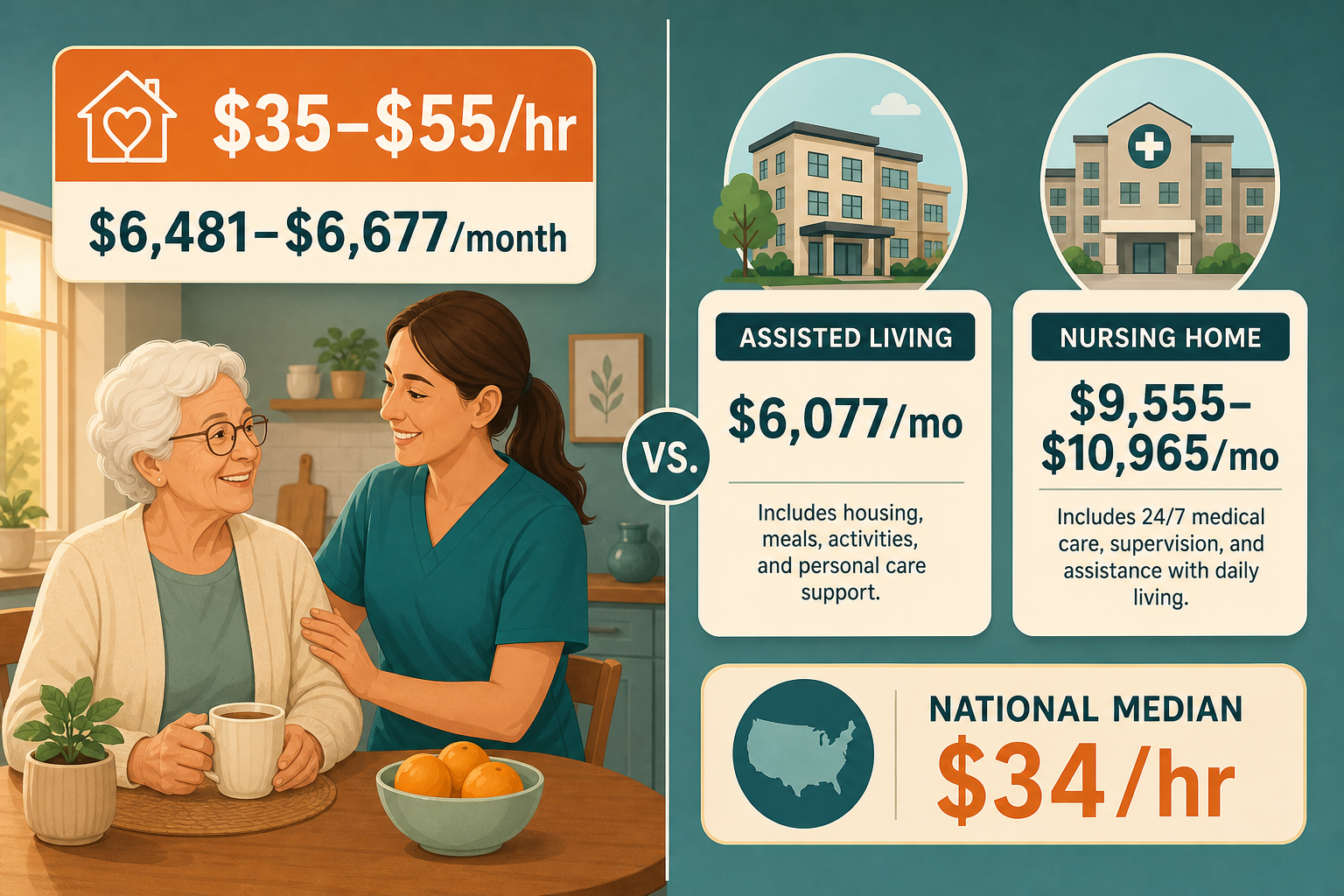
A side-by-side look at the monthly cost ranges for three common care options.
The Cost Comparison Headline: Home Instead vs. Assisted Living vs. Nursing Home
When a parent can no longer manage safely alone, the question of cost lands on the table fast. For families considering Home Instead Senior Care, the first number that matters is the full-time monthly rate: $6,481 to $6,677 for 44 hours of care per week. That figure, drawn from the Genworth Cost of Care Survey and reported by SeniorLiving.org, places Home Instead slightly above the median cost of an assisted living facility but well below the price of a nursing home.
National monthly cost comparison for full-time care arrangements. Home Instead costs assume 44 hours per week of care.
Care Option
Monthly Cost (Median / Range)
Source
Home Instead (44 hrs/week)
$6,481 – $6,677
SeniorLiving.org / Genworth 2025
Assisted Living (private room)
$6,077
SeniorLiving.org / Genworth 2025
Nursing Home (semi-private room)
$9,555 – $9,581
SeniorLiving.org / CareScout 2025
Nursing Home (private room)
$10,798 – $10,965
CareScout 2025 / SeniorLiving.org
The headline takeaway is straightforward: full-time home care through Home Instead runs about 6–10% more than the typical assisted living facility, but it is roughly 40–50% less expensive than a private nursing home room. That gap alone makes home care the clear financial winner when a senior does not require round-the-clock skilled nursing. But the real story is more nuanced, because Home Instead charges by the hour, and that changes everything.
Why Hourly Billing Changes the Math: The Tipping Point
Home Instead's pricing model is built on an hourly rate that typically falls between $35 and $55 per hour, depending on the level of care needed and the local market, according to client-reported data collected by The Senior List. That means your total monthly cost is a direct function of how many hours of help you schedule. Unlike a facility, where you pay a fixed monthly fee regardless of how much care is actually delivered, home care costs scale linearly with usage.
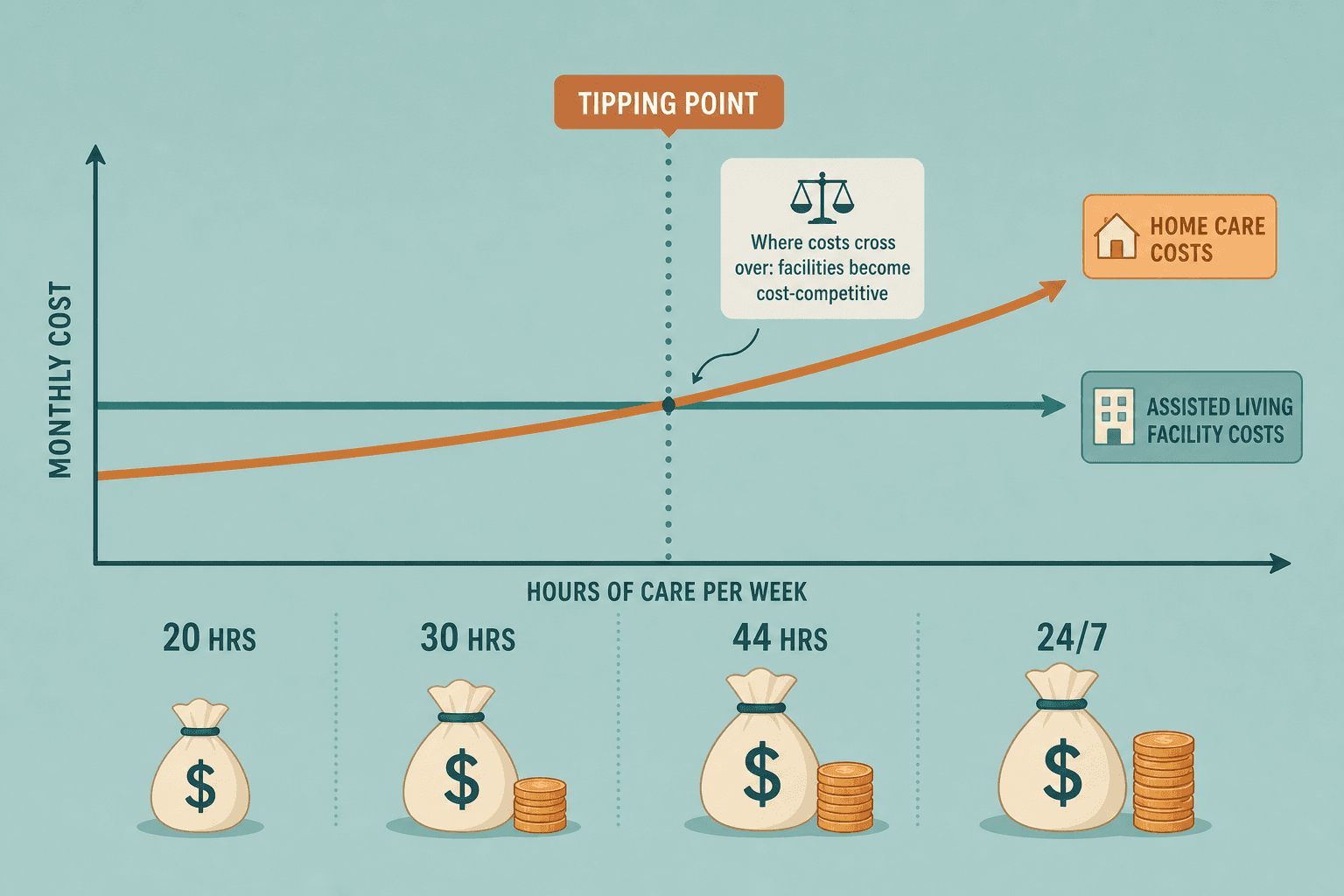
This creates a critical tipping point. At lower weekly hour totals, home care is significantly cheaper than a facility. But as hours climb, the monthly cost of home care rises until it crosses the assisted living median. Based on the national Home Instead rate range and the $6,077 assisted living median, the breakeven zone sits between 30 and 44 hours per week. Once a senior needs care approaching full-time hours, the financial advantage of home care narrows considerably.
The tipping point where home care costs cross the assisted living median occurs between 30 and 44 hours per week.
For context, the national median for all home care agencies sits at $34 per hour according to A Place for Mom's 2026 report, and $35 per hour per CareScout's 2025 survey. Home Instead's rates tend to run about $5 per hour higher than the average agency, as noted by The Senior List. That premium shifts the tipping point slightly in favor of facilities compared to what a family would face with a lower-cost agency.
Scenario Breakdown: What Different Levels of Care Actually Cost
To make the comparison concrete, here is how Home Instead's monthly cost stacks up against assisted living and nursing home medians at four common care levels. The Home Instead figures use the national rate range of $35–$55 per hour.
Monthly cost comparison across care levels. Home Instead 20- and 30-hour scenarios use the national median of $35/hr for the low end and $55/hr for the high end. The 44-hour scenario uses the $6,481–$6,677 range from SeniorLiving.org for the low end and $55/hr for the high end.
Care Scenario
Home Instead (Monthly Range)
Assisted Living (Median)
Nursing Home Private (Median)
20 hrs/week (light support)
$3,033 – $4,767
$6,077
$10,798
30 hrs/week (moderate support)
$4,550 – $7,150
$6,077
$10,798
44 hrs/week (near full-time)
$6,481 – $10,467
$6,077
$10,798
24/7 care (168 hrs/week)
$24,570 – $38,610
$6,077
$10,798
A few patterns emerge immediately. At 20 hours per week — roughly 3 hours of daily help with bathing, meals, and medication reminders — Home Instead costs roughly half of what an assisted living facility charges. At 30 hours, the low end of the Home Instead range is still below the assisted living median, but the high end crosses it. At 44 hours, the low end of Home Instead's range is only about $400 above the assisted living median, and the high end is substantially more. And 24/7 care through an agency is almost never financially viable compared to a facility — the monthly cost can exceed $24,000 even at the low end of the rate range.
Hidden Costs of Home Care and Facilities
The monthly rates above are starting points, not final numbers. Both home care and facility care come with additional expenses that families need to factor into their comparison.
Home Care Costs That Add Up
Overtime and holiday rates: Many agencies charge premium rates for evenings, weekends, and holidays. If your parent needs care during these times, the effective hourly rate can climb well above the standard $35–$55 range.
Caregiver backup: When a regular caregiver calls in sick, the agency sends a replacement. That replacement may be billed at the same rate, but the disruption can mean additional coordination costs for the family — or lost work hours if you have to fill the gap yourself.
Supplies and equipment: Home care agencies typically do not cover the cost of disposable gloves, personal hygiene supplies, or durable medical equipment like grab bars, shower chairs, or hospital beds. These costs fall on the family.
Unpaid caregiver burden: The most significant hidden cost of home care is the unpaid labor that family members provide. Even with 44 hours of paid care per week, someone still needs to manage the care schedule, coordinate appointments, handle medication refills, and respond to emergencies. The value of that time is real, even if it does not appear on a bill.
Facility Costs That Are Easy to Miss
Community or entrance fees: Many assisted living facilities charge a one-time community fee ranging from $1,000 to $5,000 or more. This fee is typically non-refundable.
Level-of-care add-ons: The base monthly rate for assisted living usually covers a set number of care hours. If a resident needs more than that — for example, help with transferring, incontinence care, or dementia-specific supervision — the facility adds a monthly fee that can range from $500 to $2,000 or more.
Administrative and service charges: Some facilities charge separately for laundry, housekeeping, meal delivery to the room, or medication management. These fees are sometimes optional but often become necessary as care needs increase.
Rate increases: Assisted living and nursing home rates typically increase 5–10% annually. A facility that fits the budget today may be significantly more expensive in two or three years.
How Geographic Variation Shifts the Breakeven
The national averages provide a useful starting point, but local home care rates vary dramatically. According to A Place for Mom's 2026 state-by-state report, the median hourly rate for home care ranges from $25 per hour in Mississippi to $44 per hour in South Dakota. Home Instead's rates tend to run above these medians, but the geographic pattern is the same: the cost of home care is heavily influenced by local labor markets.
This variation directly affects the tipping point between home care and facility care. In a low-cost state like Mississippi, even 44 hours of home care per week at $25–$30 per hour would cost roughly $4,400–$5,280 per month — well below the national assisted living median. In a high-cost state like South Dakota, 44 hours at $44–$50 per hour would run $7,744–$8,800 per month, making assisted living the more affordable option for full-time care.
Estimated monthly cost of Home Instead care at 44 hrs/week across selected states, compared to the national assisted living median. Home Instead estimates assume a $5/hr premium over the state median, based on The Senior List's finding that Home Instead costs roughly $5/hr more than the average agency.
State
Home Care Median (per hour)
Home Instead Estimated (44 hrs/week)
Assisted Living (National Median)
Mississippi
$25
$4,400 – $5,280
$6,077
Texas
$28
$4,928 – $5,984
$6,077
Florida
$32
$5,632 – $6,864
$6,077
California
$38
$6,688 – $8,184
$6,077
South Dakota
$44
$7,744 – $8,800
$6,077
The practical implication: families in high-cost states should run the numbers carefully before assuming home care is the cheaper option for near-full-time needs. In low-cost states, home care retains a clear financial advantage even at higher hour totals.
Non-Financial Tradeoffs: Independence, Familiarity, and Caregiver Burden
Cost is only one dimension of the decision. The qualitative factors that families weigh alongside the dollars are often what tip the scale one way or the other.
Staying at home: For many older adults, remaining in their own home is deeply tied to their sense of identity and autonomy. The familiar environment — the kitchen where they have cooked for decades, the garden they tend, the neighbors they know — provides comfort that no facility can replicate. This emotional value is real, even if it does not appear on a spreadsheet.
Social isolation risk: Home care keeps a senior at home, but it does not automatically solve for loneliness. An assisted living facility offers built-in social opportunities — group meals, activities, and common spaces — that can be harder to replicate at home without intentional effort from the family.
Caregiver burden on family: Home care shifts the coordination burden onto the family. Someone has to manage the schedule, communicate with the agency, handle emergencies when a caregiver does not show up, and fill the gaps between paid shifts. For adult children who work full-time or live out of state, this burden can be unsustainable.
Safety and supervision: A facility provides 24/7 staffing, which means someone is always available to respond to a fall, a wandering episode, or a medical emergency. Home care, even at 44 hours per week, leaves 124 hours of the week uncovered. For seniors with dementia or high fall risk, those uncovered hours represent genuine safety risk.
Skilled nursing needs: Home care agencies like Home Instead provide non-medical personal care — bathing, dressing, meal preparation, companionship. They do not provide skilled nursing services like wound care, IV medications, or catheter management. If a senior needs these services, a nursing home or home health agency is the appropriate setting, not a non-medical home care provider.
Decision Framework: When Home Care Wins Financially vs. When Assisted Living Does
The following framework is designed to help families make a clear, data-informed decision during a financial meeting. It is not a substitute for personalized advice from a financial planner or elder law attorney, but it provides a structured starting point.
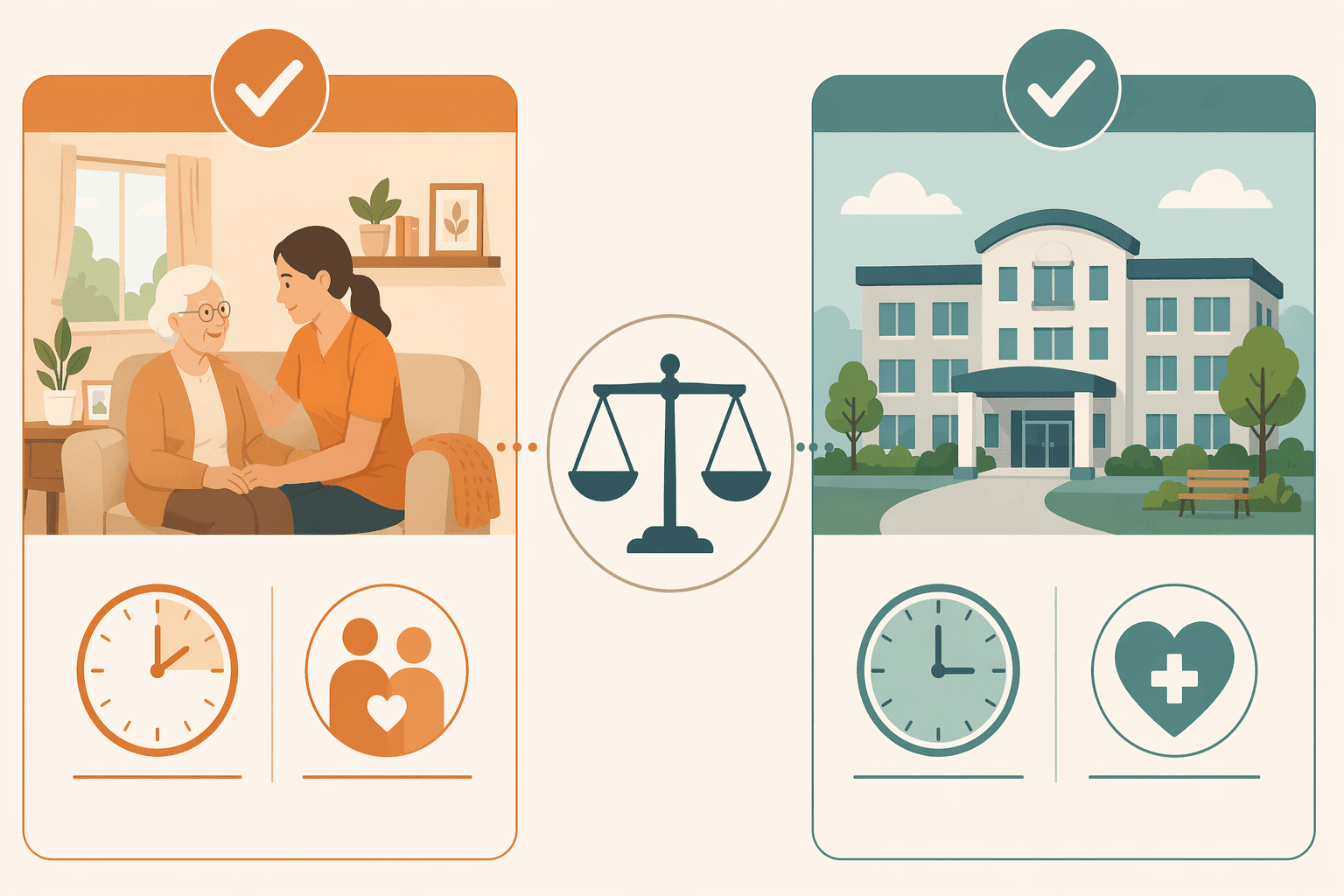
A visual decision framework for families weighing home care against facility care.
Home Instead Is Likely the Better Financial Choice When:
The senior needs 30 hours or fewer of care per week. At this level, Home Instead's monthly cost is almost always below the assisted living median, even at the higher end of the rate range.
A family member can cover the remaining hours. If a spouse or adult child can provide care during evenings, weekends, or overnight, the paid hours stay low and the cost advantage of home care widens.
The senior lives in a low-cost state. In states where home care rates are well below the national median, home care retains a financial edge even at higher hour totals.
The senior does not need 24/7 supervision. If the senior is safe alone for extended periods — for example, they can sleep through the night without assistance — home care is the clear financial winner.
Assisted Living or Nursing Home Is Likely the Better Financial Choice When:
The senior needs 44 or more hours of care per week. At this level, Home Instead's cost is comparable to or higher than assisted living, and the gap widens as hours increase.
The senior requires skilled nursing care. Non-medical home care cannot provide wound care, IV medications, or other skilled services. A nursing home or home health agency is the appropriate setting.
The family has no local caregiver support. If no family member lives nearby to manage the care coordination, fill gaps, or respond to emergencies, the hidden costs of home care — lost work time, stress, and burnout — can exceed the financial savings.
The senior is at high risk for falls or wandering. A facility provides 24/7 staffing and a secured environment. The safety risk of leaving a high-needs senior alone for 124 hours per week may outweigh any cost savings from home care.

Comments
Join the discussion with an anonymous comment.