
Caregiver decision guide
Agency vs. Private Sitter for Elderly: A Decision Framework for Families
A detailed guide for adult children weighing whether to hire a home care agency or a private caregiver. Covers cost trade-offs, employer responsibilities, liability, backup care, and a structured decision framework to help families choose the right path.

Agency vs. Private Sitter: Which Path Is Right for Your Family?
When you realize your parent needs regular help at home, the first practical question is not "how much does it cost?" — it is "who do I hire?" You have two fundamentally different paths: a home care agency that handles everything, or a private caregiver you employ directly. The choice is not simply a cost calculation. It is a trade-off between saving 20–30% with private hire and taking on the administrative, legal, and liability responsibilities of being an employer.
Families who understand this trade-off before they start searching make better decisions that last. This guide walks through both pathways, compares them head-to-head, and provides a structured decision framework to help you choose the right path for your specific situation.
Start Here: A Quick Self-Assessment
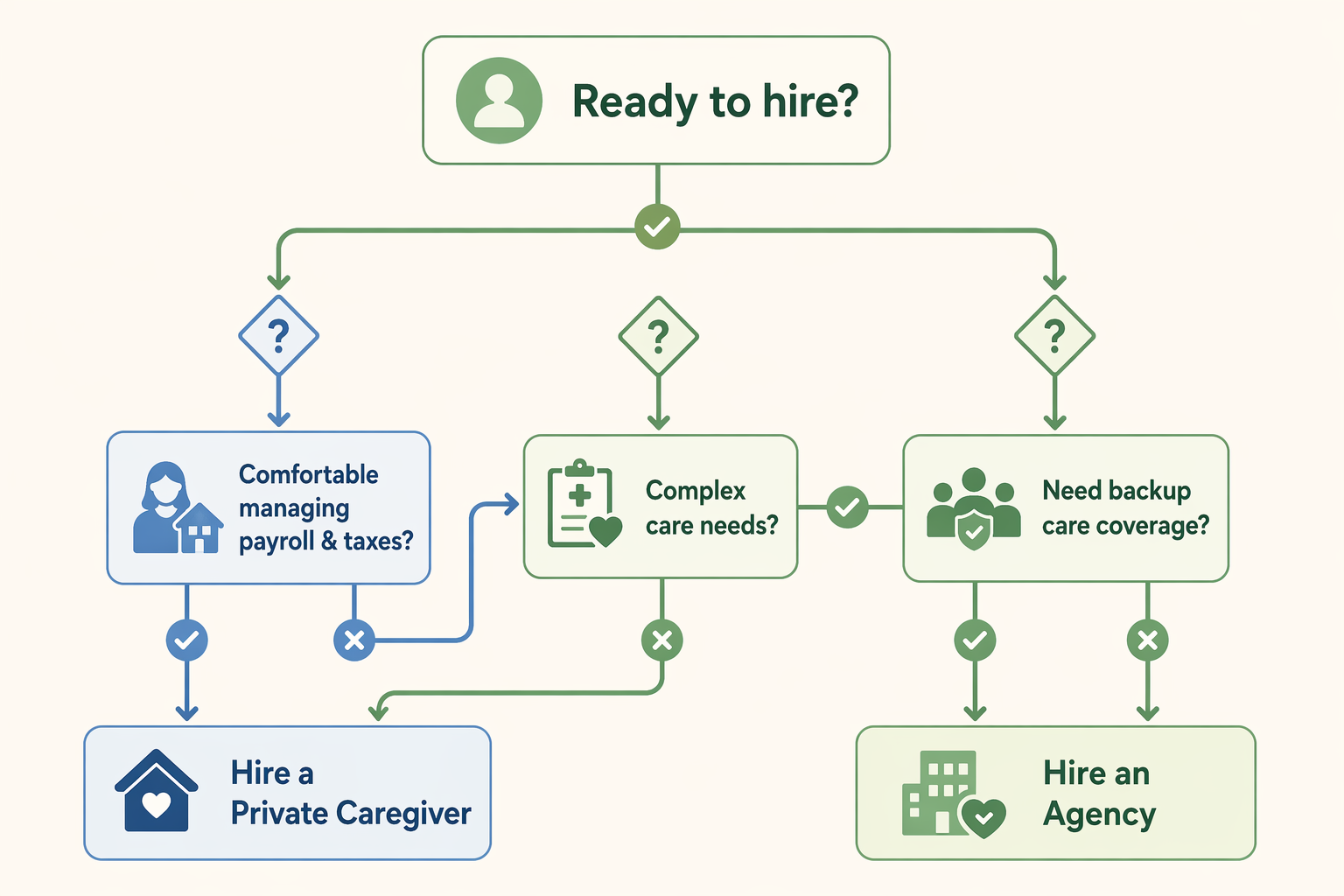
Before reading the detailed breakdowns, take a moment to assess your situation across four dimensions. Your answers will determine which pathway is a better fit.
- Management experience: Have you ever managed payroll, withheld taxes, or filed employment paperwork? Are you comfortable being someone's legal employer?
- Budget: Is your budget tight enough that a 20–30% savings would make a meaningful difference, or do you have room to pay the agency premium for convenience and protection?
- Urgency: Do you need care to start within days, or do you have weeks to interview, vet, and set up a private hire?
- Care complexity: Does your parent need only companionship and light help, or are there medical tasks, mobility challenges, or dementia-related behaviors involved?
If you are unsure whether a sitter (companion) is sufficient or if a home health aide is needed, our guide on recognizing the signs that your parent needs a sitter can help clarify the level of care required before you decide on a hiring path.
The Agency Pathway: What You Get for the Higher Price
A home care agency employs the caregivers and sends them to your home. You pay the agency, and the agency handles everything else. According to CareScout data cited by SeniorLiving.org, the national median cost for a home health aide through an agency is $35 per hour in 2026, with homemaker services at a median of $33.99 per hour. Agencies typically charge 20 to 30 percent more than what you would pay a private caregiver directly.
What the Agency Premium Covers
The higher hourly rate is not arbitrary. It pays for a bundle of services that would otherwise fall on your shoulders:
- Background checks and screening: Agencies conduct criminal background checks, verify references, and often check motor vehicle records and professional registries before hiring a caregiver.
- Payroll and tax handling: The agency manages all payroll, Social Security and Medicare withholding, unemployment taxes, and year-end tax forms. You receive a simple invoice.
- Liability insurance and workers' compensation: The agency carries general liability insurance and workers' comp coverage. If a caregiver is injured in your home, the agency's insurance handles it — not your homeowner's policy.
- Backup staffing: If the regular caregiver is sick, on vacation, or quits, the agency sends a replacement. You do not scramble to find coverage.
- Training and supervision: Most agencies provide ongoing training and have a supervisor who periodically evaluates the caregiver's performance in your home.
Key Questions to Ask Any Agency Before Signing
- What does your screening process include — national background check, motor vehicle record check, professional reference verification?
- What is your backup policy if the assigned caregiver is unavailable? How quickly can you send a replacement?
- Do you provide written care plans and supervisor visits? How often does a supervisor evaluate care in the home?
- What is your cancellation policy? Is there a minimum number of hours per visit or per week?
- Can we meet the caregiver before they start, and can we request a different caregiver if the fit is not right?
For a deeper explanation of how agencies differ from registries and home health companies, see our comparison of home care agency vs. home health agency vs. registry.
The Private Hire Pathway: Lower Cost, Higher Responsibility
Hiring a private caregiver directly means you become the employer. The cost savings are real — families typically pay $25 to $35 per hour for private caregivers, compared to $35 to $48 per hour through an agency. The caregiver themselves typically earns $15 to $17 per hour, according to PayingForSeniorCare data. The difference between what the caregiver earns and what you pay covers your employer costs.
The Hidden Costs of Private Hire
The savings are not pure profit. You will incur several costs that are bundled into the agency rate:
- Payroll service fees: You can handle payroll manually, but most families use a third-party payroll service that costs $40–$80 per month to calculate withholding, file taxes, and generate W-2 forms.
- Employer payroll taxes: As the employer, you pay half of Social Security (6.2%) and Medicare (1.45%) taxes, plus federal and state unemployment taxes. This adds roughly 7.65% to 10% on top of the caregiver's wages.
- Workers' compensation insurance: Required in most states if you have a household employee. A policy typically costs $300–$800 per year depending on your state and the caregiver's duties.
- Background checks: A comprehensive national background check costs $30–$100. You are responsible for verifying the caregiver's identity, work history, and criminal record.
Your Legal Responsibilities as an Employer
This is the area where most families underestimate the complexity. Under IRS rules, a private caregiver who performs services in your home is a household employee, not an independent contractor. You cannot pay them as a 1099 contractor. The IRS requires you to:
- Have the caregiver complete an I-9 form (employment eligibility verification) and a W-4 form (tax withholding) before they start working.
- Withhold Social Security and Medicare taxes from each paycheck and pay the employer matching portion yourself.
- Pay federal and state unemployment taxes (FUTA and SUTA).
- Issue a W-2 form at the end of each year, not a 1099-NEC.
- Register with your state's labor department or unemployment agency — requirements vary by state.
The Family Caregiver Alliance notes that all U.S. employees must complete I-9 and W-4 forms, and families should check their homeowner's insurance policy to understand whether liability coverage extends to a household employee. Many standard policies exclude or limit coverage for injuries to domestic workers.
Head-to-Head Comparison: Agency vs. Private Sitter
The table below summarizes the key differences across the dimensions that matter most to families making this decision.
| Dimension | Home Care Agency | Private Caregiver |
|---|---|---|
| Typical cost per hour (2026) | $35–$48 (national median $35/hr) | $25–$35 |
| Background checks | Handled by agency; includes criminal, MVR, and reference checks | Family must arrange and pay for background checks |
| Payroll and tax handling | Agency manages all payroll, withholding, and tax filings | Family must manage payroll or use a third-party service |
| Liability insurance | Agency carries general liability coverage | Family must check homeowner's policy; may need separate coverage |
| Workers' compensation | Covered by agency | Family must purchase a policy (required in most states) |
| Backup care | Agency sends a replacement if caregiver is unavailable | Family must arrange their own backup coverage |
| Caregiver training | Agency provides training and supervision | Family is responsible for training and oversight |
| Control over caregiver selection | Agency assigns caregiver; family can request changes | Family selects, interviews, and hires directly |
| Administrative burden | Low — pay an invoice each week or month | High — payroll, taxes, compliance, scheduling |
Hybrid Options: Getting the Best of Both Worlds
The choice is not binary. Several hybrid approaches let you combine elements of both pathways to fit your specific needs.
Use a Third-Party Payroll Service
If you want the cost savings of private hire but are intimidated by payroll and tax compliance, a household payroll service can handle the employer-side paperwork for $40–$80 per month. Services like these calculate withholding, file quarterly and annual tax forms, issue W-2s, and often help you set up workers' comp coverage. You still manage hiring, scheduling, and backup care yourself, but the tax burden is outsourced.
Hire Privately with Geriatric Care Manager Oversight
A geriatric care manager (often a social worker or nurse) can help you find, interview, and supervise a private caregiver without the full agency markup. The care manager conducts periodic home visits, evaluates the caregiver's performance, and helps you adjust the care plan as needs change. You still handle payroll and taxes, but you get professional oversight that reduces the risk of a bad hire or declining care quality.
Use a Registry That Screens but Does Not Employ
Some registries perform background checks and verify credentials on independent caregivers, then connect them with families for a flat fee or a percentage of the first month's pay. The caregiver is still your employee — you handle payroll, taxes, and liability — but the registry reduces the risk of hiring someone with a problematic background. This sits between the full-service agency model and a completely independent search.
Funding Source Considerations
Your choice may also be influenced by how you plan to pay. Long-term care insurance policies often cover agency-provided care but may not cover private hires. Medicaid HCBS waivers and VA benefits have their own rules about who can provide care. If you are relying on any of these funding sources, check the requirements before deciding on a hiring path. Our guide on funding sources for elderly care covers long-term care insurance, Medicaid waivers, VA benefits, and other options that may offset costs regardless of which hiring route you choose.
Decision Guide: When Each Option Makes Sense
Based on the self-assessment you did at the start of this guide, here is how the two pathways map to different family situations.
Choose an Agency When:
- You need reliable backup coverage. If you work full-time or live far from your parent, you cannot afford gaps in care. An agency guarantees a replacement when the regular caregiver is unavailable.
- You want to avoid payroll and liability hassle. If the thought of managing payroll taxes, workers' comp, and IRS compliance feels overwhelming, the agency premium is worth the peace of mind.
- Care needs are complex or changing. If your parent has dementia, mobility challenges, or medical needs that require trained caregivers, an agency can match the right skill level and adjust as needs evolve.
- You have a higher budget. If the 20–30% premium fits within your budget, the convenience and protection are worth the cost.
Choose Private Hire When:
- You have time to manage the employment process. If you can dedicate several hours to interviewing, running background checks, setting up payroll, and managing schedules, private hire is feasible.
- You have a reliable backup plan. If you or another family member can fill in when the caregiver is unavailable, or if you have a network of potential substitutes, the lack of agency backup is less risky.
- You want maximum flexibility and control. Private hire lets you set the exact schedule, duties, and approach without agency policies or minimum-hour requirements.
- Your budget is tight. If the 20–30% savings is the difference between affording care and not, private hire may be your only viable option.
This decision is one part of a larger caregiving landscape. For a broader framework on making care decisions for your parent, see our decision framework for adult children managing a parent's care.
Questions to bring to a clinician or OT
This is not medical, legal, or a family's final decision — only a framework. Bring these questions to a clinician, occupational therapist, or your local Area Agency on Aging.
Find Local HelpRelated reading
Noticed something outdated or inaccurate on this page? Flag a correction. We review every report against CDC, NIA, and AARP HomeFit guidance before updating a page.