
Caregiver decision guide
Options for Elderly Care: A Complete Guide to Paying for Home Care, Assisted Living, and Nursing Homes in 2026
Confused about how to pay for elderly care? This guide explains what Medicare actually covers (and the costly myth it doesn't), how Medicaid works with asset limits and the 5-year look-back, VA benefits up to $2,874/month, long-term care insurance, and proactive strategies to protect your family's savings.

The 2026 Cost Reality: What Families Are Up Against
Before you can figure out how to pay for care, you need to know what you're paying for — and the numbers in 2026 are sobering. The CareScout 2025 Cost of Care Survey, which collected data from July through November 2025, pegs the national median cost of a private nursing home room at $10,798 per month — that's $129,575 annually. A semi-private room runs $9,581 per month, or $114,975 per year. Assisted living sits at a median of $6,200 per month ($74,400 per year), according to the same survey, while SeniorLiving.org's May 2026 estimate puts the figure slightly higher at $6,313 per month ($75,756 per year).
For families hoping to keep a parent at home, the math is not necessarily cheaper. Full-time home care — defined as 44 hours per week — costs a national median of $6,478 per month, based on A Place for Mom's 2026 Costs of Long-Term Care and Senior Living Report. At $35 per hour (the CareScout national median non-medical caregiver rate), that works out to roughly $80,080 per year. Memory care, which many families discover they need only after a dementia diagnosis, carries a median of $7,645 per month.
| Care Setting | Monthly Cost (Median) | Annual Cost (Median) | Source |
|---|---|---|---|
| Nursing home (private room) | $10,798 | $129,575 | CareScout 2025 Survey |
| Nursing home (semi-private) | $9,581 | $114,975 | CareScout 2025 Survey |
| Assisted living | $6,200 – $6,313 | $74,400 – $75,756 | CareScout / SeniorLiving.org |
| Memory care | $7,645 | $91,740 | U.S. News (CareScout data) |
| Home care (44 hrs/wk) | $6,478 | $80,080 | A Place for Mom 2026 Report |
| Board and care (private) | $7,300 | $87,600 | U.S. News (CareScout data) |
| Independent living | $3,523 | $42,276 | U.S. News (CareScout data) |
| Adult day services | $95/day | ~$24,700 | CareScout 2025 Survey |
To put these numbers in context: the average Social Security benefit as of January 2026 is $2,071 per month. That covers roughly one-third of the cost of assisted living and less than one-fifth of a private nursing home room. The gap between what most older adults receive in guaranteed income and what care actually costs is the central financial challenge this guide addresses.
Nearly 70% of Americans over age 65 will need some form of long-term care in their lifetime, according to data from the U.S. Department of Health and Human Services cited by NewLifestyles and CareScout. With 10,000 Baby Boomers turning 65 every day — a pace that continues until 2030 — the question of how to pay for that care is not hypothetical. It is arriving in millions of households right now.
The Medicare Myth: What It Actually Covers (and What It Doesn't)
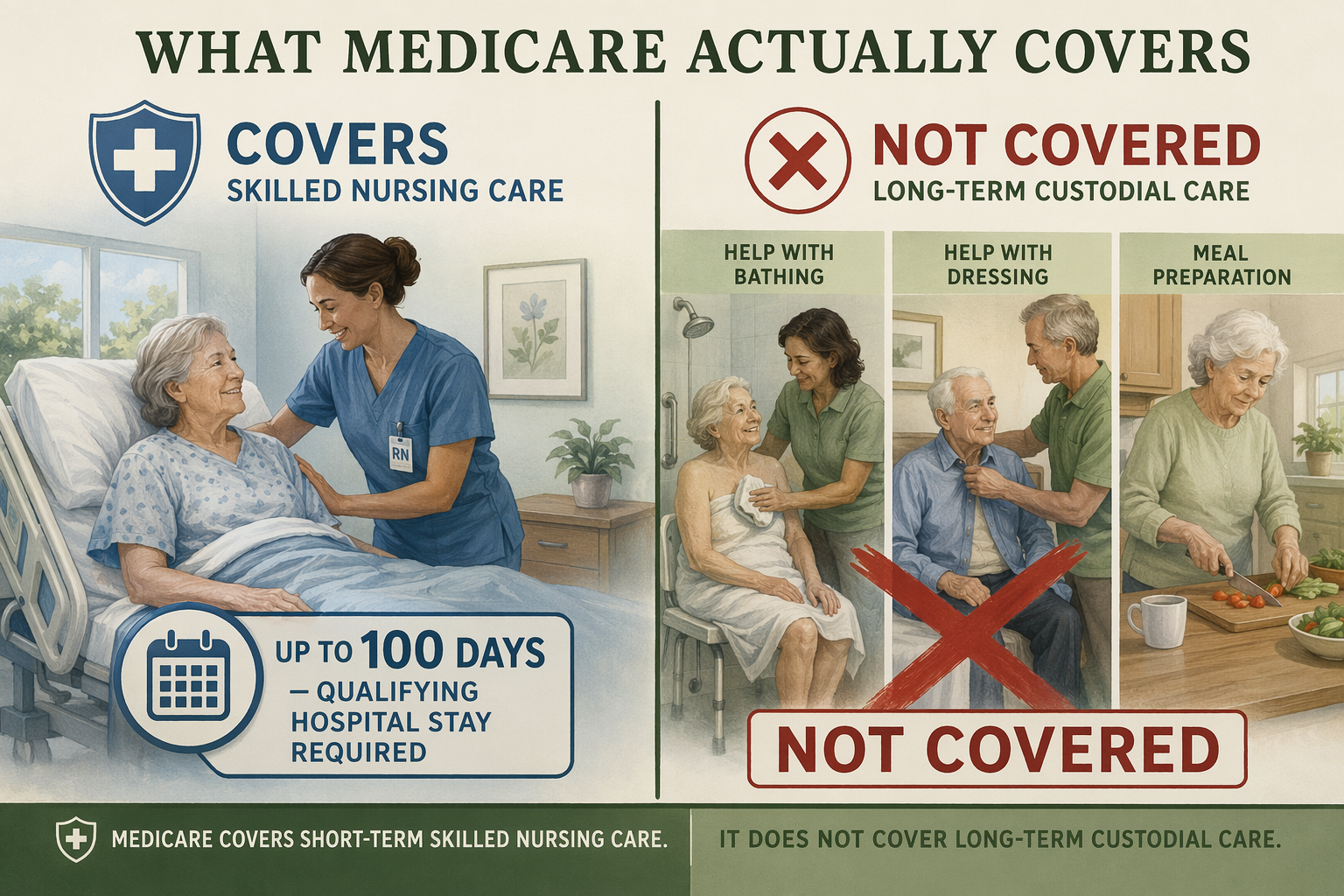
If there is a single mistake that derails more family financial plans than any other, it is this: assuming Medicare will pay for long-term care. It will not. The National Institute on Aging states plainly that Medicare has only limited coverage of home health services — and those services must be short-term and provided by Medicare-certified agencies. For nursing homes, the NIA is equally direct: Medicare does not cover long-term stays. For assisted living, the answer is the same: Medicare does not pay for it.
What Medicare actually covers is a specific, time-limited benefit: skilled nursing care in a Medicare-certified facility for up to 100 days following a qualifying hospital stay of at least three days. This is the source of the so-called "100-day myth." Many families hear "100 days" and assume they have three months of nursing home coverage. In reality, the benefit is heavily front-loaded. Medicare pays 100% of the cost for the first 20 days. From day 21 through day 100, the patient is responsible for a daily coinsurance amount ($204 per day in 2025, adjusted annually). After day 100, Medicare pays nothing. And the patient must still require skilled nursing or therapy services — not just custodial care — to remain eligible.
Here is what Medicare does cover, and what it explicitly does not, when it comes to long-term care:
- Skilled nursing facility care: Covered for up to 100 days after a qualifying hospital stay, but only if the patient needs skilled nursing or therapy. Days 1–20 are fully covered; days 21–100 require a daily coinsurance payment. Custodial care alone does not qualify.
- Home health services: Covered only if the patient is homebound and needs part-time skilled nursing care or physical/occupational therapy. Services must be ordered by a doctor and provided by a Medicare-certified agency. Medicare does not cover 24-hour-a-day care at home, meal delivery, or personal care (bathing, dressing) when that is the only help needed.
- Hospice care: Covered for patients with a terminal illness (six months or less to live). Includes pain management, symptom control, and respite care for caregivers (up to 5 consecutive days in a hospital or skilled nursing facility).
- What Medicare never covers: Long-term nursing home stays, assisted living facility costs, board and care homes, adult day care (though Medicaid may cover it in some states), emergency medical alert systems, geriatric care managers, and most dental, vision, or hearing services.
The bottom line: Medicare is a health insurance program, not a long-term care insurance program. It pays for medical treatment and short-term rehabilitation. It does not pay for the daily assistance with living that constitutes the bulk of long-term care costs. Families who understand this distinction early — before a crisis — are in a far stronger position to plan for the real costs ahead.
For a deeper look at what Medicare's home health benefit actually covers and how to navigate its limitations, see our guide: What Medicare Actually Pays For When an Elderly Parent Needs Care at Home.
Medicaid: The Largest Payer of Nursing Home Bills — and How to Qualify
If Medicare is not the answer for long-term care, what is? For millions of American families, the answer is Medicaid. NewLifestyles notes that Medicaid is the single largest payer of nursing home bills in the United States. But qualifying for Medicaid is not simple, and it requires planning — ideally years before care is needed.
Medicaid is a joint federal and state program that pays for long-term care for individuals with limited income and assets. Unlike Medicare, which is an entitlement based on age or disability, Medicaid is needs-based. To qualify, an applicant must meet strict financial thresholds that vary by state. In New York, for example, an individual must have no more than approximately $30,182 in countable assets to qualify for nursing home Medicaid. Other states have similar limits, though the exact figure differs.
The most important rule to understand is the five-year look-back period. When an individual applies for Medicaid long-term care benefits, the state reviews all asset transfers made during the previous five years. If the state finds that assets were transferred for less than fair market value — for example, gifting money to children, selling a house to a family member at a discount, or funding an irrevocable trust — it imposes a penalty period during which the applicant is ineligible for Medicaid coverage. The length of the penalty is calculated based on the value of the transferred assets divided by the average monthly cost of nursing home care in the state.
This is why proactive planning is essential. Families who wait until a parent is already in a nursing home to apply for Medicaid have missed the window for most asset protection strategies. The five-year look-back means that any significant asset transfers must be completed well before the application is submitted.
Spend-Down Strategies: What Counts and What Doesn't
For families whose assets exceed the Medicaid limit but whose income cannot cover the full cost of care, the solution is often a "spend-down" — reducing countable assets to the eligibility threshold. Not all spending counts equally. The following are generally permissible ways to spend down assets without triggering a penalty:
- Paying for medical and dental care not covered by insurance, including private-duty nursing, prescription drugs, and medical equipment.
- Paying off existing debt, including mortgages, car loans, and credit card balances.
- Making home modifications for accessibility (ramps, grab bars, walk-in tubs) — these are considered medical expenses if medically necessary.
- Prepaying funeral and burial expenses, which are exempt assets under most state Medicaid programs.
- Purchasing a newer vehicle, which is typically an exempt asset.
What does not work: simply giving money to family members or friends. Any transfer for less than fair market value within the five-year look-back period will trigger a penalty. This is where many well-intentioned families make a costly mistake — they transfer the house or savings to adult children thinking they are protecting assets, only to discover that the transfer creates a Medicaid penalty that leaves them without coverage when they need it most.
Medicaid Asset Protection Trusts (also called irrevocable trusts) are one legal strategy for protecting assets while still qualifying for Medicaid. Assets placed in an irrevocable trust are no longer considered countable assets for Medicaid purposes — but the trust must be established at least five years before applying for Medicaid, and the terms must be carefully structured to comply with state rules. This is not a do-it-yourself project. An elder law attorney with Medicaid expertise is essential.
Veterans Aid & Attendance: An Overlooked Benefit Worth Up to $2,874/Month
For veterans and their surviving spouses, the Aid & Attendance pension benefit is one of the most valuable — and most underutilized — funding sources for senior care. According to the American Council on Aging, as cited by U.S. News in April 2026, the monthly benefit amounts are:
| Recipient | Maximum Monthly Benefit |
|---|---|
| Single veteran | $2,424 |
| Married veteran | $2,874 |
| Surviving spouse | $1,558 |
These are not small amounts. For a married veteran receiving $2,874 per month, that benefit could cover nearly half the cost of assisted living ($6,200/month median) or a significant portion of full-time home care. For a surviving spouse receiving $1,558 per month, it could offset the gap between Social Security income and the cost of a board and care home or in-home aide services.
To qualify for Aid & Attendance, a veteran or surviving spouse must meet three conditions:
- Service requirement: The veteran must have served at least 90 days of active duty, with at least one day during a wartime period, and received an other-than-dishonorable discharge.
- Medical need: The applicant must require the regular assistance of another person to perform activities of daily living (bathing, dressing, toileting, eating, transferring), be bedridden, be a patient in a nursing home due to mental or physical incapacity, or have significantly reduced eyesight (5/200 or less in both eyes).
- Financial need: The applicant's net worth must be below $163,699 (as of 2026, adjusted annually). This includes assets such as savings, investments, and real estate other than the primary residence. The VA counts net worth more generously than Medicaid — the primary home and vehicle are generally excluded.
One important note: the VA does not directly pay for assisted living facility costs. The Aid & Attendance pension is a cash benefit paid to the veteran or surviving spouse, who can then use it to pay for any type of care — including assisted living, home care, or adult day services. This flexibility makes it a powerful component of a hybrid funding strategy.
Long-Term Care Insurance: When to Buy and What It Covers
Long-term care insurance is designed specifically to cover the costs that Medicare does not: help with activities of daily living in home care, assisted living, nursing homes, and memory care. But it is a product that must be purchased before the need arises — ideally in one's 50s or early 60s, while still in good health.
Most long-term care insurance policies work on a reimbursement or indemnity basis. Once the policyholder meets the benefit trigger — typically needing help with two or more ADLs (bathing, dressing, toileting, transferring, continence, eating) or having a severe cognitive impairment — the policy begins paying a daily or monthly benefit amount, up to a maximum benefit period (commonly 2, 3, or 5 years) and a lifetime maximum.
Key features to evaluate when comparing policies:
- Inflation protection: This is arguably the most important feature. A policy that pays $150 per day today will cover far less of the actual cost in 10 or 20 years. Inflation protection adjusts the benefit amount annually, typically at 3% or 5% compound interest.
- Benefit period: The length of time the policy will pay benefits. A 3-year benefit period is common, but given that the average nursing home stay is about 2.5 years and some individuals need care for much longer, a 5-year or unlimited benefit period provides more protection.
- Elimination period: The waiting period (typically 30, 60, or 90 days) before benefits begin. A longer elimination period lowers the premium but means the policyholder must cover the initial costs out of pocket.
- Coverage scope: Does the policy cover home care, assisted living, nursing home, and memory care? Some older or cheaper policies cover only nursing home care. Make sure the policy covers the settings most likely to be needed.
- Benefit trigger: How does the policy define the event that triggers benefits? Most use the ADL-based trigger (needing help with 2 of 6 ADLs) or cognitive impairment. Policies that use a stricter trigger (e.g., needing help with 3 ADLs) are harder to qualify for.
The ideal time to purchase long-term care insurance is between ages 50 and 65, while premiums are still relatively affordable and before health conditions make underwriting difficult. Once a person has already been diagnosed with dementia, Parkinson's disease, or another condition that is likely to require long-term care, they will almost certainly be denied coverage. For families who have already passed that window, the other funding sources in this guide — Medicaid, VA benefits, and private pay — become the primary options.
Private Pay and Hybrid Strategies: Combining Funding Sources
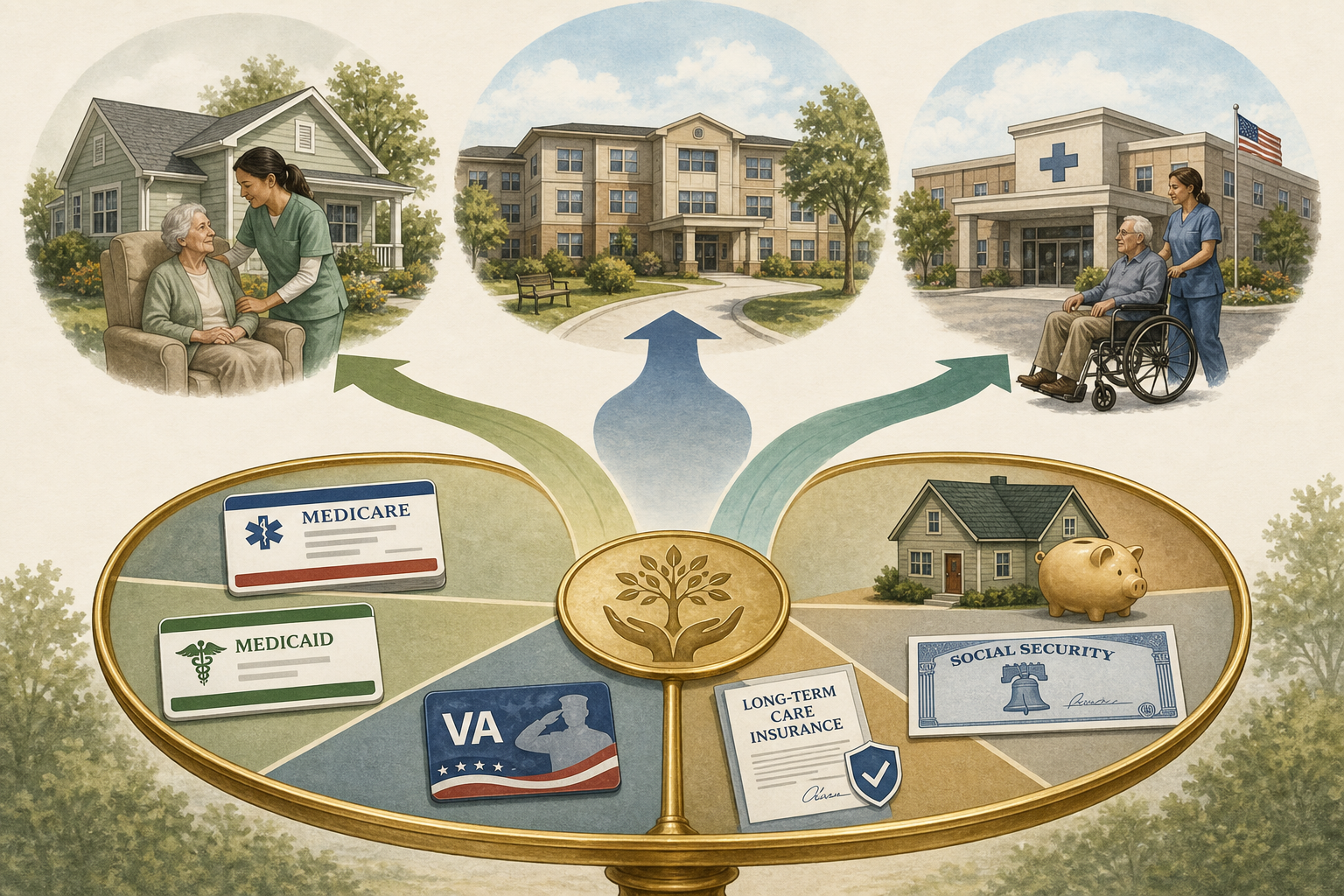
Very few families pay for long-term care from a single funding source. The most financially resilient approach is a hybrid strategy that layers multiple sources to cover the total cost of care. Understanding how these sources interact — and which combinations work best for each care setting — is the key to making a finite pool of resources last as long as possible.
The starting point for most families is the older adult's own income. The average Social Security benefit in 2026 is $2,071 per month. Some retirees also have pension income, retirement account distributions (from 401(k)s, IRAs, or annuities), or part-time work income. This recurring income should be applied first to the cost of care, with other sources filling the gap.
For many families, the largest asset is the family home. A reverse mortgage (Home Equity Conversion Mortgage) allows homeowners aged 62 and older to convert a portion of their home equity into cash without selling the home or making monthly mortgage payments. The loan is repaid when the homeowner sells the home, moves out permanently, or passes away. Reverse mortgages can provide a significant lump sum or monthly income stream to pay for home care or assisted living, but they come with fees, interest, and the risk of reducing the inheritance left to children.
| Care Setting | Primary Funding Sources | Secondary / Supplemental Sources |
|---|---|---|
| Home care (44 hrs/wk) | Private pay (savings, retirement accounts, Social Security) | VA Aid & Attendance, long-term care insurance, reverse mortgage, Medicaid HCBS waivers (state-dependent) |
| Assisted living | Private pay, VA Aid & Attendance, long-term care insurance | Social Security, pension, reverse mortgage, some state Medicaid programs (limited) |
| Nursing home (short-term rehab) | Medicare (days 1–20 full, 21–100 coinsurance) | Medigap / Medicare Advantage, private pay for coinsurance, long-term care insurance |
| Nursing home (long-term custodial) | Medicaid (after spend-down) | Social Security (personal needs allowance), VA Aid & Attendance, private pay during penalty periods |
| Memory care | Private pay, long-term care insurance, VA Aid & Attendance | Medicaid (if facility is Medicaid-certified and resident qualifies), family contributions |
A common hybrid strategy for married couples works like this: the couple uses the veteran spouse's Aid & Attendance benefit ($2,874/month maximum) plus Social Security income to pay for assisted living or home care for the spouse who needs it. Meanwhile, they preserve their savings and investments to cover the cost of a potential future nursing home stay for either spouse. If the care needs eventually exceed what the VA benefit and income can cover, they can then draw on savings or transition to Medicaid after a planned spend-down.
Another common strategy for a single older adult: use long-term care insurance (if they have it) to cover the first 2–5 years of care, then transition to Medicaid once the policy benefits are exhausted and assets have been spent down to the Medicaid limit. This approach preserves some assets during the early years of care while ensuring that the individual will not be left without coverage if care needs extend beyond the insurance benefit period.
For readers specifically interested in funding home-based care, see our companion guide: How to Pay for Home Services for the Elderly: A Family Guide to Layering Funding Sources in 2026.
Tax Deductions for Medical and Long-Term Care Costs
Long-term care costs are among the largest unreimbursed medical expenses many families face — and the IRS does allow some of these costs to be deducted as medical expenses on federal income taxes. The rules are specific, and the deduction is only available to taxpayers who itemize rather than taking the standard deduction.
Medical expenses — including long-term care costs — are deductible to the extent that they exceed 7.5% of the taxpayer's adjusted gross income (AGI). For example, if your AGI is $80,000, you can deduct medical expenses that exceed $6,000 (7.5% of $80,000). If your total qualifying medical expenses are $25,000, you can deduct $19,000 ($25,000 minus $6,000).
Which long-term care costs qualify as deductible medical expenses? The key distinction is between medical care and custodial care:
- Nursing home costs: If the primary reason for being in the nursing home is medical care (skilled nursing, therapy, or supervision due to cognitive impairment), the full cost of the nursing home — including room and board — is deductible as a medical expense. If the primary reason is custodial care only, only the medical portion is deductible.
- Assisted living costs: The portion of assisted living fees that covers medical care (medication management, nursing supervision, assistance with ADLs) is deductible. The portion covering room and board is generally not deductible unless the resident is in the facility primarily for medical reasons.
- Home care costs: Wages paid to home health aides, homemakers, and other caregivers who provide medical or personal care services are deductible as medical expenses. This includes the cost of a registered nurse, licensed practical nurse, or home health aide who provides assistance with ADLs.
- Long-term care insurance premiums: A portion of long-term care insurance premiums is deductible as a medical expense. The deductible amount is based on the insured's age and is adjusted annually by the IRS. For 2025, the deductible limits range from $480 (age 40 or under) to $3,900 (age 71 and older).
- Home modifications: Ramps, grab bars, walk-in tubs, stair lifts, and other modifications made for medical reasons are deductible as medical expenses, but only to the extent that they do not increase the home's value.
Tax rules in this area are complex and fact-specific. The distinction between deductible medical care and non-deductible custodial care is not always clear-cut, and IRS guidance has evolved over time. Consulting a tax professional who is familiar with medical expense deductions for long-term care is strongly recommended.
Proactive Planning: Steps to Take Before a Crisis
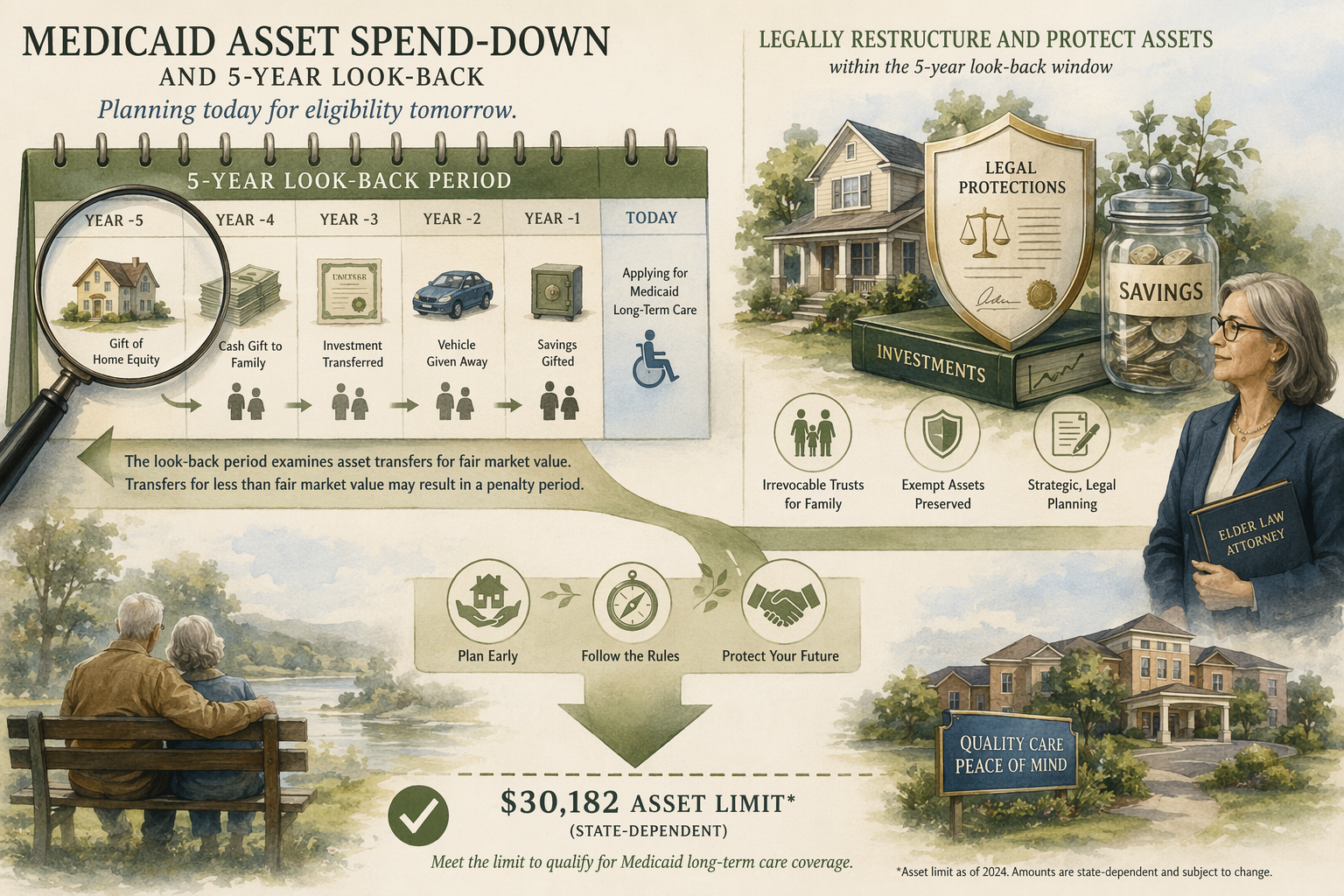
The single most important thing families can do is start planning before a crisis. The difference between a family that plans proactively and one that reacts to an emergency is often the difference between preserving a significant portion of assets and exhausting a lifetime of savings in a matter of months. NewLifestyles emphasizes that proactive planning — including a comprehensive financial audit, review of insurance and legal documents, and use of legal strategies like irrevocable trusts — can legally protect significant assets when done well before care is needed.
Here are the concrete steps to take, ideally 2–5 years before long-term care is anticipated:
- Consult an elder law attorney. This is the single most important step. An attorney who specializes in elder law can advise on Medicaid planning, asset protection trusts, powers of attorney, advance directives, and the specific rules in your state. The cost of a consultation is a fraction of what a planning mistake can cost.
- Conduct a comprehensive financial audit. List all assets (savings, investments, real estate, retirement accounts, life insurance policies) and all sources of income (Social Security, pensions, annuities, rental income). Determine which assets are countable for Medicaid purposes and which are exempt. This audit forms the foundation for all planning decisions.
- Review and update legal documents. Ensure that durable powers of attorney for finance and healthcare are in place and name trusted individuals. Review beneficiary designations on retirement accounts and life insurance policies. Consider whether a revocable living trust or irrevocable Medicaid Asset Protection Trust is appropriate.
- Evaluate long-term care insurance. If the older adult is still in good health and under age 70, long-term care insurance may be a worthwhile investment. Compare policies with inflation protection, a 3–5 year benefit period, and coverage for home care, assisted living, and nursing home care.
- Explore Medicaid Asset Protection Trusts. An irrevocable trust can protect assets from being counted for Medicaid eligibility, but it must be funded at least five years before applying for Medicaid. Assets placed in the trust are no longer owned by the individual, so the decision to use this strategy should not be taken lightly — it means giving up control of those assets.
- Document care preferences. Have the conversation about what kind of care the older adult would prefer — home care, assisted living, or nursing home — and under what circumstances. Document these preferences in advance directives and discuss them with family members. Knowing the preferred care path makes financial planning more concrete.
- Apply for VA benefits early. If the older adult is a veteran or surviving spouse, begin the Aid & Attendance application process as soon as care needs begin to emerge, not after a crisis. The application process can take 6–12 months, and benefits are not retroactive to the date of application.
For families who are just beginning this journey, our Senior Care Assistance Triage: What to Do Now, Next Week, and Next Month guide provides a step-by-step action plan organized by time horizon. And for a comprehensive overview of the entire caregiving landscape, A Compass for Caregiving: Your Guide to Help for Elderly and Disabled Adults is a good starting point for new caregivers.
The cost of long-term care in 2026 is high — there is no way around that reality. But the families who fare best financially are not necessarily the wealthiest. They are the ones who understand the rules of the game: what Medicare covers (short-term skilled care only), what Medicaid requires (asset limits and a five-year look-back), what VA benefits offer (up to $2,874 per month for a married veteran), and how to layer these sources together. The time to learn those rules is now — not when a hospital discharge planner is asking for a decision by Friday.
Questions to bring to a clinician or OT
This is not medical, legal, or a family's final decision — only a framework. Bring these questions to a clinician, occupational therapist, or your local Area Agency on Aging.
Find Local HelpRelated reading
- How to Pay for Senior Health Care Services: A Family Guide to Medicare, Medicaid, Private Pay, and Everything in Between
- The True Cost of Assisted Care: A Financial Roadmap for Families Comparing Home Care, Assisted Living, and Nursing Homes in 2026
- Senior Citizen Day Care vs. In-Home Care vs. Assisted Living: The 2026 Cost Comparison Most Families Miss
Noticed something outdated or inaccurate on this page? Flag a correction. We review every report against CDC, NIA, and AARP HomeFit guidance before updating a page.