How to Choose a Home Care Agency Your Family Can Trust
15 minutesReviewed: 2026-07-09
How to Choose a Home Care Agency Your Family Can Trust
This guide provides a practical, step-by-step framework for family caregivers evaluating home care agencies for the first time. Learn the six key categories to assess—from licensing and caregiver screening to backup policies and billing—to make an informed choice beyond price and availability.
By Editorial Team
new caregiver
experienced caregiver
long-distance caregiving
spousal caregiver
working caregiver
daily routines
medication management
personal hygiene
care coordination
first steps
ADLs
IADLs
By the time most families search for elder care home care, the question is no longer whether help is needed. It is who can be trusted to walk through the door, help a parent safely, and keep showing up after the intake call is over.
Price and availability matter. If an agency cannot staff the hours your parent needs, it is not the right agency. If the rate is impossible for your family, the conversation has to change. But those two filters tell you very little about what happens on a Tuesday morning when the assigned caregiver is sick, your mother refuses a shower, or your father’s care needs have quietly become more complicated.
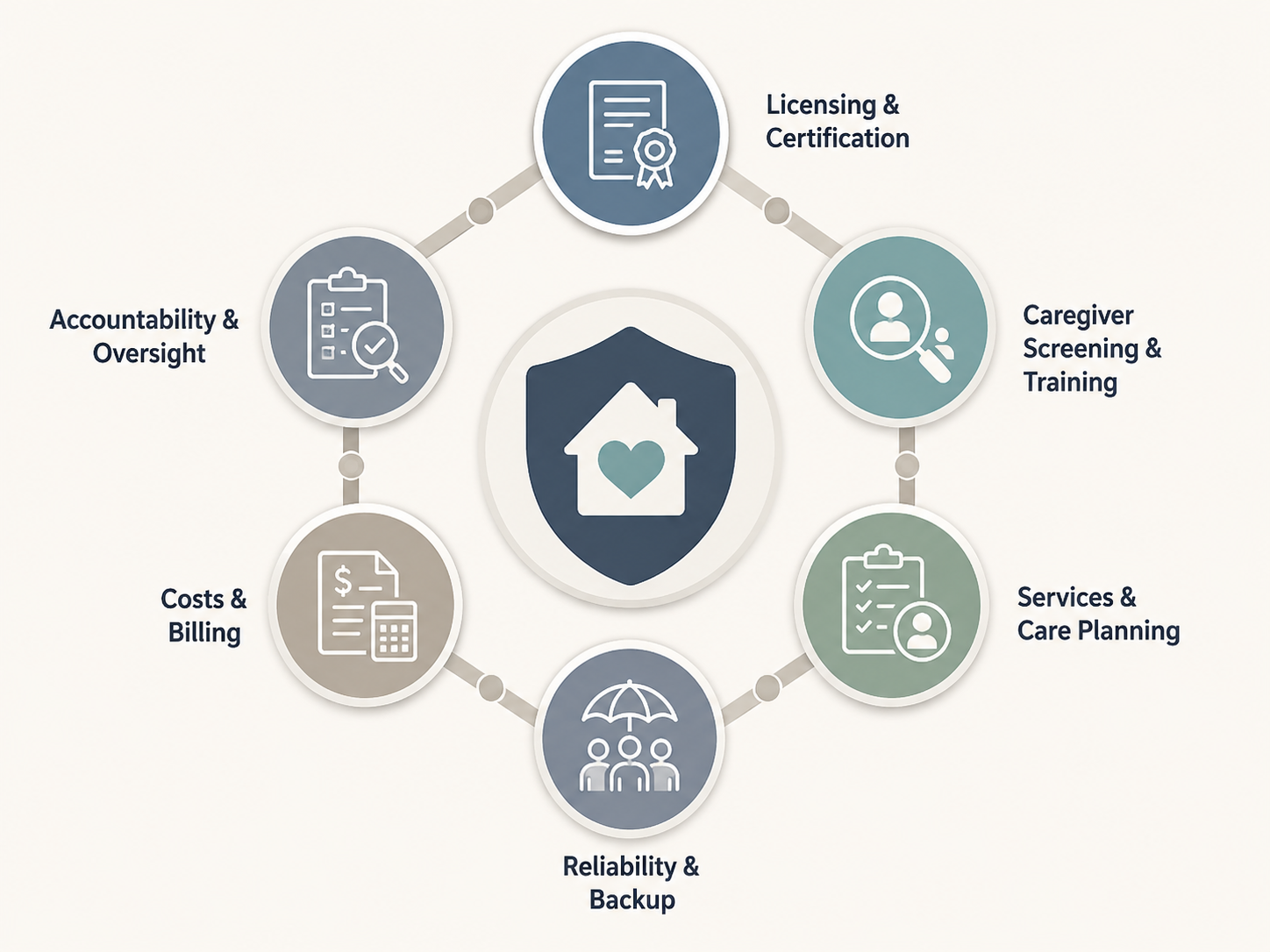
A better first screen is built around six categories: licensing and certification, caregiver screening and training, services and care planning, reliability and backup coverage, costs and billing, and accountability and oversight. Use them on the first phone call, during the in-home assessment, and again before signing an agreement.
First, Know What You Are Actually Hiring
A home care agency is not just selling hours. A true employer-agency usually takes on recruiting, background checks, training requirements, payroll, taxes, workers’ compensation insurance, supervision, and replacement coverage when a caregiver cannot work. That is why agency care usually costs more than hiring privately. NCOA describes independent caregivers as less expensive, but also makes clear that the family then carries the work of hiring, firing, background checks, taxes, and employment logistics. Its cost comparison places independent caregivers at roughly $15 to $17 per hour versus about $35 per hour for agency care.[1]
There is also a middle ground that can confuse families: registries. Some registries may help connect families with caregivers and may offer some screening, but the caregiver may not be the registry’s employee. That detail matters. If the caregiver is not an employee, ask who handles payroll taxes, insurance, supervision, complaints, and replacement when the caregiver cancels.
If you are still deciding between an agency and a private caregiver, that fork deserves its own conversation. For choosing an agency, the immediate task is narrower: find out whether the higher agency rate is buying you real systems or only a friendly coordinator and a schedule.
A Fast Triage When You Need Help Soon
When a discharge planner hands you a list, or a parent suddenly cannot be left alone, you may not have two weeks to interview every option. In that situation, narrow the list quickly, but do not narrow it only by who can start tomorrow.
Ask first
Why it matters
Move forward if
Are you licensed in this state, if licensing is required?
Non-medical home care rules vary by state.
The agency can name the license, regulator, or state rule that applies.
Are your caregivers employees, contractors, or registry referrals?
This determines who carries payroll, insurance, supervision, and replacement duties.
The answer is direct and matches the written agreement.
What screening do caregivers complete before their first shift?
The website phrase “fully screened” is not enough.
The agency lists background checks, reference checks, skills review, and any required training.
What happens if the caregiver does not arrive?
The family should not become the backup staffing department by default.
There is a written backup or escalation process.
Who supervises the care plan after services begin?
Care needs change, and the first plan is often incomplete.
A named role reviews the plan and responds to concerns.
What is the hourly rate, minimum shift, cancellation rule, and billing cycle?
The cheapest hourly rate may not be the lowest actual cost.
The agency can explain all recurring charges before intake.
This first pass is not a full investigation. It is a way to remove agencies that cannot answer basic operational questions. A warm intake call is pleasant; a clear backup policy is useful at 7:15 a.m.
1. Licensing and Certification: Verify the Right Thing
Families often hear “licensed,” “certified,” “bonded,” and “Medicare-approved” as if they all mean the same thing. They do not.
Medicare-certified home health agencies provide skilled services such as nursing or therapy when a person meets Medicare’s coverage rules. The National Institute on Aging points families to Medicare’s Care Compare tool for checking home health agencies, while noting that services for older adults at home can come from different types of providers.[2]
Non-medical home care is different. Help with bathing, dressing, meals, reminders, companionship, and light housekeeping is usually overseen at the state level, and there is no single federal licensing standard for non-medical home care agencies. Some states have detailed licensing requirements; others have lighter oversight. That means the correct question is not simply, “Are you certified?” It is, “What license or registration is required for the services you provide in this state, and how can I verify it?”
A strong answer sounds like: “We are licensed as a home care organization through the state department of health. Our license number is on our agreement, and you can verify it through the state’s online lookup.”
A weak answer sounds like: “All our caregivers are certified,” with no explanation of the agency’s own license, regulator, or scope of service.
A concerning answer sounds like: “Licensing does not really matter for companion care,” unless the agency can point to the specific state rule that makes that true.
Also separate licensing from insurance and bonding. A license says the agency has met a government requirement where one exists. Insurance and bonding speak to financial protection if something goes wrong. You want to understand both before a caregiver enters the home.
2. Caregiver Screening and Training: Get Past “We Hire Carefully”
Screening is one of the easiest areas for an agency to describe vaguely. Almost every agency will say it hires compassionate, qualified caregivers. That tells you very little. Ask what happens before a caregiver is allowed to work alone in a client’s home.
At minimum, ask about criminal background checks, identity verification, reference checks, prior employment checks, driving record checks if transportation is involved, skills assessment, orientation, and training for the kinds of needs your parent has. NCOA’s hiring guidance emphasizes checking references, background checks, training, and fit when evaluating caregivers, and CareScout’s agency selection framework similarly pushes families to look beyond surface claims when comparing providers.[1][3]
For dementia: ask whether caregivers receive dementia-specific training and how the agency handles refusal of care, wandering risk, agitation, or repeated questions.
For mobility problems: ask how caregivers are trained on transfers, fall prevention, gait belts, and when they are not allowed to lift.
For medication reminders: ask what caregivers may and may not do under state law and agency policy.
For transportation: ask whether the caregiver drives the client’s car or their own car, and what insurance applies.
The best agencies can explain their screening process in ordinary language. They do not need to hand you a personnel file, and they cannot disclose everything about an employee. But they should be able to tell you the steps, timing, disqualifying issues, and whether checks are repeated.
Listen carefully when the agency talks about matching. A parent who needs quiet morning help after a stroke is not the same client as a parent who needs an outgoing companion for errands and meals. The agency should ask about routines, language, pets, smoking, mobility, memory, toileting, personality, and family communication preferences. If the intake feels like a scheduling form with a credit card field attached, keep asking.
Questions that usually reveal the real process
“What background checks do you run, and are they local, state, national, or all three?”
“Do you verify previous caregiving employment and references?”
“What training is required before the first shift, and what training continues after hiring?”
“Who decides whether a caregiver is appropriate for dementia care, transfers, or overnight shifts?”
“If the first caregiver is not a good fit, how do we request a change?”
An evasive answer here is not a small thing. The caregiver is the person your parent will actually experience. The agency’s brochure does not help your mother get dressed; the caregiver does.
3. Services and Care Planning: Make the Work Visible
Before comparing agencies, write down what help is actually needed. Not “a few hours a week.” More specific: shower setup and standby assistance, laundry in the basement, meal prep for a diabetic diet, medication reminders, transportation to appointments, cueing to change clothes, evening reassurance, or supervision while an adult child is at work.
A serious agency should turn that list into a care plan. The plan should say what the caregiver does, what they do not do, when tasks happen, what safety issues exist, who to call with changes, and how updates are made. If your parent has skilled medical needs, ask whether a non-medical agency can legally provide the help you are requesting or whether a home health referral is needed.
The in-home assessment is where you learn whether the agency is paying attention. Someone should ask to see the bathroom setup, stairs, entryway, bedroom, laundry area, kitchen, and medication location if reminders are part of the plan. They should ask how your parent moves through the day, not only what diagnosis appears on a form.
Ask for the written care plan before services begin.
Ask who updates it when needs change.
Ask whether caregivers document completed tasks after each shift.
Ask how family members can see notes, raise concerns, or request changes.
Ask what tasks the agency will not perform.
The “will not perform” question matters. Some agencies cannot do hands-on transfers above a certain assistance level. Some cannot provide medication administration. Some will not accept clients who require two-person lifting or continuous supervision without a different staffing arrangement. It is better to hear that before the first shift than after a fall risk becomes obvious.
4. Reliability and Backup: Ask What Happens When the Plan Breaks
Home care is human work, so schedules break. Caregivers get sick, cars fail, children have school emergencies, and clients cancel appointments. The difference between a strong agency and a weak one is not whether disruption ever happens. It is whether the agency has a system before the disruption reaches you.
Caregiver consistency is a fair concern. NCOA notes that turnover at home care agencies can be high, which means families should ask directly how an agency handles continuity and replacement.[1]
Do not settle for “We always try to send someone.” That is not a policy. Ask what time the agency knows a caregiver is late, who calls the family, whether a supervisor can fill in, how backup caregivers are oriented to the care plan, and whether backup coverage is guaranteed or only attempted.
Situation
Question to ask
Answer you want to hear
Caregiver is late
How do you know, and when do you notify us?
The agency uses clock-in monitoring or another check-in process and has a defined notification window.
Caregiver calls out sick
Who finds replacement coverage?
The agency, not the family, starts the replacement process.
No backup is available
What happens if no one can cover the shift?
The agency explains escalation, supervisor involvement, and how the family is informed.
Caregiver fit is poor
How quickly can we request a different caregiver?
There is a process that does not require blaming the client or tolerating unsafe care.
Needs increase
Can hours or skill level change quickly?
The agency reassesses before simply adding hours.
If your parent cannot safely be alone, backup coverage becomes a safety issue, not a convenience. Say that plainly during the interview. “My father cannot be left alone if no one arrives. What exactly happens then?” A good agency may still explain limits, especially in a tight labor market, but it should not pretend the risk does not exist.
5. Costs and Billing: Compare the Whole Arrangement, Not Just the Hourly Rate
In 2026, the national median cost of non-medical home care is $34 per hour, with state median rates ranging from $25 per hour in Mississippi to $44 per hour in South Dakota, according to A Place for Mom’s 2026 cost report.[4]
That number is a starting point, not a quote. It reflects median private-pay rates for non-medical home care and may not capture high-cost metro areas, specialty dementia care, live-in arrangements, short shifts, or urgent starts. A family in an expensive city may see rates above the state median, while a family in a lower-cost area may still pay more for weekends, holidays, or complex needs.
Ask for the full billing picture in writing:
Hourly rate for weekdays, weekends, holidays, overnights, and live-in shifts if offered.
Minimum shift length and minimum weekly hours.
Assessment, start-up, care management, or administrative fees.
Cancellation policy and how much notice is required.
Billing cycle, payment methods, deposits, and late fees.
Whether long-term care insurance invoices, Medicaid documentation, or family portal access are supported.
Medicaid can cover some in-home care in some circumstances, but coverage depends heavily on state programs, eligibility rules, and waiver availability. U.S. News’ 2026 guide emphasizes that Medicaid home care benefits vary by state and program, so families need to check current state waiver rules rather than assuming a national benefit applies.[5]
As of Q3 2026, policy implementation details from recent federal changes are still unfolding, so treat Medicaid information as something to verify locally. The agency may help with documentation, but it should not be your only source for eligibility advice.
6. Accountability and Oversight: Find Out Who Owns the Problem
Once care begins, problems often arrive in small forms: the caregiver does not follow the shower routine, your parent says lunch was skipped, the laundry is done but medications were not reminded, the caregiver spends too much time on the phone, or a sibling hears something secondhand and wants answers. The question is not whether every shift will be perfect. The question is who investigates and corrects the pattern.
Ask for a named supervisor or care coordinator before the first shift. You should know who reviews caregiver notes, who checks in after the first visit, who handles complaints, and who has authority to change the care plan. If skilled home health services are involved, ask what clinical oversight applies. If services are non-medical, ask what supervisory visits or quality checks the agency performs under its own policy and any state requirements.
“Who is our day-to-day contact after care starts?”
“Who supervises the caregiver, and how often does that person review the case?”
“How do caregivers document each shift?”
“What happens after I report a missed task or safety concern?”
“If I am not satisfied with the response, who is the next person I contact?”
A strong agency can describe an escalation path without becoming defensive. A weak one makes every concern sound like a personality conflict between the family and the caregiver. Families should not have to manage an employee they did not hire, train, insure, or supervise.
How to Compare Finalists Without Letting the Cheapest Option Win by Default
After two or three interviews, the agencies may start to blur together. Put them side by side using the same categories. Do not rely on which coordinator sounded kindest or which website looked most reassuring.
Category
Agency A
Agency B
Agency C
License or state verification documented
Caregivers are employees, contractors, or registry referrals
Screening steps explained clearly
Training matches parent’s needs
Written care plan before first shift
Backup policy for call-outs and no-shows
Supervisor or care coordinator named
Rates, minimums, fees, and cancellation terms in writing
Complaint and escalation path explained
If one agency costs more but has a written backup process, a clear supervisor, documented screening, and a care plan review schedule, the higher rate may be buying something real. If another agency is cheaper but cannot say who replaces a caregiver or who reviews the plan, the savings may be coming from work that will fall back on you.
This does not mean the most expensive agency is automatically best. It means the rate has to be interpreted next to the responsibilities the agency is actually carrying.
The Final Decision Rule
Before signing, pause long enough to answer these questions in writing or from clear notes:
Can the agency document licensing, certification, or state registration where it applies?
Can it explain caregiver screening, training, employment status, insurance, and bonding without vague reassurance?
Will it create a written care plan that matches your parent’s real routines, risks, and limits?
Does it have a backup process for late arrivals, call-outs, no-shows, and poor caregiver fit?
Are rates, fees, minimums, cancellation rules, and billing terms clear before services begin?
Is there a named person who supervises care and a real escalation path when something is not working?
No home care choice removes all risk. Caregivers change. Schedules strain. Parents resist help. Needs shift faster than anyone expected. The agency worth choosing is the one whose hidden systems are strong enough to absorb ordinary caregiving problems before those problems land entirely back on the family.


Comments
Join the discussion with an anonymous comment.