
Caregiver decision guide
Overnight Care for Elderly Parents with Dementia: Managing Sundowning, Wandering, and Caregiver Sleep Deprivation
For family caregivers of a parent with Alzheimer's or dementia, nighttime confusion and wandering can make sleep impossible. This guide explains why dementia care changes at night, how sundowning and wandering create unique risks, and what overnight dementia-trained caregivers actually do to keep your loved one safe and help you rest.
Why Dementia Care Changes at Night
When the sun goes down, the rules of caregiving shift. For a person living with Alzheimer's or another dementia, the brain's internal clock — the circadian rhythm — is often damaged by the disease process itself. The result is a cascade of nighttime challenges that look nothing like the daytime routine: confusion deepens, agitation rises, and the person who was calm at noon may become restless, fearful, or disoriented by dusk.
This is not a failure of will or a bad day. It is a neurobiological reality. And it is the reason why general overnight care models — the kind designed for a senior who simply needs supervision or help with a bathroom trip — often fall apart when applied to dementia. The stakes are high. Research by Rowe and colleagues, published in the journal Alzheimer's & Dementia, found that 70% of family caregivers who eventually placed a loved one in a nursing home cited sleep disruptions and nighttime exhaustion as the primary contributing factor. That statistic, drawn from a 2009 study that remains widely cited in the field, makes a stark point: the night is not just harder on the person with dementia — it is often the breaking point for the family caregiver.
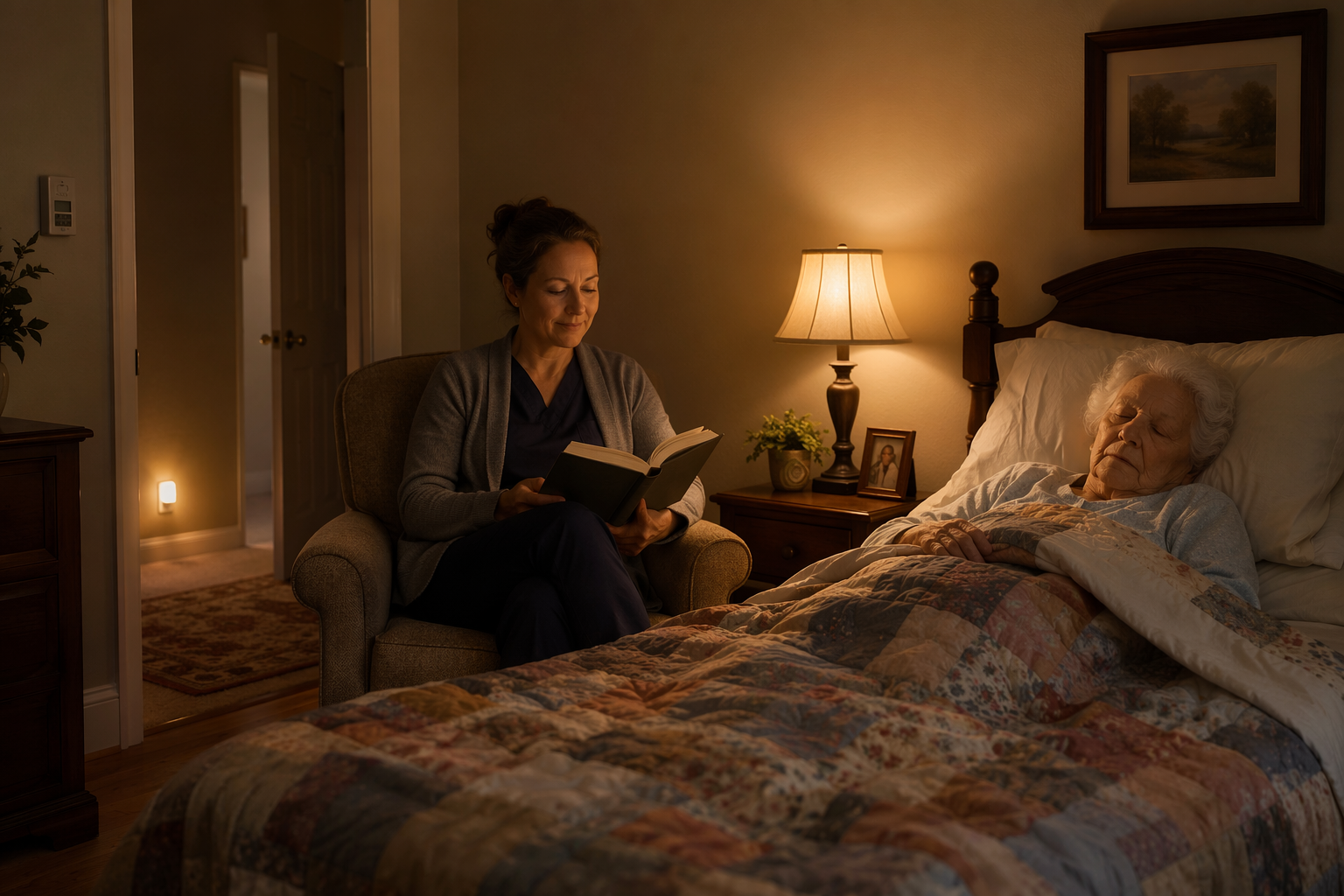
This article is written for the family caregiver who is living through that reality right now: the parent who paces the hallway at 2 a.m., the sundowning agitation that starts like clockwork at 5 p.m., the bone-deep exhaustion that makes you wonder how much longer you can keep going. The goal is not to overwhelm you with more problems. It is to explain what is happening, why it is happening, and what a dementia-trained overnight caregiver actually does to make the night safe — so you can sleep.
What Is Sundowning?
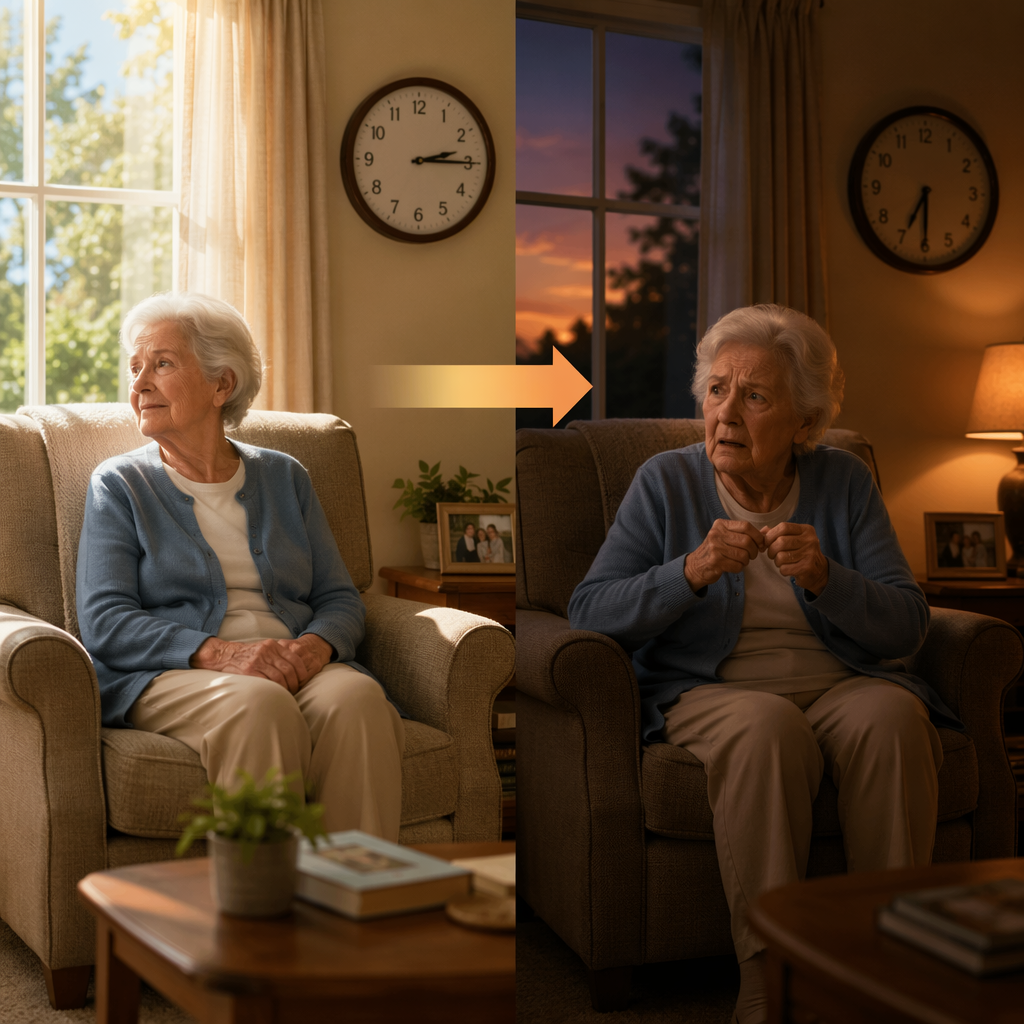
Sundowning — sometimes called sundowner's syndrome — is not a disease itself. The Alzheimer's Association defines it as a set of symptoms or dementia-related behaviors that typically emerge from dusk through night. These can include increased confusion, anxiety, agitation, pacing, hallucinations, and disorientation. The pattern is so common that many dementia caregivers come to recognize it as a daily event: the calm afternoon gives way to a restless evening, and the person who was able to hold a conversation at lunch becomes visibly distressed as the light fades.
What Triggers Sundowning?
Researchers have identified several factors that contribute to sundowning episodes. Understanding these triggers is the first step toward managing them:
- Mental and physical exhaustion accumulated over the day
- A disrupted internal body clock (circadian rhythm), which is common in Alzheimer's as the brain regions that regulate sleep-wake cycles deteriorate
- Low lighting that creates shadows, making familiar rooms look strange and frightening
- The natural age-related reduction in the need for sleep, combined with the brain's inability to distinguish day from night
- Unmet needs that become harder to communicate as the day wears on — hunger, thirst, pain, or the need to use the bathroom
The Alzheimer's Association recommends several non-pharmacological interventions that can reduce the severity and frequency of sundowning episodes. These include maintaining a regular daily routine, reducing evening stimulation (avoiding television or loud music in the hours before bed), keeping the home well lit in the evening to minimize shadows, and offering calm reassurance without physical restraint if the person becomes agitated.
What Sundowning Is Not
It is important to understand that sundowning is not deliberate behavior. The person is not trying to be difficult. The agitation and confusion are driven by a brain that can no longer process sensory information the way it used to. Responding with frustration or trying to reason the person out of their distress will almost always make things worse. The evidence-based approach is redirection, reassurance, and environmental adjustment — not argument or medication.
Wandering Risk: Why Nighttime Is the Most Dangerous Time
Wandering is one of the most dangerous behaviors associated with dementia, and the risk is highest at night. According to the Alzheimer's Association, 6 in 10 people with dementia will wander at least once. Of those who wander and are not found within 24 hours, nearly half suffer a serious injury or death. These are not abstract statistics — they represent real families who woke up to an empty bed and a front door left ajar.
Nighttime wandering is more common than daytime wandering for several reasons. The disorientation caused by darkness compounds the cognitive confusion of dementia. Sundowning-driven agitation can create a sense of urgency or fear that compels the person to "go home" or "get to work" — even if they are already in their own home. Unmet physical needs, such as the need to urinate or pain from arthritis, can trigger restlessness that escalates into wandering.
For a detailed guide on creating a wandering prevention plan — including door alarms, identification strategies, and neighborhood notification systems — see our Dementia Wandering Safety Plan for Caregivers at Home. That article covers the full prevention framework; this section focuses specifically on why the night hours demand a different level of vigilance.
The Caregiver Sleep Crisis: Why You Can't Do This Alone
The most dangerous myth in dementia caregiving is that you can somehow "power through" the sleep deprivation. You cannot. The human brain requires uninterrupted sleep to regulate emotion, make decisions, and maintain physical health. When you are waking up three, four, five times a night to check on a wandering parent or calm a sundowning episode, you are not just tired — you are cognitively impaired in ways that directly affect your ability to provide safe care.
The numbers bear this out. The Cleveland Clinic reports that more than 60% of caregivers experience symptoms of burnout, including emotional exhaustion, withdrawal from loved ones, changes in appetite and sleep, and feelings of hopelessness. Among dementia caregivers specifically, the rate is even higher — and the primary driver is almost always nighttime disruption.
The Rowe et al. study found that 70% of dementia caregivers who placed a loved one in a nursing home cited sleep disruption as the primary reason. Think about what that means: it is not the daytime confusion, not the memory loss, not the difficulty with bathing or dressing that ultimately drives the decision to move to a facility. It is the exhaustion that comes from months or years of broken sleep.
If you are reading this and recognizing yourself in these descriptions, the most important thing you can do is stop treating your own sleep as optional. Bringing in overnight help is not a luxury or a sign that you have failed. It is a medical necessity for both you and your parent. For a deeper look at the warning signs of burnout and how to recover, see our guide on Caregiver Burnout: Warning Signs and How to Recover.
What an Overnight Dementia Caregiver Actually Does
There is a common misconception that overnight care means someone simply "being in the house" while you sleep — a warm body who can call you if something goes wrong. That is not what dementia-trained overnight care looks like. A skilled overnight dementia caregiver is proactive, not reactive. Their job is to prevent problems before they happen, not just respond to crises.
Here is what a dementia-trained overnight caregiver actually does during a typical shift:
- Redirection during sundowning episodes: When agitation begins in the early evening, the caregiver uses calm conversation, a familiar activity, or a change of environment to de-escalate before the person becomes distressed.
- Calming bedtime routines: Dimming lights, playing quiet music, offering a warm non-caffeinated drink, and following a consistent sequence of steps that signals to the brain that it is time to rest.
- Medication reminders and monitoring: Ensuring evening medications are taken correctly and watching for side effects that might contribute to confusion or restlessness.
- Environmental monitoring: Checking that doors and windows are secured, motion sensors are active, and the home is free of tripping hazards that become more dangerous in low light.
- Managing nighttime incontinence and bathroom needs: Assisting with toileting at scheduled intervals to prevent discomfort, falls, and the restlessness that comes from a full bladder.
- Wandering prevention: Responding to the first signs of restlessness — before the person gets out of bed — with reassurance and redirection, rather than waiting for an exit attempt.
This is skilled, proactive care. A study published in PMC found that caregivers using a nighttime monitoring system were 85% less likely to experience a dangerous event — such as an injury or an unattended exit — compared to those without one. That statistic underscores a critical point: the combination of a trained human caregiver and supportive technology creates a safety net that neither can provide alone.
Your Options for Overnight Dementia Care
When you decide that overnight help is needed, the next question is what kind of help to get. For dementia-specific overnight care, the options differ from general overnight care in important ways. The table below summarizes the most common options, framed within the dementia context.
| Option | Best For | Typical Cost Range | Key Dementia Consideration |
|---|---|---|---|
| In-home overnight dementia care (professional aide) | Families who want the parent to remain at home with skilled support | $25–$40/hour (agency); $120/night for 8-hour student caregiver shift (CareYaya model) | Aide must have dementia-specific training in sundowning, wandering, and redirection techniques |
| Memory care facility overnight programs | Families whose parent's needs exceed what in-home care can safely manage | Varies widely by facility and region; typically $5,000–$8,000/month | 24/7 dementia-trained staff; structured environment reduces nighttime confusion triggers |
| Short-term respite stays in memory care | Caregivers who need a break to recover from burnout or handle a personal situation | Often $200–$400/night for short-term stays | Gives the caregiver guaranteed sleep; can also serve as a trial for full-time placement |
The student caregiver model — such as the one offered by CareYaya at approximately $120 per night for an 8-hour shift — represents a newer option that can make overnight care more affordable. These caregivers are typically pre-health or nursing students who receive dementia-specific training. However, this model is not available in all geographic markets, and families should verify the training and supervision structure before hiring.
When Overnight Care at Home Is No Longer Enough
There comes a point for many dementia families when in-home overnight care, no matter how skilled, cannot keep up with the progression of the disease. Recognizing this transition is not a failure — it is a compassionate decision that prioritizes safety and quality of life for both the person with dementia and the caregiver.
While our existing article Is It Time for Overnight Care? Recognizing the Red Flags in Your Aging Parent covers general red flags for overnight care, the dementia-specific escalation points are different and often more urgent. Here are the signs that in-home overnight care may no longer be sufficient:
- Escalating aggression that endangers the caregiver: If the person with dementia becomes physically aggressive during nighttime confusion — hitting, kicking, or throwing objects — the risk of injury to both of you becomes unacceptable for home care.
- Frequent falls despite monitoring: A person who falls repeatedly at night, even with a caregiver present, may need the fall-proofed environment and 24/7 nursing oversight of a memory care unit.
- Successful wandering attempts: If the person has managed to leave the home despite door alarms, locks, and a caregiver's presence, the safety risk is too high for home care to manage reliably.
- The caregiver's own health crisis: When the family caregiver develops a serious health condition — or reaches the point of clinical burnout — continuing to provide care at home becomes unsafe for everyone involved.
Technology Supports That Extend Safe Home Care
Technology cannot replace a trained human caregiver, but it can extend the window of safe home care by reducing the burden on the overnight caregiver and adding layers of protection that human vigilance alone cannot sustain. The key is to use technology as a supplement, not a substitute.
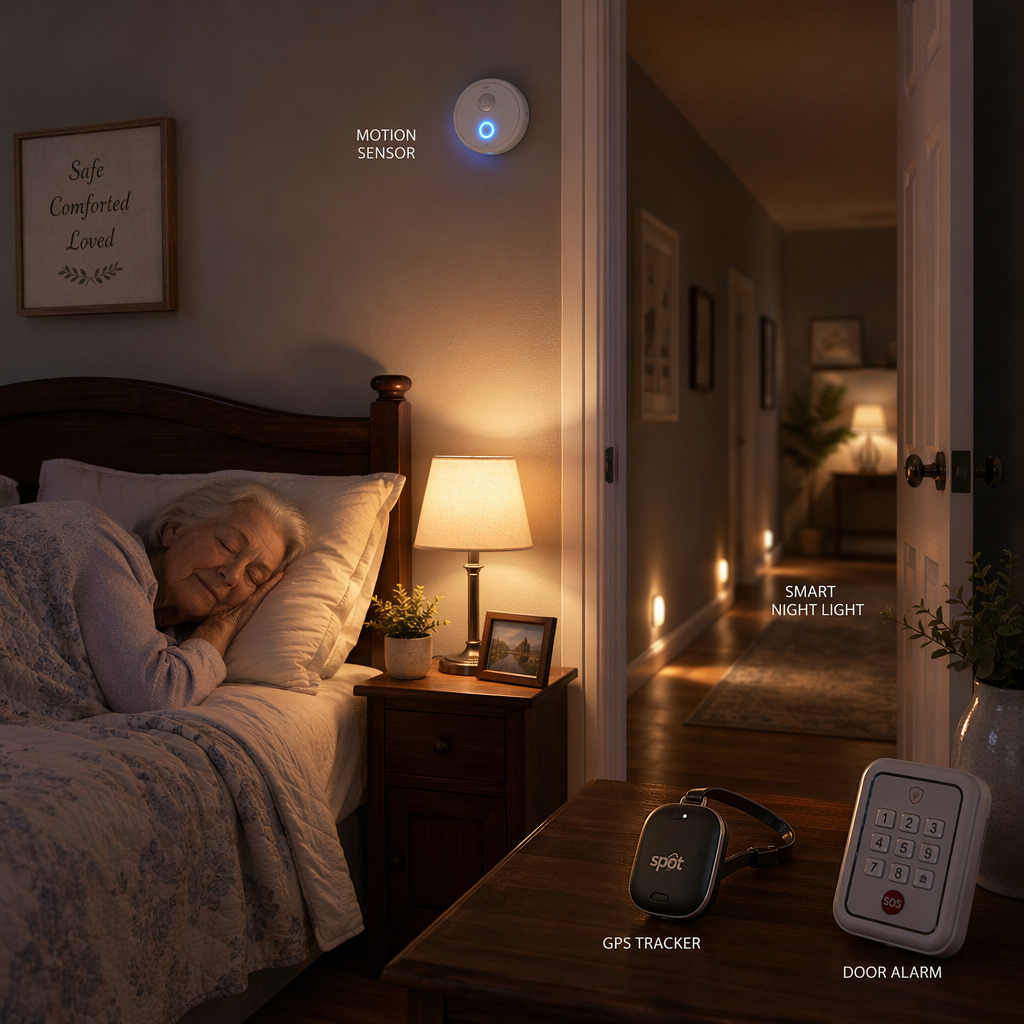
The following technology categories are particularly relevant for overnight dementia care:
- Door and window alarms: Simple magnetic alarms that sound when a door or window is opened. These are the first line of defense against wandering and can alert the caregiver immediately.
- Motion sensors: Placed in hallways, the kitchen, and near exits, these sensors can detect movement during the night and alert the caregiver without requiring them to stay awake and watch.
- GPS trackers: Wearable devices that allow the caregiver to locate the person quickly if they do manage to leave the home. These are especially important for families where wandering has already occurred.
- Smart night lighting: Motion-activated lights that illuminate pathways to the bathroom and exits, reducing the disorientation and fall risk that comes from navigating a dark home.
- Bed exit alarms: Pressure-sensitive pads or motion detectors that alert the caregiver when the person gets out of bed, allowing for timely assistance before a fall or wandering attempt.
For a detailed guide on choosing between different types of wearable monitors and matching them to your parent's specific risks, see our article How to Match a Wearable Health Monitor to Your Aging Parent's Specific Risks. That guide covers the evaluation dimensions — battery life, fall detection accuracy, response time, and privacy considerations — that matter most when selecting a device for a person with dementia.
The combination of a trained overnight caregiver and thoughtfully selected technology creates a nighttime environment that is safer, calmer, and more sustainable than either approach alone. And for the family caregiver who has been running on empty for months, that combination can mean the difference between reaching the breaking point and finding a way to keep going.
Questions to bring to a clinician or OT
This is not medical, legal, or a family's final decision — only a framework. Bring these questions to a clinician, occupational therapist, or your local Area Agency on Aging.
Find Local HelpRelated reading
Noticed something outdated or inaccurate on this page? Flag a correction. We review every report against CDC, NIA, and AARP HomeFit guidance before updating a page.