
Caregiver decision guide
How to Find and Pay for Home Help for an Elderly Parent: A Step-by-Step Guide
Most families struggle to find home help not because they search in the wrong place, but because they skip a critical step. This guide walks adult children through a four-step process: assess what help is actually needed, determine who pays, identify the right provider type, and vet individual caregivers with 10 essential questions.

Why Most Families Get Stuck (and How to Avoid It)
If you are reading this, you have likely already discovered the hard truth: the system for finding home help for an aging parent is fragmented, confusing, and expensive. A 2026 U.S. News/360 Reviews poll found that 93% of adults 55 and older want to age in place, yet the infrastructure to make that happen is a patchwork of agencies, insurance programs, and state-by-state waivers that seems designed to exhaust anyone who tries to navigate it.
The mistake most families make is not that they search in the wrong place. It is that they skip a critical step in a four-step process. They start by calling agencies or searching online directories before they have answered two fundamental questions: What help is actually needed? And who is going to pay for it? Doing the steps out of order — or skipping any one of them — leads predictably to the three most expensive errors: paying for services the older adult does not need, assuming Medicare covers things it never will, or hiring an agency that cannot deliver the promised care.
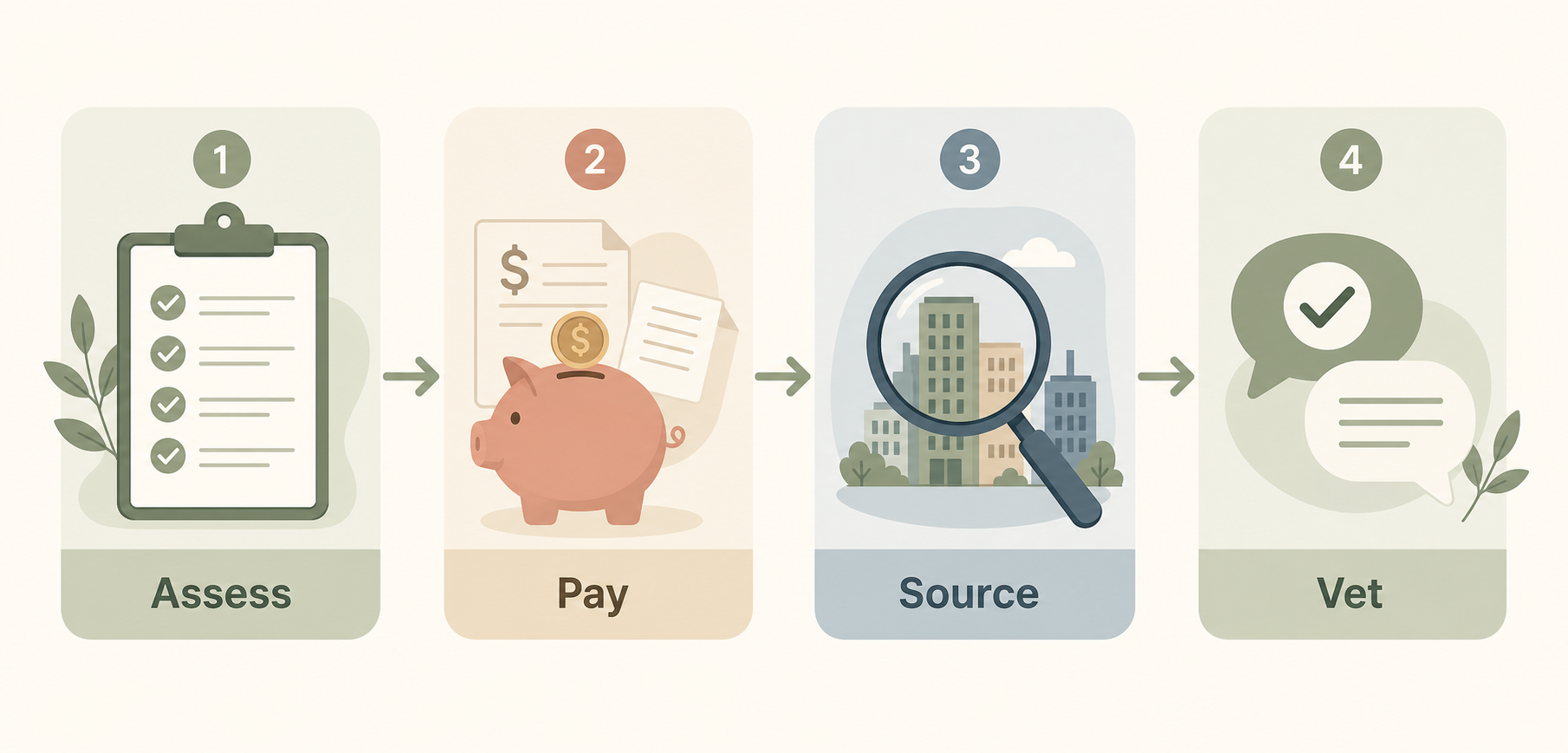
This guide walks you through the correct sequence: Assess what help is actually needed, Pay — determine who pays, Source — identify the right provider type, and Vet individual caregivers with specific questions. If you are completely new to caregiving and need a broader orientation first, our 5-Step Triage Framework for New Caregivers provides the big-picture context. This article builds on that framework with the specific steps for finding and paying for home help.
Step 1: Assess What Help Is Actually Needed (Before You Search)
The single most common reason families overpay for home help is that they skip the assessment step. They assume their parent needs "some help around the house" and hire a full-time aide when what is actually needed is a weekly grocery delivery service and a ride to medical appointments. The result: thousands of dollars spent on services that do not match the actual need.
The tool for getting this right is the Activities of Daily Living (ADL) and Instrumental Activities of Daily Living (IADL) framework. ADLs are the basic self-care tasks: bathing, dressing, eating, transferring (moving from bed to chair), toileting, and continence. IADLs are the higher-level tasks needed for independent living: meal preparation, medication management, housekeeping, transportation, managing finances, and using the telephone or communication devices.
The National Institute on Aging provides a Worksheet: Questions To Ask Before Hiring a Care Provider that walks you through this assessment. Use it with your parent, not for them. Sit down together and go through each activity one by one. For each task, ask: Can they do this independently? Do they need someone to be present? Do they need physical help? Do they need someone to do it for them?
| Type of Activity | Examples | Who Typically Provides This Help |
|---|---|---|
| ADL: Bathing and Grooming | Showering, brushing teeth, hair care | Personal care aide or home health aide |
| ADL: Dressing | Putting on clothes, buttoning, managing zippers | Personal care aide |
| ADL: Transferring | Getting in and out of bed or a chair | Home health aide or physical therapist |
| ADL: Toileting and Continence | Using the toilet, managing incontinence | Personal care aide or home health aide |
| ADL: Eating | Feeding oneself, cutting food | Personal care aide or home health aide |
| IADL: Meal Preparation | Cooking, meal planning, grocery shopping | Homemaker or companion service |
| IADL: Medication Management | Remembering doses, organizing pillboxes | Home health aide or nurse |
| IADL: Housekeeping | Cleaning, laundry, dishes | Homemaker or companion service |
| IADL: Transportation | Driving to appointments, grocery store | Companion service, family, or ride service |
| IADL: Managing Finances | Paying bills, managing bank accounts | Family member or geriatric care manager |
Once you have completed the assessment, you will have a clear list of needs. This list is your specification. It tells you exactly what type of help you need, how many hours per week, and what skills the caregiver must have. Do not proceed to Step 2 until this list is written down.
Step 2: Determine Who Pays — Your Five Funding Paths
With your assessment in hand, you now know what kind of help is needed and roughly how many hours per week. The next question is who pays for it. There are five main funding paths, and most families will use a combination of them. The critical thing to understand upfront: Medicare almost never covers ongoing personal care.
The Center for Medicare Advocacy, citing MedPAC data, reports that home health aide utilization under Medicare has declined by almost 94% over the past two decades. In 1998, the average beneficiary received 6.7 home health aide visits per month. By 2022, that number had fallen to less than half a visit per month. Home health aides now account for only about 5% of all home health visits under Medicare, down from 48% in 1997. While Medicare technically authorizes up to 28–35 hours per week of combined home health aide and nursing care, in practice this level of care is "almost non-existent," according to the Center for Medicare Advocacy.
| Funding Source | What It Covers | Key Limitation | Who Qualifies |
|---|---|---|---|
| Out-of-Pocket (Private Pay) | Any type of home care — nonmedical or skilled | No limit, but expensive: national median $34–$35/hr | Anyone |
| Long-Term Care Insurance | Personal care, homemaker services, sometimes skilled nursing | Must have policy in place before need arises; varies widely by policy | Policyholders who meet benefit triggers |
| Medicaid HCBS Waivers | Nonmedical in-home care, including personal care and homemaker services | Eligibility and program names vary by state; waitlists common | Low-income seniors who meet state financial and functional criteria |
| VA Aid and Attendance | In-home care, adult day care, assisted living | Must be a veteran or surviving spouse; requires medical and financial eligibility | Veterans and surviving spouses who need help with ADLs |
| PACE Programs | Comprehensive medical and social services including in-home care | Must be 55+, live in a PACE service area, and meet state nursing home level of care | Seniors who qualify for nursing home level of care but want to stay at home |
The national median cost for nonmedical home care in 2026 is $34 per hour (per A Place for Mom) or $35 per hour (per CareScout, cited by U.S. News and SeniorLiving.org). State medians range from $25 per hour in Mississippi to $44 per hour in South Dakota. At the national median of $34 per hour, 15 hours per week costs approximately $2,208 per month, and 30 hours per week costs approximately $4,416 per month. For context, a semi-private nursing home room costs a national median of $9,581 per month.
For a deeper dive into each funding source — including how to apply for Medicaid HCBS waivers, how VA Aid and Attendance works, and what long-term care insurance policies typically cover — see our dedicated guide: How to Pay for Senior Caregiver Services: Medicare, Medicaid, VA Benefits, and Out-of-Pocket Options. The section below provides a concise overview to keep you moving through the four-step process.
Step 3: Source the Right Provider Type — Agency, Private Caregiver, or Self-Directed
Now that you know what help is needed and who pays, you can decide what kind of provider to use. There are three main options, and each has trade-offs between cost, risk, and convenience.
- Home Care Agencies: These are businesses that employ caregivers, handle payroll and taxes, provide background checks, and typically offer backup coverage if a caregiver calls in sick. The trade-off is cost: agencies typically charge 20–30% more than independent caregivers (SeniorLiving.org, citing CareScout data). For many families, the peace of mind is worth the premium.
- Private Caregivers (Independent Hires): You find and hire a caregiver directly, often through a referral from a friend, a local ad, or an online platform. The cost is lower — you pay the caregiver's hourly rate without agency markup — but you become the employer. That means handling payroll taxes, verifying credentials yourself, and having no backup if the caregiver does not show up.
- Medicaid Self-Directed Care: In states that offer it, Medicaid HCBS waivers allow the participant to choose their own caregiver — including a trusted family member — and pay them directly through a financial management services provider. There is no agency overhead, and the caregiver is someone the older adult already knows and trusts. However, eligibility and program rules vary significantly by state, and not all states allow hiring family members.
The most reliable free entry points for finding providers are the Eldercare Locator at 800-677-1116 and your local Area Agency on Aging. These are federally funded, state-administered networks that can connect you with licensed home care agencies, explain your state's Medicaid HCBS waiver options, and provide referrals to local resources. Do not start with a Google search — start with the Eldercare Locator. For finding Medicare-certified home health agencies (if your parent needs skilled care), use Medicare Care Compare.
Step 4: Vet Individual Caregivers — 10 Essential Questions to Ask
Once you have identified a few agencies or candidates, it is time to vet them. This is where most families drop the ball — they are so relieved to have found someone that they skip the hard questions. Do not. The following 10 questions will separate a reliable provider from one that will cause you headaches down the road.
- Can you provide proof of current Medicare certification? On May 13, 2026, CMS enacted a six-month nationwide moratorium on new Medicare enrollments for home health agencies to combat fraud. Any agency that claims to be "awaiting Medicare certification" or cannot provide a current Medicare enrollment number should be treated with extreme caution. Existing agencies with current certification are not affected by the freeze.
- What background checks do you run on your caregivers? Ask specifically about national, state, and county-level criminal background checks, as well as a check of the state's abuse registry. A reputable agency will run all of these.
- What is your backup policy if a caregiver calls in sick or is late? A reliable agency will have a system for sending a replacement caregiver within a reasonable time frame. If they cannot give you a clear answer, that is a red flag.
- What training and supervision do your caregivers receive? Ask about initial training, ongoing education, and how supervisors monitor caregiver performance. For dementia-specific care, ask whether caregivers have specialized training.
- Are your caregivers bonded and insured? This protects you if a caregiver is injured in your home or if property is damaged. A legitimate agency will carry both general liability insurance and workers' compensation insurance.
- Do you provide a written care plan? A written care plan should specify the tasks the caregiver will perform, the schedule, and any special instructions. If an agency cannot or will not provide one, move on.
- What is your pricing structure, and are there any additional fees? Ask for a complete breakdown of hourly rates, any minimum-hour requirements, overtime rates, holiday rates, and fees for weekend or overnight care. Get it in writing.
- Can you provide references from current or past clients? A reputable agency should be able to connect you with families who have used their services. If they hesitate or offer only a generic testimonial, that is a warning sign.
- How do you handle caregiver-client matching? Ask how they match caregivers to clients based on personality, skills, and schedule. A good agency will try to find a compatible match, not just send whoever is available.
- What is your complaint and resolution process? If something goes wrong — a caregiver is late, disrespectful, or not performing the agreed-upon tasks — what is the process for resolving it? A clear, documented process is a sign of a professional agency.
The National Institute on Aging's Worksheet: Questions To Ask Before Hiring a Care Provider is an excellent downloadable resource that includes many of these questions in a printable format. Take it with you to every interview.
If your assessment indicates that your parent needs round-the-clock support, you may be considering a live-in caregiver arrangement. For detailed guidance on that specific situation, see our Complete Step-by-Step Guide to Hiring a Live-In Caregiver.
Red Flags: When to Walk Away From an Agency or Caregiver
Even after asking the 10 questions, you may encounter warning signs that should cause you to walk away. Here is a quick-reference checklist of red flags to watch for during the vetting process.
- Cannot verify current Medicare enrollment. Given the May 2026 CMS nationwide freeze on new home health agency enrollments, any agency that cannot provide proof of current Medicare certification should be treated as high-risk. The freeze is a temporary measure to combat fraud, but it means that agencies without current certification are not legitimate Medicare providers.
- Unclear or variable pricing. If an agency cannot give you a clear, written price list with all fees disclosed, walk away. Hidden fees for weekends, holidays, or overtime are common in this industry.
- No written care plan. A professional agency will always provide a written care plan. If they say "we will figure it out as we go," that is not acceptable.
- Refuses to provide references. Any agency or independent caregiver who cannot or will not provide references from current or past clients should be eliminated from consideration.
- Caregivers are not bonded or insured. This is non-negotiable. If a caregiver is injured in your home and the agency does not have workers' compensation insurance, you could be held liable.
- Pressures you to commit immediately. A reputable agency will encourage you to take your time, ask questions, and interview multiple candidates. If they pressure you to sign a contract on the spot, that is a major red flag.
Your Next Steps: A Checklist for Moving Forward
You now have a complete process. Here is a concise checklist you can print or save to guide your next actions. Follow these steps in order, and you will dramatically reduce the risk of costly mistakes.
- Complete the ADL/IADL assessment with your parent using the NIA worksheet. Write down exactly what help is needed and how many hours per week.
- Identify your payment path. Review the five funding options (out-of-pocket, long-term care insurance, Medicaid HCBS waivers, VA Aid and Attendance, PACE) and determine which ones apply to your situation.
- Contact the Eldercare Locator at 800-677-1116 or visit your local Area Agency on Aging. Use these free resources to find licensed home care agencies and learn about state-specific programs.
- Interview at least two agencies or independent candidates using the 10 essential questions. Take notes and compare answers.
- Verify Medicare certification and check references. Use Medicare Care Compare for Medicare-certified agencies. Call the references and ask about their experience.
- Review the NIA hiring worksheet and take it with you to every interview. It is your best tool for staying organized during the vetting process.
Finding home help for an aging parent is one of the most complex tasks a family caregiver will face. The system is fragmented, the costs are high, and the stakes are personal. But by following this four-step process in order — assess, pay, source, vet — you can navigate it with confidence. You do not need to become an expert in every funding program or every type of care. You just need to follow the steps, ask the right questions, and trust the process.
Questions to bring to a clinician or OT
This is not medical, legal, or a family's final decision — only a framework. Bring these questions to a clinician, occupational therapist, or your local Area Agency on Aging.
Find Local HelpRelated reading
Noticed something outdated or inaccurate on this page? Flag a correction. We review every report against CDC, NIA, and AARP HomeFit guidance before updating a page.