The Complete Guide to In-Home Assistance for Seniors
Reviewed: 2026-07-09
The Complete Guide to In-Home Assistance for Seniors
This guide helps new family caregivers understand the full spectrum of in-home assistance for seniors—from companion care to skilled nursing—and how to avoid costly mistakes by identifying the right type of help, finding trustworthy providers, and navigating Medicare, Medicaid, and other payment options.
By Editorial Team
new caregiver
experienced caregiver
long-distance caregiving
spousal caregiver
working caregiver
daily routines
medication management
personal hygiene
care coordination
first steps
ADLs
IADLs
Searching for in home assistance for seniors usually means the family has reached the uncomfortable middle: a parent is still at home, but ordinary routines are no longer ordinary. Someone needs to make sure meals happen, showers are safe, medications are not missed, the discharge instructions make sense, or Dad is not alone all day after a fall. The hard part is that “help at home” is not one service. It is a spectrum, and the wrong first call can send a family toward the wrong provider, the wrong bill, or the wrong assumption about what Medicare will cover.
The National Institute on Aging describes in-home services as a broad mix that can include personal care, homemaker services, companion care, skilled home health care, and live-in or around-the-clock support.[1] Those categories sound tidy on paper. In real life, they often arrive together: a parent comes home from the hospital needing a nurse for wound care, a physical therapist for a few weeks, and then a non-medical aide for bathing and meal help long after the skilled care ends.
Start With The Task, Not The Agency
Before calling providers, write down what actually needs to happen in the home. Not “Mom needs care.” More specific: “Mom needs someone to help her transfer from bed to chair,” “Dad needs rides and conversation,” “the house is not being cleaned,” “the incision needs skilled wound care,” or “someone must be awake overnight because wandering has started.”
That list determines the category. The category determines the provider. The provider determines which payment options are realistic. If the order gets reversed, families end up debating Medicare, Medicaid, agencies, private caregivers, and sibling budgets before they have named the need.
What your parent needs
Likely type of in-home assistance
Usual care focus
Conversation, supervision, errands, social connection
Companion care
Reducing isolation and helping with non-medical daily routines
Meals, laundry, light housekeeping
Homemaker services
Keeping the home livable and routines on track
Bathing, dressing, toileting, transfers, eating
Personal care / home care aide
Hands-on help with activities of daily living
Wound care, injections, medication teaching, physical therapy, occupational therapy
Skilled home health care
Short-term or intermittent clinical care ordered by a clinician
Continuous supervision, overnight help, high fall risk, extensive hands-on care
24/7, live-in, or shift-based care
Coverage across many hours, sometimes with both non-medical and skilled services
What Each Type Of In-Home Assistance Actually Means
Companion Care
Companion care is often the lightest form of paid help. A companion may visit, talk, play cards, go on walks, help with errands, accompany a parent to appointments, or provide a steady presence while family caregivers are at work. It can matter a great deal when the problem is isolation, mild forgetfulness, or a spouse who cannot safely leave the house alone.
The boundary is important: companion care is not nursing care. It is not wound care, physical therapy, or medication management in the clinical sense. Depending on the provider and state rules, a companion may remind someone to take medicine, but that is different from administering medication or making clinical judgments.
Homemaker Services
Homemaker help covers the domestic tasks that start to fail quietly: meal preparation, grocery shopping, laundry, dishes, changing linens, and light housekeeping. This can be the right fit when a parent is medically stable but the home is becoming harder to manage.
Families often underestimate homemaker help because it does not sound medical. But missed meals, spoiled food, cluttered walkways, and laundry piling up can become safety problems. The catch is payment: homemaker services by themselves are generally not what Medicare means by covered home health care.
Personal Care
Personal care is hands-on help with activities of daily living: bathing, dressing, toileting, grooming, eating, and moving from one place to another. This is the category many families are really describing when they say, “She can’t be alone anymore,” or “He’s not safe getting in the shower.”
A personal care aide may also do some homemaker tasks during a visit, depending on the care plan and agency policy. That overlap is normal. What should not be blurred is the difference between personal care and skilled care. Helping a parent bathe is not the same as changing a surgical dressing. Helping someone dress is not the same as providing physical therapy.
Skilled Home Health Care
Skilled home health care is clinical care at home. It can include skilled nursing, physical therapy, occupational therapy, speech-language pathology, wound care, injections, and other services ordered as part of a medical plan.[1] This is usually the category involved after a hospitalization, surgery, stroke, new wound, medication change, or sudden decline that requires professional assessment and treatment.
This is also where the language gets families into trouble. A “home health aide” in a Medicare-covered home health episode may provide limited aide services tied to a skilled plan of care. A “home care aide” hired privately may help with bathing, dressing, meals, and supervision for months or years. The names sound close enough to be cruel, but the payment rules are not close at all. For a deeper comparison, use a dedicated home care versus home health care decision guide rather than trying to solve that distinction during a sales call.
24/7, Live-In, And Overnight Support
Around-the-clock care is not just “more hours.” It is a different staffing and cost problem. A parent may need overnight help after repeated falls, advanced dementia, unsafe wandering, severe mobility loss, or a situation where one family caregiver has been providing constant supervision and is running out of safe endurance.
Some arrangements use live-in caregivers; others use multiple shifts so someone is awake and available. Families should ask exactly what “live-in” means, whether the caregiver sleeps, what breaks are required, how emergencies are handled, and what happens if the assigned caregiver calls out. For dementia in particular, the need may be supervision as much as hands-on care. The CDC reports that 80% of adults with Alzheimer’s disease and related dementias receive care at home, and more than 11 million unpaid U.S. caregivers provide 18.4 billion hours of care annually.[5] Paid help often enters when the unpaid schedule stops being sustainable.
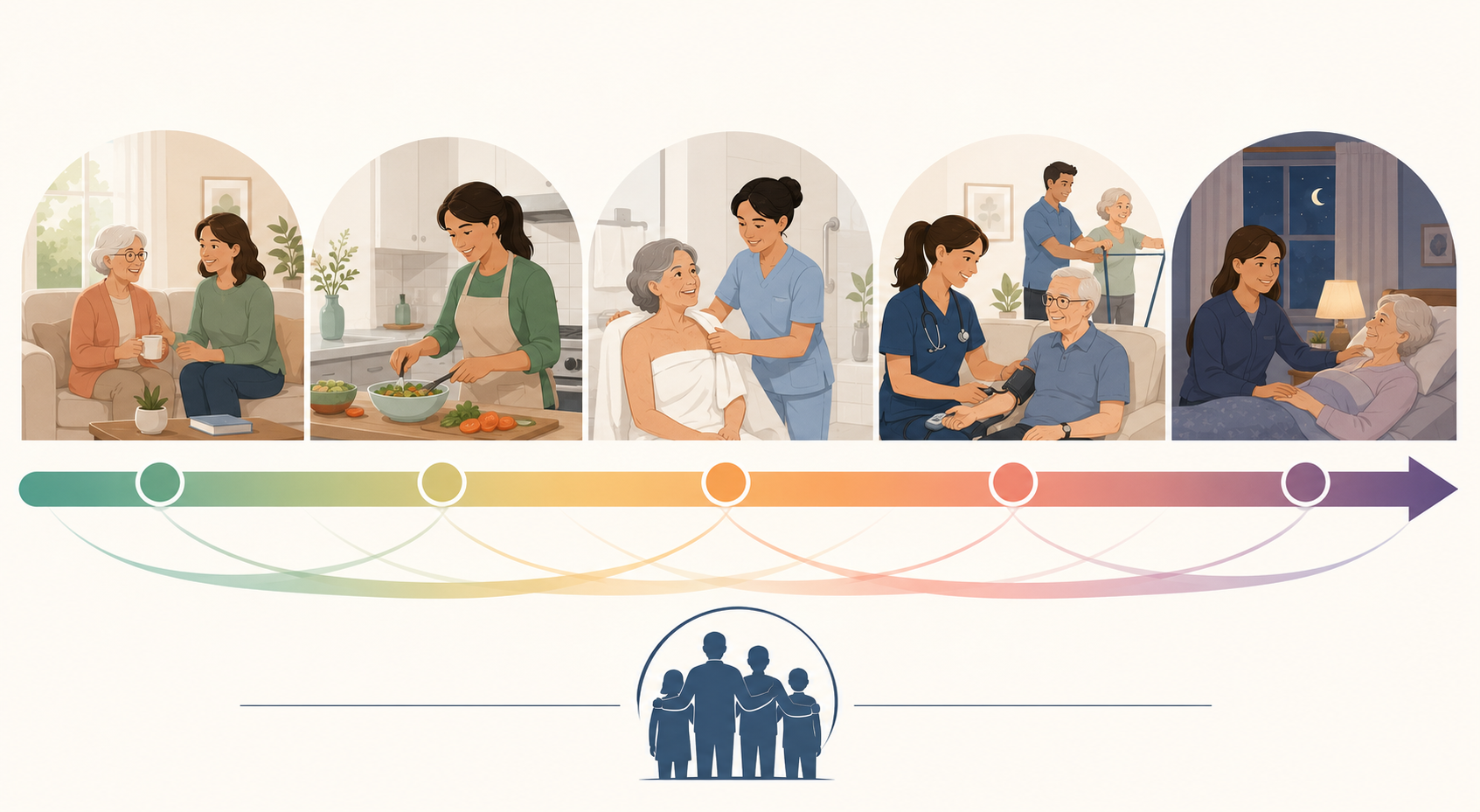
One Parent May Move Across Categories
The category you need this week may not be the category you need next month. After a hospital stay, a parent might qualify for intermittent skilled home health visits: a nurse checks the wound, a physical therapist works on walking, and an occupational therapist looks at bathroom safety. Once the skilled need ends, the family may still need a personal care aide three mornings a week for showering and dressing. Later, if dementia progresses or falls continue, the question may become overnight or 24-hour support.
That progression is not a failure of planning. It is the reason planning has to be specific. “Home care” can be temporary, ongoing, non-medical, skilled, part-time, or continuous. The safest sentence to use with any provider is: “Here are the tasks we need covered. Which of these can your staff legally and safely do, and which require a different provider?”
What In-Home Assistance Costs In 2026
Cost only becomes useful after the care type is clear. The 2026 national median hourly rate for a home health aide is $35 per hour, with state medians ranging from about $23 per hour in Louisiana to about $42 per hour in Washington, according to SeniorLiving.org’s summary of CareScout data.[2] At the national median, 40 hours per week comes to approximately $6,070 per month.[2]
That number is not a quote for your parent. It is a national reference point. Local wages, state rules, urban versus rural labor supply, weekend needs, overnight needs, dementia-related supervision, minimum shift lengths, and whether care comes through an agency or an individual caregiver can all change the bill.
Schedule
How to think about the cost
A few visits per week
Often used for companion care, errands, bathing help, meals, or family respite
20 to 40 hours per week
Can support regular personal care and homemaker routines, but still leaves many uncovered hours
Overnights or 24/7 care
Usually moves far beyond a simple hourly comparison because staffing model, sleep rules, and backup coverage matter
Short-term skilled home health
May be covered differently if Medicare or another insurer approves skilled, intermittent care
Agencies commonly cost more than hiring an individual caregiver directly. SeniorLiving.org reports that agencies charge about 20% to 30% more than individual caregivers, while also typically providing background checks, training, bonding, insurance, and backup coverage.[2] That does not automatically make an agency better in every family’s situation, but it explains part of the price difference. A cheaper hourly rate can become expensive if there is no replacement when the caregiver is sick, no workers’ compensation coverage, or no clear supervisor to call when something goes wrong.
What Medicare Will And Will Not Pay For
Medicare’s home health benefit is narrower than many families expect. Medicare covers home health services when a patient is homebound and needs skilled nursing care or therapy on a part-time or intermittent basis, and the care is ordered and reviewed under Medicare’s rules.[3] Medicare describes part-time or intermittent aide and skilled nursing services as up to 28 hours per week, or up to 35 hours per week for short periods when the need is predictable and finite.[3]
The exclusions matter just as much. Medicare does not cover 24-hour-a-day care at home, meals delivered to the home, homemaker services such as shopping or cleaning when that is the only care needed, or personal care such as bathing and dressing when that is the only care needed.[3] This is the sentence families need before they build a budget around a benefit that will not be there.
A parent can have Medicare and still need to private-pay for non-medical personal care. A parent can receive Medicare-covered skilled home health after discharge and still need separate help with meals, laundry, bathing, transportation, or supervision. Those are not contradictions. They are different categories of help moving through different payment doors.
Where Medicaid Fits
Medicaid is a major payer for home care, but it is not a single national program you can understand from one paragraph. KFF reports that Medicaid covers two-thirds of all U.S. home care spending, and about 4.5 million people receive Medicaid-covered home care each year through Home and Community-Based Services programs.[4] States operate more than 300 different HCBS programs, which is why one family’s answer in one state may not match another family’s answer across a state line.[4]
KFF notes that income for Medicaid home care eligibility is generally capped at 300% of the SSI limit, about $2,901 per month in 2025, and assets are usually limited to $2,000 per person.[4] Those figures are useful for orientation, not self-diagnosis. Spousal rules, medical need, waiver availability, waiting lists, estate recovery concerns, and state-specific program design can all affect the answer.
The practical move is to check your state Medicaid agency and your local Area Agency on Aging before assuming your parent is either clearly eligible or clearly not. Medicaid may be the most important pathway for long-term help at home, but it is also the pathway where local rules matter most.
Other Ways Families Pay
Many families use a patchwork. Private pay fills gaps when Medicare does not cover ongoing custodial care and Medicaid is unavailable, delayed, or too limited. Some families use long-term care insurance if the parent bought a policy years earlier. Veterans may have benefit pathways through the Department of Veterans Affairs. Local nonprofit, county, or state programs may help with meals, transportation, respite, or limited homemaker support.
This is where it helps to separate the care plan from the funding plan. First price the help that is actually needed. Then ask which hours, if any, might be covered by Medicare, Medicaid, VA benefits, long-term care insurance, local programs, or family funds. Trying to make the care plan match the easiest payer can leave the real risk uncovered.
How To Find Help Without Being Pulled Straight Into A Sales Funnel
Once you know the care category, start locally. The Eldercare Locator, supported by USAging and the Administration for Community Living, connects older adults and families with local services and receives about 400,000 requests each year.[6] It is available at 800-677-1116 and online, and it can route you toward an Area Agency on Aging or other local resources rather than a single company’s intake form.[6]
For a new caregiver, that neutrality matters. A discharge planner may give you a list. A neighbor may love one agency. An online search may produce ten providers that all sound identical. The Eldercare Locator and your Area Agency on Aging can help you understand what exists in your county, what public programs might apply, and which questions to ask next.
If the need is clinical after a hospital stay, ask the discharge planner or physician which Medicare-certified home health agencies can provide the ordered skilled services.
If the need is bathing, dressing, meals, errands, or supervision, ask for licensed non-medical home care agencies and local caregiver support programs.
If the need is dementia supervision, ask specifically about memory-care experience, wandering risk, overnight coverage, and caregiver consistency.
If the need is financial help, ask about Medicaid HCBS, state programs, respite programs, veterans benefits, and local nonprofit services.
Questions To Ask Before Signing With A Provider
Screening questions do not need to turn you into a home care expert. They need to slow the conversation down enough that you can see whether the provider is actually suited to the job. Home care guidance from TheKey, the Institute on Aging, and Christian Health converges around the same practical areas: hiring and screening, training, caregiver matching, backup plans, insurance and bonding, and contract clarity.[7][8][9]
What tasks can your caregivers perform, and what tasks are outside their role or license?
How do you screen caregivers before hiring them?
What training do caregivers receive for transfers, fall prevention, dementia care, infection control, or personal care?
How do you match a caregiver to my parent’s needs, schedule, language, personality, and home environment?
What happens if the caregiver is sick, late, unavailable, or not a good fit?
Are caregivers employees, contractors, or registry workers, and who handles taxes, supervision, insurance, bonding, and workers’ compensation?
What are the hourly rate, minimum shift length, weekend or holiday rates, cancellation rules, deposit requirements, and contract termination terms?
Who updates the care plan, and how will the family be notified if the caregiver notices a change?
Listen for precise answers. “We can do everything” is not as reassuring as it sounds. A trustworthy provider should be able to say what they do, what they do not do, when a nurse or therapist is required, when emergency services are appropriate, and how the family will know if the care plan needs to change.
A First-Call Plan For Families
If you are doing this under pressure, use a short sequence and resist skipping to the payer first.
Write down the tasks that need to happen at home: companionship, meals, housekeeping, bathing, toileting, transfers, medication reminders, wound care, therapy, supervision, transportation, or overnight coverage.
Sort those tasks into categories: companion care, homemaker services, personal care, skilled home health care, or 24/7 support.
If there is a skilled medical need after illness, injury, surgery, or hospitalization, ask the physician or discharge planner whether Medicare-covered home health may apply.
If the need is ongoing personal care, homemaker help, or supervision, price non-medical home care and check Medicaid HCBS, state programs, VA benefits, long-term care insurance, and private-pay options.
Call the Eldercare Locator at 800-677-1116 or contact your Area Agency on Aging for local routing before committing to a provider.
Use screening questions before signing anything, especially around caregiver duties, backup coverage, insurance, rates, and contract terms.
The decision discipline is simple, even when the situation is not: assess the need before choosing the provider, and choose the provider before assuming the payer. That order will not remove the stress from caregiving, but it can prevent the most expensive early mistakes.

Comments
Join the discussion with an anonymous comment.