
Nighttime Fall Prevention: How to Make the Bed-to-Bathroom Route Safe for Older Adults
The most dangerous moment for an older adult is the nighttime trip from bed to bathroom — when grogginess, poor lighting, and urgency collide. This guide provides a focused strategy for family caregivers to reduce fall risk along that critical path.
Why Nighttime Falls Are Different and More Dangerous
Every older adult who gets up to use the bathroom at 2 a.m. faces a perfect storm of fall risks. The body’s blood pressure can drop upon standing — a phenomenon called orthostatic hypotension — and this drop is more pronounced in the dark when the vestibular system is already disoriented from sleep. Add the urgency of a full bladder, poorly lit pathways, and the grogginess of being only half-awake, and a simple trip to the toilet becomes the single most dangerous movement of the day.
Nationally, falls remain the leading cause of fatal and non-fatal injuries for Americans age 65 and older. According to the CDC, one in four older adults falls each year, and falling once doubles the risk of falling again. In 2021 alone, falls resulted in 38,000 deaths and 3 million emergency department visits. The total healthcare cost of non-fatal falls in 2020 reached $80 billion, with Medicare covering 67% of that burden. The average cost per inpatient fall visit was $18,658, and each ED visit averaged $1,112.
But the location data is what makes the bedroom so critical. Among falls that happen inside the home — and roughly 60% of all falls do — 30% occur in the bedroom, according to an analysis cited by Lively from Best Buy Health. Another 9% of falls happen directly from a bed, chair, or other furniture. These are not daytime accidents. They are overwhelmingly nighttime events, driven by the combination of disorientation, poor lighting, and the urgent need to reach the bathroom.
Bed-to-Bathroom Path Audit
Before buying any equipment, walk the exact route your loved one takes from the bed to the bathroom door. Do this at night with the lights off, using only the ambient light that would be available during a typical middle-of-the-night trip. Note every obstacle, every change in flooring, every glare or shadow. The following checklist covers the most common hazards.
- Furniture and clutter: Is there a clear, straight path at least 36 inches wide? Remove wastebaskets, shoes, pet bowls, low tables, and any cords that cross the floor. Chairs or dressers that jut into the path should be repositioned or moved.
- Flooring transitions: If the route crosses from carpet to tile, hardwood, or vinyl, the height change or texture difference can catch a foot. Install a low-profile transition strip or ensure the carpet edge does not curl upward.
- Throw rugs and mats: These are the number one trip hazard along nighttime paths. Remove any rug that is not securely taped to the floor. Ideally, remove all throw rugs from the entire route.
- Lighting gaps: Identify every dark zone. The typical bedroom has a lamp on the nightstand that lights only the bedside area. The path to the bathroom is often entirely dark. Mark where a nightlight or motion-sensor light is needed.
- Doorway clearance: Does the bathroom door swing inward? Can a person using a walker or cane navigate through it? A door that opens inward can trap someone who falls behind it. Consider reversing the door swing or installing a pocket door.
- Handhold availability: Along the entire route, is there something sturdy to hold onto every step of the way? A wall, a piece of furniture (secured), a grab bar? If the path has a stretch longer than an arm’s length without a handhold, add a grab bar or install a transfer pole.
Lighting Strategy for Overnight Safety
After clearing the path, lighting is the most impactful intervention. A summary of research from the National Institutes of Health, cited by New Star Lighting, found that visual-cue lighting can reduce nighttime falls among older adults in institutional settings by more than 30%. While the study setting may not perfectly match a private home, the principle applies: when the brain can perceive the environment clearly and see where the floor and walls are, balance improves and hesitation decreases.
For the bed-to-bathroom route, consider these lighting upgrades:
- Motion-sensor nightlights: Plug one into an outlet near the bed and another near the bathroom door. They turn on automatically when movement is detected, so your loved one never has to fumble for a switch. Choose models with soft warm light (not harsh blue-white) to preserve night vision.
- Under-bed LED strips: Adhesive strips placed under the bed frame or along the baseboard create a low-level glow that outlines the path without blinding the user. They are especially helpful for defining the drop-off from the bed edge to the floor.
- Touch-activated lamps: A lamp on the nightstand that turns on with a single tap avoids the struggle with traditional switches. Place it within easy reach from the bed.
- Red-spectrum or amber bulbs: Red light preserves the eyes' night vision far better than white or blue light. Replace a bedroom lamp bulb with a red or amber bulb for the nighttime path. The brain can still navigate safely, and returning to sleep is easier because the circadian system is not disrupted.
Aim to have continuous, softly lit coverage from the bedside to the bathroom. Every dark stretch increases the risk of misjudging a step or losing balance.
Bed Exit Safety: Rails, Grab Bars, and Fall Mats
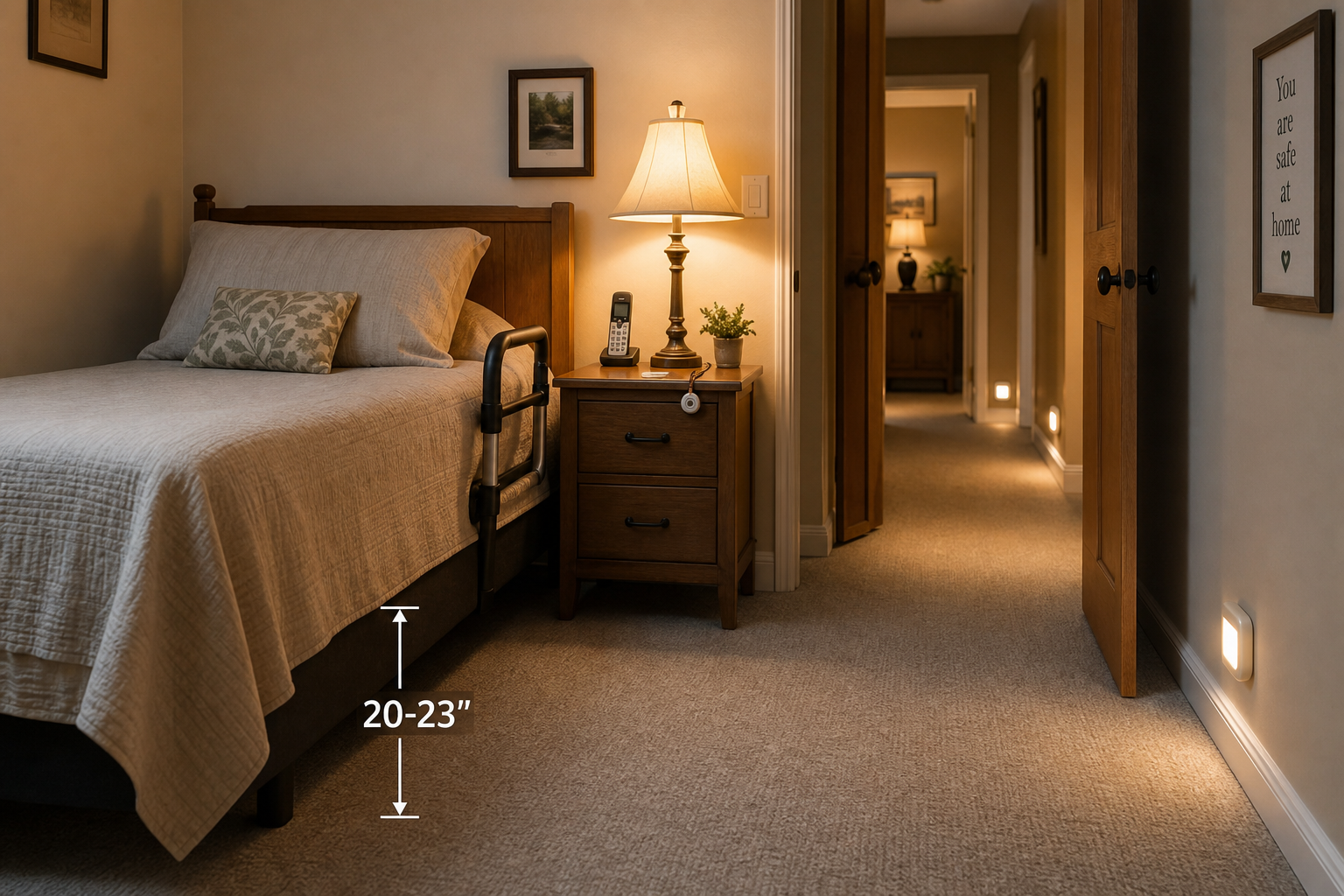
The moment of getting out of bed is where many nighttime falls begin. A bed that is too high forces a precarious drop; a bed that is too low makes standing up a struggle. Occupational therapy guidance recommends an ideal bed height of 20 to 23 inches from the top of the mattress to the floor, so that when the person sits on the edge, both feet rest flat on the floor. Measure your bed and adjust the bed frame or add a low-profile box spring to hit that range.
Once the height is correct, choose a bed exit support. The options vary in design, weight capacity, and suitability for different conditions. The table below compares the main categories.
| Type | Description | Best for | Key considerations |
|---|---|---|---|
| Half- or full-length bed rail | Metal or plastic rail that attaches to the bed frame; one or both sides. | People who roll out of bed or need a stable handhold to reposition. | Full-length rails can act as a barrier; not recommended for those with cognitive impairment because they may try to climb over them. Older designs risk entrapment. |
| Bed assist rail (adjustable feet) | A free-standing rail with legs that sit on the floor, providing support without bolting to the bed. | People who need help sitting up or standing from the edge. | Sturdy on hard floors but may shift on carpet. Check weight capacity. |
| L-shaped bed handle | Slips between mattress and box spring, low profile. | Lightweight assistance for getting in and out without a large visual presence. | Less weight-bearing than other options; suitable for moderate support only. |
| Transfer pole (floor to ceiling) | Pole that mounts between floor and ceiling with a tension mechanism; can be placed bedside. | People who need a strong, stable vertical support for standing and pivoting. | Does not attach to the bed, so it can be positioned for the optimal standing trajectory. Requires a secure ceiling and floor (no suspended ceilings). |
| Grab bar (wall-mounted) | A standard bathroom-style grab bar installed on the wall beside the bed. | When the bed is positioned against a wall or near a strong wall. | Must be anchored into studs or use heavy-duty toggle bolts. A wall-mounted bar provides the most reliable handhold. |
Fall mats placed alongside the bed provide a cushioned landing if a fall does occur. They are not a substitute for prevention, but they can reduce the severity of injury — especially hip fractures, which are a common and costly outcome of nighttime falls. Choose a mat that is at least 3 to 4 feet long and 2 inches thick, placed flush against the side of the bed where the person exits.
Managing Nighttime Urgency
The most effective way to eliminate the danger of the bed-to-bathroom trip is to make the trip unnecessary. A bedside commode — a portable toilet placed next to the bed — removes the entire journey. This is not a decision anyone makes lightly, but for many families it is the single intervention that prevents the highest-risk falls.
- Place the commode beside the bed on the side the person uses for exit. Ensure it is close enough that they can reach it without standing up fully and turning.
- Choose a model with a splash guard, seat cover, and handles for support during sitting and standing.
- Install a nightlight near the commode so it is visible without needing to turn on an overhead light.
- Empty and clean the commode every morning to maintain hygiene and dignity. Use a covered container or disposable liners.

For those who want to continue using the bathroom but struggle with urgency, incontinence management is equally important. Limiting fluid intake after dinner can reduce nighttime urinary frequency, but do not withhold water if the person is thirsty — dehydration causes its own problems. Incontinence briefs may be a practical alternative if the person is willing to wear them at night, removing the need to get up at all.
Emergency Communication Within Arm’s Reach
Even with every preventive measure in place, a fall can still happen. When it does, the speed of help depends on whether the person can call for assistance. A phone or alert device left on the nightstand is useless if the person falls on the way to the bathroom. The device must be reachable from the floor — or worn on the body.
- Cordless phone with large buttons: Keep the phone on the bedside table, but also consider a second handset placed in a low drawer beside the bed where it can be reached while lying on the floor.
- Medical alert pendant or wristband: A wearable PERS device with a button that connects to a monitoring center is the most reliable option because it stays with the person regardless of where in the room they fall. Many modern devices include automatic fall detection.
- Voice-activated assistant: A smart speaker (Amazon Echo, Google Nest) can be programmed to call a designated contact if the person says “Help” or a customized phrase. It does not require the person to be near a phone.
- Call bell: A simple push-button bell placed on the nightstand is a low-tech backup. It alerts the caregiver in the next room but does not provide two-way communication.
Position any device so that it can be activated both from the bed and from the floor immediately beside the bed. Test it weekly to ensure batteries are charged and the service is active.
When Confusion Is a Factor: Dementia and Sundowning Considerations
If your loved one has Alzheimer’s disease or another form of dementia, the nighttime routine changes fundamentally. Sundowning — a pattern of increased confusion, agitation, and restlessness that begins in the late afternoon and continues into the night — makes the bed-to-bathroom route even more perilous. A person who is disoriented may not remember where the bathroom is, may wander into other rooms, or may try to leave the house.
- Use a bedside commode as a first-line strategy: For someone with dementia, the goal of reaching the bathroom may be forgotten mid-journey. A commode right next to the bed removes the need for route memory.
- Avoid full-length bed rails: As noted earlier, rails can be climbed over, leading to a higher-impact fall. A low bed (as close to the floor as possible) with a fall mat is generally safer.
- Secure the environment: Lock exterior doors and windows if wandering is a risk. Install motion sensors that alert the caregiver when the person leaves the bed.
- Maintain a consistent bedtime routine: Dim lights gradually, avoid stimulating activities, and keep the same schedule every night to reduce sundowning episodes.
- Use door alarms or bed-exit pads: Simple alarm mats placed on the floor beside the bed or under the mattress can alert you when the person gets up, allowing you to assist before they attempt the walk.
Your Nighttime Safety Plan: Next Steps
This guide covers the highest-risk scenario, but a safe bedroom involves more than the bed-to-bathroom route. Use the summary checklist below to build your personalized plan, and then broaden your safety assessment with the full-room resources linked at the end.
- Walk the nighttime path: Identify and fix obstacles, flooring transitions, and lighting gaps.
- Install lighting: Add motion-sensor nightlights, under-bed strips, or red-spectrum bulbs along the entire route.
- Set the correct bed height: Adjust so feet rest flat on the floor when seated on the edge (20–23 inches from mattress top to floor).
- Choose a bed exit support: Select between a bed rail, transfer pole, grab bar, or assist rail based on mobility and cognition.
- Place a fall mat: Add a cushioned mat on the exit side to reduce injury severity.
- Consider a bedside commode: Evaluate whether eliminating the journey altogether is the safest option.
- Position emergency communication: Ensure a call device is within arm’s reach from both the bed and the floor.
- Address dementia-specific risks: If cognitive impairment is present, implement low bed height, bed-exit alarms, and a consistent sundowning routine.
For deeper guidance on the destination side of the journey, see the Bathroom Safety Checklist for Seniors: Zone-by-Zone Hazard Assessment with Tiered Action Priorities. And if you are considering permanent structural changes to the bedroom, the Bedroom Modifications for Seniors Aging at Home: A Safety and Accessibility Guide provides cost estimates, funding options, and contractor considerations.
Related reading
Noticed something outdated or inaccurate on this page? Flag a correction. We review every report against CDC, NIA, and AARP HomeFit guidance before updating a page.
Part of the Fall Prevention section.