Loneliness Is a Health Risk: What the Data Says About Companion Care for Older Adults
Loneliness is a measurable health risk comparable to smoking 15 cigarettes a day. This article presents the latest evidence — including a 2025 global meta-analysis — and explains how companion care can reduce depression, slow cognitive decline, and lower fall risk for aging adults.
By Editorial Team
companion care
social isolation
loneliness
caregiver guides
new caregiver
📄
A printable version of this guide is available. Use your browser's print function (Ctrl+P / ⌘P) to save or print.
Meaningful human connection is a measurable health intervention, not just a social nicety.
The Loneliness Crisis in Older Adults: What the 2025 Data Reveals
Loneliness among older adults is not a niche emotional concern — it is a widespread, measurable public health crisis. A 2025 systematic review and meta-analysis published in Nature, which pooled data from 126 studies involving 1,250,322 older adults worldwide, found that the global prevalence of loneliness is 27.6%. That means more than one in four older adults experiences loneliness at a level that affects their health.
The numbers are even starker for specific populations. North America has the highest regional prevalence at 30.5% (95% CI: 24.7–37), followed by Asia at 27.9% and Europe at 27.2%. Older women face a rate of 30.9%, and the most vulnerable group — older adults living in institutional settings — reports a prevalence of 50.7% (95% CI: 43.7–57.6).
These findings align with a 2025 AARP study that found 40% of U.S. adults aged 45 and older report feeling lonely — a significant increase from prior years. The U.S. Surgeon General has declared loneliness a public health crisis, equating its impact on mortality to smoking 15 cigarettes a day. This is not hyperbole. The physiological toll of chronic loneliness is now well-documented, and it demands the same seriousness as any other major risk factor.
How Loneliness Harms Physical and Cognitive Health
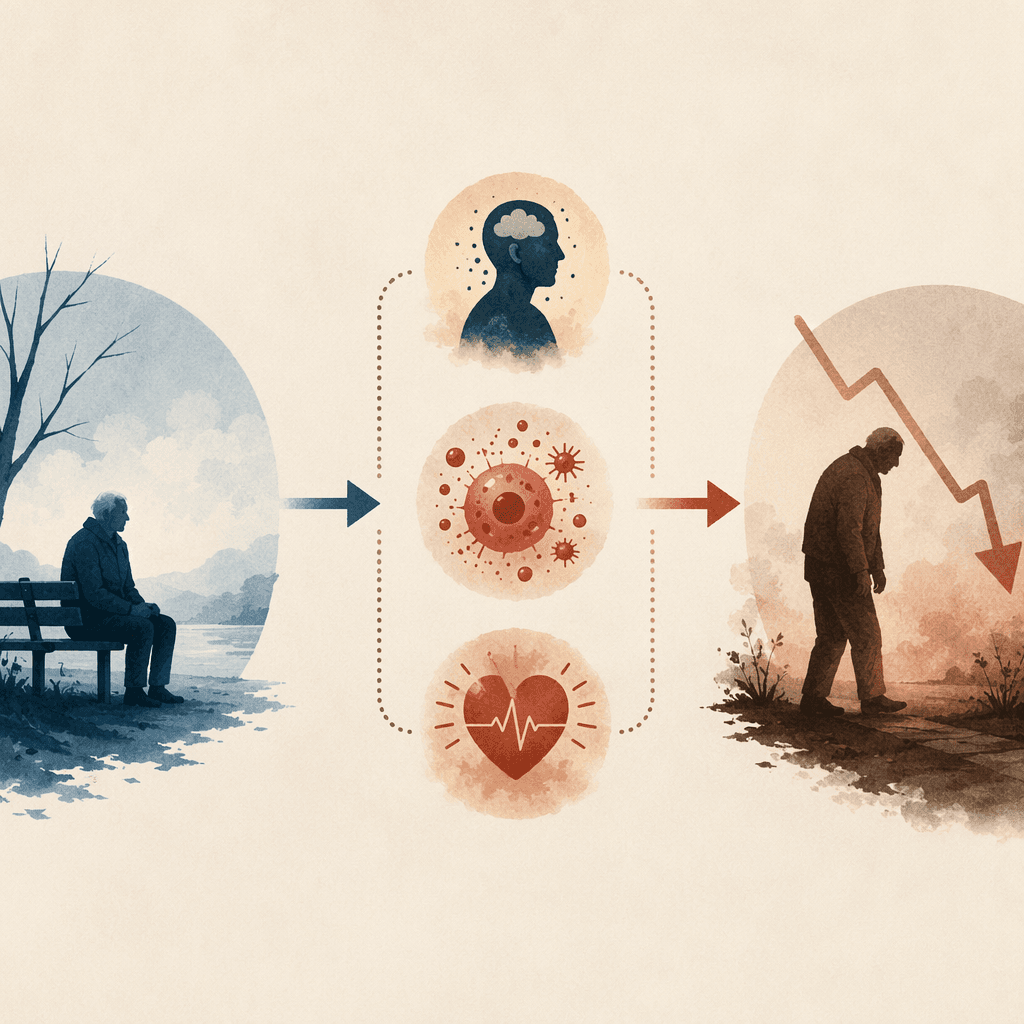
Loneliness is not simply an unpleasant feeling — it triggers a cascade of physiological stress responses that damage the body over time. When the brain perceives social isolation as a threat, it activates the hypothalamic-pituitary-adrenal (HPA) axis, leading to chronically elevated cortisol levels. This sustained stress response contributes to systemic inflammation, which is a known driver of cardiovascular disease, diabetes, and arthritis.
The 2025 meta-analysis identified several factors consistently associated with loneliness in older adults: depressive symptoms, widowhood, living alone, poor health status, frailty, and cognitive impairment. These are not separate problems — they form a feedback loop. Loneliness worsens depression, which deepens social withdrawal, which accelerates cognitive decline, which increases frailty and fall risk.
Chronic loneliness triggers measurable physiological damage through elevated cortisol, systemic inflammation, and cardiovascular strain.
The health consequences are concrete and measurable:
Increased cardiovascular strain: Chronic loneliness is associated with higher blood pressure and greater risk of coronary heart disease.
Accelerated cognitive decline: Social isolation reduces cognitive stimulation, which is a protective factor against dementia. The meta-analysis confirms cognitive impairment as a significant associated factor.
Higher fall risk: Frailty and poor health status — both linked to loneliness — are direct contributors to falls, the leading cause of injury among older adults.
Greater healthcare utilization: Socially isolated older adults visit emergency departments more frequently and have longer hospital stays.
Why Companion Care Is an Evidence-Based Intervention
Companion care is a non-medical service that provides regular social contact, structured routine, cognitive engagement, and transportation access. It is not home health care — companions do not perform clinical tasks, administer medications, or provide personal care. What they do provide is something the data shows is equally vital: consistent human connection.
The evidence for companion care as a health intervention comes from multiple sources. Research on the Senior Companion Program (SCP), published in the PMC journal, studied 59 female SCP volunteers (mean age 70, 81.4% African American, 62.7% living below poverty) and identified four major psychosocial benefits: reducing social isolation, improving quality of life, finding purpose and meaning, and increasing understanding of aging. Volunteers reported that the program reduced depression, provided daily motivation, and created meaningful relationships with clients described as "sisterly bonds."
Notably, the benefits were reciprocal. Volunteers who helped others reported reduced feelings of depression and a greater sense of accomplishment. This is a critical insight for family caregivers: companion care does not just serve the older adult — it creates a relationship that benefits both parties.
Volunteers reported that the program reduced depression, provided daily motivation, and created meaningful relationships with clients described as 'sisterly bonds.'
Companion care addresses loneliness through several mechanisms:
Regular social contact: Scheduled visits create predictable social interaction, which counteracts the unpredictability of loneliness.
Structured routine: Companions help maintain daily rhythms — meal times, walks, activities — which support cognitive function and emotional stability.
Cognitive engagement: Conversation, games, reading, and shared activities provide mental stimulation that helps slow cognitive decline.
Transportation access: Companions provide rides to medical appointments, social events, and errands, reducing the isolation that comes from losing the ability to drive.
Safety monitoring: Regular visits mean someone is observing changes in health, cognition, or home safety — a set of eyes that can catch problems early.
Key Statistics Every Family Caregiver Should Know
The following table summarizes the most important data points for understanding loneliness as a health risk and companion care as an intervention. These numbers can help you make the case to family members, or to the older adult themselves, that companionship is not a luxury — it is a health necessity.
Key data points on loneliness prevalence and companion care costs. All figures are the most current available as of mid-2026.
Statistic
Source
Year
Global prevalence of loneliness in older adults: 27.6%
Loneliness mortality impact equivalent to smoking 15 cigarettes/day
U.S. Surgeon General
2023
National median cost of companion care: $34–$35/hour
Genworth Cost of Care Survey (via SeniorLiving.org)
2025–2026
Typical 4-hour minimum visit cost: ~$200
SeniorLiving.org
2025–2026
Translating the Data Into a Decision Framework for Your Family
Knowing the statistics is one thing. Knowing what to do with them is another. Here is a simple framework for moving from concern to action.
Step 1: Assess the Level of Social Isolation
Start by honestly evaluating how much meaningful social contact your loved one has in a typical week. Consider: Do they have at least one in-person conversation that is not transactional (not just ordering food or paying a bill)? Do they leave the house for non-essential activities? Do they have a regular routine that includes another person? If the answer to any of these is no, they may be experiencing isolation at a level that warrants intervention.
For a more detailed assessment of specific behavioral signs, see our guide on recognizing the signs a senior needs social support. That article focuses on the observable behaviors — declining hygiene, loss of interest in hobbies, avoidance of social activities — that signal it is time to act.
Step 2: Consider Companion Care as a First-Line Intervention
For many families, companion care is the most accessible and effective starting point. It is less expensive than home health aide services (which require licensed professionals), does not require a doctor's order, and can be started with as little as a few hours per week. The national median cost of $34–$35 per hour, with a typical 4-hour minimum visit costing around $200, makes it a realistic option for many households — especially when compared to the costs of untreated health decline.
If you are unsure where to begin the process of finding and hiring help, our 5-step triage framework for new caregivers provides a structured approach to assessing needs, identifying resources, and taking the first steps without feeling overwhelmed.
Step 3: Know When to Escalate
Companion care is powerful, but it is not a solution for every situation. If your loved one has advanced dementia, complex medical needs, or severe mobility limitations that require skilled care, companion care alone will not be sufficient. The next section addresses these scenarios directly.
Companion care is a powerful first-line intervention, but some situations require a higher level of support.
When Companion Care Alone Isn't Enough
Companion care is designed for older adults who need social contact, supervision, and help with non-medical tasks. It is not designed for situations that require skilled nursing, personal care (bathing, toileting, feeding), or 24/7 monitoring. Here are the scenarios where companion care should be supplemented or replaced by a higher level of support:
Advanced dementia: When a person with dementia requires assistance with all activities of daily living, has significant behavioral symptoms (aggression, wandering, sundowning), or needs constant supervision for safety, a companion is not equipped to manage these needs. A home health aide or memory care facility may be necessary.
Complex medical needs: If your loved one requires wound care, medication management (beyond simple reminders), catheter care, or monitoring of vital signs, a licensed home health aide or nurse is required.
Severe mobility limitations: If the older adult cannot transfer from bed to chair without assistance, or requires a lift for bathing, a companion cannot safely provide this care. An occupational therapist or physical therapist should assess the situation first.
Signs of clinical depression: While companion care can reduce feelings of loneliness, it is not a substitute for mental health treatment. If your loved one shows signs of clinical depression — persistent sadness, loss of interest in all activities, changes in sleep or appetite, thoughts of death — they need a professional evaluation.
For a detailed comparison of companion care versus home health aide services, including cost differences and scope of care, see our guide on choosing the right level of in-home care. That article provides a practical decision framework for matching your loved one's needs to the appropriate type of care.
The Bottom Line: Loneliness Is Treatable
The data is clear: loneliness is a serious, measurable health risk that affects more than a quarter of older adults globally. It damages the body through inflammation, elevated cortisol, and cardiovascular strain. It accelerates cognitive decline. It increases fall risk. It is, by the Surgeon General's assessment, as dangerous as smoking 15 cigarettes a day.
But here is the hopeful part: loneliness is also treatable. Companion care is one of the most evidence-based, accessible interventions available. It does not require a prescription, a diagnosis, or a complex care plan. It requires a commitment to regular human contact — something that the research shows benefits both the older adult and the companion.
If you are reading this because you are worried about a parent, a spouse, or another loved one, the first step is simple: have the conversation. Use the data in this article to explain why companionship matters. Then use the triage framework to figure out what to do next. You do not need to solve everything at once. You just need to start.




Comments
Join the discussion with an anonymous comment.