
Caregiver decision guide
Senior Home Services: A Practical Decision Framework for When to Hire Help, What It Costs, and How to Start
This guide provides a staged decision framework for adult children who have experienced a triggering event with a parent — such as a fall, missed medication, or a concerning phone call. It walks through functional assessment, hour mapping, agency vs. independent caregiver tradeoffs, cost realities, funding sources, and a strategy to start small and scale up.

The Triggering Event: Recognizing When It’s Time for Senior Home Services
For most families, the decision to hire help doesn't arrive as a slow, reasoned conclusion. It arrives as a jolt — a parent who fell in the bathroom and lay on the floor for hours, a missed dose of blood pressure medication that led to an ER visit, or a phone call where the conversation was so confused and rambling that you knew something was wrong. These are the triggering events, and they share a common feature: they reveal that the current arrangement — the assumption that Mom or Dad is managing fine alone — has already broken down.
If you're reading this after one of those moments, you're not alone. A 2025 survey of 1,029 caregivers found that 78% report experiencing feelings of burnout, and only about 1 in 4 (24%) felt completely prepared when caregiving began. The instinct to rush into a solution — hire a full-time aide, tour assisted living facilities, quit your job — is understandable, but it's rarely the right move. The better approach is a staged, scalable process that starts with a clear assessment of what your parent actually needs.
If your triggering event involved a fall, you may also want to review our room-by-room fall prevention checklist to address immediate hazards while you work through the service decision.
Step 1: Functional Assessment — What Type of Help Does Your Parent Actually Need?
Before you call an agency or search for a caregiver, you need a clear picture of what your parent can and cannot do independently. The most practical tool for this is the ADL/IADL framework — a standardized way of categorizing the tasks that make up daily life.
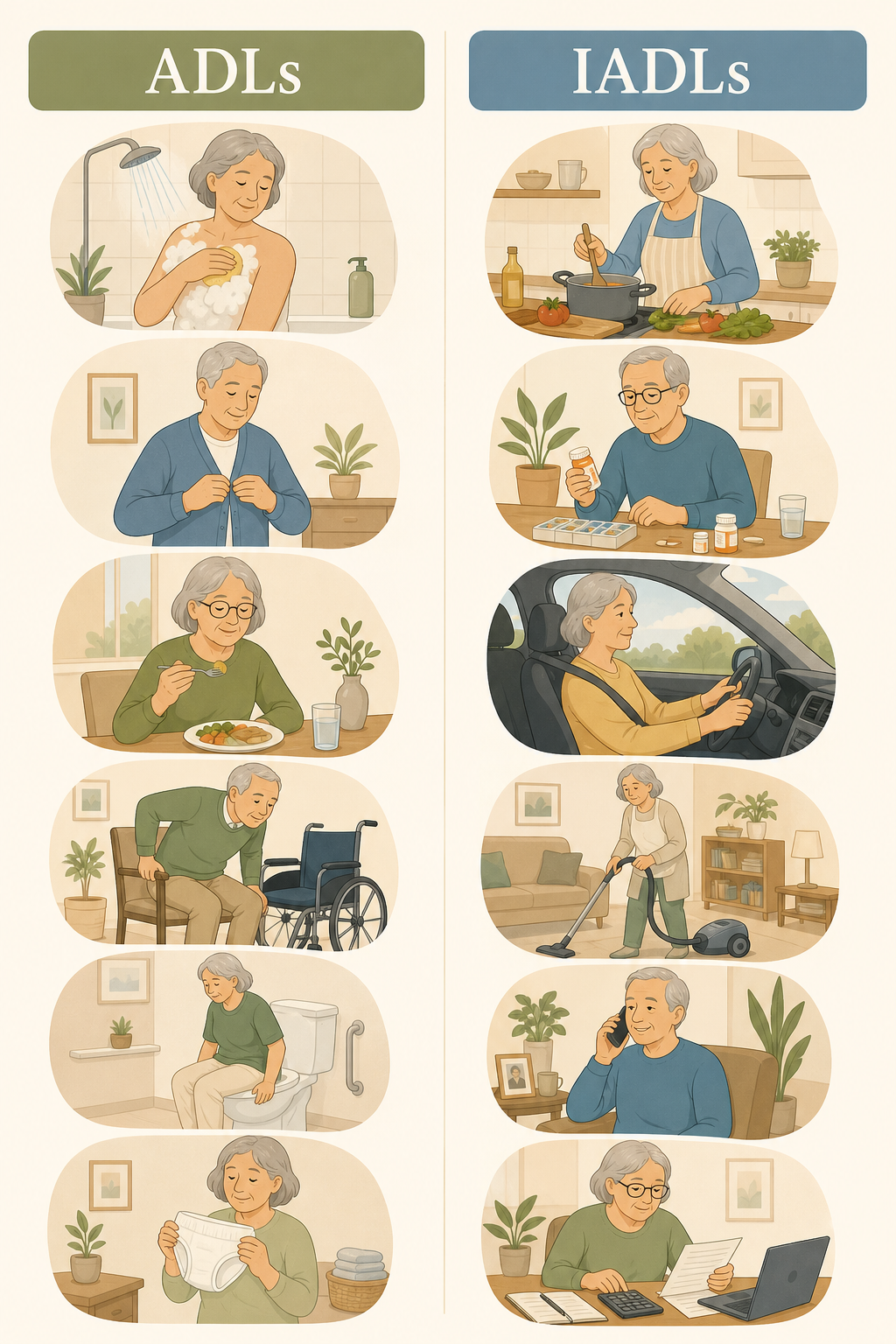
Activities of Daily Living (ADLs) are the fundamental self-care tasks: bathing, dressing, toileting, transferring (getting in and out of bed or a chair), continence management, and eating. If your parent needs help with any of these, they need personal care assistance — the kind of hands-on support typically provided by a home health aide or personal care attendant.
Instrumental Activities of Daily Living (IADLs) are the higher-level tasks that support independent living: meal preparation, housekeeping, medication management, transportation, shopping, managing finances, and using the telephone or technology. Difficulty with IADLs often appears earlier than ADL decline and can be addressed with homemaker services, companion care, or a family member's coordination.
To apply the framework, walk through each activity and ask: Can my parent do this safely and consistently without help? If the answer is no, note whether the need is for supervision (someone present to ensure safety), cueing (verbal reminders), or physical assistance. This distinction matters because it determines the level of caregiver training required and the cost.
Once you've completed the assessment, group the needs into three categories:
- Personal care needs (ADL deficits): Requires a home health aide or personal care attendant with training in bathing, transfers, and toileting assistance.
- Homemaking and transportation needs (IADL deficits): Can be met by a companion or homemaker service — no clinical training required.
- Skilled care needs (wound care, medication injections, physical therapy): Requires a licensed nurse or therapist, typically covered by Medicare under specific conditions.
Step 2: Mapping Hours — How Much Help Is Needed at Different Dependency Levels?
Once you know what type of help is needed, the next question is how much. Most families overestimate or underestimate by a wide margin — either assuming a few hours a week will cover everything, or jumping to 24/7 care before testing lighter options.
The table below maps common dependency profiles to estimated weekly hours. These are starting points, not prescriptions. Your parent's actual needs will depend on their specific ADL/IADL profile, the layout of their home, and whether a family caregiver is available to fill gaps.
| Dependency Level | Typical Profile | Estimated Weekly Hours | Monthly Cost (at $34/hr) |
|---|---|---|---|
| Light support | Needs help with meals, light housekeeping, and transportation to appointments. No ADL deficits. | 7 hours/week | $1,031/month |
| Moderate support | Needs help with medication management, bathing assistance, and meal preparation. Some IADL deficits, one or two ADL deficits. | 15 hours/week | $2,208/month |
| Intensive support | Needs help with multiple ADLs (bathing, dressing, toileting) and most IADLs. May need supervision during waking hours. | 30 hours/week | $4,416/month |
| Near-continuous care | Needs assistance with most ADLs, including transfers and toileting. May need overnight support or multiple shifts. | 44 hours/week | $6,478/month |
Notice the jump from 30 to 44 hours per week. At 44 hours, the monthly cost of in-home care ($6,478) approaches or exceeds the national median for assisted living, which was approximately $4,500–$5,500 per month in 2025. This is the threshold where a facility-based option may become more cost-effective — but it's also the point where many families find that a combination of family caregiving and paid services can keep the total hours below that level.
Step 3: Agency vs. Independent Caregiver — Tradeoffs in Cost, Liability, and Peace of Mind
Once you know the type and volume of care needed, the next fork in the road is whether to hire through a home care agency or find an independent caregiver directly. Both paths have legitimate tradeoffs, and the right choice depends on your risk tolerance, budget, and how much administrative work you're willing to take on.
| Factor | Agency | Independent Caregiver |
|---|---|---|
| Hourly cost | 20–30% more than independent (national median ~$34–$35/hr) | Typically $22–$28/hr, depending on location and experience |
| Background checks | Included — agency screens and verifies credentials | You must conduct your own (county records, state registry, references) |
| Worker's compensation | Agency carries insurance; you have no liability for workplace injuries | You may be liable if the caregiver is injured in your home |
| Backup coverage | Agency provides a replacement if the regular caregiver is sick or unavailable | You are responsible for finding backup coverage |
| Payroll and taxes | Agency handles all payroll, withholding, and tax reporting | You become a household employer — you must withhold Social Security, Medicare, and unemployment taxes |
| Caregiver training | Agency provides orientation and ongoing training; caregivers are typically certified | Training and certification are your responsibility to verify |
| Continuity | You may see multiple caregivers due to scheduling; less consistency | Higher consistency if you find one reliable person |
For most families, the agency route is the safer choice for the first few months, even at the higher cost. Once you understand the care routine and have built trust with a specific caregiver, you can explore transitioning to an independent arrangement if the cost savings justify the additional administrative burden.
Step 4: The Cost Reality — What You’ll Actually Pay for Senior Home Services in 2026
Cost is the single most common source of confusion for families exploring home care. The headline numbers — $34 or $35 per hour — sound manageable until you multiply them by the number of hours your parent actually needs. The table below uses the 2026 national median of $34/hour from the A Place for Mom Costs of Long-Term Care and Senior Living Report, with state medians ranging from $25/hour in Mississippi to $44/hour in South Dakota.
| Weekly Hours | Monthly Cost (at $34/hr) | Monthly Cost (at $25/hr — low state) | Monthly Cost (at $44/hr — high state) |
|---|---|---|---|
| 7 hours/week | $1,031 | $758 | $1,335 |
| 15 hours/week | $2,208 | $1,625 | $2,860 |
| 30 hours/week | $4,416 | $3,250 | $5,720 |
| 44 hours/week | $6,478 | $4,767 | $8,391 |
At 44 hours per week — roughly the point where a family is paying for a full-time caregiver plus some overtime — the monthly cost of in-home care ($6,478 at the national median) approaches or exceeds the cost of assisted living, which averaged $72,924 per year ($6,077 per month) in 2025 according to Genworth data cited by SeniorLiving.org. This doesn't mean you should automatically choose assisted living at that threshold; many families prefer the familiarity of home and are willing to pay a premium for it. But it does mean that the financial comparison should be made explicitly, not assumed.
A few additional cost realities to keep in mind:
- Agencies charge 20–30% more than independent caregivers, but that premium buys background checks, worker's compensation insurance, backup coverage, and payroll handling.
- The median hourly cost increased approximately 5% from 2023 to 2024 (SeniorLiving.org/CareScout data), and similar annual increases are expected going forward.
- Many agencies have minimum shift lengths (typically 3–4 hours), which means you may pay for more hours than you strictly need.
- Overnight care is typically billed at a flat rate or a reduced hourly rate, depending on whether the caregiver is expected to sleep.
Step 5: Funding Sources — What Pays for Home Care (and What Doesn’t)
Most families assume Medicare will cover home care. The reality is more limited, and understanding the boundaries upfront can save you from expensive surprises.
Here is a brief overview of the major funding sources. Each is covered in depth in our existing articles on government programs and financial assistance for home care; this section provides the high-level map so you know which paths to explore.
- Private pay (out-of-pocket): The most common funding source. Most families pay for home care from savings, retirement income, or family contributions. No eligibility requirements, but no subsidy either.
- Medicare (Part A and Part B): Covers home health services only when skilled nursing care or therapy is needed AND the patient is homebound. Covered services include part-time or intermittent skilled nursing, physical therapy, occupational therapy, and speech-language pathology. Medicare explicitly does NOT pay for 24-hour-a-day care, home meal delivery, homemaker services (shopping, cleaning) unrelated to the care plan, or custodial/personal care alone. "Part-time or intermittent" typically means up to 8 hours a day combined, for a maximum of 28 hours per week (up to 35 hours/week for short-term). Beneficiaries pay nothing for covered services but pay 20% of the Medicare-approved amount for durable medical equipment.
- Medicaid Home and Community-Based Services (HCBS) waivers: Available in most states for individuals who meet financial and functional eligibility criteria. Coverage varies significantly by state — some states cover personal care, homemaker services, and home modifications; others have limited programs with long waiting lists. State-by-state verification is essential.
- Long-term care insurance: Policies vary widely in what they cover, but many include home care benefits. Check the policy's elimination period (waiting period before benefits begin), daily or monthly benefit maximum, and whether it covers both skilled and custodial care.
- VA Aid & Attendance: A pension benefit for veterans and surviving spouses who need assistance with daily activities. The benefit can be used to pay for home care, assisted living, or nursing home care. Eligibility is based on military service, income, and medical need. Benefit amounts should be cross-checked against current VA schedules.
10 Questions to Ask Any Home Care Agency Before You Sign
When you're ready to contact agencies, use this list as your interview script. The answers will tell you not just what the agency offers, but how they operate under pressure — which is when their policies matter most.
- What is your screening process for caregivers? Do you conduct national background checks, state registry checks, and reference verification?
- What training do your caregivers receive before they are assigned to a client? Is it ongoing or one-time?
- What happens if my regular caregiver calls in sick or doesn't show up? How quickly can you provide a replacement?
- Do you carry worker's compensation insurance and general liability insurance? Can you provide proof of coverage?
- What is your minimum shift length? Do you charge a different rate for weekends, holidays, or overnight care?
- How do you handle billing? Is there a contract term, a cancellation policy, or a notice period?
- Can we meet the primary caregiver before they start? What if we request a different caregiver after the first visit?
- How do you communicate with families about changes in the client's condition, missed visits, or concerns? Is there a care coordinator assigned to our account?
- Do you conduct supervisory visits to the home? How often, and what do you assess during those visits?
- What is your policy if a caregiver and client are not a good match? How do you handle reassignment requests?
Start Small and Scale Up: The ‘Try 7 Hours a Week First’ Strategy

The most counterintuitive — and most important — piece of advice in this guide is this: start smaller than you think you need. The instinct after a triggering event is to overcorrect, to hire a full-time aide or move to a facility. But the evidence and expert guidance point in the opposite direction.
Vicki Demirozu, a 30-year home care industry veteran whose guidance is cited in the A Place for Mom cost report, notes that "even small amounts of in-home care, such as helping someone with meals or light housekeeping, can extend their independence." The logic is straightforward: a caregiver coming in for a few hours a few days a week can prepare meals, do laundry, pick up prescriptions, and provide companionship — tasks that, when left undone, accelerate functional decline. The caregiver also becomes a second set of eyes, noticing changes in mobility, appetite, or mood that a family member who visits once a week might miss.
Starting at 7 hours per week — roughly one shift of 3–4 hours, two to three days per week — has several advantages:
- It gives your parent time to adjust to having a stranger in the home, which is often the biggest psychological barrier.
- It gives you time to evaluate the agency and the specific caregiver without a long-term commitment.
- It keeps the monthly cost manageable — around $1,031 at the national median rate — while you explore funding options.
- It preserves your parent's sense of independence, which is critical for emotional wellbeing and may slow the progression of functional decline.
From that baseline, you can scale up as needs change — adding hours, adding days, or transitioning to a higher level of care. The key is to treat home services as a dynamic, adjustable resource, not a one-time purchase. The families who do best are the ones who start early, start light, and build a relationship with a caregiver before a crisis forces a rushed decision.
Questions to bring to a clinician or OT
This is not medical, legal, or a family's final decision — only a framework. Bring these questions to a clinician, occupational therapist, or your local Area Agency on Aging.
Find Local HelpRelated reading
Noticed something outdated or inaccurate on this page? Flag a correction. We review every report against CDC, NIA, and AARP HomeFit guidance before updating a page.