How to Prevent Bed Falls in Older Adults: A Bedroom Safety Audit
8 minutesReviewed: 2026-07-05
How to Prevent Bed Falls in Older Adults: A Bedroom Safety Audit
This guide provides a systematic five-layer bedroom safety audit to help caregivers identify and address the specific causes of nighttime bed falls, from bed height and roll barriers to medical risk factors like nocturia and medications.
By Editorial Team
new caregiver
experienced caregiver
long-distance caregiving
spousal caregiver
working caregiver
daily routines
medication management
personal hygiene
care coordination
first steps
ADLs
IADLs
After an older adult falls from bed, the first job is not to buy the biggest-looking safety device. It is to slow the scene down: Were they rolling in sleep, sliding while sitting on the mattress edge, standing up too fast, reaching for something, rushing to the bathroom, or wandering while confused? Those are different problems. They need different fixes.
A practical way to prevent bed falls in older adults is to audit the bedroom in layers, starting with the bed and ending with the medical reasons the person may be getting up, dizzy, weak, or disoriented at night. The room may need a lower bed, a better landing surface, a commode, a lighting change, a medication review, or all of these. But the order matters because one change can quietly create another hazard.
Audit layer
What to check tonight
What the finding may mean
Bed height and mattress surface
Can the person sit with feet flat and stand without rocking, sliding, or being pulled up?
The bed may be too high for safe landing or too low for safe rising.
Roll barriers
Is the person rolling out, trying to climb over a rail, or getting trapped near the edge?
A soft boundary may help; a rail may add risk for some people.
Floor protection
What would the hip, shoulder, or head land on if a fall happened anyway?
A fall mat can reduce injury severity, but it must not become a trip point.
Nighttime navigation
Is the person getting up for the bathroom, phone, water, or a light switch?
The real hazard may be the trip after waking, not the bed itself.
Medical and behavioral risk factors
Are dizziness, nocturia, sedating medications, recent illness, or dementia symptoms involved?
Furniture changes may not be enough without clinical review.
Start With the Bed Height, Not the Bed Rail
Stand beside the bed and ask the older adult to sit at the edge if it is safe to do so. Their feet should reach the floor with enough control to stand, pause, and turn. A bed that is too high increases the distance and force of a fall. A bed that is too low can make standing harder for someone with weak hips, knees, or thighs, which may lead to rocking, grabbing, or sliding off the mattress edge. VNS Health specifically notes both sides of this problem: high beds can worsen fall injury risk, while very low beds can make rising difficult for people with limited strength or mobility.[1]
The test is not whether the bed looks low enough. It is whether this person can use it at 2 a.m., half-awake, possibly needing the bathroom, without a strong caregiver standing there. If they need to push up with both hands, pause before walking, or use a walker, the edge of the bed has to support that sequence rather than fight it.
If their feet dangle, lower the bed if the frame allows it, remove unnecessary mattress toppers, or consider a lower-profile mattress.
If they collapse back onto the bed or cannot rise without pulling, the bed may be too low, too soft, or placed where they cannot safely use a stable handhold.
If they slide forward while sitting, check whether the mattress edge is too soft, the bedding is slippery, or the floor surface lets their feet skid.
If they recently came home from the hospital or a rehab stay, reassess bed height again; strength and balance may not match last month’s setup.
Mattress surface matters because many bed falls begin before the person is standing. A very plush mattress can let the body sink and then roll toward the edge. A slick mattress protector or loose fitted sheet can turn a seated transfer into a slide. A concave or scoop-style mattress, or a surface with raised edges, may create a gentler boundary for someone who rolls but should be chosen for comfort, pressure needs, and the person’s ability to get out safely.[2]
Watch One Transfer Before You Change the Room
If possible, watch the bedtime and morning routine without rushing in too quickly. Notice where the hands go. Notice whether the person scoots too close to the edge before standing. Notice whether the walker is slightly out of reach. These details tell you whether the fall risk is a height problem, a strength problem, a surface problem, or a layout problem.
For a broader home setup beyond the bedroom, a mobility-level approach can help; this bedroom audit should stay focused on the few feet where night falls often begin. General home adaptations are covered separately in Maintaining Mobility at Home.
Choose Roll Barriers With Entrapment Risk in Mind
Bed rails are often the first thing families think of after a frightening fall, and sometimes rails are used appropriately as transfer aids or bed-boundary supports. The problem is that a rail changes the hazard. Instead of falling onto the floor, a confused or restless person may climb over it, become trapped between the rail and mattress, or be restrained by it in a way no one intended.
The FDA warns that adult portable bed rails should not be used as restraints and that people with dementia, confusion, pain, uncontrolled body movement, or altered mental status may be at increased risk of entrapment or injury. The agency also describes reported deaths and serious injuries involving entrapment, asphyxiation, and falls related to adult portable bed rails.[3]
That warning does not mean every rail in every home must disappear tonight. It does mean a rail should not be treated as an automatic answer. If a rail is already in place, check the exact fit, the gap between the rail and mattress, whether the mattress shifts, whether the person tries to climb over it, and whether they can call for help. If dementia, delirium, heavy nighttime sedation, or agitation is part of the picture, a softer boundary is often the safer place to start the conversation.
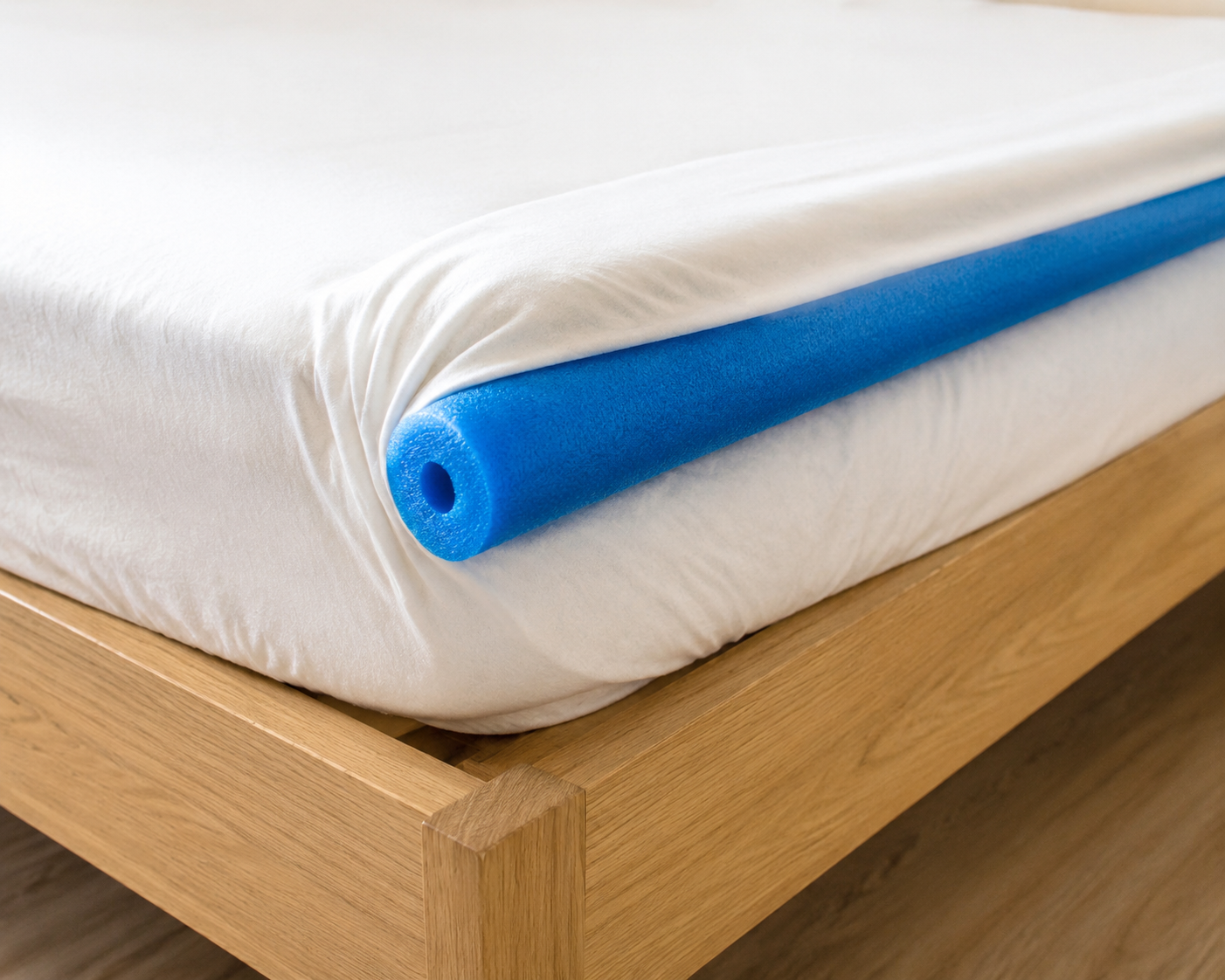
A simple pool noodle under the fitted sheet, placed lengthwise near the mattress edge, can create a small tactile cue: the body meets a bump before it reaches open air. Foam wedges, body bolsters, and bed bumpers are other non-rail options described in caregiver and senior-living guidance.[4][2] These are not magic. They are best for a person who rolls or drifts toward the edge, not for someone who is trying to get up repeatedly and will fight the barrier.
Use a soft roll barrier when the fall pattern is rolling, drifting, or losing position during sleep.
Avoid creating a barrier so high that the person has to climb over it to get out.
Keep the exit side clear if the person must get up independently or with a walker.
Recheck the barrier after the bed is made; loose bedding can move the whole setup.
If skin breakdown, pressure pain, or limited repositioning is an issue, ask a clinician before changing mattress shape or adding bolsters.
Make the Landing Safer Without Creating a New Trip Hazard
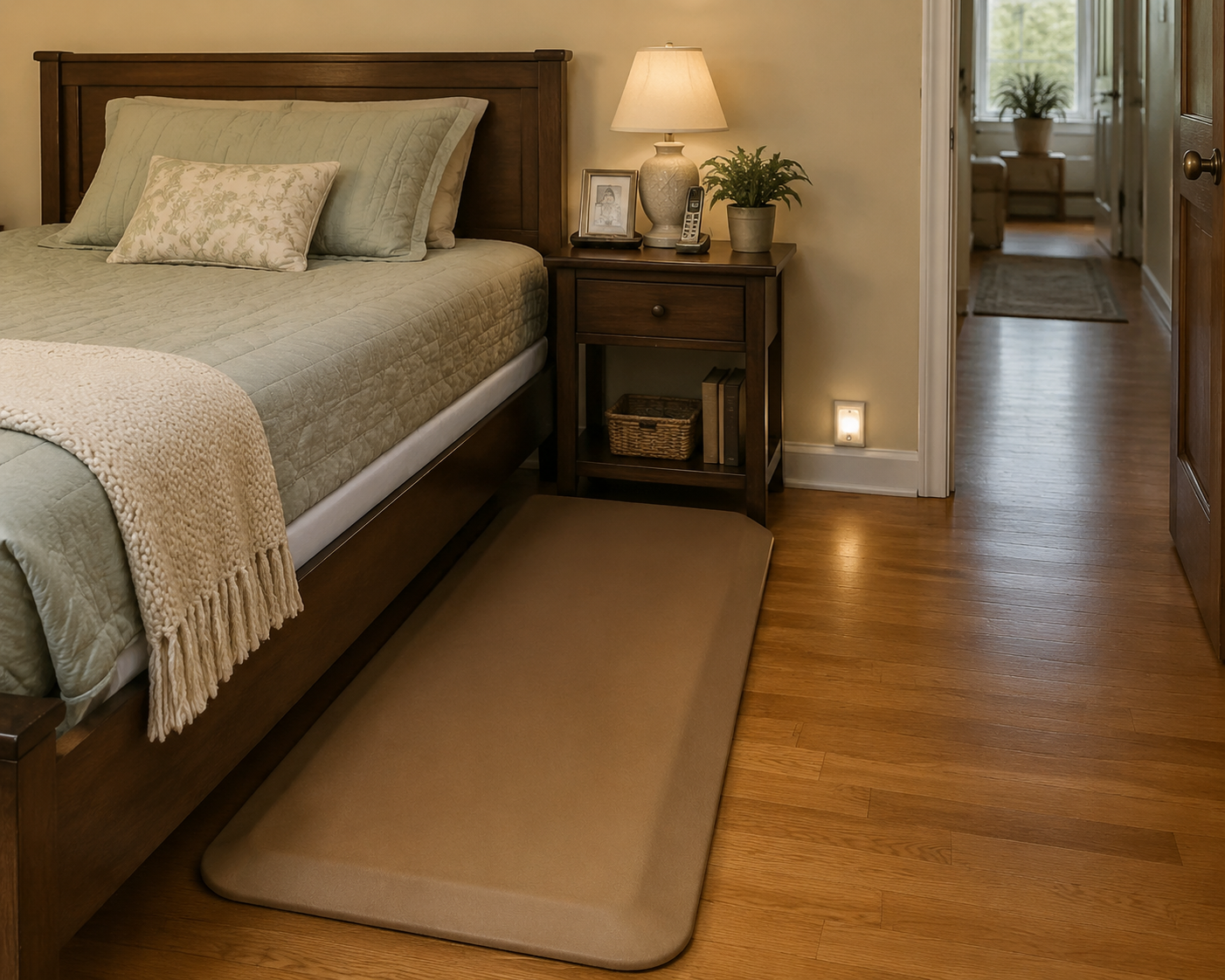
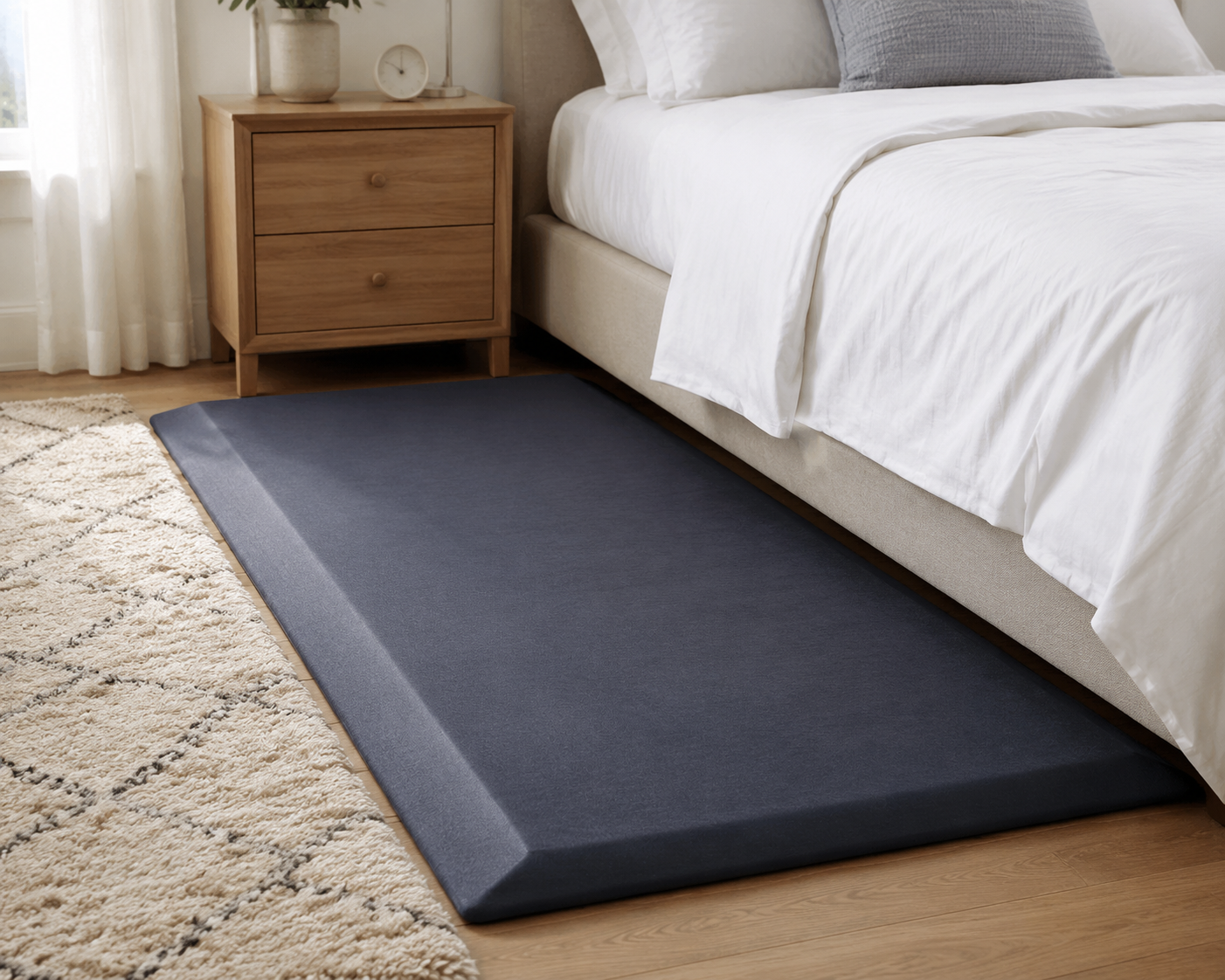
A fall mat is not an admission that the fall will happen. It is a recognition that prevention has layers, and one of them is injury reduction. The mat belongs where the body would actually land: beside the bed edge, not tucked halfway under furniture or placed where the walker wheels catch.
Look for a mat with enough cushioning to matter, a non-slip base, and beveled edges that reduce the chance of tripping. Commercial long-term-care guidance commonly describes bedside fall mats in the 1- to 4-inch thickness range, with beveled edges and slip-resistant backing.[5] The thicker mat is not always the better mat if the person must step across it in the dark.
One often-cited lab-testing figure, reported by Accora from Bowers et al. 2008, says the risk of severe head injury fell from about 40% for a fall from normal bed height over a rail onto unprotected flooring to about 1% from a low bed position onto a fall mat.[5] That is a striking difference, but it is cited through a commercial vendor source here, so it should be treated as a reason to verify the original study before building a policy or purchase decision around the exact numbers.
For tonight, the practical test is plain: walk the route in socks with the same low light the older adult will have. If your toe catches, if the walker bumps, or if the mat slides, fix that before bedtime. A mat that prevents a head strike but causes a standing fall is not doing the job you bought it for.
Follow the Night Route to the Bathroom, Phone, and Light
Many bed falls are really bathroom-trip falls that start at the mattress edge. The person wakes, feels urgency, sits up quickly, reaches for a lamp, stands before fully steady, and turns toward a dark doorway. If that pattern is happening, a roll barrier alone will not solve it. It may only delay the moment when the person tries to get out.
Nocturia deserves particular attention. In one study, waking three or more times per night to urinate was associated with a 28% increased risk of incident falls within three years.[6] That figure should not be stretched into a promise that treating nocturia will remove the risk, but it is enough to take repeated nighttime bathroom trips seriously during a bedroom audit.
A bedside commode can be one of the most useful changes when the bathroom is far away, the route has a turn, or urgency is driving unsafe speed. It also asks something of the older adult’s dignity. Place it where it is reachable and stable, but not in the middle of the room like a public announcement. Keep supplies discreet and easy to manage. If the person resists, the conversation may go better when the commode is framed as a night-only safety measure rather than a permanent loss of independence.
The National Institute on Aging recommends room-by-room fall prevention steps such as keeping floors clear, securing rugs, improving lighting, and placing items within easy reach.[7] In the bedroom, that means the path from bed to bathroom or commode should be boring: no laundry basket, no charging cord, no loose slippers, no decorative rug edge, no furniture corner that requires a sideways shuffle.
Put a soft automatic nightlight low enough to show the floor, not just the wall.
Place the walker or cane on the exit side of the bed, in the same position every night.
Keep the phone, call button, glasses, water, and tissues reachable without leaning.
Remove small rugs unless they are firmly secured and do not catch feet or walker tips.
Check the return trip from the bathroom too; fatigue and sleepiness are often worse on the way back.
When the Cause Is in the Body, the Bedroom Can Only Help So Much
If the fall happened after standing, ask about dizziness before you ask about another product. Orthostatic hypotension — a blood pressure drop after standing — can make a careful bedroom setup fail in seconds. The CDC’s STEADI materials advise older adults who feel dizzy when standing to sit or lie down and tell a healthcare provider, and clinicians commonly evaluate fall risk with medication review, gait and balance assessment, vision checks, and blood pressure considerations.[8]
The home version of that advice is to build in a pause. Sit up. Put both feet on the floor. Wait. Stand with support. Wait again. Then walk. This will not fix every cause of dizziness, but it gives the caregiver a clear observation to report: whether dizziness happens on sitting, on standing, after a few steps, or only on certain nights.
Medication changes deserve the same careful attention. Sedatives, some sleep medicines, blood pressure medicines, antidepressants, anticholinergic drugs, and combinations of medications can affect alertness, balance, blood pressure, or toileting urgency. Do not stop a prescribed medication on your own after a fall. Do write down what changed in the last few weeks and ask the prescribing clinician or pharmacist to review fall risk.
Recent hospitalization, infection, dehydration, pain, and new weakness can also turn a previously safe bed routine into a risky one. A parent who could stand smoothly before a hospital stay may now need a transfer pole, supervised toileting, physical therapy input, or a temporary commode. The bedroom should be reassessed after health changes, not only after furniture changes.
Dementia Changes the Meaning of Every Barrier
For a person with dementia, delirium, or nighttime confusion, the question is not only whether a device blocks a fall. It is whether the person understands it. A rail may look like something to climb over. A dark doorway may look like the wrong room. A commode may be ignored if it is not visible and familiar. A roll bumper may work because it gives a body cue without creating a challenge.
In this situation, keep the room simple and consistent. Use familiar bedding if possible. Avoid rearranging the whole room at once unless the current setup is clearly dangerous. Make the safe action easier than the unsafe one: the commode visible, the light automatic, the path short, the call device reachable, and the barrier low enough not to invite climbing.
A Quick Bedroom Audit for Tonight
If you are standing in the room after a fall and need a safe order of operations, use the same route the body uses: bed, edge, floor, path, then medical triggers.
Check bed height: feet flat, knees controlled, no dangling, no deep rocking to stand, no sliding on the mattress edge.
Check the mattress and bedding: no loose fitted sheet, slippery protector, sagging edge, or topper that makes the bed too high or unstable.
Match the roll barrier to the behavior: use a soft cue for rolling; be cautious with rails if there is dementia, confusion, climbing, restraint risk, or poor fit.
Protect the landing zone: place a non-slip, beveled fall mat where the body would land, then test whether feet or walker wheels catch.
Clear the route: remove cords, loose rugs, clutter, and furniture edges between the bed, bathroom, commode, phone, and light.
Add night visibility: use automatic low lighting that shows the floor without forcing the person to reach for a switch.
Shorten urgent trips: consider a bedside commode when nocturia, urgency, weakness, or a long bathroom route is part of the fall pattern.
Flag medical causes: report dizziness on standing, repeated nighttime urination, new medications, recent illness, new weakness, or nighttime confusion to the appropriate clinician.
A fall caused by rolling out of bed may need a mattress-edge cue. A fall caused by sliding during transfer may need a different bed height or firmer edge. A fall caused by rushing to the bathroom may need a commode and lighting more than a rail. A fall caused by dizziness, sedation, nocturia, or confusion needs the bedroom made safer, but it also needs the medical cause brought into the open.

Comments
Join the discussion with an anonymous comment.