
Caregiver decision guide
Adult Day Care vs In-Home Care vs Nursing Home: A Cost Comparison and Decision Guide for Family Caregivers
Compare the true costs of adult day care, in-home care, and nursing homes to find the right fit for your parent and your budget. This guide helps adult children under financial and time pressure make an informed decision after a parent's functional decline or dementia diagnosis.

The Hidden Middle Option: Why Adult Day Care Deserves a Closer Look
When a parent's health takes a turn — a fall, a dementia diagnosis, a noticeable decline in their ability to manage daily tasks — most adult children immediately think of two options: hire a home health aide or find a nursing home. These are the poles of the care conversation, and they dominate search results, family discussions, and financial planning. But there is a third path that sits squarely between them, and it is one that far too few families consider during the critical window when it could make the biggest difference.
Adult day care — more formally called adult day services by the National Adult Day Services Association — provides supervised, structured daytime care in a community setting. Participants receive health monitoring, assistance with activities of daily living, medication management, meals, and social engagement, then return home each evening. It is not a short-term stopgap after a hospital stay, and it is not a place for people who need 24/7 skilled nursing. It is a sustained, cost-effective care model that can keep a senior at home for years longer than going it alone.
The financial case is striking. According to the 2025 CareScout Cost of Care Survey, the national median daily rate for adult day health care is $95 per day. That is roughly half the cost of having a home health aide for an eight-hour day and about one-third the cost of a semi-private nursing home room. Yet the option remains invisible to many families who are making care decisions under intense emotional and financial pressure.
This guide is written for the adult children — typically in their 40s and 50s — who are suddenly thrust into the role of care coordinator after a parent's functional decline. It compares adult day care, in-home care, and nursing homes across cost, care needs, and caregiver impact, so you can make a decision that fits both your parent's needs and your family's budget.
Three Options, Three Price Tags: A Side-by-Side Cost Comparison
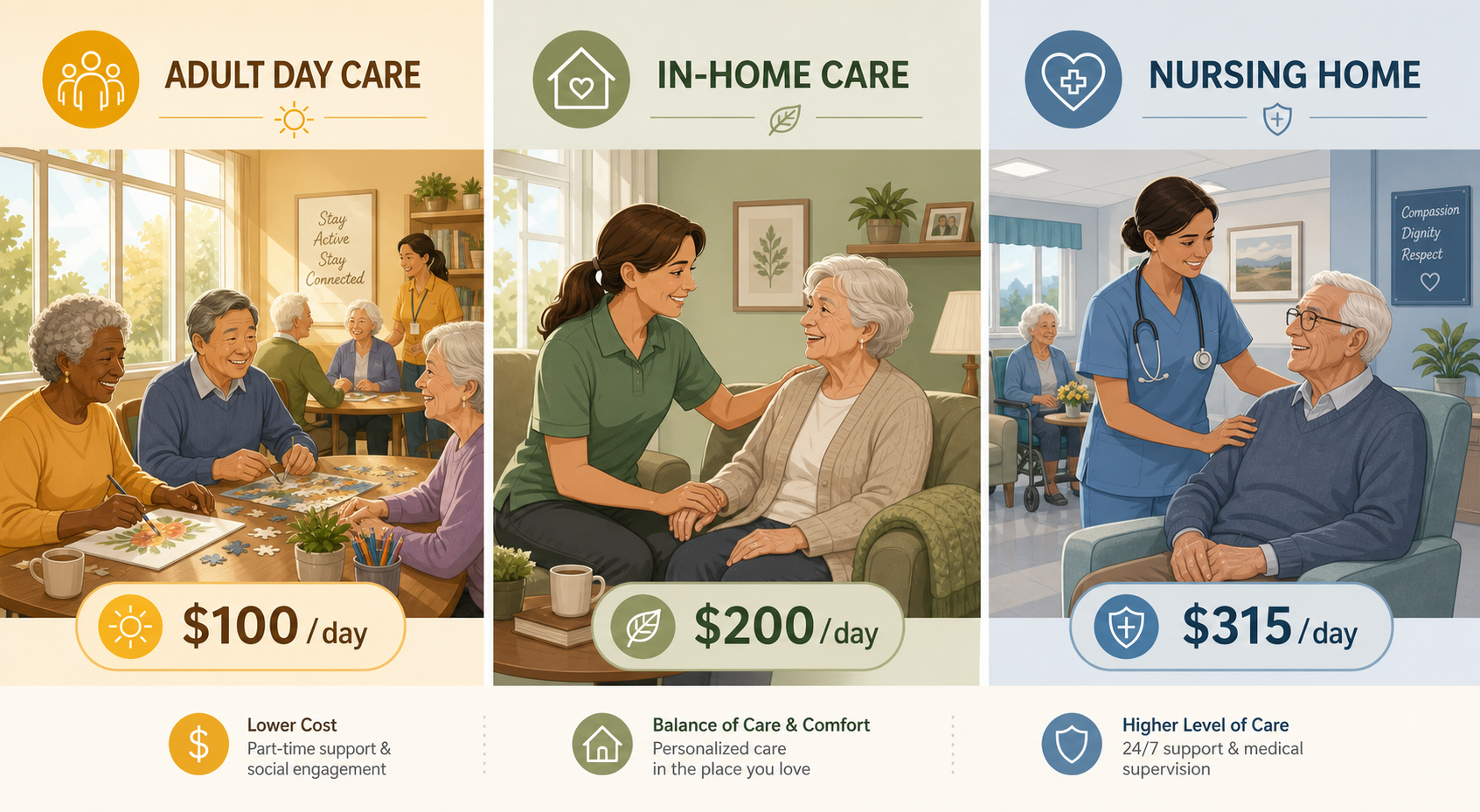
Cost is often the first question families ask, and for good reason. Long-term care is expensive, and most families are paying out of pocket. The table below uses the most current national median data available — the CareScout 2025 Cost of Care Survey (data collected July–November 2025) and Genworth data cited by SeniorLiving.org — to give you a clear picture of what each option costs per day, per month, and per year.
| Care Option | Daily Rate (National Median) | Monthly Estimate (22 Days) | Annual Estimate |
|---|---|---|---|
| Adult Day Health Care | $95/day (CareScout 2025) | $2,090 | $25,080 |
| In-Home Non-Medical Caregiver (8 hrs/day) | $280/day ($35/hr × 8 hrs) | $6,160 | $80,080 |
| Nursing Home (Semi-Private Room) | $315/day (CareScout 2025) | $9,450 | $114,975 |
| Nursing Home (Private Room) | $355/day (CareScout 2025) | $10,650 | $129,575 |
A few important notes on these numbers. The in-home care figure assumes eight hours of care per day, which is a common schedule for a family caregiver who works during the day. If your parent needs more or fewer hours, that cost will shift proportionally. The nursing home figures are for a full month of residency, including room, board, and 24-hour supervision. Adult day care typically operates 7 to 10 hours per day, and you only pay for the days your parent attends.
The annual savings of choosing adult day care over in-home care can exceed $55,000, and the savings over nursing home placement can approach $90,000 per year. Over several years, that difference can mean the difference between depleting a retirement fund and preserving financial security for the surviving spouse.
Who Each Option Serves Best: A Decision Matrix by Care Needs and Caregiver Situation
Cost is only one dimension of the decision. The right choice depends on your parent's specific care needs, their cognitive status, and your own situation as a caregiver. The matrix below maps each option to the scenarios where it works best.
| Factor | Adult Day Care | In-Home Care | Nursing Home |
|---|---|---|---|
| Daily supervision need | Moderate — needs monitoring during the day but is safe overnight | Flexible — can range from a few hours to 24/7 | High — requires 24/7 supervision and care |
| Dementia stage | Early to middle stage; specialized memory care programming available at many centers | Early to advanced; requires consistent caregiver training | Middle to advanced; secure memory care units available |
| Medical needs | Health monitoring, medication assistance, therapy (varies by center) | Skilled nursing available via home health agencies | Skilled nursing available 24/7 on-site |
| Social engagement | High — structured group activities, peer interaction | Low to moderate — depends on caregiver interaction | Moderate — facility activities, but variable |
| Mobility | Must be able to transfer with assistance; centers may have limits | Adaptable to any mobility level with proper equipment | Adaptable to any mobility level |
| Caregiver works full-time | Good fit — covers the workday | Good fit — can schedule around work hours | Not a primary factor — facility provides full-time care |
| Long-distance caregiver | Challenging — requires local transportation and coordination | Challenging — requires trusted local agency | Easier — facility manages all care coordination |
| Budget constraint | Best value — lowest cost of the three options | Moderate to high cost depending on hours | Highest cost — most expensive option |
Adult day care is the strongest fit for seniors who need daytime supervision and health monitoring but do not require overnight care or 24/7 skilled nursing. This describes a large portion of the aging population: people who are still living at home, often with a spouse or alone, but who are no longer safe or comfortable spending the entire day without support.
Nearly half of all adult day care participants have some level of dementia, according to the Alzheimer's Association. Many centers now offer specialized memory care programming — including music therapy, pet therapy, cognitive stimulation, and reminiscence activities — that is specifically designed for people with Alzheimer's and related dementias. A 2023 study in Aging & Mental Health found that regular adult day services helped individuals with dementia get to bed earlier and prevented sleep disturbances, which are a common source of caregiver stress.
How Adult Day Care Supports Aging in Place
Aging in place is the goal for the vast majority of older adults, but it requires a support system. Adult day care functions as a critical bridge in that system — providing daytime structure, health monitoring, and social engagement while the family caregiver works, rests, or manages their own household.
Without this bridge, many seniors face one of two undesirable outcomes: staying home alone during the day, which carries risks of isolation, falls, and unmet medical needs; or moving to a residential facility before they truly need that level of care. Adult day care offers a third path that preserves the senior's independence and familiar home environment while adding a layer of professional support during the hours when it is most needed.
The services provided at adult day centers go well beyond simple supervision. According to the Alzheimer's Association and the CDC, centers may offer:
- Health monitoring (blood pressure checks, glucose monitoring)
- Medication assistance
- Personal care (bathing, toileting, grooming assistance)
- Physical, occupational, and speech therapy (varies by center)
- Social and recreational activities (art, music, exercise, cognitive stimulation)
- Meals and nutritional support
- Behavior management for dementia-related symptoms
The evidence that adult day care can delay nursing home placement is compelling. A case study published in Missouri Medicine (PMC) documented an 84-year-old woman with dementia who attended the University of Missouri's Adult Day Connection for 14 years before eventually needing nursing home care. Over that period, the cost difference between adult day care ($70.20/day) and a semi-private nursing home bed ($139/day) saved Missouri taxpayers nearly $500,000. While this is an extreme example — most people will not use adult day care for 14 years — it illustrates the magnitude of potential savings when institutionalization is delayed by even one or two years.
The Caregiver Respite Case: Why Your Own Wellbeing Matters in This Decision
Family caregivers often make the mistake of evaluating care options based only on the senior's needs, while ignoring their own. This is a dangerous omission. Research published in Missouri Medicine found that elderly spousal caregivers aged 66 to 96 have a 63% higher mortality rate than non-caregivers of the same age. Caregiving is not just stressful — it is physically dangerous for the caregiver.
Adult day care provides built-in respite. The DaSH study (Zarit et al., 2014), cited in the Frontiers in Public Health article on adult day services, demonstrated that caregivers experienced reduced stress and improved affect on days when their care recipient attended adult day care. This is not a marginal benefit — it is a measurable improvement in the caregiver's daily quality of life.
For adult children who are balancing caregiving with full-time work and their own families, adult day care can be the difference between staying employed and having to leave the workforce. The cost comparison above shows that adult day care is the most affordable option, but the value goes beyond dollars: it buys you time to work, rest, and care for your own health.
If you are already feeling the strain of caregiving, explore our Respite Care Options for Family Caregivers guide for additional respite models beyond adult day care.
How to Pay for Adult Day Care: Medicaid, VA Benefits, and Other Funding Sources
One of the most common misconceptions about adult day care is that it is not covered by insurance or government programs. The reality is more nuanced — and more encouraging.
Original Medicare (Part A and Part B) does not cover adult day care as a routine service. The only exception is if the participant is enrolled in hospice, in which case Medicare may cover up to five days of adult day care for respite purposes. However, some Medicare Advantage (Part C) plans may offer limited coverage for adult day services as a supplemental benefit. You need to check your specific plan.
The two most significant funding sources are:
- Medicaid Home and Community-Based Services (HCBS) Waivers: These waivers allow states to use Medicaid funds to pay for home- and community-based services — including adult day care — for people who would otherwise need nursing home care. Coverage is state-dependent and eligibility is based on income and assets. Not every state offers the same level of coverage.
- VA Aid & Attendance Benefits: Eligible veterans and their surviving spouses may receive a monthly pension supplement to help pay for adult day health care. This is a separate benefit from VA medical care and requires an application.
Beyond these major programs, there are additional ways to reduce the cost:
- Sliding-scale fees: Many adult day centers offer reduced rates based on income.
- Tax deductions: Adult day care costs are nearly always tax-deductible as a medical expense (subject to the 7.5% AGI floor).
- Dependent care credit: For the 2024 tax year, you can claim up to $3,000 for one qualifying person or $6,000 for two or more qualifying persons.
- Long-term care insurance: Some policies cover adult day care. Check your parent's policy.
For a comprehensive overview of all federal, state, and local benefits that may be available to your family, see our Elder Care Assistance Programs guide.
How to Evaluate Which Option Fits Your Specific Situation
Choosing between adult day care, in-home care, and a nursing home is not a one-time decision — it is a process of matching your parent's needs and your family's resources to the available options. Here is a practical evaluation framework.
Step 1: Assess Your Parent's Needs
- How many hours per day do they need supervision? If they are safe alone overnight, adult day care may be sufficient.
- What medical tasks are required? Medication management and health monitoring are available at many adult day centers; skilled nursing is not.
- What is their cognitive status? People with early to middle-stage dementia often thrive in adult day care settings with specialized programming.
- Do they need social engagement? If isolation is a concern, adult day care provides structured social interaction that in-home care cannot match.
Step 2: Assess Your Own Situation
- Do you work full-time? Adult day care typically covers a 7-to-10-hour day, which aligns with a standard work schedule.
- What is your stress level? If you are experiencing burnout, adult day care provides built-in respite that in-home care may not.
- What is your budget? Use the cost comparison table above to estimate annual costs for each option in your state.
- Do you live nearby? Adult day care requires transportation to and from the center, which may be a challenge for long-distance caregivers.
Step 3: Visit and Interview
When touring an adult day center, ask these questions:
- What is the staff-to-participant ratio? (Lower ratios mean more individual attention.)
- Do you offer specialized dementia programming? (Nearly half of participants have dementia, so this is a critical question.)
- What are your hours of operation? Do you offer weekend or evening hours?
- Do you provide transportation? (Many centers offer van service.)
- What meals and snacks are provided? Can you accommodate dietary restrictions?
- What is your policy for handling medical emergencies or behavioral issues?
- Do you offer a trial period? (The Alzheimer's Association recommends using services at least twice a week for a month before deciding.)
For a deeper dive into in-home care costs and services, see our Complete Guide to In-Home Care Options for Seniors and the In-Home Senior Care Cost in 2026 guide for detailed cost breakdowns.

Next Steps: Your Action Checklist
You now have the framework to make an informed decision. Here is your action checklist:
- Get your state's cost data for adult day care, in-home care, and nursing homes. Use the CareScout Cost of Care tool or SeniorLiving.org's state-by-state tables.
- Check Medicaid HCBS waiver eligibility in your state. Contact your local Area Agency on Aging for guidance.
- If the care recipient is a veteran or surviving spouse, apply for VA Aid & Attendance benefits.
- Tour at least three adult day centers in your area. Use the questions above as your evaluation checklist.
- Get quotes from at least two home care agencies for comparison.
- Discuss your findings with your parent's primary care doctor or geriatrician.
- Try adult day care for at least two weeks before making a final decision. The Alzheimer's Association recommends using services at least twice a week for a month.
For additional context on how adult day care fits into the broader landscape of care options, see our guides on Short-Term Care for Elderly and the Hidden Costs of Aging in Place to ensure you have a complete picture of what aging at home really costs.
Questions to bring to a clinician or OT
This is not medical, legal, or a family's final decision — only a framework. Bring these questions to a clinician, occupational therapist, or your local Area Agency on Aging.
Find Local HelpRelated reading
Noticed something outdated or inaccurate on this page? Flag a correction. We review every report against CDC, NIA, and AARP HomeFit guidance before updating a page.