
Caregiver decision guide
24-Hour Care at Home for the Elderly: Can Technology Reduce the Cost and Human Hours?
For adult children facing the $24,733/month cost of 24/7 shift care, this guide explores a hybrid model that combines partial in-person care with passive sensor monitoring. Backed by clinical evidence, it shows how technology can close the overnight safety gap at 30-60% of the cost of full human care.
The $24,733 Problem: Why Full Shift Care Is Out of Reach for Most Families
When a parent's overnight safety becomes a daily concern — after a fall, a wandering episode, or a diagnosis of dementia — the first question most adult children ask is, "Can we just have someone here all the time?" The answer, for the vast majority of families, is no — not because it isn't needed, but because the numbers simply do not work.
According to A Place for Mom's 2026 Cost of Long-Term Care and Senior Living Report, the national median cost of nonmedical home care is $34 per hour. For 24/7 shift care — which requires two to three caregivers rotating to cover all hours — that works out to approximately $816 per day, $5,712 per week, and $24,733 per month. That figure is not an outlier; it reflects the labor reality of round-the-clock staffing in a sector where wages have risen as much as 50% over the past five years.
For context, the median monthly cost of assisted living is $5,419. A live-in caregiver — who stays overnight but is legally entitled to eight hours of uninterrupted sleep — typically costs between $5,500 and $9,000 per month. But even the live-in model has a critical limitation: the caregiver is sleeping, not monitoring. If your parent needs supervision during the night — to prevent a fall, redirect wandering, or respond to sundowning — a sleeping caregiver cannot provide it.
This creates what families call the "overnight gap": the hours between 10 PM and 6 AM when the risk of falls, wandering, and unattended home exits is highest, but the cost of full human coverage is prohibitive. The question is not whether 24/7 human care would be ideal — it is whether a different model can close that gap safely and affordably.
If you are still determining whether 24-hour care is the right path at all, our decision framework for 24-hour home care can help you evaluate the options. For families who already know they need around-the-clock safety but cannot afford full shift care, the evidence points toward a different solution.
What the Evidence Says About Technology Monitoring at Home
The idea that sensors and software can substitute for some human care hours is not speculative. A growing body of clinical research — including randomized controlled trials and systematic reviews — supports the effectiveness of remote monitoring technology in reducing hospitalizations, detecting falls, and improving caregiver wellbeing.
A 2024 systematic review published in npj Digital Medicine (Tan et al., analyzing 29 RCTs from 16 countries) examined remote patient monitoring (RPM) interventions during the transition from hospital to home. The review found that digital sensor alerting systems produced a 9.6% mean decrease in hospitalizations and a 3% mean decrease in all-cause mortality (Iqbal et al. meta-analysis, cited within). Patients who were remotely monitored also had lower 30-day readmission risks and significantly shorter lengths of stay when hospitalized.
For dementia-specific overnight risks, a 12-week pilot study by Ault et al. (2020, n=5 dyads) tested the Night-time Wandering Detection and Diversion (NWDD) system — a smart home setup using off-the-shelf components like pressure mats, motion sensors, smart bulbs, and speakers. The results were striking: caregiver depression scores dropped from 5.2 to 3.6 (a 31% decrease), and anxiety scores fell from 6.8 to 5.8 over the 12-week period. Caregivers averaged 6.1 hours of sleep per night at baseline — a figure that improved as the system reduced the need for constant vigilance.
Fall detection technology has also matured significantly. A 2022 scoping review in PMC (Kim et al., covering 30 studies) documented multiple detection modalities with high accuracy rates:
- WiFi-based fall detection (DeFall system) achieved 95% detection rate using existing home WiFi infrastructure (Hu et al., IEEE 2020)
- Radar-based fall detection using millimeter-wave radar reached 98.74% accuracy with an average prediction time of 51.4 milliseconds (Wang et al., 2020)
- Bed-exit monitoring using infrared and pressure sensors detected transitions (lying, sitting, standing, exiting) with nearly 90% accuracy (Lu et al., 2016)
- Sensor data analyzing daily activity patterns detected depression with up to 96% accuracy (Kim et al., 2017)
These figures come from controlled lab and pilot settings. Real-world performance depends on home layout, WiFi quality, and user adherence. But the trajectory is clear: sensor technology has moved from experimental to operationally viable for many overnight safety scenarios.
The Sensor Ecosystem: What Each Technology Does and How It Works
The PMC scoping review identified 16 distinct types of sensor technologies used for in-home monitoring. The most common were passive infrared (PIR) motion sensors (present in 21 of 30 studies) and contact sensors (present in 19 studies). Understanding what each sensor type does — and what it does not do — is essential for designing a system that matches your parent's specific overnight risks.
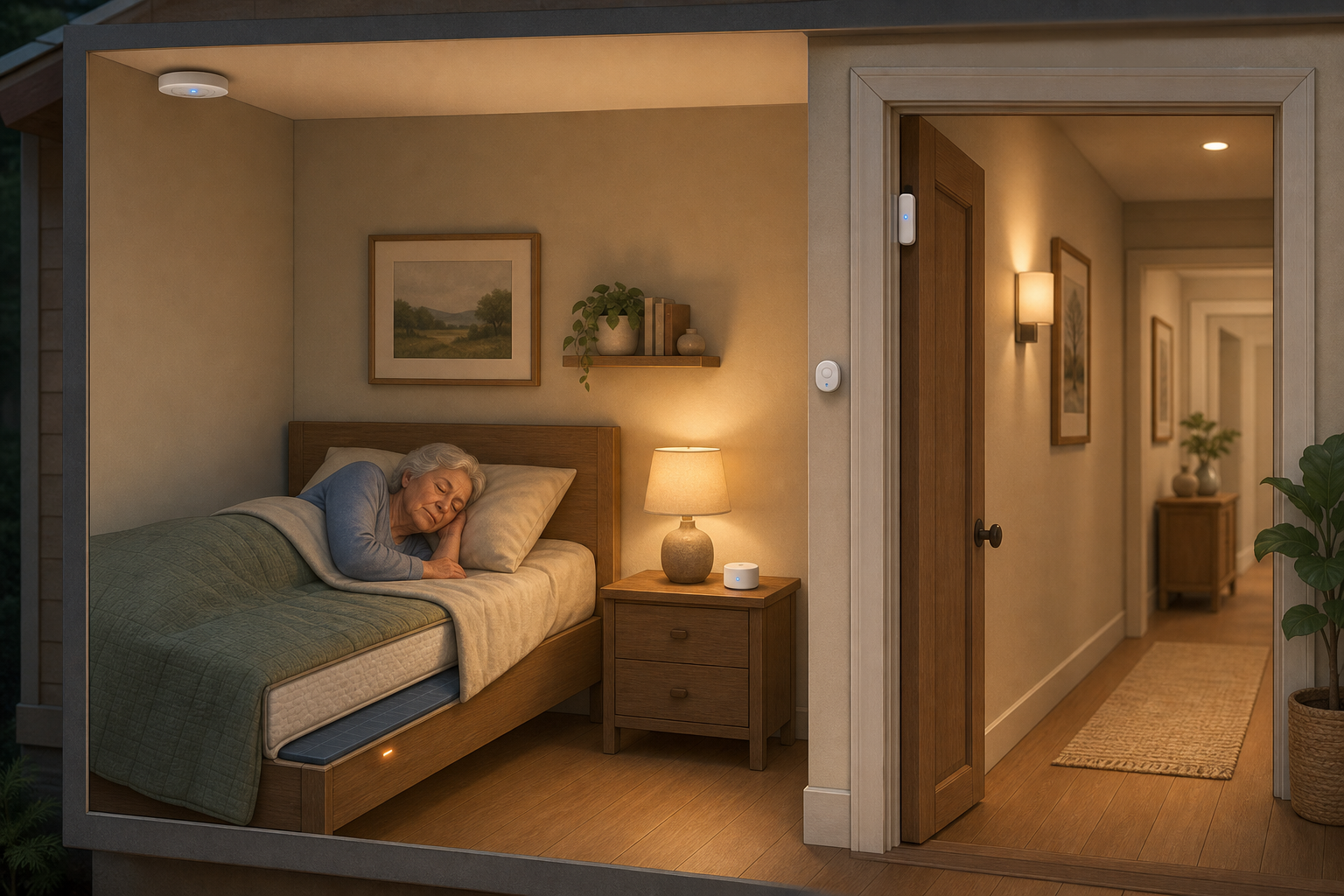
| Sensor Type | What It Detects | How It Alerts | Typical Cost Range |
|---|---|---|---|
| Passive infrared (PIR) motion sensor | Movement in a room or hallway | Sends alert when motion is detected during a set window (e.g., 2 AM) | $20–$60 per sensor |
| Pressure mat | Bed exit, chair exit, or presence on a surface | Triggers alert when weight is removed or applied | $30–$80 per mat |
| Door contact sensor | Door opened or closed (bedroom, exterior, closet) | Alerts when a door is opened during restricted hours | $15–$40 per sensor |
| Radar fall detector (mmWave) | Sudden fall, change in vertical position | Real-time alert with location data; 98.74% accuracy in lab settings | $100–$300 per unit |
| WiFi-based fall detection | Fall detected via disruption in ambient WiFi signals | No hardware needed; uses existing router; 95% detection rate | Software subscription typically $10–$30/month |
| Audio sensor / microphone | Sounds of distress, calling out, or unusual noise patterns | Sends alert when specific audio signatures are detected | $30–$100 per sensor |
| Smart bulb / lighting | Night-time movement triggers automated lighting | Lights turn on to reduce fall risk and disorient wandering | $15–$40 per bulb |
Questions to bring to a clinician or OT
This is not medical, legal, or a family's final decision — only a framework. Bring these questions to a clinician, occupational therapist, or your local Area Agency on Aging.
Find Local HelpRelated reading
- Helping Your Aging Parent with Technology: A Caregiver Wellbeing Strategy, Not Just a Chore
- The Hidden Health Toll of Caring for an Aging Parent: What the Data Reveals and How to Protect Your Own Health
- The Hidden Financial Toll of Caring for Aging Parents: What Adult Children Lose and How to Protect Themselves
Noticed something outdated or inaccurate on this page? Flag a correction. We review every report against CDC, NIA, and AARP HomeFit guidance before updating a page.