Stair Lift Alternatives Compared: Costs, Pros, and Cons for Every Situation
Reviewed: 2026-07-05
Stair Lift Alternatives Compared: Costs, Pros, and Cons for Every Situation
This article compares all viable alternatives to a stair lift — from dual handrails and stair climbing aids to wheelchair lifts and home elevators — with real cost ranges and guidance on which solution fits different mobility needs and home layouts.
By Editorial Team
new caregiver
experienced caregiver
long-distance caregiving
spousal caregiver
working caregiver
daily routines
medication management
personal hygiene
care coordination
first steps
ADLs
IADLs
A stair lift quote can make a family pause fast: straight stair lifts commonly run $2,500–$5,000, curved stair lifts $8,000–$12,000 or more, and outdoor stair lifts $4,000–$8,000.[1] Those numbers matter, but the bigger issue is fit. A stair lift helps a seated person ride along the stairs. It does not solve every stair problem, especially when the person uses a wheelchair, cannot transfer safely, has a very tight landing, or may soon need a different level of support.
If you are still deciding whether a stair lift belongs in the first round of options, the broader Stair Lift vs. Alternatives decision guide is a useful starting point. This piece goes deeper on stair lift cost and alternatives, especially the middle category many families miss: stair climbing aids that cost less than many lifts but still require the user to walk.
Cost and Fit Comparison
Option
Typical Cost
Best Fit
Main Limitation
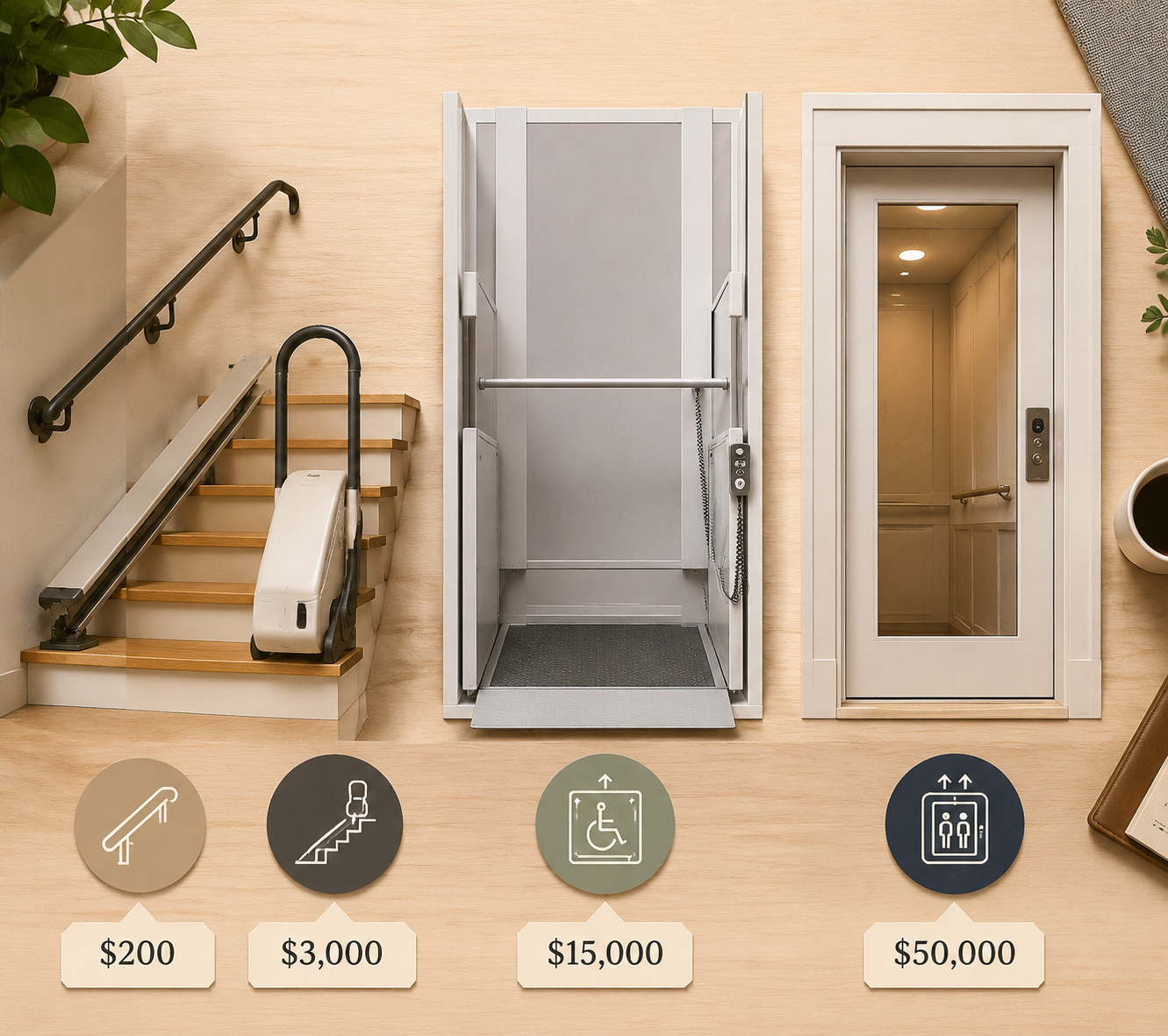
Dual handrails
Under $200 installed
Mild instability; person can still climb stairs independently
Does not reduce exertion much and does not help if legs are unreliable
Stair climbing aid
$1,000–$4,000 estimated; US pricing is less consistent
Ambulatory user who needs controlled upper-body support
User must still be able to walk stairs
Straight stair lift
$2,500–$5,000[1]
Seated rider on a simple straight staircase
Requires transfers and does not carry a wheelchair user in the chair
Curved stair lift
$8,000–$12,000+[1]
Seated rider on stairs with turns, landings, or curves
Custom rail raises cost and may not suit changing mobility
Outdoor stair lift
$4,000–$8,000[1]
Porch or exterior stair access for a seated rider
Weather exposure and transfer needs still matter
Portable stair climber
$2,000–$5,000
Occasional stair access when a trained second person is available
Caregiver-operated; not a simple independent solution
Vertical platform lift
$3,600–$15,900 residential; some provider estimates run $12,000–$35,000
Wheelchair or scooter user who should avoid transfers
Needs more floor space than a stair lift
Ground-floor living conversion
$10,000–$50,000+
Stairs are becoming the wrong problem to solve
Cost depends heavily on bathroom, bedroom, and layout changes
Home elevator
$10,000–$100,000+[3]
Long-term aging in place with budget and construction tolerance
Major structural work; not a quick fix
The table is not a cheapest-to-best ranking. It is a mismatch detector. A $150 handrail is a bargain only if mild balance support is the actual problem. A $9,000 curved stair lift is still the wrong purchase if the rider cannot transfer safely into the seat. A home elevator can be sensible in a long-term plan, but it is rarely the fastest way to make next week safer.
When Two Handrails Are Enough
Dual handrails belong at the low end of the intervention scale. They help when the person is still walking stairs but feels steadier with support on both sides. For someone who pauses on each step, carries laundry one-handed, or reaches across the body for the only rail, a second rail can remove a small but real hazard.
This is not a mobility device in disguise. It does not carry weight the way a lift does, and it does not solve knee weakness, severe fatigue, dizziness, or unreliable foot placement. It is worth considering first when the problem is mild instability, not when the stairs already require a family member standing behind the person every time.
The Overlooked Middle Option: Stair Climbing Aids
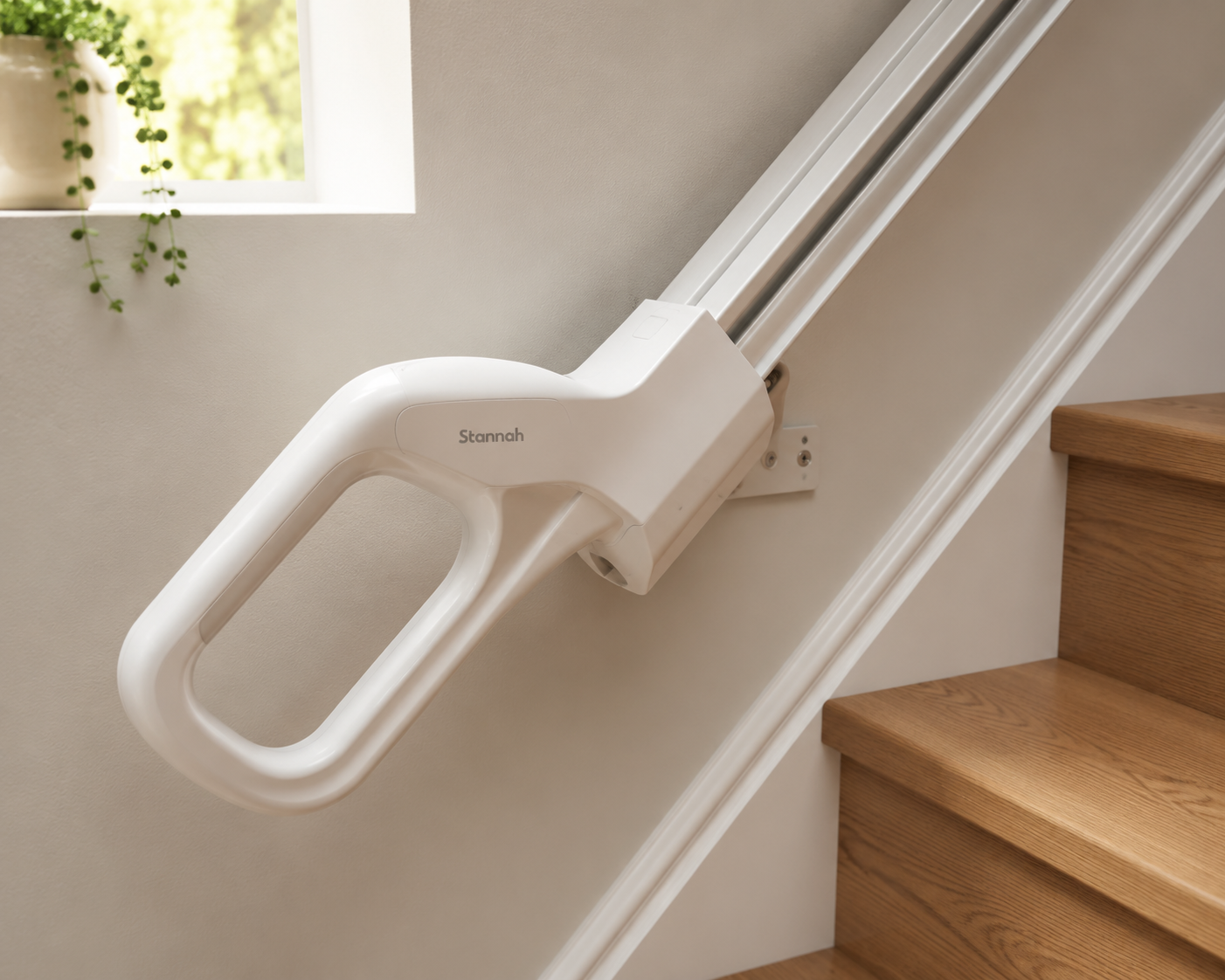
Stair climbing aids sit between a simple handrail and a motorized lift. Products in this category, including AssiStep-style systems, use a rail-mounted handle that slides along the stairs and locks when the user puts weight on it.[2] The person still climbs the stairs step by step, but the handle gives a more controlled support point than a standard rail.
The practical appeal is easy to understand. There is no motor, no battery charging routine, and no electrical work. The rail can be modular, and installation is usually a smaller project than a custom curved stair lift. For a family staring at a curved stair lift quote, an estimated $1,000–$4,000 stair climbing aid can look like the first option that is both serious and not financially shocking.
The price range deserves a real caveat. Much of the visible pricing for TOPRO Step, AssiStep, and StairSteady-style products comes from European markets, and US-specific pricing is not as consistently published. Treat $1,000–$4,000 as a planning estimate, then confirm current availability, installation requirements, and dealer pricing before comparing it to a stair lift quote.
The other caution is physical. A stair climbing aid is for someone who can still walk the stairs. They need enough leg function to step and enough upper-body control to use the handle safely. If the person freezes on stairs, cannot reliably lift a foot, faints, or needs another person to bear their weight, this category is too optimistic.
Good fit: ambulatory user with balance concerns who wants more secure support than a rail.
Possible fit: someone avoiding a curved stair lift because of cost, as long as walking stairs remains realistic.
Poor fit: wheelchair user, person unable to climb steps, or person whose condition is changing quickly.
Key quote question: Is installation available in your area, and what happens if the stairs later need a lift instead?
When a Stair Lift Still Makes Sense
A stair lift can be the right answer when the person can transfer safely onto the seat, sit upright during the ride, and get off safely at the top and bottom. It is especially straightforward on a straight staircase, where the rail is less expensive than a custom curved system.[1]
The transfer is the part that deserves more attention than it usually gets. If the person uses a wheelchair on one floor and needs another wheelchair or walker waiting on the other floor, the stair lift has not removed the transfer problem. It has created a transfer routine at both ends. That can work for some households. For others, it becomes the daily weak point.
Curved stairs make the decision harder because the cost jumps. A custom curved rail may be completely reasonable for a person who can use it safely for years. It is harder to justify when the family already suspects the person may soon need wheelchair-level access or main-floor living.
Wheelchair Users Usually Need a Different Answer
For a wheelchair or scooter user, the cleanest stair solution is often not a stair lift. It is a vertical platform lift or a layout change that avoids repeated transfers. Residential vertical platform lift estimates in the research commonly fall from $3,600–$15,900, while some provider ranges run $12,000–$35,000 depending on configuration and installation.
A vertical platform lift takes more space than a stair lift, but that space buys something important: the person can remain in the wheelchair. That matters when transfers are painful, risky, slow, or dependent on a spouse who is not getting younger either.
The layout question comes next. A platform lift may work well for a porch, garage entry, or split-level transition. It may be much harder to place inside a narrow older home without taking over circulation space. The quote should include not only equipment, but landing space, door clearances, electrical needs, permits, and whether the user can approach and exit the lift independently.
Portable Stair Climbers Are Not a Shortcut for Every Home
Portable stair climbers can look attractive because they avoid permanent construction and typically cost less than many built-in systems, with planning estimates around $2,000–$5,000. Some models are designed for loads up to about 330 pounds. The catch is not hidden in the equipment; it is standing right there in the hallway. A second trained person has to operate it.
That makes portable stair climbers better for occasional use than for a frail spouse managing a daily routine alone. If the adult child who was trained on the device lives 40 minutes away, it may not matter that the device technically works. The operating plan has to match real people’s schedules, strength, confidence, and willingness to use it every time.
Ground-Floor Conversion Changes the Problem
Sometimes the safest stair alternative is not another stair device. It is moving daily life downstairs. A ground-floor living conversion can range from roughly $10,000–$50,000 or more, but that range covers very different projects: turning a den into a bedroom, widening access paths, adding a bathroom, changing plumbing, or rearranging the home so the upstairs becomes optional.
This option deserves respect because it removes the repeated risk point. It also deserves caution because the price can grow quickly once a full bathroom is involved. Before spending thousands on stair equipment, families should ask whether the person needs access to the second floor or whether everyone is emotionally attached to a layout that no longer fits.
For broader budgeting beyond the staircase, a room-by-room home modification cost guide can help families compare stair access with bathroom safety, entrance access, lighting, flooring, and other changes that may reduce fall risk more directly.
Home Elevators Belong in Long-Term Plans, Not Panic Decisions
Home elevators are the largest alternative in both cost and construction. Published comparisons place home elevators around $10,000–$100,000 or more, depending on type and site conditions.[3] They can require weeks of construction and meaningful structural work, which makes them a poor match for a family that needs stair access solved immediately.
The argument for an elevator is different from the argument for a stair lift. A stair lift is generally cheaper and less disruptive, but it is usually treated as accessibility equipment rather than a resale upgrade. Elevator comparisons often note a potential home value increase of about 10% and a 60%–100% return on investment, though that depends on the home and market.[3] Dealer-side comparisons also emphasize the tradeoff: stair lifts avoid major construction, while elevators are more integrated into the home and can serve more users over time.[4]
That does not make an elevator the premium answer for every family. It makes it a planning answer. It fits best when the homeowner expects to stay for years, has the budget, can tolerate construction, and wants access that may still make sense if mobility declines further.
Match the Alternative to the Situation
The cleanest decision starts with the person’s actual movement on the stairs, not the product catalog. Watch one ordinary trip up and down, preferably when the person is not performing for company. Notice whether the problem is balance, pain, endurance, fear, transfers, wheelchair access, or the caregiver’s ability to help safely.
Situation
Usually Start With
Move Past It When
Mild instability but still independent
Second handrail, better lighting, clutter removal
The person pulls heavily, pauses from fear, or needs supervision
Can walk stairs but needs strong upper-body support
Stair climbing aid
The person cannot step reliably or lacks grip and trunk control
Can sit and transfer safely but cannot climb stairs
Straight or curved stair lift
Transfers are unsafe or wheelchair access is needed on both floors
Wheelchair or scooter user
Vertical platform lift or ground-floor conversion
The home lacks space or the second floor is no longer necessary
Occasional access with trained help available
Portable stair climber
The operator is unavailable, untrained, or physically unable
Mobility is declining quickly
Occupational therapist or qualified home modification assessment
Before committing to any custom rail, lift, or construction project
Long-term aging-in-place plan with budget
Ground-floor conversion or home elevator
Construction cost or disruption outweighs the benefit
One household may pass through more than one of these rows. A parent with early balance issues might do well with dual rails now and a stair climbing aid later. A wheelchair user may skip both and compare a platform lift with a downstairs bedroom plan. A person whose mobility has changed twice in six months should not be locked into a custom solution without a professional assessment.
Funding and Coverage Questions
Medicare is often the disappointment in this conversation. NCOA’s Medicare coverage guidance explains that stair lifts are generally considered home modifications rather than durable medical equipment, so Original Medicare typically does not cover them.[5] That does not mean no help exists, but it does mean families should check funding before signing a custom order.
Possible help may come from Medicaid waiver programs, veterans benefits, state or local home modification programs, nonprofit grants, tax-related options, or financing through providers. The rules vary enough that it is better to check the specific program than assume the sales quote is the final answer. A dedicated guide to funding sources for home modifications is the better place to compare those routes in detail.
Questions to Ask Before You Sign
Can the person use this solution independently, or does it require a caregiver every time?
If transfers are involved, who assists, and what happens on a bad pain or fatigue day?
Will this still work if the person moves from a cane to a walker or wheelchair?
Does the quote include installation, permits, electrical work, landing changes, removal, and service?
Is the staircase itself wide enough, and what space is lost at the top and bottom?
Would moving daily life downstairs reduce more risk than modifying the stairs?
The practical rule is simple enough to use at the kitchen table. If the person can still walk stairs with support, compare dual handrails and stair climbing aids before moving straight to a lift. If they use a wheelchair or transfers are unsafe, look at vertical platform lifts or layout changes. If the plan is long-term aging in place and the budget supports it, compare ground-floor conversion with a home elevator. If mobility is changing quickly, get an occupational therapist or qualified home modification assessment before committing thousands of dollars to equipment that may fit only the current month.

Comments
Join the discussion with an anonymous comment.