
Caregiver decision guide
10 Warning Signs Your Elderly Parent Needs 24-Hour Home Care — and How to Know Which Model Fits
Most families wait until a crisis to consider round-the-clock care. This guide helps adult children identify early warning signs and use a simple nighttime risk assessment to choose between live-in and shift-based 24/7 care before an emergency forces the decision.

The Decision You Hope You Never Have to Make
The call comes at 2:00 AM. Your mother has fallen trying to get to the bathroom. She is disoriented, bruised, and frightened. You rush over, help her up, clean the scrape on her arm, and sit with her until dawn. In the morning, she insists she is fine — it was just a misstep. You go back to work, exhausted, and wonder if this was a one-time event or the beginning of something you are not prepared to face.
This scenario plays out in thousands of homes every night. Most families do not consider 24-hour home care until a crisis — a fall, a wandering episode, a hospitalization — forces the conversation. By then, the decision is reactive, rushed, and often more expensive than it would have been with earlier planning.
This guide is designed to help you recognize the observable warning signs before a crisis arrives and to understand the critical difference between the two models of round-the-clock care: live-in care and shift-based 24/7 care. Matching the right model to your parent's actual needs — especially their nighttime needs — is the difference between a sustainable care plan and one that breaks down within weeks.
If you are still in the earlier stages of assessing whether any in-home help is needed, the guide When Does an Aging Parent Need In-Home Services? A Practical Decision Guide provides a broader framework. This article focuses specifically on the threshold where part-time help is no longer sufficient and round-the-clock support becomes necessary.
10 Warning Signs That 24-Hour Care May Be Needed
Across every major home care organization — Visiting Angels, TheKey, Homewatch CareGivers, Commonwise Home Care — the same indicators appear consistently. These 10 warning signs cluster into four categories. No single sign alone means it is time for 24-hour care, but when multiple signs appear across different categories, the pattern becomes unmistakable.
Falls and Physical Safety
- Frequent falls or near-falls. This is the single most cited warning sign across all sources. A fall that results in a fracture or head injury changes everything — but even repeated near-misses indicate that mobility, balance, or environmental hazards have outpaced the current level of supervision.
- Decreased mobility or agility. If your parent can no longer get out of a chair without assistance, navigate stairs safely, or transfer from bed to wheelchair without help, the risk of a serious fall rises dramatically — especially during unsupervised hours.
- Recent hospitalization or surgery. The period after a hospital stay is one of the highest-risk windows for older adults. Deconditioning, medication changes, and unfamiliar environments can all accelerate the need for round-the-clock monitoring.
Cognition, Wandering, and Nighttime Confusion
- Wandering or leaving the home unsafely. This is not just a dementia symptom — it is a safety emergency. A person who wanders at any time of day or night cannot be left alone, even for short periods. Multiple sources identify wandering as the clearest indicator that shift-based 24/7 care, not live-in care, is required.
- Nighttime confusion or sundowning. Agitation, restlessness, or confusion that worsens in the evening or during the night is a hallmark of dementia. If your parent is awake and distressed for hours after midnight, a live-in caregiver who must sleep for 8 hours cannot provide the necessary supervision.
- Medication mismanagement. Missing doses, taking the wrong pills, or double-dosing is one of the most dangerous yet underrecognized warning signs. When medication errors occur despite pill organizers or reminder systems, the need for supervised medication administration has likely exceeded what part-time help can provide.
Nutrition, Hydration, and Personal Hygiene
- Significant weight loss or dehydration. If your parent is not eating regular meals, forgetting to drink water, or losing weight without a medical explanation, the issue is often not access to food but the ability to prepare it and remember to eat. This is a strong indicator that daily, hands-on assistance is needed.
- Neglected personal hygiene. Unwashed clothes, body odor, unbrushed teeth, or a home that has become unsanitary are signs that your parent can no longer manage the activities of daily living independently. For guidance on maintaining dignity while assisting with bathing, dressing, and grooming, see the guide Personal Care for Elderly Parents: A Caregiver's Guide to Bathing, Dressing, Grooming, and Hygiene with Dignity.
- Incontinence or bathroom accidents. Frequent accidents, especially at night, increase the risk of falls (rushing to the bathroom), skin breakdown, and urinary tract infections. Managing incontinence effectively requires someone who is available to assist promptly — not just during scheduled visits.
Family Caregiver Burnout
- You are exhausted and it is affecting your health. This is the warning sign that families most often ignore. According to a 2025 analysis by Wolff, Cornman, and Freedman published in Health Affairs and reported by the Population Reference Bureau, family caregivers of older adults with dementia spent an average of 31.0 hours per week on care in 2022 — up nearly 50% from 21.4 hours per week in 2011. During the same period, the share of dementia caregivers who were able to hold jobs dropped from 42.5% to 34.6%. If you are losing sleep, missing work, or feeling resentful, your body is telling you that the current arrangement is not sustainable.
Live-In vs. Shift-Based 24/7 Care: What Each Model Actually Means
Many families use the terms "live-in care" and "24/7 care" interchangeably. They are not the same thing, and confusing them can lead to a care arrangement that is unsafe, illegal, or both.
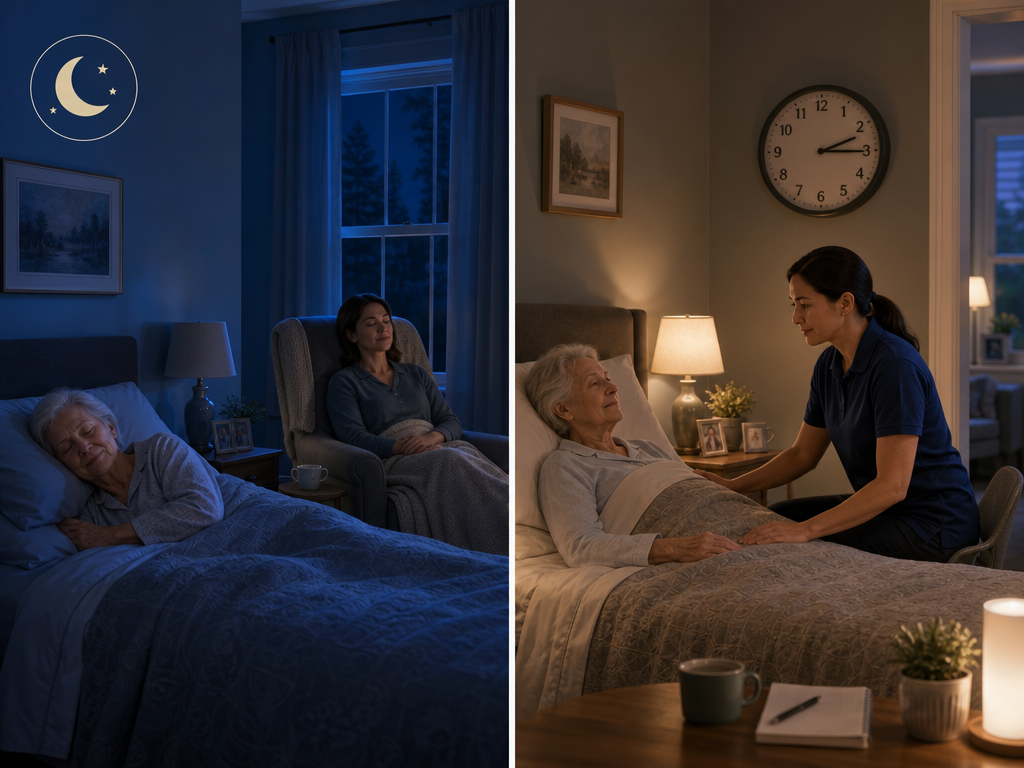
The critical difference comes down to one factor: whether the caregiver is required to stay awake and attentive throughout the night. This is not a preference or a budget choice — it is a clinical and legal necessity determined by your parent's nighttime needs.
| Feature | Live-In Care | Shift-Based 24/7 Care |
|---|---|---|
| Number of caregivers | One primary caregiver who lives in the home | Two or more caregivers working rotating shifts |
| Nighttime supervision | Caregiver must receive 8 hours of uninterrupted sleep in a private bedroom | At least one caregiver is awake and on duty at all times |
| Best for seniors who... | Sleep through the night and need daytime supervision and assistance only | Wander, sundown, need frequent repositioning, or cannot be left alone at night |
| Typical monthly cost range | $8,000 – $12,000 per month | $15,000 – $25,000+ per month |
| Legal requirement | Caregiver must have a private bedroom and 8 consecutive hours of rest (FLSA) | No rest-period requirement; caregivers are paid for all hours worked |
For a deeper comparison of these two models, including how to evaluate agencies and what questions to ask, see the existing guide Live-In Caregiver vs. 24/7 Shift Care: Understanding the Real Difference and Which One Your Parent Actually Needs. If you are weighing home care against a facility, the article Live-In Caregiver vs. Assisted Living: How to Decide When Your Parent Can't Be Left Alone can help you compare the two paths.
Which Warning Signs Point to Which Model
Not every warning sign leads to the same care model. The table below maps each of the 10 signs to the appropriate staffing arrangement. Use this as a starting point, not a prescription — a professional in-home assessment is the only way to confirm the fit.
| Warning Sign | Appropriate Model | Why |
|---|---|---|
| Frequent falls or near-falls | Live-in or shift-based, depending on fall timing | If falls occur only during waking hours, live-in care may suffice. If they occur at night, shift-based care is needed. |
| Decreased mobility or agility | Live-in (if stable at night) | Daytime mobility assistance can be provided by a single live-in caregiver. |
| Recent hospitalization or surgery | Live-in or shift-based (short-term) | Post-hospital needs are often temporary but may require overnight monitoring during recovery. |
| Wandering or leaving the home unsafely | Shift-based 24/7 care only | A wandering person cannot be left unsupervised at any time. A live-in caregiver who must sleep cannot provide this level of monitoring. |
| Nighttime confusion or sundowning | Shift-based 24/7 care only | Sundowning requires an awake caregiver throughout the night. Live-in care is not appropriate. |
| Medication mismanagement | Live-in or shift-based | If medication needs are predictable and occur during daytime hours, live-in care can work. If doses are needed overnight, shift-based care is required. |
| Significant weight loss or dehydration | Live-in (if no nighttime issues) | Meal preparation and hydration reminders can be managed during waking hours. |
| Neglected personal hygiene | Live-in (if no nighttime issues) | Bathing, dressing, and grooming assistance is a daytime task. |
| Incontinence or bathroom accidents | Shift-based if frequent at night | Occasional daytime accidents can be managed by a live-in caregiver. Frequent nighttime accidents require an awake caregiver for prompt assistance and fall prevention. |
| Family caregiver burnout | Either model, depending on other signs | Burnout is a signal that the current arrangement is failing. The appropriate replacement model depends on the senior's other needs. |
A Simple 3-Question Decision Framework
When you are sitting at the kitchen table trying to make sense of conflicting advice from family members, friends, and online forums, these three questions will cut through the noise. They are drawn directly from the operational requirements that home care agencies use to determine staffing models.
- Does your parent need attention or supervision during overnight hours? This is the single most important question. If the answer is yes — because of wandering, sundowning, frequent bathroom trips, or the need for repositioning — then a live-in model is not appropriate. You need shift-based 24/7 care.
- Can one caregiver get 8 hours of uninterrupted rest in a private space? Even if your parent sleeps through the night, the live-in model requires that the caregiver have a private bedroom and be able to sleep for 8 consecutive hours without being called upon. If your home does not have a private room for a caregiver, or if your parent's condition makes it impossible for the caregiver to get that rest, shift-based care is the only legal option.
- Is wandering or nighttime confusion a risk? If the answer is yes, the decision is made for you. Wandering is a safety emergency that requires continuous, awake supervision. No reputable agency will place a live-in caregiver in a home where the senior wanders, because the caregiver cannot legally or safely provide the necessary level of monitoring while also getting required rest.
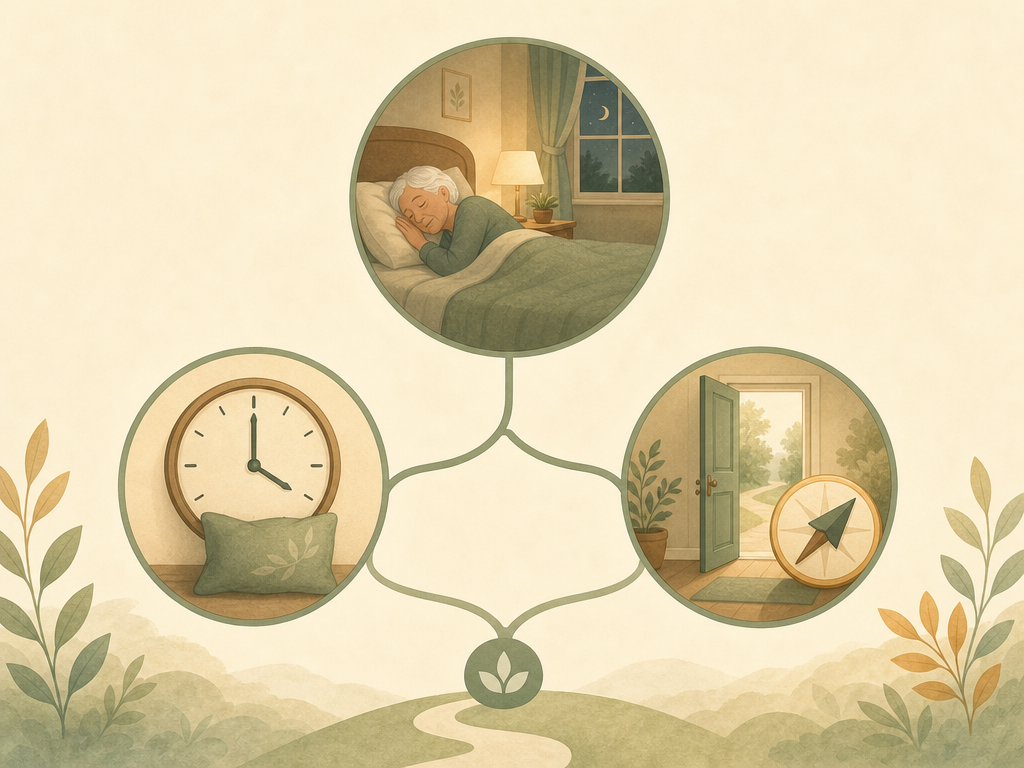
If the answer to all three questions is no — your parent sleeps through the night, you have a private room for a caregiver, and there is no wandering or nighttime confusion — then live-in care is likely a safe and appropriate choice. If any answer is yes, you need to plan for shift-based 24/7 care.
When Part-Time Care Can Be Scaled Up — and When Only 24/7 Will Do
Many families reading this article are already using part-time home care — perhaps 20 or 30 hours per week — and wondering whether they can simply add more hours rather than switching to a structured 24/7 model. The answer depends on the predictability of your parent's needs.
Scaling up part-time care (for example, from 40 to 60 hours per week) can work when:
- The gaps in coverage are predictable and occur during daytime hours.
- The family caregiver can reliably cover the remaining hours without sacrificing sleep or health.
- Your parent does not wander, sundown, or require overnight attention.
However, when needs are unpredictable, require overnight attention, or have already caused significant caregiver burnout, adding more part-time hours is like patching a leaking roof with duct tape. The underlying problem — the absence of a structured, sustainable care system — remains.
If you are still unsure whether your parent's needs have crossed the threshold into 24/7 territory, the guide When Does an Aging Parent Need In-Home Services? A Practical Decision Guide provides a broader decision framework that covers the full spectrum from occasional help to round-the-clock care.
What to Do Next: Scheduling a Professional In-Home Assessment
Once you have identified the warning signs and have a sense of which model might fit, the next step is straightforward: contact a licensed home care agency and request a complimentary in-home assessment. Most reputable agencies provide this at no cost, and it is the only way to confirm whether your assessment matches a professional evaluation.
Before the assessment, prepare the following:
- A written list of the warning signs you have observed, including dates and specific incidents.
- A log of nighttime patterns: how often your parent wakes, whether they seem confused or agitated, and whether they attempt to get out of bed unassisted.
- A list of all medications, including dosages and schedules.
- Your answers to the three-question framework above.
During the assessment, ask the agency representative these specific questions:
- How do you divide shifts between caregivers, and what happens if a caregiver calls in sick?
- How often are caregivers rotated to prevent burnout and ensure continuity of care?
- Can family members share caregiving duties with the professional caregivers, and if so, how is that coordinated?
- What is your process for updating the care plan as needs change?
If the process feels overwhelming — and it almost certainly will — the guide From Crisis to Confidence: A Stage-Based Guide for New Caregivers of Elderly Parents was written specifically for families in your position. It walks through the emotional and practical stages of becoming a caregiver, from the first shock of recognition to building a sustainable care system.
Real Families, Real Decisions
The decision to move to 24-hour care is rarely clean or linear. Families who have been through it describe a period of uncertainty where they questioned every observation and second-guessed every instinct.
One adult daughter described the moment she realized part-time care was no longer enough: "My mother had been getting by with a caregiver for six hours a day. I thought that was enough. Then I started finding the stove on in the morning, burners lit with nothing on them. She was getting up at 3 AM to 'cook breakfast.' That was the moment I understood that six hours a day meant nothing if she was unsafe for the other eighteen."
Another family shared the experience of trying live-in care before realizing it was the wrong model: "We hired a live-in caregiver because it was more affordable. But my father has Alzheimer's and sundowns every evening. The caregiver was exhausted within two weeks — she wasn't getting any sleep. We switched to 12-hour shifts with two caregivers, and it was like night and day. My father was safer, and the caregivers were actually able to do their jobs."
These stories share a common thread: the families did not fail to notice the warning signs. They saw them. What they lacked was a framework for interpreting what the signs meant and a clear understanding of the difference between the two care models. That is the gap this guide is designed to close.
Questions to bring to a clinician or OT
This is not medical, legal, or a family's final decision — only a framework. Bring these questions to a clinician, occupational therapist, or your local Area Agency on Aging.
Find Local HelpRelated reading
Noticed something outdated or inaccurate on this page? Flag a correction. We review every report against CDC, NIA, and AARP HomeFit guidance before updating a page.