
Caregiver decision guide
Live-In Caregiver vs. Assisted Living: How to Decide When Your Parent Can’t Be Left Alone
A decision framework for adult children comparing the real costs, care quality, and lifestyle trade-offs of hiring a live-in caregiver versus moving a parent to assisted living — when staying home alone is no longer safe.

The Moment You Realize ‘Mom Can’t Be Alone’
It often arrives without warning. A call from a neighbor who found your mother wandering the block at 2 a.m. A fall in the bathroom that left her on the floor for hours. A hospital discharge summary that says “unsafe to return home alone.” For adult children in their 40s and 50s, this is the moment the abstract idea of “aging in place” collides with the concrete reality that staying home alone is no longer an option.
Two paths emerge: hire someone to live in, or move to a facility. The instinct is to assume that staying home is cheaper and better. But the data tells a more complicated story. In 2026, the national median cost of assisted living and the cost of a live-in caregiver through an agency both fall in the $4,500–$6,500/month range. The decision is no longer about cost alone. It is about care intensity, cognitive status, social needs, home equity, and family logistics.
This guide provides a structured framework for families weighing these two options. It is written for the adult child who needs to make a decision this week or this month — not a theoretical comparison, but a practical tool for a specific situation.
Cost Comparison: Live-In Caregiver vs. Assisted Living (2026)
The most common assumption families bring to this decision is that staying home with a caregiver will save money. In many cases, that assumption is wrong — or at least, not as straightforward as it seems.
| Cost Category | Live-In Caregiver (Agency) | Live-In Caregiver (Private Hire) | Assisted Living |
|---|---|---|---|
| Monthly cost range | $4,500–$6,000 | $3,500–$5,000 | $4,300–$6,500 |
| National median (2026) | ~$5,250 | ~$4,000 | $5,419 |
| What's included | 24/7 presence, ADL support, meals (if prepared) | Same as agency, but no admin overhead | Room, board, meals, basic ADL support, social programming |
| What's extra | Home maintenance, utilities, food, home modifications | Same as agency, plus payroll taxes, background checks | Care tier add-ons (medication management, memory care), community fees |
| Payment sources | Medicaid HCBS waivers, VA, LTC insurance, reverse mortgage | Same, but harder to qualify for waivers without agency | Medicaid (if certified), VA Aid & Attendance, LTC insurance, private pay |
The counterintuitive finding is that for a senior who truly cannot be left alone — meaning they need supervision or assistance throughout the day and night — the monthly cost of live-in care and assisted living often lands in the same bracket. The decision then shifts to what each option actually delivers for that monthly payment.
The Hidden Costs of Each Choice
The monthly rate is only part of the picture. Both options carry secondary costs that can shift the total by hundreds or thousands of dollars per month.
Hidden costs of live-in care at home
- Home maintenance and utilities: The senior still pays mortgage or rent, property taxes, insurance, utilities, and maintenance. These costs continue and may increase if the home requires modifications (grab bars, stair lifts, widened doorways).
- Food and household supplies: The caregiver eats from the same kitchen. A formal care agreement should specify whether room and board is provided as part of compensation or charged separately.
- Home modifications: If the home is not already accessible, modifications can range from $50 for a grab bar to $3,000–$10,000 for a stair lift. These are one-time costs but can be significant.
- Backup care: Live-in caregivers receive 8 hours of sleep and daytime breaks. If the senior cannot be left alone during those breaks, the family needs backup — either a second caregiver or a family member. This adds cost.
- Employer responsibilities: If hiring privately, the family becomes an employer — responsible for payroll taxes, workers' compensation insurance, and compliance with state labor laws. Ten states (CA, CT, HI, IL, MA, NV, NM, NY, OR, VA) and two cities (Seattle, Philadelphia) have Domestic Worker Bills of Rights that mandate minimum standards (AgingCare.com).
Hidden costs of assisted living
- Care tier add-ons: The base rate typically covers room, board, and basic assistance. Medication management, incontinence care, memory care, and specialized dementia programming often cost extra — sometimes $1,000–$2,000/month more.
- Community and move-in fees: Many facilities charge a one-time community fee ($1,000–$5,000) that is non-refundable.
- Loss of home equity: If the senior owns a home, moving to assisted living means selling or renting the property. A reverse mortgage can fund live-in care at home but cannot be used if the senior moves to a facility (PayingForSeniorCare.com).
- Level-of-care increases: As needs escalate, the facility may require a move to a higher care tier or a different unit, often at a significantly higher rate.
One-on-One Care vs. Staff-to-Resident Ratios
The most significant qualitative difference between live-in care and assisted living is the attention the senior receives. A live-in caregiver provides undivided, one-on-one support. In an assisted living facility, staff are shared across multiple residents.
| Factor | Live-In Caregiver | Assisted Living |
|---|---|---|
| Attention model | One-on-one, continuous | Shared (typical ratio 1:8 to 1:12 during daytime) |
| Response time | Immediate — caregiver is in the home | Variable — resident may need to call for assistance and wait |
| Continuity | Same caregiver (or small team) builds relationship | Rotating staff shifts; different faces daily |
| Nighttime support | Caregiver sleeps in the home; can respond to calls | Night staff coverage varies; may be minimal |
| Personalization | Care routines adapt to the senior's preferences and schedule | Care follows facility schedules (meal times, bathing times, activity times) |
For seniors who need frequent repositioning, toileting assistance every two hours, or have unpredictable behaviors like wandering, the one-on-one model can be a decisive advantage. A live-in caregiver can respond immediately to a fall or a wandering episode. In assisted living, the resident may need to use a call button and wait for an available staff member.
However, the live-in model has limits. Under the Fair Labor Standards Act (FLSA), live-in caregivers must receive an 8-hour sleep period and daytime breaks (DOL Fact Sheet #79B). If the senior requires 24/7 awake supervision — meaning someone must be alert and available at all times — a single live-in caregiver is not sufficient. That situation requires multiple caregivers working shifts, which raises the cost to $814–$842/day for 24/7 awake care (SeniorLiving.org).
The Social Isolation Trade-Off
Safety is not the only consideration. Social connection is a fundamental determinant of health in older adults, and the two options address it in fundamentally different ways.
According to a 2024 University of Michigan poll, one in three older adults (34%) reported feeling isolated from others in the past year (SeniorLiving.org). A live-in caregiver provides companionship and conversation, but that is a single relationship. The senior's social world remains largely confined to the home.
Assisted living offers built-in social infrastructure: communal dining, scheduled activities, exercise classes, game nights, and peer interaction. For a senior who is naturally social and would thrive in a group setting, this can be a powerful counterweight to the loss of home.
The AARP reports that 77% of adults ages 50+ want to remain in their own homes long-term (SeniorLiving.org). But wanting to stay home and thriving at home are different things. A senior who is isolated, lonely, and eating alone in front of the television may be physically safer at home but emotionally worse off than they would be in a community setting.
Which Option Fits Your Parent’s Condition?
The right choice depends heavily on the senior's specific condition. A one-size-fits-all recommendation is not possible, but the following decision matrix can help families match their situation to the most suitable option.
| Condition | Live-In Care May Be Better If... | Assisted Living May Be Better If... |
|---|---|---|
| Dementia (early to middle stage) | Familiar home environment reduces sundowning and agitation. The senior recognizes their surroundings and feels secure. | Wandering is frequent and the home cannot be secured. Specialized memory care units offer secured wandering prevention and dementia-trained staff. |
| Dementia (advanced) | A single live-in caregiver may not be sufficient for 24/7 awake supervision needs. Multiple shifts may be required. | Memory care units are designed for advanced dementia with secured environments, structured routines, and staff trained in behavior management. |
| Mobility limitations | The home can be modified (grab bars, stair lift, ramp) to support safe mobility. One-on-one assistance is available for transfers. | The facility is already fully accessible. No home modifications needed. Staff assist with transfers and mobility. |
| Post-hospital recovery | Short-term live-in care (4–8 weeks) can provide intensive recovery support in a familiar environment. Easier to discontinue when recovery is complete. | Short-term rehab or skilled nursing may be more appropriate if the senior needs daily physical therapy or skilled nursing care. |
| Chronic conditions requiring monitoring | A live-in caregiver can monitor symptoms, manage medications, and coordinate with healthcare providers. Continuity of care is high. | Facility staff can monitor and coordinate care, but the senior may see different staff daily. Medication management is typically an add-on cost. |
For families considering dementia care, the familiar home environment can be a powerful therapeutic tool. A live-in caregiver who understands the senior's routines, triggers, and preferences can reduce behavioral symptoms like sundowning and agitation. However, for seniors who wander frequently or have aggressive behaviors, a secured memory care unit may be the safer choice. The 10 Signs It's Time for Memory Care guide provides a detailed framework for recognizing when dementia care needs exceed what can be provided at home.
Transition Triggers: When Live-In Care Is No Longer Enough
Live-in care is not a permanent solution for every senior. At some point, the needs of the senior may exceed what a single caregiver — or even a team of caregivers — can provide in a home setting. Recognizing these transition triggers early can prevent a crisis move.
- Escalating behavioral issues: Aggression, severe sundowning, or frequent wandering that exceeds one caregiver's capacity to manage safely.
- 24/7 awake care needs: If the senior requires someone awake and alert at all times, a single live-in caregiver is not sufficient. Multiple shifts raise the cost to $24,745–$25,496/month (SeniorLiving.org), which is almost always more expensive than assisted living or memory care.
- Unsafe home environment: If the home cannot be modified to accommodate the senior's needs — narrow doorways, stairs that cannot be navigated, lack of a bedroom on the main floor — the home itself becomes a barrier to safe care.
- Caregiver burnout: If the family is providing significant backup care and experiencing physical or emotional exhaustion, the sustainability of the live-in arrangement is compromised.
- Medical complexity: If the senior requires daily skilled nursing care (wound care, IV medications, ventilator support), a home health agency may be needed in addition to the live-in caregiver, adding significant cost and complexity.
The When Aging in Place Is No Longer Viable guide provides a broader framework for recognizing functional decline markers that signal a move may be necessary, beyond the specific live-in care context.
Making the Decision: A Step-by-Step Framework
When the options are this close in cost and the stakes are this high, a structured decision process can help families move from anxiety to action. The following steps are designed to be completed in sequence over the course of a week or two.
- Assess your parent's care needs. Use the ADL (Activities of Daily Living) and IADL (Instrumental Activities of Daily Living) frameworks to document exactly what assistance is needed and when. Key questions: Does your parent need help with toileting at night? Can they be left alone during a caregiver's 4-hour daytime break? Do they wander? Are they at risk of falling? The Senior Health Services by Care Need guide can help match services to specific needs.
- Get a realistic cost estimate for both options in your area. Contact at least three home care agencies for live-in rates and three assisted living facilities for their all-in monthly costs, including care tier add-ons. Use the table in this guide as a starting point, but local quotes will be more accurate.
- Evaluate the home's safety and suitability. Conduct a room-by-room home safety audit. Can the senior navigate to the bathroom at night? Is there a bedroom and full bathroom on the main floor? Can the home be modified to accommodate a wheelchair or walker? The Paying for Elderly Home Care in 2026 guide covers funding options for home modifications and care.
- Consider your family's availability for backup and oversight. Live-in care requires a family member or backup caregiver to cover the caregiver's breaks and days off. If the family lives far away or is not available, assisted living may be more practical.
- Discuss preferences with your parent. This is the hardest step, but it is essential. The senior's preferences about staying home, their social needs, and their willingness to accept a stranger into their home are critical factors. The Live-In Companion vs. Assisted Living article covers the companion-care model, which may be a gentler transition for seniors who are not yet ready for hands-on personal care.
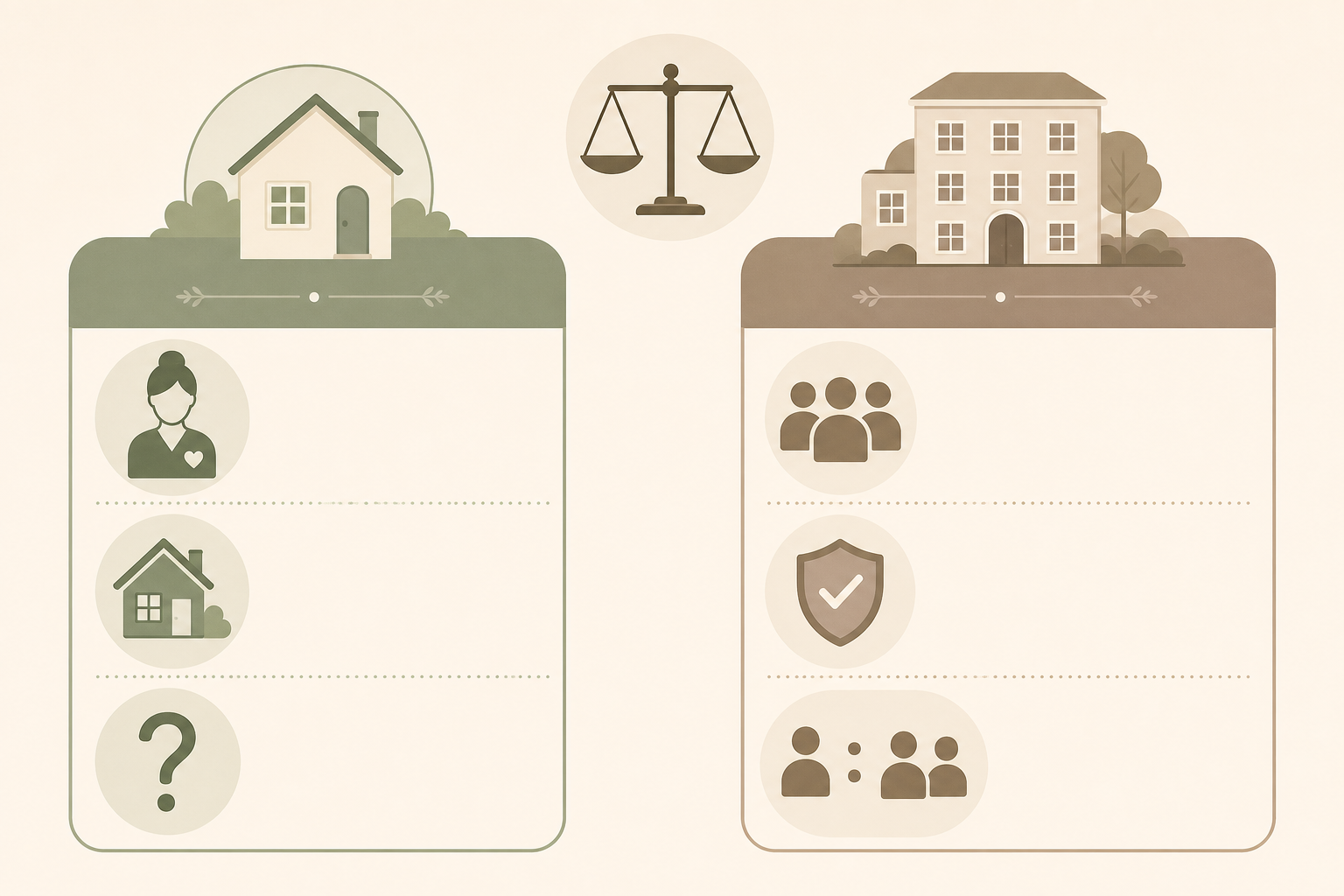
There is no universally right answer. The best choice is the one that fits this specific senior, this specific family, and this specific situation. The goal is not to find the perfect option — it is to find the option that works well enough to provide safety, dignity, and quality of life for the months and years ahead.
Questions to bring to a clinician or OT
This is not medical, legal, or a family's final decision — only a framework. Bring these questions to a clinician, occupational therapist, or your local Area Agency on Aging.
Find Local HelpRelated reading
Noticed something outdated or inaccurate on this page? Flag a correction. We review every report against CDC, NIA, and AARP HomeFit guidance before updating a page.